Buyer Fit Snapshot
| Best fit | Branded Recycled Tissue Paper projects where brand print, material claims, artwork control, MOQ, and repeat-order consistency need to be specified before quoting. |
|---|---|
| Quote inputs | Share finished size, material target, print colors, finish, packing count, annual reorder estimate, ship-to region, and any compliance wording. |
| Proofing check | Approve dieline scale, logo placement, barcode or warning zones, color tolerance, closure strength, and carton packing before bulk production. |
| Main risk | Vague material claims, crowded artwork, missing packing details, or unclear freight terms can make a low unit price expensive after revisions. |
Fast answer: Branded Recycled Tissue Paper: Material, Print, Proofing, and Reorder Risk should be specified like a repeatable production item. The safest quote records material, print method, finish, artwork proof, packing count, and reorder notes in one written spec.
Production checks before approval
Compare the actual filled-product size with the drawing, then confirm tolerance on folds, seals, hang holes, label areas, and retail display edges. Reserve space for logos, QR codes, warning copy, and material claims before decorative graphics fill the panel.
Quote comparison points
Review material grade, print process, finish, sampling route, tooling charges, carton quantity, and freight assumptions side by side. A quote is only useful when the supplier can repeat the same color, closure quality, and packing count on the next order.
Open a good retail box or a carefully packed gift shipment, and the first branded layer most customers touch is often branded recycled tissue paper. That first fold does more than protect the product. It slows the unboxing moment, signals care, and tells the buyer something about the brand before they ever reach the item itself. A single sheet can do what a paragraph of copy cannot.
Used well, branded recycled tissue paper gives you a clean presentation, a lighter environmental footprint, and a packaging detail that feels deliberate rather than decorative clutter. Used poorly, it looks thin, prints muddy, or arrives after the launch it was supposed to support. Those failures rarely start on the press. They usually start with a weak spec, vague artwork, or a rushed approval cycle.
For most buyers, the best packaging material is not the one that sounds the most premium in a sales deck; it is the one that folds cleanly, prints clearly, and survives the real packing line without drama.
That is why branded recycled tissue paper deserves a practical look. The material is simple, but the ordering decisions are not. Sheet size, recycled fiber content, print coverage, minimum order quantity, lead time, and even storage humidity can shift the final result. A brand can spend weeks choosing box finishes and still lose the first impression if the inner wrap arrives dull, torn, or off-color. The tissue sits closer to the product than almost any other printed surface. It gets noticed.
What Branded Recycled Tissue Paper Is and Why It Stands Out
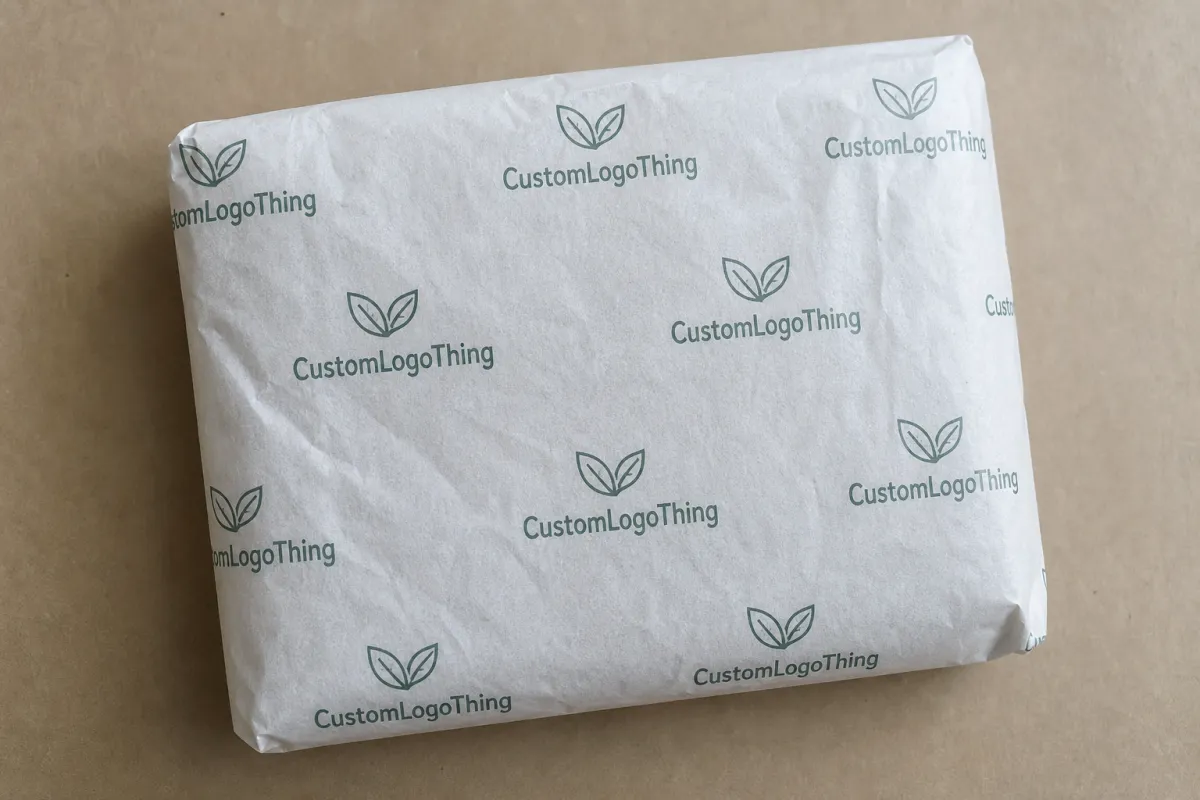
Branded recycled tissue paper is lightweight tissue sheet stock made with recovered fiber, then printed with a logo, repeat pattern, or custom artwork for packaging presentation. In plain language, it is the branded wrap layer that sits around apparel, accessories, gifts, inserts, or folded goods, often before the item goes into a mailer, box, or shopping bag. It is not trying to be rigid board or heavy wrap paper. Its job is narrower and more useful: fold neatly, cover surfaces cleanly, and add a controlled visual cue without adding much bulk.
What makes branded recycled tissue paper different from virgin-fiber tissue is not that it has to look rough or budget-grade. That misconception still hangs around because recycled paper is often discussed as though lower impact must mean lower quality. The reality is more interesting. Recycled fiber can still produce a soft hand feel, workable opacity, and a premium presentation when the furnish, caliper, and drying process are balanced correctly. The sheet may show slight fiber speckling or a more natural white instead of a bright optical white, but many brands prefer that quieter, less processed appearance because it matches a responsible packaging story.
From a packaging buyer's point of view, branded recycled tissue paper solves several problems at once. It supports sustainability language, it adds a recognizable brand layer to the unboxing moment, and it can reduce the need for extra fillers, stickers, or insert cards. For clothing, cosmetics, gifts, and lightweight accessories, it often gives enough visual structure that the rest of the pack can stay simpler. There is a kind of economy in that. A minimal system that looks considered tends to age better than a crowded one that tries to announce itself from every surface.
There is also a trust factor. Buyers and shoppers are far more alert now to packaging claims that feel inflated. If the outer carton is plain but the inner wrap is thoughtfully printed and sourced, the experience reads as consistent and grounded. That is one reason branded recycled tissue paper shows up so often in retail packaging programs that need both brand presence and a more responsible material choice. It is the packaging equivalent of a well-cut jacket lining: mostly hidden, yet strangely revealing.
Expect a little natural variation. Recycled fiber content can bring slight differences in shade, texture, and softness from one production lot to another, especially if the base stock is not heavily bleached. In practice, that variation is not always a defect; sometimes it is exactly what makes branded recycled tissue paper feel honest and materially specific instead of generic. The key is knowing where variation helps the look and where it interferes with fine logo detail. A soft shift in tone can read as character. A blotchy repeat can read as poor control.
One more practical point: branded recycled tissue paper is not just for premium brands. It is useful for any operation that wants a repeatable, recognizable opening moment. If your packaging system includes bags, boxes, or wraps across multiple channels, the same printed tissue can tie the whole presentation together. A buyer who understands that sees the material as part of a packaging system, not just an extra decorative layer. A small item, handled at scale, can carry more brand memory than many larger assets.
How Branded Recycled Tissue Paper Is Made and Printed
The production path for branded recycled tissue paper starts with recovered fibers that are repulped, cleaned, screened, and formed into a thin web. The furnish is refined to remove contaminants and keep the sheet consistent enough to run through tissue machines without breaking apart. After that, the sheet is pressed, dried, and finished to reach the softness, surface stability, and light opacity that packaging buyers expect. A well-made converted sheet should still fold neatly and hold a crease without cracking, waving, or losing shape.
Once the base tissue is made, the branding step begins. Most branded recycled tissue paper programs use flexographic printing because it is efficient for repeat patterns and large quantities. Some jobs may use other print setups depending on the supplier, the artwork, and the ink coverage, but the principle is the same: the logo or pattern needs to sit lightly on the surface without overwhelming the sheet. Heavy flood coverage can make the tissue feel stiffer, show more show-through, and increase the chance of rub-off if the surface is not engineered well.
Logo placement matters more than many buyers expect. A centered mark, a diagonal repeat, or a small allover pattern can all work, but each one changes the visual balance. On thin tissue, a large block of ink may reproduce unevenly if the substrate is too absorbent or the design is too dense. That is why branded recycled tissue paper often looks best with strong shapes, moderate line weights, and enough negative space for the print to breathe. Fine type can work, but it needs careful proofing and realistic expectations. A 6-point tagline may look elegant on a screen and stubborn on tissue.
Common material choices include sheet size, basis weight, color, and finish. For retail packaging, you will often see sheet sizes such as 15 x 20 inches, 18 x 24 inches, or 20 x 30 inches. Basis weights around 17 to 22 gsm are common for branded recycled tissue paper, though the exact number depends on the source stock and the final use. A lighter sheet is easier to crumple and wrap around product edges, while a slightly heavier sheet may feel more substantial and hold up better during packing. The difference of a few grams can change the whole packing experience.
Color also changes the final result. Natural white, soft white, kraft-toned tissue, and lightly tinted shades all tell a different story. Recycled stock may not have the bright whiteness of virgin fiber, but that is often a feature, not a flaw. The surface can feel calmer and more tactile. When brands choose branded recycled tissue paper for apparel, gifts, or e-commerce packaging, they are often choosing that softer, more material look on purpose. A bright white can signal polish; a softer white can signal restraint. Those are not identical brand languages.
There is a real balancing act here. Good branded recycled tissue paper is not simply a logo on a sheet. It is a compromise between visual impact, foldability, print clarity, and how the sheet behaves in a packing room. If the material is too thin, it tears too easily. If it is too heavily printed, it can lose the lightness that makes tissue useful in the first place. The best suppliers pay attention to all of that before the press ever starts running. That is where the difference between an okay packaging vendor and a dependable one usually shows up.
For brands that care about sourcing, it is worth checking whether the paper is certified and what the claim actually covers. FSC can apply in different ways, including recycled content and chain-of-custody programs, so the label should be read carefully rather than assumed. You can review certification basics at FSC, and the U.S. EPA also has a useful overview of recycling and recovered fiber concepts at EPA recycling guidance. Those resources are not about tissue alone, but they help buyers ask better questions about what the paper is made from and how it is documented. A packaging claim that can be traced tends to age better than one that only sounds ethical.
Branded Recycled Tissue Paper Cost, MOQ, and Pricing Factors
The cost of branded recycled tissue paper depends on more than the paper itself. Quantity, print colors, sheet dimensions, ink coverage, setup work, packaging configuration, and freight all affect the final number. A buyer comparing quotes should never look only at the sheet price. The quote may be built around a plate charge, a prepress fee, or a minimum production requirement that changes the economics once the order is placed.
In practical terms, the minimum order quantity for branded recycled tissue paper often starts around 5,000 to 10,000 sheets, although some suppliers will go lower or higher depending on the print method and sheet size. Small orders usually carry a higher unit cost because the setup costs are spread across fewer pieces. That does not automatically make them a bad choice, but it does mean the buyer should judge the order against the actual packaging need, not against a wishful low-unit-price target. A small run can be the right answer when a launch is narrow or the brand is still testing the market. Price alone rarely tells that story.
Typical pricing ranges can vary widely, but for planning purposes a simple one-color run of branded recycled tissue paper might land somewhere around $0.10 to $0.22 per sheet at moderate quantities, while more complex coverage or smaller orders can move higher. If the art uses multiple colors, larger print areas, or additional proofing, the cost often rises accordingly. Special die patterns, custom sheet sizing, and rush timing can also push the number up. That is normal; tissue is a light material, but custom production still has real setup economics. A custom sheet is not expensive because it is difficult to carry. It is expensive because press time, setup, and waste do not disappear just because the product itself is thin.
The table below gives a general sense of how pricing often shifts. These numbers are directional, not universal, because supplier region, paper source, and freight terms can change the final math quite a bit.
| Option | Typical MOQ | Common Use | Typical Unit Range |
|---|---|---|---|
| Unprinted recycled tissue | 1,000 to 5,000 sheets | Basic wrap, filler, or stock presentation | $0.03 to $0.08 |
| Single-color branded recycled tissue paper | 5,000 to 10,000 sheets | Logo repeat, retail wrap, e-commerce unboxing | $0.10 to $0.22 |
| Two-color branded recycled tissue paper | 10,000 sheets or more | Stronger brand presence, pattern work, gift programs | $0.14 to $0.28 |
| Full-coverage custom print | 10,000 to 25,000 sheets | High-visibility retail packs, seasonal programs | $0.18 to $0.35+ |
Those ranges are only useful if the quote assumptions are aligned. A lower per-sheet quote for branded recycled tissue paper can still cost more overall if it includes extra setup, multiple proof rounds, split shipments, or heavier freight charges. I always tell buyers to compare apples to apples: same sheet size, same print colors, same order quantity, same packaging format, same delivery destination. Otherwise, the numbers look tidy while hiding the actual cost difference. A quote can be technically accurate and commercially misleading at the same time.
There is also a value question. In some programs, branded recycled tissue paper replaces a separate insert card, a branded sticker, or even some of the visual load that would otherwise be carried by a custom box. That does not mean tissue is a substitute for everything, but it can simplify the pack and reduce the number of distinct items the team has to source, count, and store. Viewed that way, the material sometimes pays for itself in operational clarity. The savings may not show up only on the invoice; they can show up in fewer SKUs, fewer errors, and a less crowded packing table.
Process and Timeline: From Artwork to Production
A smooth branded recycled tissue paper order usually starts with a clear spec sheet. The buyer should define the sheet size, desired quantity, product use, color target, folding style, and print area before asking for a formal quote. If the tissue will wrap shoes, apparel, gift sets, or fragile accessories, the folding logic changes, and that should be built into the brief from the start. A supplier can work faster when they are not guessing how the final sheet is supposed to behave in the pack.
From there, the workflow usually follows a predictable path: quote, artwork review, proof, approval, production, finishing, packing, and shipment. A straightforward branded recycled tissue paper job may move from approved art to press-ready production in roughly 10 to 15 business days, with another 2 to 5 business days for transit depending on destination and carrier. Complex artwork, specialty sheet sizes, or busy seasonal periods can extend that timeline. The lead time is not just the press run; it is the whole path from design file to delivered cartons. A packaging calendar that ignores that chain tends to fail in the same old place: too late, not too slow.
Artwork delays are common, and they are usually avoidable. The most frequent issues are low-resolution logos, missing vector files, vague color references, and a lack of confirmation on whether the repeat pattern should be centered, staggered, or edge aligned. When a buyer supplies clean vector art and a clear repeat instruction, branded recycled tissue paper proofing tends to move much faster. When the art has to be rebuilt from a screenshot or a flattened web image, the schedule slows down before production even starts. A screenshot may be enough for a mood board; it is rarely enough for a press file.
To keep the process realistic, it helps to think in stages:
- Initial briefing and quote alignment
- Artwork cleanup and proof preparation
- Proof review and customer approval
- Production scheduling and press setup
- Printing, drying, and finishing
- Carton packing and freight booking
That rhythm is fairly standard for branded recycled tissue paper, though each supplier will have its own queue and quality checks. If you are launching a seasonal collection or refreshing packaging before a trade show, build the calendar backward from the in-hand date, not from the moment you send the art. A one-week cushion can feel luxurious during planning and perfectly ordinary during production.
It also pays to keep approvers aligned. If brand, operations, and procurement each have different opinions on the logo scale or color strength, the proof stage can drag out longer than the press run. Branded recycled tissue paper works best when one person or one small team owns the final sign-off. That is not about control for its own sake; it is about preventing a three-day approval loop from turning into a two-week delay. A good file can still stall if three people are trying to correct it at once.
Key Factors That Affect Print Quality and Performance
Print quality on branded recycled tissue paper starts with the substrate. Tissue that is too porous can soak up ink and soften the edges of the logo. Tissue that is too smooth may produce a cleaner edge but can be less forgiving if the print setup is not dialed in. The surface texture, basis weight, and opacity all influence how the art lands on the sheet. A buyer looking for a crisp mark should ask for a proof that reflects the actual tissue stock, not a generic simulation on heavy paper. A proof on glossy stock tells you little about how ink behaves on lightweight tissue.
Design complexity matters just as much. Fine lines, tiny fonts, and dense gradients are more likely to fail on branded recycled tissue paper than bold shapes and clear spacing. If the brand identity depends on small type or a delicate icon, the art may need to be simplified for the material. That is not a compromise in the wrong direction; it is smart adaptation. A clean one-color repeat often looks more premium on tissue than a crowded, overworked design that tries to do too much. Minimal can look expensive when the substrate is honest.
Performance is not only about appearance. The best branded recycled tissue paper also folds well, resists tearing during packing, and stays presentable once it is wrapped around the product. A sheet that looks beautiful on press but splits along the fold line will create more problems than it solves. For that reason, buyers should think about how the tissue will be handled in the real packing flow: will it be stuffed into a box, wrapped around a retail item, or used as a top sheet that sits flat? Each of those uses stresses the sheet in a different way.
Storage conditions matter more than people think. Lightweight tissue can curl, wrinkle, or shift dimensionally if it is stored in a humid room or stacked badly under weight. If the pallets are exposed to moisture, branded recycled tissue paper may lose some of its flatness before it ever reaches the packing line. Keep cartons off damp floors, avoid direct sun where possible, and store the material in a stable environment. These are simple habits, but they protect the print result. Paper remembers where it has been. That is especially true at tissue weight.
For transit planning, broader packaging guidance still matters. ISTA testing standards are useful if the tissue is part of a larger ship-ready pack that will travel by parcel or distribution channel, because a wrap layer can be perfect and still arrive looking tired if the outer system fails. The tissue itself is light, but the final customer sees the whole package, not a single component.
One subtle issue is color expectation. Recycled fiber often softens bright brand colors slightly, and that is especially visible with light pastels or delicate neutrals. A deep navy or strong black usually reproduces more reliably than a pale gray or a pale gold. That is why branded recycled tissue paper proofs should always be viewed under decent light, with the actual packaging color target beside them if possible. The eye can catch a mismatch faster than a spec sheet can describe it. A color that looks acceptable on screen can feel wrong the moment it is held against the carton.
If you want the print to hold up, think in terms of function first and style second. That sounds plain, but it is the right order of operations for branded recycled tissue paper. A sheet that matches the packing team’s workflow, the product shape, and the customer's opening experience will outperform a prettier sheet that creates friction at the line or confusion at the proof stage. Packaging has enough moving parts already. The strongest details are often the ones that make the rest of the process quieter.
Common Mistakes When Ordering Branded Recycled Tissue Paper
The first mistake is overcomplicating the artwork. Buyers sometimes bring a full-color brand graphic, a thin tagline, a QR code, and several small marks to a substrate that is meant to stay light and foldable. On branded recycled tissue paper, delicate details can blur, stretch, or disappear into the texture. The safer path is to use one strong logo repeat or a simplified pattern that keeps enough breathing room around the elements. Tissue rewards clarity. It punishes clutter.
The second mistake is choosing the wrong sheet size. A 20 x 30 sheet may be excellent for one fold style and awkward for another. If the tissue is too small, it will not cover the product cleanly, and the team will waste time adding extra sheets. If it is too large, the pack may look sloppy or the corners may bunch. The best branded recycled tissue paper order starts with the product dimensions and the fold method, not with a guess based on what looked nice in a sample image. A beautiful mockup can still be the wrong tool.
The third mistake is underbudgeting. It is easy to focus on unit price and forget setup, freight, art changes, and the possibility of reprints if the proof is approved too quickly. A quote for branded recycled tissue paper should be checked as a total landed cost, especially if the order has to reach multiple warehouses or distribution centers. Even a small split shipment can alter the final math enough to matter on a tight packaging budget. One extra truck line item can erase the savings from a lower sheet price.
The fourth mistake is rushing approval. If the proof arrives and no one checks the repeat spacing, color balance, or base stock appearance, the final run can come back with issues that were visible all along. Recycled substrate sometimes softens color more than a buyer expects, and if the team signs off without looking carefully, the result can feel off-brand even when the print technically matches the file. Good branded recycled tissue paper production depends on a real proof review, not a quick skim. The difference between "approved" and "actually checked" can be expensive.
The fifth mistake is ignoring timing. Seasonal packaging resets, holiday gift programs, and product launches all compress the schedule. If the order for branded recycled tissue paper is placed after the launch calendar is already locked, the team may end up accepting a weaker spec just to meet the date. That is avoidable. Build the order window with enough time for proofing, production, and transit, then add a little more cushion if the packaging will move through several internal approvals. A short buffer is usually cheaper than an emergency reprint.
There is one more trap worth mentioning: buying without testing the tissue inside the actual pack. A sample sheet can look fine on its own and still behave poorly once it is folded around a hard edge or tucked into a small carton. A quick mockup with the real box or bag often reveals the issue before the order is placed. That is cheap insurance for branded recycled tissue paper, and it prevents a lot of avoidable disappointment. A five-minute pack test can save a week of regret.
Expert Tips and Next Steps for a Better Order
The cleanest way to buy branded recycled tissue paper is to start with a simple spec sheet. List the product size, the box or bag dimensions, the fold style, the desired sheet size, the artwork file type, and the planned order quantity. If you know the expected monthly usage, include that too. A supplier can quote more accurately when the brief is specific, and a clear brief also makes it easier to compare one quote against another without guessing what changed. Specificity is not bureaucracy here. It is what prevents expensive interpretation.
Ask for a sample or mockup whenever possible. Even if the sample is not the exact final run, it can still show how the recycled base looks under light, how the logo sits on the paper, and whether the fold memory works for the item you are packing. A good sample of branded recycled tissue paper is worth far more than a verbal promise. It lets you inspect opacity, texture, print sharpness, and rub resistance before you commit to a larger quantity. A sheet in the hand tells the truth faster than a quote in the inbox.
Quote comparison works best when the assumptions are identical. One supplier may quote 5,000 sheets with single-color print and freight included, while another may quote 10,000 sheets with freight excluded and a different sheet size. Those are not comparable numbers. For branded recycled tissue paper, I recommend lining up quantity, art complexity, shipping method, and delivery location before judging the price. Otherwise, the lowest quote can become the most expensive order by the time it arrives. A cheaper unit price can hide an awkward carton count, a surcharge, or a transit delay.
Planning around the actual launch date is smarter than chasing the fastest stated turnaround. If the packaging needs to support a catalog rollout, a retail reset, or a seasonal promotion, build your calendar backward and leave time for proof corrections. Branded recycled tissue paper is a low-profile item until it is missing, late, or wrong. Once that happens, the whole pack can look unfinished. A little planning keeps the packaging team from scrambling at the end. Packaging problems are often visible weeks earlier if someone looks for them.
For buyers who want to see how packaging programs are handled in more detailed cases, the Case Studies page is a useful next stop. It can help you think through order quantity, presentation style, and how a printed tissue layer supports the larger packaging system. That context matters, because branded recycled tissue paper works best when it is designed as part of the whole experience, not as a last-minute add-on. The wrap layer should feel inevitable, not improvised.
Here is the practical action list I would use if I were placing the order myself:
- Gather clean vector artwork and confirm brand colors before requesting a quote for branded recycled tissue paper.
- Measure the product and the package so the sheet size matches the real fold, not a rough guess.
- Ask for a proof and review it under normal lighting with the actual packaging nearby.
- Compare landed cost, not just unit price, because freight and setup can change the total quickly.
- Confirm lead time early so branded recycled tissue paper arrives before the launch, not during it.
If you keep those steps in order, branded recycled tissue paper becomes a straightforward packaging tool instead of a source of avoidable back-and-forth. That is the real value here: a material that supports the brand, respects the packing workflow, and feels like it belongs in the box from the start. It does not need to shout. It only needs to do its job well, repeatedly, and without surprises.
What makes branded recycled tissue paper different from standard tissue?
It uses recycled fiber content while still allowing custom printing, so branded recycled tissue paper can support sustainability goals without giving up brand visibility. It may have a slightly more natural look or softer brightness than virgin-fiber tissue, which many brands see as part of the appeal. The biggest difference is that it combines packaging function with a branded presentation layer instead of acting as plain filler. That combination matters when the unboxing moment needs to carry both utility and identity.
Is branded recycled tissue paper strong enough for retail packaging?
Yes, when the sheet weight, fold style, and box or bag size are matched correctly to the product and packaging format. branded recycled tissue paper works well for clothing, accessories, gift items, and other light to medium retail presentations where the tissue is mainly protecting and presenting. For heavier or sharper items, the tissue may need to be paired with other materials to avoid tearing. Strength in tissue is relative; the right question is whether it performs cleanly in the actual pack.
What affects branded recycled tissue paper pricing the most?
Quantity, print colors, sheet Size, and Setup requirements usually have the biggest impact on unit cost. Finer artwork, heavier ink coverage, rush timing, and freight can all raise the total cost even when the paper itself seems inexpensive. Comparing quotes only works well when each supplier is using the same specs and order assumptions for branded recycled tissue paper. A small difference in sheet dimensions can matter more than a buyer expects.
How long does it usually take to produce branded recycled tissue paper?
The timeline depends on artwork readiness, proof approval, quantity, and current production load. Simple orders move faster when the file is print-ready and the customer approves the proof quickly. For branded recycled tissue paper, lead time should always include production plus shipping, not just the press run itself. A realistic schedule protects the launch date and keeps packaging from becoming an emergency.
What artwork files work best for branded recycled tissue paper?
Clean vector artwork is usually best because it holds edges and scales well across a repeating sheet pattern. Simple logos, bold shapes, and clear spacing tend to print more reliably than tiny text or highly detailed gradients. Supplying the correct dimensions, color references, and repeat pattern instructions helps avoid proof delays, especially when the job is branded recycled tissue paper for a retail or e-commerce program. If the file needs to be explained in a paragraph, it probably needs simplifying before it goes to press.
Branded recycled tissue paper earns its place when it looks good, packs efficiently, and supports the brand story without adding unnecessary complexity. If you Choose the Right sheet size, keep the artwork honest to the substrate, and give the production timeline enough breathing room, it becomes one of the most practical and visible packaging upgrades you can make. The clearest next step is simple: define the pack dimensions, approve the print-ready file, and verify the proof in real light before the order moves to press.