Buyer Fit Snapshot
| Best fit | Custom Pallet Boxes for Export projects where brand print, material claims, artwork control, MOQ, and repeat-order consistency need to be specified before quoting. |
|---|---|
| Quote inputs | Share finished size, material target, print colors, finish, packing count, annual reorder estimate, ship-to region, and any compliance wording. |
| Proofing check | Approve dieline scale, logo placement, barcode or warning zones, color tolerance, closure strength, and carton packing before bulk production. |
| Main risk | Vague material claims, crowded artwork, missing packing details, or unclear freight terms can make a low unit price expensive after revisions. |
Fast answer: Custom Pallet Boxes for Export: Cost, Size, and Setup should be specified like a repeatable production item. The safest quote records material, print method, finish, artwork proof, packing count, and reorder notes in one written spec.
Production checks before approval
Compare the actual filled-product size with the drawing, then confirm tolerance on folds, seals, hang holes, label areas, and retail display edges. Reserve space for logos, QR codes, warning copy, and material claims before decorative graphics fill the panel.
Quote comparison points
Review material grade, print process, finish, sampling route, tooling charges, carton quantity, and freight assumptions side by side. A quote is only useful when the supplier can repeat the same color, closure quality, and packing count on the next order.
Custom Pallet Boxes for Export: Size, Cost, and Setup That Holds Up in Transit
An export shipment can look solid on the warehouse floor and still fail between the first forklift move and the final receiving dock. With Custom Pallet Boxes for export, the real question is not whether the packaging looks substantial. It is whether the load arrives without shifting, crushing, or getting tied up in inspection long enough to erase the margin. Good export packaging is less about adding mass and more about matching the box to the freight lane, the product, and the equipment that will touch it along the way.
For a packaging buyer, the job is practical. Protect the goods. Keep the pallet stable. Prevent surprises at customs, inside the container, or on the destination dock. That sounds straightforward until a short domestic route is compared with an ocean lane that adds vibration, humidity, and multiple handoffs. The right build often sits somewhere between a pallet, a crate, and a fully enclosed box. The structure should support the load rather than simply cover it.
Teams that already manage branded packaging or broader product packaging programs usually treat export pallet boxes as a separate category. These are not retail cartons. They are load-bearing logistics tools, and the best version solves three problems at once: protection, stackability, and border-ready handling.
Custom Pallet Boxes for Export: What They Actually Do
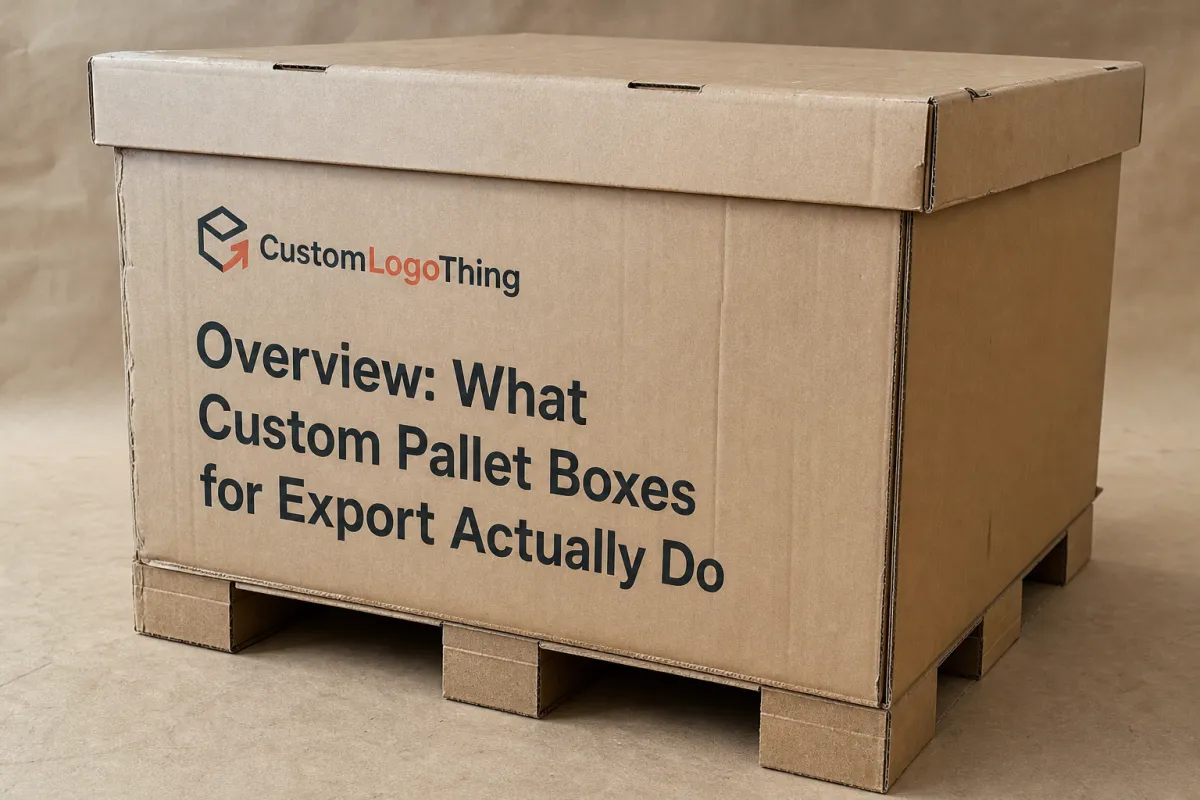
A standard pallet gives you a base. A pallet collar adds height around the sides. A crate adds structure. A full pallet box closes the system and creates a container around the product, the dunnage, and the movement that happens between pack-out and destination. That difference matters because export damage rarely begins with one dramatic event. It usually starts with a little movement, a little compression, or a small gap that turns into a larger failure after two or three transfers.
In practice, Custom Pallet Boxes for export are built around three measurements: the product footprint, the pallet footprint, and the total shipping profile. A 40 x 48 base with a 52-inch stack height is a different engineering problem than a narrow, top-heavy machine component on a custom skid. If the box is too large, freight cost climbs and the load can wander. If it is too tight, packing becomes awkward and the product can rub against the walls during vibration.
Buyers often compare a few structural styles before they commit:
- Standard pallet: open base, low cost, minimal containment, best when the product already has its own shipping unit.
- Pallet collar: stacked frame around the load, useful for modular loads or returnable systems.
- Crate: more rigid side protection, often used for heavier machinery or higher-value cargo.
- Fully enclosed box: strongest privacy and surface protection, often chosen when moisture, dust, or inspection cleanliness matter.
Each option has a place. The thickest build is not always the right one. The most expensive option is not automatically the best one either. Fit matters. So does route, climate, and handling pattern. That is especially true when the box sits inside a broader package branding or branded packaging program, because a well-made export box can stay plain and still feel deliberate, while a crowded print layout can raise cost without improving protection.
Border readiness separates export packaging from ordinary shipping cartons. A container may be opened for inspection, reloaded, or staged several times before it reaches the end customer. The box should hold together through that treatment. An engineering review usually answers that better than a quick guess based on unit price. For teams comparing build styles, the range of Custom Packaging Products helps frame the tradeoffs before a quote is locked in.
A pallet box that survives one warehouse move but fails at the port is not a savings. It is deferred damage.
How Custom Pallet Boxes for Export Work in Transit
The shipping path is where the design gets tested. A pallet box may look perfect during packing, then face vibration on a local truck, compression in a stacked warehouse lane, tilt during forklift handling, and humidity inside a container. Those conditions do not happen one at a time. They arrive as a bundle, which is why export packaging has to behave like a system.
The packing line is the first checkpoint. Product goes into the box or onto the pallet base, then gets secured with blocking, braces, foam, corrugated inserts, or timber supports depending on weight and fragility. Heavy items need more than movement control; they need force distributed so one point does not absorb all the stress. Corner crush shows up here often. So does internal abrasion, where the product shifts only a few millimeters but repeats the motion over and over.
Warehouse handling comes next. Stacking pressure surprises a lot of buyers. A box that looks fine on its own may fail when another pallet lands nearby or when strap tension changes during handling. Export packaging needs both static and dynamic thinking. Static load is the long-term weight sitting on the box. Dynamic shock is the jolt from a brake, a drop, or a dock plate transition. A build that manages only one of those still leaves risk on the table.
Moisture control is another quiet failure point. Sea freight brings condensation, salt air, and ambient humidity swings to wood and plywood structures. A moisture barrier bag, desiccant, vapor corrosion inhibitor materials for metal parts, or an external wrap can make a real difference. None of those should be treated as a substitute for structure. The box carries the load; the wrap and barriers manage the environment around it.
Material choice changes how the box behaves in transit:
- Solid wood gives strong edge support and holds up well under abuse, but it can add weight and must meet treatment rules.
- Plywood is lighter and cleaner-looking, with good dimensional stability for many export lanes.
- Corrugated hybrid builds can reduce tare weight and cost for lighter freight, especially when the product itself is rigid.
- Reinforced corners and skids improve forklift durability and reduce the chance of sidewall collapse.
Testing often follows the same logic used in ISTA procedures or ASTM-style vibration, compression, and drop expectations. The method is not the whole answer, though it gives the buyer and supplier a shared language. Ocean freight, truck transfer, and warehouse staging call for packaging built around a mixed environment, not just around shelf storage or a single drop test.
That is the core idea. Custom Pallet Boxes for export are not standalone containers. They are part of the transport system, and the design only works when it accounts for each stage between pack-out and final receipt.
Key Factors That Shape Design, Strength, and Compliance
Good packaging design starts with the load, not the artwork. Weight is the first input. Fragility comes next. Center of gravity is the one people tend to miss. A light load with a high center of gravity can tip during handling even when the walls are strong. A dense load can crush its own base if the bottom deck is not sized correctly. A long, narrow component can twist the box if it is allowed to float inside the structure.
That is why the buyer brief should include more than dimensions. It should also capture whether the shipment is top-heavy, whether it needs to be double-stacked, and whether forklifts or pallet jacks will enter from all sides or only one. Those details affect skid design, runner placement, and the amount of internal blocking required. In export packaging, small details rarely stay small.
Compliance is the other hard boundary. If the design includes wood, the packaging supplier must account for ISPM 15 treatment requirements for solid wood packaging material. A missing stamp, incomplete documentation, or a treatment mismatch can trigger holds, rework, or rejection. That is not a theoretical risk. It is the kind of issue that turns a quote into a delay. Buyers who want responsibly sourced fiber can also ask about chain-of-custody options from FSC when wood origin matters to procurement or to a customer audit.
Route conditions shape the material choice too. A short domestic leg followed by air freight does not create the same moisture risk as a long sea route through a humid port. Salt spray, rainfall during yard transfer, and prolonged container dwell time can all influence the sealing strategy. A tighter closure, edge sealing, or a coated corrugated hybrid can beat a heavier wood build in some cases. In other cases, the heavier build is exactly right.
A tight fit can reduce freight inefficiency, but only if the product still has enough clearance for safe packing and shock absorption. Oversized packaging wastes material and space. Undersized packaging creates damage. The sweet spot sits in the narrow lane between those two mistakes.
Unit cost and landed packaging value are not the same thing. A box that costs a few dollars more but cuts claims, reduces repacking, and fits the container more efficiently can pay for itself quickly. That is especially true for custom printed boxes or branded packaging where the visual finish matters, because the box has to do double duty: protect the freight and represent the company inside the supply chain.
For buyers comparing specification levels, this table shows how the main build types usually stack up:
| Build type | Best fit | Typical unit cost range | Strength profile | Watch-outs |
|---|---|---|---|---|
| Corrugated hybrid pallet box | Lighter loads, clean product presentation, lower tare weight | $22-$55 at mid-size volumes | Good compression for the price, lower moisture tolerance | Needs careful moisture control and strong internal bracing |
| Plywood pallet box | General export freight, balanced cost and strength | $45-$110 depending on size and quantity | Stable, lighter than solid wood, good for export handling | Edge protection and closure design still matter a lot |
| Solid wood reinforced crate | Heavy equipment, irregular shapes, rough handling routes | $60-$140+ | Strong impact resistance and good load support | Heavier tare weight and ISPM 15 compliance requirements |
| Heavy-duty custom enclosed box | High-value cargo, long ocean lanes, sensitive surfaces | $90-$220+ depending on supports and finish | High protection with better environmental control | Higher setup cost and more engineering time |
The numbers above are directional, not universal. Size, print coverage, treatment, and order quantity move them quickly. Even so, the comparison keeps buyers from making a familiar mistake: judging the build only by the outer shell, when actual performance comes from structure, blocking, fasteners, and fit.
Custom Pallet Boxes for Export: Process and Timeline
The fastest projects begin with a clean brief. The slowest ones usually miss a dimension, a handling detail, or a destination rule. A straightforward process helps everyone. Brief first. Measurements and photos next. Engineering review after that. A sample or prototype follows if the shipment is complex. Approval comes after the test. Production should start only then.
The brief should capture more than outside size. Include product weight, center-of-gravity concerns, whether the shipment is fragile or top-heavy, the pallet footprint, the shipping mode, and the destination country. If the cargo has a finish that scratches easily, say so. If the box needs to be opened for inspection and closed again, say that too. Details like those affect closure design and cut down the back-and-forth.
Prototypes are worth the time when the shipment is high value, awkward in shape, or tied to a fixed vessel booking. A sample build lets the team check fit, confirm access for a forklift or pallet jack, and spot problems before materials are already cut in volume. A packaging failure found on a prototype is cheap. The same failure found after production can be expensive because it may force redesign, rework, or emergency freight.
Lead time depends on a few predictable variables:
- Material availability - plywood thickness, timber supply, and specialty board can all affect schedule.
- Treatment requirements - ISPM 15 heat treatment or related documentation adds process steps.
- Branding and print - simple labels move faster than custom printed boxes with full-panel graphics.
- Order quantity - small runs can be quick, but setup cost per unit is usually higher.
- Engineering complexity - more braces, inserts, or moisture barriers usually mean more coordination.
A practical planning rule is to work backward from the ship date, not forward from the quote. If a vessel closes on Friday, the packaging cannot still be in concept on Monday. Many teams leave a review window of 7-10 business days for spec alignment, then another 10-15 business days for production once the proof is approved. Complex builds can take longer, especially when test samples are required.
That planning discipline matters even more when packaging sits inside a wider product launch or a retail packaging rollout. A buyer may be coordinating cartons, labels, outer shippers, and pallet configurations at the same time. If export packaging slips, everything around it slips too. Many teams keep the supplier involved early and compare options through Custom Packaging Products before the schedule tightens.
One detail often ignored is the final pack-out environment. A humid warehouse in one region can behave very differently from a climate-controlled facility elsewhere. If the pallet boxes are built in one climate and used in another, sealing and storage conditions should be reviewed before launch. The box needs to be ready for the route it will actually travel.
Cost, Pricing, MOQ, and Quote Factors for Export Pallet Boxes
Price is where many buyers start, but it should not be where they stop. A low unit price can hide expensive problems later. The Quote for Custom pallet boxes for export usually reflects four big factors: material grade, size, internal supports, and compliance requirements. Branding, print coverage, and moisture-control features can matter too, but structure and fit usually drive the biggest swings.
MOQ shapes the math as well. At low quantities, setup costs matter more, especially if the design needs cutting dies, specialized fasteners, or custom blocking. At larger quantities, the per-unit price can drop because tooling and engineering are spread across more units. One buyer may see a $120 unit cost on a 25-piece run while another sees $55 on a 500-piece run for a comparable design. The structure may be similar, but the economics are not.
When quoting gets more accurate, the supplier has enough information to build a realistic solution. Share product dimensions, total weight, pallet footprint, destination country, and shipping mode. Then add handling realities: forklift entry, pallet jack access, stacking limit, inspection access, and whether the goods must be opened and resealed. If the load is awkward, send photos from multiple sides. A clear photo can prevent a lot of guesswork.
Here is a simple way to read the numbers:
- Material cost covers board, wood, skids, fasteners, and any interior supports.
- Setup cost covers engineering, tooling, and proofing.
- Compliance cost covers treatment, documentation, and labeling if wood is used.
- Logistics savings show up in fewer claims, lower repack risk, and less wasted cube in the container.
That last line carries weight. The cheapest quote is not always the lowest total cost. A fragile shipment damaged in transit can cost more in claims, delayed revenue, and labor than the packaging premium ever would have. Overbuilding is not smart either. Thick walls and oversized boxes burn material, increase tare weight, and can push freight cost up without improving protection enough to justify it.
For buyers who need branded packaging, there is another wrinkle. Adding logo placement, handling icons, or custom printed boxes can improve identification and professionalism, but print should support the logistics story, not distract from it. If the shipment is export-focused, keep graphics functional. A clean label panel, destination marking, and handling instructions usually deliver more value than heavy decoration.
This comparison shows how buyers often think about cost versus performance at a mid-volume order level:
| Decision | Lower-cost choice | Higher-performance choice | What usually happens |
|---|---|---|---|
| Material selection | Light corrugated hybrid | Plywood or reinforced wood | Lower cost helps on light freight; stronger builds help when damage risk is real |
| Internal support | Minimal blocking | Engineered bracing and corner support | Minimal support can work for stable loads; bracing usually pays off on heavy or awkward cargo |
| Compliance approach | Basic treatment only | Treatment plus documentation and clear markings | Basic treatment may be enough for some lanes, but incomplete paperwork can create delays |
| Quote detail | Approximate size and weight | Full brief with photos and destination | Better information usually produces a more accurate price and fewer revisions |
A useful procurement habit is to ask for two versions of the quote: a baseline build and an upgraded build with added moisture control or reinforcement. That side-by-side view makes the decision easier. It turns a vague discussion into a comparison of risk, not just price.
Common Mistakes That Cause Damage, Delays, and Overspend
The first mistake is designing for the product only. The route matters just as much. A box that works inside a plant may fail on a rough export lane because it never had to survive vibration, temperature swings, or repeated lifts. Experienced buyers tend to treat packaging design as a transport problem, not merely a product packaging problem.
The second mistake is ignoring internal movement. Even small movement can do real damage. A corner that slides a few millimeters can crush a panel edge after repeated acceleration and braking. A component that bounces inside a loose cavity can wear through a liner or fracture a support. The outer shell may look strong while the real failure happens inside it.
Vague specs create their own cost. If the supplier only gets a rough idea of the size, the safest response is usually to overbuild. That can mean more board, more wood, a heavier skid, or a larger footprint than the shipment really needs. Oversizing may feel conservative, but it often increases freight charges and material spend at the same time.
Compliance shortcuts are even more expensive. Wood treatment rules are not paperwork trivia. If the shipment is held because the treatment mark is missing or the documentation is incomplete, the buyer may need reinspection, repackaging, or delayed delivery booking. A small admin mistake can cost more than the box itself. Confirm compliance early and keep records clean.
Another trap is assuming the lowest unit cost will stay low once the shipment is in motion. A cheap box that fails can create hidden expenses quickly: damage claims, labor to repack, missed vessel cutoffs, and lost time on the receiving end. Those costs do not show up on the purchase order, but they hit the margin anyway.
There is also a visual mistake that matters more than some buyers expect. A pallet box can be structurally correct and still be awkward to handle if it has no clear label panel, no visible orientation marks, or no obvious access point for inspection. Logistics teams move faster when the packaging speaks clearly. A strong layout supports the operational side of package branding and reduces confusion at every handoff.
Do not assume moisture risks can be solved with a liner alone. If cargo travels through damp storage or a long ocean lane, the full package may need a combination of vapor control, desiccant, closure method, and fit. The failure usually comes from one weak link, not from the absence of one perfect material.
A buyer who avoids these mistakes usually ends up with a better result, even if the unit price is not the absolute lowest. The real objective is not to buy the cheapest box. It is to ship the goods once, ship them safely, and avoid paying for the same freight twice.
Expert Tips and Next Steps for Ship-Ready Export Packaging
Start with a packaging brief that a supplier can actually use. The best brief includes product photos, dimensions, weight, center-of-gravity notes, pallet footprint, destination country, shipping mode, and stacking expectations. Add the handling environment too. If forklifts enter from two sides, say so. If the shipment will sit in a humid warehouse, say that too. The more concrete the brief, the more accurate the design.
Test one design against a realistic load scenario before scaling. That can be a prototype with full product weight, real dunnage, and the same closure method the production run will use. The point is not to create a perfect laboratory test. The point is to catch practical problems before production volume locks them in. If the box flexes too much, if the clearance is too tight, or if the internal blocking is inefficient, adjust the structure while changes are still cheap.
Bring logistics, sales, and operations into the conversation early. Packaging decisions made in isolation often cause trouble later. Sales may want a cleaner presentation. Logistics may care about stackability and cube. Operations may care about assembly speed and labor. When those groups compare notes before the quote is approved, the final build is usually more balanced and easier to live with.
If the project involves multiple lanes or multiple product families, compare two or three build paths instead of one. A lighter hybrid box may work for one line, while a reinforced plywood design may be the better answer for a heavier SKU. That is where a supplier’s engineering review becomes useful. It turns the discussion from opinion into specification.
For teams that want a practical next step, build the brief first and make it specific enough to quote without guessing. Include weight, center of gravity, pallet footprint, route, destination country, handling method, and any moisture or compliance concerns. That single document usually reveals whether the right answer is a light hybrid, a plywood box, or a reinforced crate. It also reduces the back-and-forth that slows export launches and inflates cost.
For teams that also manage retail packaging or branded packaging programs, export packaging should follow the same discipline: clear specs, stable materials, and graphics that support the job instead of complicating it. That does not mean every box needs artwork. It means the box should be deliberate. A plain but well-engineered pallet box often does more for the business than an attractive box that fails under freight conditions.
Done well, custom pallet boxes for export become part of the shipping system rather than a last-minute add-on. That is where the savings show up: fewer claims, fewer delays, less rework, and a cleaner handoff from production to port to destination.
FAQs
What are custom pallet boxes for export used for?
They secure heavy, fragile, or high-value goods on a pallet-sized base for international transport. The box helps reduce shifting, crushing, and moisture damage across trucks, ports, and containers. It also makes handling easier when forklifts, pallet jacks, and stacking are part of the route.
How do I choose the right material for custom pallet boxes for export?
Match the material to product weight, fragility, and moisture exposure rather than choosing only by budget. Use stronger rigid materials for heavy loads and hybrid or corrugated builds for lighter freight that still needs protection. Ask whether the shipment needs treatment, sealing, or internal bracing before choosing the final build.
What details should I include when requesting a quote for custom pallet boxes for export?
Share product dimensions, weight, pallet footprint, destination country, and shipping mode. Include handling details like stacking limits, forklift access, and whether the load is fragile or top-heavy. Add any branding, compliance, or moisture-control needs so the quote reflects the real build.
How long does the production process usually take?
Lead time depends on size, material availability, treatment requirements, and order quantity. A clear brief and approved prototype can reduce back-and-forth and keep the schedule moving. Plan backward from vessel booking or warehouse dispatch so packaging does not become the bottleneck.
How can custom pallet boxes for export lower total shipping costs?
They can reduce damage claims, rework, and repacking costs by keeping cargo stable. A tighter design may also cut wasted material and improve freight efficiency. The cheapest quote is not always the lowest total cost once losses and delays are included, which is why custom pallet boxes for export should be judged by the full shipping outcome, not just the unit price.

