Buyer Fit Snapshot
| Best fit | Branded Rigid Boxes Price projects where brand print, material claims, artwork control, MOQ, and repeat-order consistency need to be specified before quoting. |
|---|---|
| Quote inputs | Share finished size, material target, print colors, finish, packing count, annual reorder estimate, ship-to region, and any compliance wording. |
| Proofing check | Approve dieline scale, logo placement, barcode or warning zones, color tolerance, closure strength, and carton packing before bulk production. |
| Main risk | Vague material claims, crowded artwork, missing packing details, or unclear freight terms can make a low unit price expensive after revisions. |
Fast answer: Branded Rigid Boxes Price: What Shapes the Real Cost should be specified like a repeatable production item. The safest quote records material, print method, finish, artwork proof, packing count, and reorder notes in one written spec.
Production checks before approval
Compare the actual filled-product size with the drawing, then confirm tolerance on folds, seals, hang holes, label areas, and retail display edges. Reserve space for logos, QR codes, warning copy, and material claims before decorative graphics fill the panel.
Quote comparison points
Review material grade, print process, finish, sampling route, tooling charges, carton quantity, and freight assumptions side by side. A quote is only useful when the supplier can repeat the same color, closure quality, and packing count on the next order.
Branded Rigid Boxes Price: What Shapes the Real Cost
Branded Rigid Boxes Price can catch a buyer off guard very quickly, especially when the sample looks plain at first glance and then turns into a more involved build once custom dimensions, wrapped board, inserts, and finishing enter the specification. A rigid box is not simply a printed carton with thicker walls; it is a layered package built for presentation, protection, and repeatable quality, and each layer has a direct effect on the quote.
Two boxes that look nearly identical on a screen can land in very different cost bands once production starts. The real question is not whether a rigid box can be made cheaply; it is whether the structure, finish, and quantity create the right packaging cost for the product, the brand image, and the shipping profile. Branded rigid boxes price is shaped by measurable inputs, not guesswork, and the stronger the spec sheet, the fewer surprises later. I have watched this play out more than once: a buyer asks for a simple presentation box, then adds a magnet, a custom insert, and soft-touch lamination, and the budget suddenly needs a second look. That is normal, not a mistake.
Branded rigid boxes price: why the first quote surprises buyers
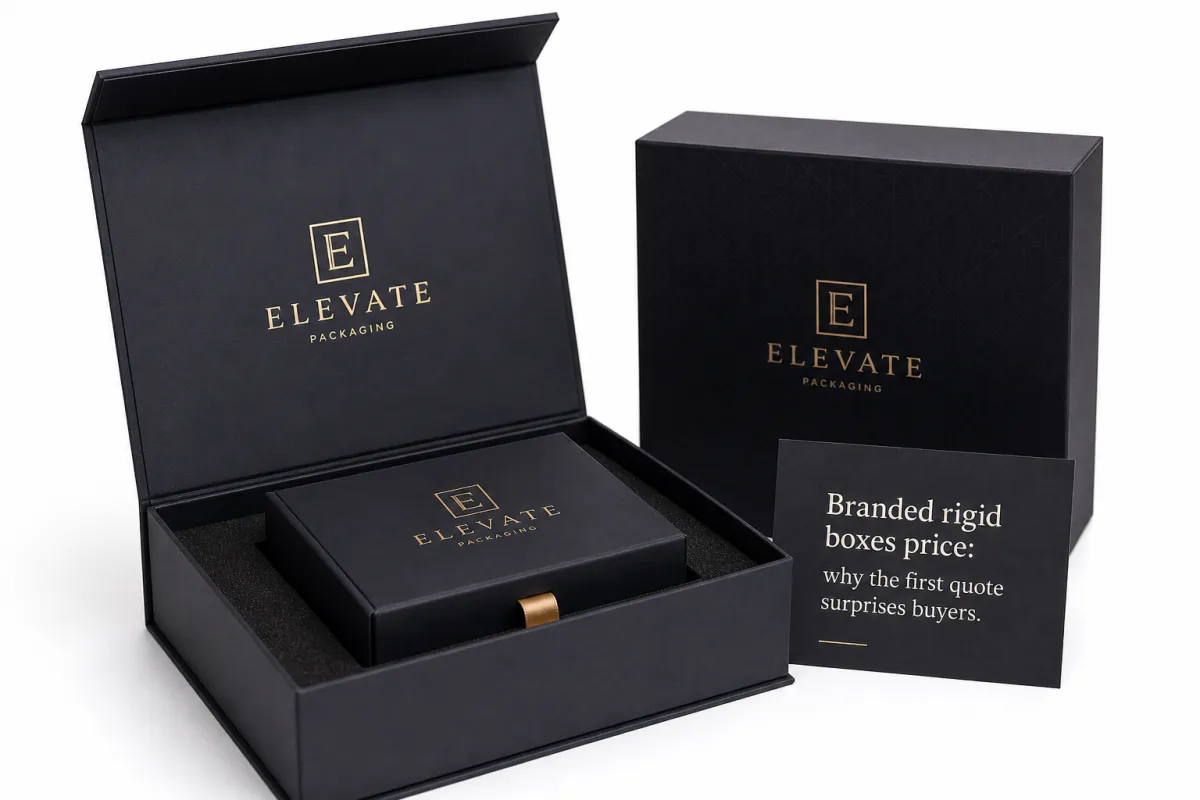
Branded rigid boxes price often appears higher than expected because the box carries more labor than many buyers assume at the start. The outer surface may look like a clean paper wrap with a logo, but underneath that finish sits chipboard, wrap paper, glue coverage, corner folding, die-cut work, insert fabrication, and assembly time. A magnetic flap, a shoulder structure, or a drawer pull adds another layer of handling because each feature has to be cut, wrapped, aligned, and checked with care.
From a packaging buyer's point of view, the first quote usually looks high when it is compared to folding cartons or mailers. That comparison does not reflect the rigid box process. A rigid box is built more like a presentation product than a simple shipping container, which is why branded rigid boxes price should be judged against the value of premium unboxing, shelf presence, and product protection rather than only against raw material thickness. Once the production steps are visible, the quote stops looking mysterious and starts looking pretty logical.
The best packaging budget is rarely the cheapest one. It is the one that balances appearance, durability, and order volume without paying for decoration the product does not need. A heavy fragrance set, a watch, a skincare gift kit, or a corporate presentation piece can justify a more refined build because the packaging is carrying real brand weight. In those cases, branded rigid boxes price becomes part of the product experience rather than an afterthought. If the box is doing its job, the buyer feels the difference in the hand, not just on paper.
Pricing becomes much easier to understand once the right questions are on the table. What are the exact product dimensions? Does the insert need to lock the item in place during transit? Is the paper wrap a standard coated sheet or a specialty texture? Will the logo be printed, foiled, debossed, or all three? Each answer moves branded rigid boxes price in a direction that can be measured, explained, and compared. A clean brief usually saves more money than a clever design tweak, kinda surprisingly enough.
A clean-looking rigid box is rarely a simple box. The cost lives in the layers: board, wrap, glue, insert, finish, and the time it takes to assemble each piece without scuffing the surface.
Product details that affect branded rigid boxes price
The anatomy of a rigid box is straightforward, but the details still matter. Most builds start with chipboard in the 1.5mm to 3mm range, then add a wrap paper that can be plain, printed, textured, or coated. Some jobs use a printed label panel, while others go with direct print across the wrap. A two-piece setup box usually has a base and lid wrapped separately, while a magnetic closure box adds concealed magnets and tighter alignment requirements. Every one of those choices changes branded rigid boxes price.
Finish selection carries real cost as well. Soft-touch lamination feels upscale, but it adds an extra converting step and can be more sensitive to scuffing during packing. Linen-texture stocks and specialty papers can look excellent, yet they often cost more than standard art paper and may have shorter supply windows. Foil stamping, embossing, debossing, and spot UV each add tooling, setup, or handling time. The decoration is not only visual; it is physical work that shows up in branded rigid boxes price.
Inserts deserve the same attention. A simple paperboard insert is faster and less expensive than a molded pulp tray or a custom die-cut foam cradle. Ribbon pulls, finger cutouts, satin tabs, and multi-part compartments can make the presentation feel more refined, but they also increase build complexity. If the product is a bottle, a device, or a gift set with several pieces, the insert is doing the heavy lifting for both fit and damage control. A better insert can lower transit risk, but it will influence branded rigid boxes price more than buyers sometimes expect.
Product fit affects the quote just as much as decoration. A snug box uses the board more efficiently, keeps the item centered, and reduces rattling in shipment. Oversized packages waste material and can force larger inserts or larger lid panels, both of which add cost. Packaging specifications should be written for the product rather than just for the artwork. A good fit supports presentation, and a good fit keeps branded rigid boxes price from drifting upward because the box was sized loosely.
For teams comparing formats, it helps to view rigid packaging alongside other lines in our Custom Packaging Products catalog, because the right structure often becomes obvious once the product, shipping method, and unboxing goal are all on the table.
Specifications, sizing, and branding choices that move the budget
Dimensions are one of the most reliable drivers of branded rigid boxes price. Larger panel sizes use more chipboard and wrap paper, while deeper walls can require more careful folding and more glue coverage at the corners. Oversized lids, wide shoulder builds, and tall drawer sleeves all increase material use and slow down handling. A compact box often produces a better unit cost, not because it looks cheaper, but because the build uses less board and less manual work.
Buyers should prepare a spec pack that covers the product dimensions, weight, insert requirements, closure style, artwork coverage, finish preference, and destination. Those inputs allow a supplier to judge whether the box needs a simple two-piece form, a magnetic flap, a book-style lid, or a drawer pull. They also reveal whether the order should be sampled as a full prototype or just a structural mock-up. The more complete the information, the more stable branded rigid boxes price becomes during quoting.
Branding choices can either push the budget up or keep it under control. Full-wrap graphics, inside printing, high-coverage backgrounds, and edge-to-edge artwork all take more production care than a single logo panel. Multi-color branding may require tighter color management, especially if the buyer wants a specific PMS match across several items in a product family. Better color control means more setup, more proofing, and often more time in prepress, all of which can influence branded rigid boxes price.
File quality matters as well. Clean vector artwork, accurate bleed, and proper dieline alignment reduce the risk of rework. Low-resolution images, missing fonts, or shifting layers can lead to extra proof rounds and a slower schedule. That is not a cosmetic issue; it is a direct cost issue. A design that is technically ready for production keeps branded rigid boxes price closer to the original target because the team spends less time correcting avoidable problems. A messy file can add days, and sometimes that delay becomes a real budget line.
Practical specs should always cover appearance and performance together. A premium box still has to survive stacking, hand packing, parcel movement, and retail handling. If the box is intended for shipping, ask how the structure will behave in drop and vibration testing, and compare that against recognized methods such as ISTA test procedures. If the board sourcing matters for a retail program, a chain-of-custody requirement such as FSC can also be worth confirming early, because paper selection may narrow once certification is part of the brief. And just to be fair, certification claims should be documented rather than assumed; it saves trouble later.
- Lower-cost control points: standard art paper, two-piece setup, paperboard insert, single-panel logo placement.
- Mid-range control points: soft-touch lamination, printed wrap, custom die-cut insert, foil accent.
- Higher-cost control points: magnetic closure, specialty textured stock, inside print, multi-compartment insert, complex foil and embossing.
Branded rigid boxes price, MOQ, and quote drivers
MOQ matters because setup cost has to be spread across the run. If the order is small, branded rigid boxes Price Per Unit rises quickly because prepress, cutting, wrapping, glue setup, inspection, and packing all consume nearly the same amount of labor whether the run is 500 units or 5,000 units. As volume rises, the unit cost usually drops because more boxes share the same setup time and the line runs with less interruption.
The main quote drivers are easy to name, but they do not always appear clearly in a supplier comparison. Board grade, wrap stock, printing method, finishing, insert type, manual assembly, and whether the order is fully custom or based on a stocked shell all affect branded rigid boxes price. A buyer who asks for a quote on a plain box, then later adds a foil mark, a custom insert, and an upgraded paper, is not comparing the same package anymore. That sounds obvious, yet it is one of the most common sources of pricing confusion.
Here is a practical comparison of common rigid box styles and how they tend to move the budget. The numbers are directional, because exact branded rigid boxes price depends on size, artwork, and order volume, but the pattern is reliable.
| Rigid box style | Typical cost impact | Build complexity | Best use case |
|---|---|---|---|
| Two-piece set-up box | Usually the lowest entry point for branded rigid boxes price | Moderate | Gift sets, cosmetics, accessories, presentation packaging |
| Magnetic closure box | Often 15% to 35% higher than a basic two-piece format | Higher | Premium retail, electronics, corporate gifting |
| Shoulder and collar box | Often 20% to 40% higher because of extra board and alignment work | Higher | Luxury goods, limited editions, display-driven launches |
| Drawer-style box | Often 25% to 50% higher depending on ribbon pulls and sleeve finishing | High | Jewelry, specialty kits, premium unboxing programs |
The table makes one thing clear: brand presentation and structure are inseparable from price. A simple shell can work beautifully if the product already has visual weight, while a premium launch may need the magnetic closure or shoulder build to match the brand position. In both cases, branded rigid boxes price should be read against the exact structure, not against a generic "rigid box" label.
Quote comparison also has to include what is inside the price. Ask whether the figure includes assembly, sampling, freight assumptions, and any extra packaging for shipment. Some quotes exclude inserts or treat them as an add-on. Some do not include the cost of special papers that need longer lead times. If those items are not listed, branded rigid boxes price can look lower on paper and then rise once the missing pieces are added.
Common pricing mistakes are easy to avoid once the buyer slows down and compares specifications line by line. A plain white rigid box is not the same as a fully wrapped, foil-stamped presentation box. A flat lid is not the same as a magnetic lid. A stock insert is not the same as a die-cut insert made around a specific product shape. If two suppliers are not quoting the same spec, the branded rigid boxes price numbers are not truly comparable.
Process, timeline, and production steps
The production flow for a rigid box usually starts with quote review, then moves to structural confirmation, artwork prep, sample approval, material ordering, production, finishing, packing, and shipping. That sequence sounds simple, but each stage has its own timing pressure. A clean approval process keeps the job moving. A slow one can stretch the schedule even when the factory has capacity.
Lead time expands most often because of special papers, complicated inserts, and multiple proof rounds. If the box uses a specialty wrap or a custom printed liner, the material may need to be sourced before production starts. If the design includes several compartments, each insert has to be checked for fit before bulk assembly begins. Branded rigid boxes price is linked to that timing too, because rushed work, split shipments, and extra revisions can all add cost. Nobody likes surprise rush charges, and honestly, they usually show up because one detail was left vague at the start.
A sample stage is worth the time on nearly every premium job. It lets the buyer check closure strength, fit, print balance, and insert behavior before full production begins. For a product that will travel through parcel networks or be handled repeatedly at retail, a sample can reveal whether the lid is too loose, the insert is too tight, or the board walls are not giving enough structure. In many cases, a sample saves money because it prevents a costly correction in the full run.
Ask practical schedule questions before release. When is artwork due? When is the proof considered approved? Is tooling released after payment or after sign-off? Is the box assembled by hand, by machine, or by a mixed line? How will freight be arranged, and does the shipping estimate assume palletized export or carton-packed domestic movement? Each answer affects the final timeline and can influence branded rigid boxes price if the order needs special handling.
Clear specs do more than speed the job. They reduce the chance of misunderstandings between design, purchasing, and production. That is one reason reliable packaging programs often look calm from the outside: the paperwork was done well, the sample was approved early, and the factory did not have to guess. When those things line up, branded rigid boxes price stays aligned with the original plan instead of drifting because of avoidable corrections. The production floor tends to reward clarity, plain and simple.
If you want to see how structure and presentation translate into finished work, our Case Studies page is a useful place to compare real packaging decisions across different product categories.
Why choose us for branded rigid boxes
Good rigid box work depends on discipline. Clean wrapping, accurate fit, even corner folds, consistent board thickness, and stable finish quality are not luxury extras; they are the baseline for premium packaging. A supplier that understands rigid construction can help a buyer avoid over-specifying the box where it does not matter and under-specifying it where it does. That is the difference between paying for useful quality and paying for decoration that does not improve the package.
From a buyer's perspective, the value is in steady execution. Clear quoting, realistic timelines, and direct feedback on artwork and structure save time and reduce back-and-forth. When the conversation is technical and honest, the order becomes easier to plan. The branded rigid boxes price is still important, of course, but the real win is a package that looks right, closes right, and arrives right on the line or in the warehouse.
Production discipline matters just as much as the design. Consistent materials, careful inspection, and controlled finishing help keep color drift, scuffing, glue marks, and warped panels out of the shipment. Buyers often focus on the visible front panel, but the hidden details are what determine whether the box feels premium in hand. A well-made rigid box should not fight the product or slow down assembly. It should support the brand without creating new problems.
We also see a lot of value in helping customers choose the right format before they commit to a print-heavy design. Some projects need a magnetic closure and a soft-touch finish. Others need a basic wrapped setup box with a clean insert and a strong logo hit. The right choice depends on the product and the channel, not on which finish looks nicest in isolation. Comparing format options early, and reviewing them against the exact branded rigid boxes price, usually leads to better packaging decisions. That early pass is where a lot of waste gets removed.
For buyers comparing formats across a larger packaging program, our Custom Packaging Products page can help narrow the field before artwork is finalized.
Next steps for an accurate branded rigid boxes price
The fastest way to get an accurate branded rigid boxes price is to send a complete spec from the start. Include the product dimensions, weight, quantity, desired box style, insert requirements, artwork files, finish preference, and shipping location. If the product has delicate surfaces, unusual geometry, or a retail shelf requirement, say so. Those details help a supplier quote the real build instead of a placeholder estimate.
Ask every supplier for the same specification so the branded rigid boxes price comparison is fair. If one quote includes a custom insert and another does not, the lower number is not a better deal. If one quote assumes standard wrap paper and another assumes a soft-touch laminate, the difference is real and should be visible. The cleanest comparison happens when the same board thickness, same finish level, same print coverage, and same freight assumptions are used across the board.
Before approving the order, confirm print coverage, finish level, insert material, and any packing or freight assumptions that could change the final bill. A buyer who checks those items early is less likely to face surprise charges later. It also helps to request a sample if the product has any risk points, because the sample can show whether the closure feels right, whether the insert grips correctly, and whether the visual balance matches the brand plan. Those checks support branded rigid boxes price discipline just as much as they support presentation quality.
Here is a simple decision path that keeps the process practical: review the sample, verify the timeline, approve the final price, and release production with a clear spec sheet. That sequence protects the budget and keeps everyone aligned. It also turns branded rigid boxes price from a vague concern into a set of controllable choices. Once those choices are visible, the buying decision gets much easier, and the final package usually feels more intentional.
Branded rigid boxes price is not a guessing game when the spec is clear, the comparison is fair, and the packaging goal is defined up front. If the next step is a quote, send the product measurements, the target quantity, and the finish details first, then build the rest of the program around that starting point. That one move usually does more for accuracy than a dozen follow-up emails.
How much do branded rigid boxes usually cost per unit?
The unit cost depends on size, board thickness, wrap paper, print coverage, finish, and insert type. Smaller runs cost more per box because setup and labor are spread across fewer units, so branded rigid boxes price can move a lot between 500 pieces and 5,000 pieces. A precise quote only becomes useful when the same specifications are compared across suppliers.
What is the biggest factor in branded rigid boxes price?
Box structure and finish level usually have the largest impact on cost. A complex magnetic box with specialty wrap and custom inserts costs more than a simple two-piece setup box, and branded rigid boxes price also rises as quantity drops because setup cost gets divided across fewer units. In many programs, the build style is the first place to look for savings.
Does MOQ change the branded rigid boxes price a lot?
Yes, MOQ can change pricing significantly because low quantities carry higher setup cost per box. Larger orders usually improve unit cost through better material use and more efficient production, which is why branded rigid boxes price often improves at the next tier break. Ask for price breaks at different quantities to find the most efficient order size.
How long does production usually take for custom rigid boxes?
Timeline depends on artwork approval, sample sign-off, material availability, and box complexity. Special finishes and custom inserts can add time to the schedule, and branded rigid boxes price may change if the order needs rushed handling or split shipments. Fast approvals and clear specs help keep the order moving.
What should I send to get an accurate branded rigid boxes price quote?
Send product dimensions, quantity, desired box style, print details, finish preferences, and insert requirements. Include artwork files and shipping location so freight and setup can be estimated correctly, because incomplete information can distort branded rigid boxes price and create avoidable revisions later. The more complete the spec, the fewer surprises after the quote.

