Buyer Fit Snapshot
| Best fit | Branded Shipping Bags for Events projects where brand print, material claims, artwork control, MOQ, and repeat-order consistency need to be specified before quoting. |
|---|---|
| Quote inputs | Share finished size, material target, print colors, finish, packing count, annual reorder estimate, ship-to region, and any compliance wording. |
| Proofing check | Approve dieline scale, logo placement, barcode or warning zones, color tolerance, closure strength, and carton packing before bulk production. |
| Main risk | Vague material claims, crowded artwork, missing packing details, or unclear freight terms can make a low unit price expensive after revisions. |
Fast answer: Branded Shipping Bags for Events: Film, Print, MOQ, and Carton Packing should be specified like a repeatable production item. The safest quote records material, print method, finish, artwork proof, packing count, and reorder notes in one written spec.
Production checks before approval
Compare the actual filled-product size with the drawing, then confirm tolerance on folds, seals, hang holes, label areas, and retail display edges. Reserve space for logos, QR codes, warning copy, and material claims before decorative graphics fill the panel.
Quote comparison points
Review material grade, print process, finish, sampling route, tooling charges, carton quantity, and freight assumptions side by side. A quote is only useful when the supplier can repeat the same color, closure quality, and packing count on the next order.
For a lot of attendees, Branded Shipping Bags for events are the first physical thing they see, and sometimes they see that before they ever touch the product inside. That outer layer carries more branding weight than many teams expect, because a mailed kit, a VIP bundle, or a giveaway pack starts telling its story the moment it lands on a doorstep.
Used well, branded shipping bags for events do more than keep items together. They build anticipation, lift the perceived value of the shipment, and make a simple delivery feel like part of the event itself instead of a plain logistics task. That is true whether the shipment is headed to a conference attendee, a creator, a sponsor, a press contact, or a customer ordering event merchandise after the show.
Branded Shipping Bags for Events: What They Are and Why They Matter
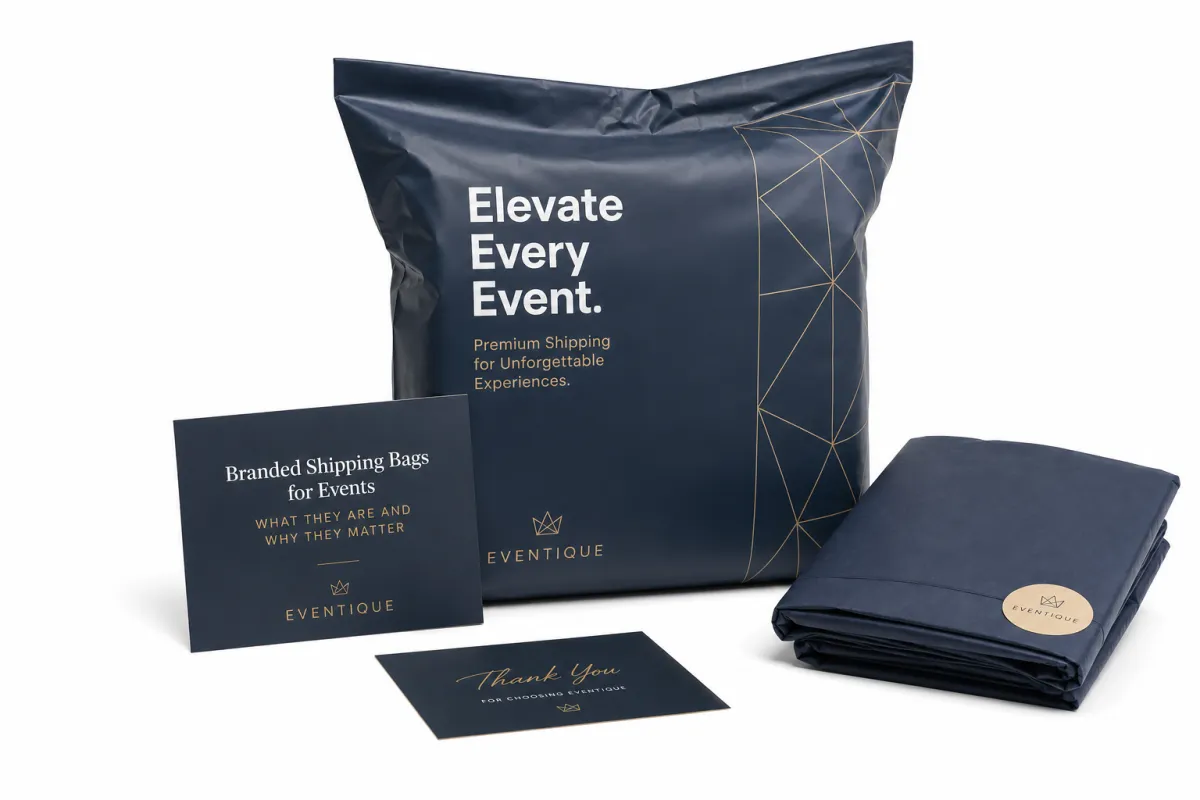
Branded shipping bags for events are custom-Printed Poly Mailers or similar shipment-ready bags designed to carry event merchandise, VIP kits, giveaway bundles, and retail orders while reinforcing the event identity. They sit right at the meeting point of packaging design and fulfillment: they need to look good, protect the contents, and hold up through carrier handling without turning the brand message into a battered arrival.
That mix matters more than people sometimes realize. A bag that arrives crisp and intentional tells the recipient the team paid attention to the details. A plain mailer can still do the job, sure, but it rarely carries the same lift in perceived value. For branded shipping bags for events, the outer package becomes part of the show, especially when the contents are meant to feel exclusive or time-sensitive.
These bags fit especially well at conferences, festivals, product launches, creator meetups, trade shows, and hybrid campaigns where the mailing moment needs to feel coordinated with the in-person brand story. The same idea applies to ecommerce shipping tied to event drops, post-event thank-you kits, and sponsor programs that want their materials to arrive with a little more polish.
From a packaging buyer's point of view, the biggest advantage is control. Color, logo placement, short copy, and a clean layout can create a branded arrival without adding a sleeve or outer carton. That keeps the package simpler while still giving the event team a stronger presentation. For many branded shipping bags for events, that simplicity is exactly the point.
There is also a practical side. Poly mailers are light, which helps with dimensional weight and shipping cost control. They stack easily, pack faster than many rigid formats, and often suit flat apparel, catalogs, stickers, small boxed items, and folded collateral. If the contents are fragile, bulky, or oddly shaped, a different format may make more sense, but for a lot of event mailers the bag is a smart middle ground between protection and presentation.
One more thing gets overlooked: the bag is also a visual cue for memory. A strong system on branded shipping bags for events can make the package recognizable at a glance, which helps with social sharing, sponsor visibility, and the kind of unboxing photos that keep moving after the event ends.
"If the outer package feels off, the whole shipment feels off." That is especially true for branded shipping bags for events, where the packaging is part logistics tool and part first impression.
How Branded Shipping Bags for Events Work in the Real World
The workflow for branded shipping bags for events is usually straightforward, but each step has real consequences. It starts with artwork setup, where the team defines what has to appear on the bag, how much blank space is needed, and whether the design should read as bold, minimal, playful, premium, or highly promotional. Then comes proof approval, followed by production, finishing, packing, and final shipment. If one of those steps slips, the schedule shifts with it.
In a typical run, the bag is the final outer package that protects the contents through sorting, stacking, and carrier handling. For event teams, that means one item has to do several jobs at once: keep products contained, provide package protection, hold up during transit packaging, and present the brand clearly after a journey that may include conveyors, trucks, and repeated handling. Branded shipping bags for events need to be designed for that reality, not just for the mockup.
Good design usually makes use of front and back print zones. The front may carry the logo and event name, while the back can hold a short line of copy, a QR code, a website, or a sponsor mark. Some teams use a bold color field on the reverse side so the bag still feels branded even if the front is partly hidden by labels or tape. Others keep the design very clean and let shape, color, and finish do most of the work. Both can work, as long as the layout stays readable after handling.
The best results come from matching the bag style to the use case. A VIP welcome kit has different needs from a giveaway mailer, and both are different again from a post-event ecommerce order. A mailer for a light apparel piece may only need a standard gauge film, while a heavier bundle with a hard insert or boxed set may need stronger seams and more material thickness. That is where practical experience matters with branded shipping bags for events: the right bag is the one that fits the actual shipment, not the one that merely looks nice on a screen.
Here is the part many teams skip. The design does not just need to look good in isolation; it has to survive the real carrier environment. If the logo is too close to the edge, it can get distorted by seams or seals. If the type is too thin, it may disappear against glossy film. If the print is overloaded with copy, the bag can look busy and lose the clean visual cue that makes branded shipping bags for events feel premium.
For testing and performance references, many packaging teams look at industry resources such as ISTA for transit test methods and the EPA for broader recycling and materials guidance. Those resources do not replace supplier specs, but they help teams ask better questions about transport durability, recyclability claims, and the real behavior of shipping materials.
For event operations, the hidden win is speed. Once the system is set, branded shipping bags for events let a packing team move quickly without giving up presentation. That matters in order fulfillment, where every extra minute on the line has a cost. A good mailer design should make packing easier, not harder.
And yes, that means the bag should be easy for a real person to use under time pressure, not just easy for a designer to admire. If the seal is awkward, the tear strip is hard to find, or the label area is too small, the line slows down. Nobody wants that on the day the pallets are already stacking up.
Materials, Sizes, and Print Choices That Shape the Result
Material choice sets the ceiling for everything else. Standard poly is the most common starting point for branded shipping bags for events because it is light, durable enough for many applications, and cost-effective at scale. Co-extruded film can improve strength and appearance, while recycled-content film may fit sustainability goals without changing the basic shipping behavior too much. Heavier gauge bags add more puncture resistance and a slightly more substantial hand feel, which can be useful for premium kits or dense contents.
Size matters just as much. A bag that is too large wastes material, takes up more cart space, and can make the shipment look underfilled. A bag that is too tight can stress the seams, distort the print, or make packing awkward. With branded shipping bags for events, the right size usually comes from the real packed dimensions, not the retail box size or the product alone. Measure the final bundle with inserts, padding, and closures included.
Print choice is where branding and budget meet. One-color logos work well for teams that want a clean, strong look and better cost control. Full-color graphics add energy, but they should earn their place on the bag. Matte finishes tend to feel softer and more premium, while gloss can make colors pop and hold up visually under bright lighting. Inside prints are a nice surprise in some campaigns, though they are not always necessary. For many branded shipping bags for events, the simplest design is the one that looks the most confident.
Functional details deserve as much attention as graphics. Adhesive strength affects seal reliability. Opacity affects privacy and how visible the contents are through the film. Tamper evidence can matter for VIP kits or sponsor materials. Carrier compatibility matters if the team is using USPS, UPS, FedEx, or regional couriers. A package that looks attractive but fails during sorting is not a win. The best branded shipping bags for events combine visual identity with practical shipping performance.
| Bag Type | Best Fit | Typical Look | Typical Unit Cost at 5,000 Pieces | Notes |
|---|---|---|---|---|
| Standard poly mailer | Light apparel, flat inserts, giveaway items | Clean, lightweight, efficient | $0.16-$0.24 | Good starting point for many branded shipping bags for events |
| Co-extruded film mailer | General event kits, moderate handling | Slightly stronger hand feel | $0.20-$0.32 | Often a smart balance of cost and durability |
| Recycled-content mailer | Sustainability-focused programs | Similar to standard poly, depending on resin | $0.22-$0.36 | Check exact material structure before making recyclability claims |
| Heavy-gauge mailer | Dense kits, premium bundles, higher abuse risk | More substantial, less flimsy | $0.28-$0.48 | Useful when package protection matters more than absolute lowest cost |
| Matte or specialty finish | Launches, VIP drops, premium branding | Higher-end tactile feel | $0.35-$0.70 | Great for presentation, but usually not the cheapest path |
That table is a working range, not a promise. Print coverage, custom sizing, finishing, film thickness, and freight all change the final number. Still, it gives a useful frame for planning branded shipping bags for events without getting lost in vague pricing language.
If the program also includes rigid kits or fragile contents, compare the mailer against other formats in Custom Packaging Products and, for denser or breakable shipments, consider whether Custom Shipping Boxes might fit the job better. A bag is not automatically the right answer just because it is lighter. The best choice is the one that protects the contents and supports the event experience at the same time.
For teams comparing formats, the same order may even use both. A premium package could ship in a box, while the thank-you reorders or lower-value merchandise go out in branded shipping bags for events. That split approach helps control cost while preserving the presentation where it matters most.
Branded Shipping Bags for Events: Pricing, MOQ, and Lead Times
Pricing for branded shipping bags for events usually comes down to five things: quantity, bag size, film thickness, number of print colors, and whether the order needs custom sizing or special finishes. Higher quantities generally reduce unit cost, but larger runs also raise the risk of ordering too much inventory if the event plan changes. That is the balancing act every buyer knows too well.
Minimum order quantities vary by supplier and construction, but event teams often see custom programs starting somewhere in the 3,000 to 5,000 piece range. Some jobs can go lower, especially if the print is simple and the bag size is standard, but lower quantities usually push the unit price up. That is why branded shipping bags for events should be planned around confirmed needs whenever possible, not a guess.
Lead time deserves a real line in the calendar. Artwork review can take a day or two, proof approval can take longer if several stakeholders want signoff, and production often runs 12 to 15 business days after approval for many standard custom jobs. Add freight, receiving, and staging, and a simple order can still need a comfortable buffer. For branded shipping bags for events, a late delivery creates more than a shipping problem; it can throw off the entire launch schedule.
Below is a practical way to think about the hidden costs that often get missed early on:
- Setup fees for plates, screens, or digital setup, depending on the print method.
- Freight charges that rise with bag size, carton count, and delivery distance.
- Rush fees if the event date is tight and the production schedule has little room.
- Reprint risk if artwork errors are found after approval.
- Overage storage if the team orders more branded shipping bags for events than it can use immediately.
Buyer tip: ask whether the quote includes freight to your receiving location, carton breakdown, and a buffer for waste. Those small details can move the real landed cost more than a difference of a few cents on the unit price. With branded shipping bags for events, a quote that looks cheap on paper is not necessarily the cheapest quote once the bags actually arrive.
Timing also affects design decisions. A simple one-color bag may be faster and less expensive than a full-bleed, multi-color version. If the event is only a few weeks away, the safer path is often a cleaner print spec and a standard bag size rather than a highly customized structure. That does not mean the package has to look generic; it just means the brand has to work within the schedule.
For procurement teams that want more context, Case Studies can help show how similar event programs were handled, and a look at Custom Poly Mailers gives a better sense of the available constructions. Those two checkpoints can save a lot of back-and-forth before a quote turns into an order.
Honestly, the safest budgeting rule for branded shipping bags for events is simple: plan for the bag, the proof, the freight, and a little slack in the calendar. That slack is what keeps a good packaging decision from becoming a last-minute scramble.
A Step-by-Step Ordering Process for Event Packaging
The cleanest way to order branded shipping bags for events is to start with the shipment itself. What is being sent? How heavy is it? Will the bag be used for VIP kits, swag, apparel, post-event ecommerce orders, or internal sponsor materials? The answers guide everything else, including bag size, film thickness, seal type, and print layout.
Next comes artwork prep. Gather the correct logo files, confirm brand colors, decide whether the bag should show the full event name or a shortened mark, and leave enough breathing room around seams, seals, and shipping labels. Many production problems happen because the design looked fine in a mockup but did not account for the way flexible film folds and stretches. With branded shipping bags for events, the design has to be built for the real substrate, not just the presentation slide.
Proof review is where quality control really happens. Spellings, QR code destinations, placement, bleed, contrast, and logo size all need a careful look. A proof is not a formality. It is the last practical chance to catch a typo or an off-center mark before production begins. If the team is ordering several styles at once, compare each proof side by side so the visual system stays consistent across the set.
One simple way to keep the process moving is to divide responsibilities clearly:
- Marketing confirms the look and message.
- Operations confirms size, quantity, and delivery timing.
- Fulfillment confirms how the bag will be packed and labeled.
- Procurement confirms budget, freight, and final approval.
After approval, production moves forward, then cartons are shipped, received, counted, and staged. The receiving step is easy to overlook, but it matters. Open the first cartons, inspect print quality, check seals, and make sure the bags fit the actual content before the full event wave starts. A small problem caught on carton one is a quick fix. A small problem caught on shipment day is a headache. That is especially true for branded shipping bags for events, where the packaging schedule is usually tied to a hard event date.
For teams handling hybrid programs, it helps to think of the bag as one part of a larger shipping system. The outer package needs to coordinate with inserts, internal wrapping, barcode labels, and warehouse flow. If the bag slows the line, it may not be the right spec. If it speeds up packing while improving presentation, it is doing its job well. In that sense, branded shipping bags for events are not just brand assets; they are operational tools.
There is also a useful checkpoint around carrier rules. Some parcels need more rigidity than a mailer can provide, and some contents demand extra package protection. If the product is unusually fragile, high-value, or unevenly shaped, compare the mailer option against boxes before locking in the spec. For a lot of event work, though, the bag remains the most efficient choice because it reduces shipping materials, keeps transit packaging light, and still gives the shipment a distinct identity.
Common Mistakes to Avoid With Event Shipping Bags
The first mistake is trusting a screen mockup too much. A design that looks polished on a monitor can fail on film if the logo is too small, the copy is too thin, or the color contrast is too low. Flexible packaging reflects light differently than paper, and that changes how details read in real life. With branded shipping bags for events, a simple, bold layout often beats a crowded one.
The second mistake is ignoring fill weight and seam stress. Event bundles can be denser than they look, especially if they include hard goods, catalogs, samples, or boxed items. A bag that handles a T-shirt may not handle a full kit. Weak seams or underspecified film can lead to damaged arrivals, which defeats the purpose of using branded shipping bags for events in the first place.
The third mistake is waiting too long. Custom work has an approval chain, a production queue, and a freight leg. Even when the design is simple, those stages take time. If the event date is fixed, the packaging deadline needs a buffer. I have seen teams treat branded shipping bags for events like a small purchase and then discover it actually sits on the critical path for the entire launch.
The fourth mistake is separating packaging from the event timeline. The bag is not a standalone item; it is part of the broader event operations plan. If the final artwork is still changing while fulfillment is already booked, inventory can get mismatched, cartons can sit unused, and the reorder cost can climb fast. That is especially painful if the team has already committed to a specific run of branded shipping bags for events and only then notices a logo update or sponsor change.
The fifth mistake is choosing the cheapest spec without checking the job. A lower-cost bag can be a great fit if the contents are light and the shipping path is forgiving. But if the package has to survive rough handling, a slightly stronger film or better seal is often worth the extra cents. The real cost of a failed shipment is not the difference in unit price; it is the replacement shipping, the labor, and the impression left behind.
Another issue shows up in sustainability claims. Recycled-content film, paper alternatives, and recyclable packaging language can all be useful, but they need to match the actual material build and local recycling rules. Do not assume a bag is recyclable just because the marketing copy says so. Check the structure, confirm the resin blend, and align the claim with the region where the shipment will be opened. That kind of honesty builds trust for branded shipping bags for events and prevents avoidable confusion.
Finally, do not forget that a mailer is part of the brand story. If the bag arrives scuffed, too loose, or visually off-brand, the whole experience can feel less intentional. That is why branded shipping bags for events deserve the same careful planning as the inserts and the product inside.
Next Steps: Launching Branded Shipping Bags for Events Successfully
If you are getting ready to source branded shipping bags for events, start with a short checklist. Define the shipment purpose, estimate the quantity, Choose the Right bag style, and set a conservative delivery deadline that includes proofing and transit time. That sounds basic, but it is exactly where good programs stay on track.
Request a sample or proof whenever possible. Seeing the film, seal, and print in person catches problems that a digital mockup can hide. Color on screen is never quite the same as color on film, and a bag that feels flimsy in hand may not be the right spec for the job. For branded shipping bags for events, that physical check is often the difference between confidence and guesswork.
Match the bag to the real shipment, not the idealized one. Check the product weight, the shipping method, the brand colors, and whether the packaging needs to work both for mailing and on-site distribution. Some teams need one format that can be handed out at the booth and also mailed the next day. Others need a dedicated shipping bag and a separate event carry bag. There is no single answer, but there is always a right fit for the use case.
If your event line includes lighter merch, a branded mailer may be all you need. If the contents are rigid, fragile, or high-value, compare that option against stronger transit packaging before signing off. The goal is not simply to print a logo on a bag; the goal is to create branded shipping bags for events that protect the contents, support the launch plan, and make the shipment feel intentional from the moment it leaves the dock.
That is the real job here: approve artwork early, build in a buffer, and place the order only after the team has confirmed the final use case and timeline. Done that way, branded shipping bags for events become a small but meaningful piece of the overall experience, and the package does exactly what it should do - arrive well, look right, and carry the event story all the way to the recipient's door.
If there is one practical rule to keep in mind, it is this: decide the shipment first, then shape the bag around it. That order saves money, reduces reprints, and keeps the branding honest to the actual job.
Frequently Asked Questions
Are branded shipping bags for events better than plain poly mailers?
Use branded shipping bags for events when the shipment is part of the experience and the outer package should reinforce the event identity. Choose plain mailers when the job is mostly utilitarian and branding matters less than speed or cost control. For many programs, the best answer is a branded bag for VIP or public-facing shipments and a plain mailer for back-office fulfillment.
How many branded shipping bags for events should I order?
Base the quantity on confirmed attendee count, expected replacements, speaker or sponsor kits, and a small overage for damaged pieces. Add extra units if the same bag will be reused for press, staff, or last-minute shipments after the event. Avoid ordering too tightly, because running short usually costs more in rush production than a modest buffer would have cost up front.
What artwork works best on branded shipping bags for events?
Strong logos, short event names, simple patterns, and high-contrast copy usually print more cleanly than crowded layouts. Keep critical elements away from seams and seals, and avoid tiny details that can blur on flexible film. If the bag needs to feel premium, consider a bold single-color design, a matte finish, or a clean full-bleed layout instead of overloading the surface.
How long do branded shipping bags for events take to produce?
Production time depends on proof approval, print complexity, quantity, and whether the order needs custom sizing or special finishes. Build in time for artwork review, freight transit, and a receiving buffer, especially if the bags must arrive before packing or kitting begins. Rush orders are possible in some cases, but they usually increase cost and reduce flexibility if changes are needed.
Can branded shipping bags for events be recycled?
Recyclability depends on the film structure and local recycling rules, so the material spec matters more than the marketing language on the bag. Recycled-content films can be a smart option when the goal is to reduce virgin plastic use without sacrificing shipping performance. If sustainability is a priority, confirm the exact material build, then pair the bag with right-sized shipments and minimal excess packing.


