Buyer Fit Snapshot
| Best fit | Branded Shipping Mailers projects where brand print, material claims, artwork control, MOQ, and repeat-order consistency need to be specified before quoting. |
|---|---|
| Quote inputs | Share finished size, material target, print colors, finish, packing count, annual reorder estimate, ship-to region, and any compliance wording. |
| Proofing check | Approve dieline scale, logo placement, barcode or warning zones, color tolerance, closure strength, and carton packing before bulk production. |
| Main risk | Vague material claims, crowded artwork, missing packing details, or unclear freight terms can make a low unit price expensive after revisions. |
Fast answer: Branded Shipping Mailers: Film, Print, MOQ, and Carton Packing should be specified like a repeatable production item. The safest quote records material, print method, finish, artwork proof, packing count, and reorder notes in one written spec.
Production checks before approval
Compare the actual filled-product size with the drawing, then confirm tolerance on folds, seals, hang holes, label areas, and retail display edges. Reserve space for logos, QR codes, warning copy, and material claims before decorative graphics fill the panel.
Quote comparison points
Review material grade, print process, finish, sampling route, tooling charges, carton quantity, and freight assumptions side by side. A quote is only useful when the supplier can repeat the same color, closure quality, and packing count on the next order.
Branded Shipping Mailers: How to Choose the Right Fit
Branded Shipping Mailers change how an order feels before the customer even gets to the opener strip. A lightweight apparel order that lands in a plain pouch can disappear into the noise. The same item in the right branded shipping mailers setup feels deliberate, protected, and worth remembering.
That is the job here: protect low-bulk products, cut waste where it is easy to cut, and give ecommerce shipping a sharper brand presence without forcing every order into a heavier box than it needs. Done well, the package works harder than the marketing copy. And honestly, that is kinda the point.
Branded Shipping Mailers: Why They Stand Out at First Touch
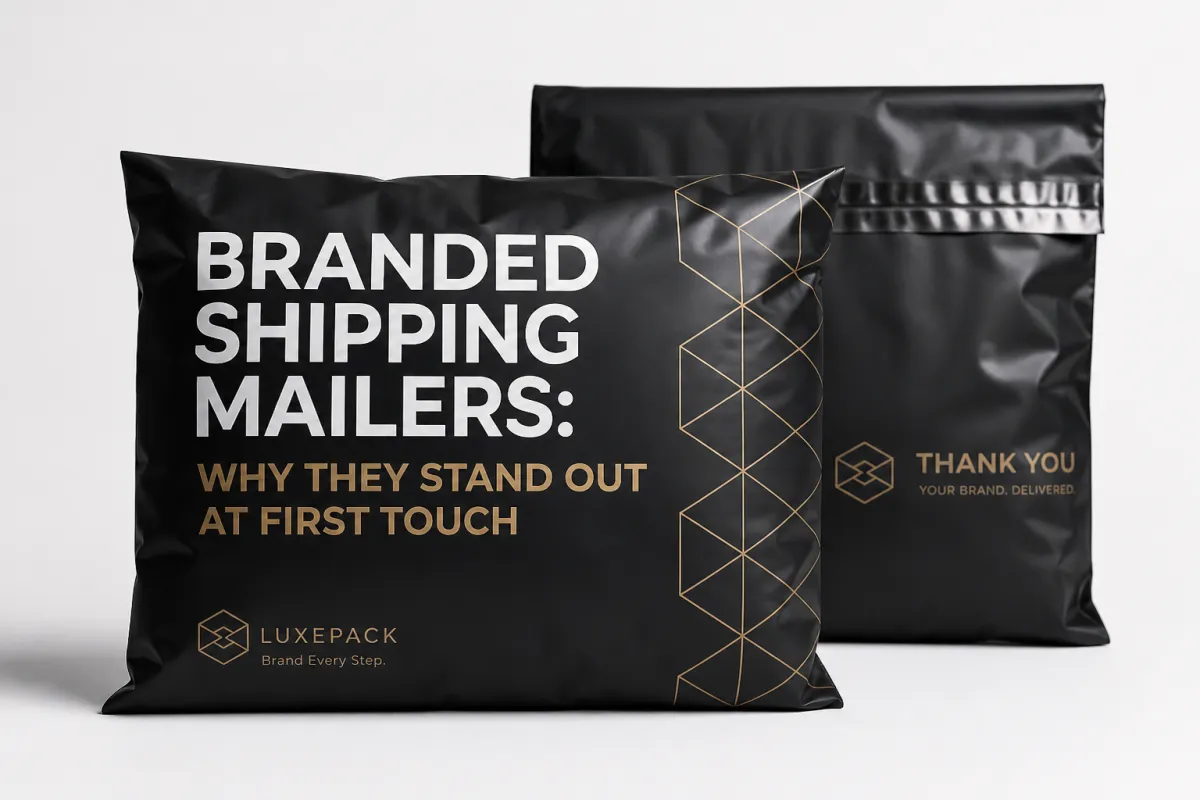
There is a packaging moment that tells you almost everything you need to know about a brand. A soft garment, a small accessory, or a beauty kit leaves the warehouse in a plain pouch, and nobody gives it a second look on the doorstep. Put the same product in branded shipping mailers, and the package feels intentional before the seal even breaks. The outer layer is not just holding the item. It is setting the tone for the whole order fulfillment experience.
That is why branded shipping mailers make sense for apparel, accessories, supplements, sample kits, subscription packs, and replacement parts that do not need the stiffness of a corrugated carton. They are usually custom-Printed Poly Mailers made from flexible film, built to protect low-bulk products while carrying logo, color, pattern, and messaging on the outside. The value is not only visual. A lighter package can also mean lower dimensional weight, faster packing, and less storage space than larger transit packaging.
The best use case is simple. If the product is flat enough, stable enough, and not easily crushed, branded shipping mailers may be the smarter choice than a box. That does not make them right for everything. Fragile goods, rigid electronics, framed items, and products that need crush protection still point toward boxes or hybrid packaging. For a lot of ecommerce shipping programs, though, a well-chosen mailer gives a better balance of package protection, brand expression, and handling efficiency.
First touch matters because the outer package gets handled by everyone in the chain: pickers, packers, sorters, drivers, and finally the customer. A mailer that tears, scuffs badly, or looks off-brand can drag down a product that is otherwise strong. A mailer that fits well and prints cleanly can make a modest order feel premium without pretending it is something it is not. That is the sweet spot where branded shipping mailers earn their keep.
How Branded Shipping Mailers Work From Film to Finished Bag
Branded shipping mailers begin as plastic film, and the film matters more than a lot of buyers expect. Most are built from LDPE, LLDPE, or a co-extruded structure that combines layers to balance flexibility, puncture resistance, and print quality. LDPE usually feels softer and more pliable. LLDPE tends to bring better toughness and tear resistance for the same thickness. Co-ex films can improve opacity, seal strength, or outer-surface appearance by assigning different jobs to different layers.
The production flow usually starts with resin extrusion, where pellets are melted and turned into film. From there, the film can be printed, slit, folded, and converted into bags with side seals, bottom seals, and an adhesive flap. Print method matters. Flexographic printing is common for larger runs because it handles solid color coverage efficiently and keeps unit pricing lower once setup is done. Digital printing often fits shorter runs or artwork that changes more often. Either way, the print step has to match the film surface so the inks bond properly and stay put during transit.
Once the print is on the film, the converting stage turns it into actual mailers. That is where the bag shape, flap, and seal quality get set. A clean seal makes the package feel crisp and professional. A weak seam can split under compression or catch during sorting. The flap adhesive matters too. A pressure-sensitive strip needs enough grab to stay closed after packing, but not so much that packing staff fight it on the line. For high-volume branded shipping mailers, those small production details are what separate a pretty sample from a durable shipping component.
Testing is worth the time. If the mailer will travel through rough shipping lanes, ask for package testing against relevant parcel profiles, including methods used in ISTA procedures. The International Safe Transit Association publishes widely used test frameworks at ISTA, and those profiles are useful because they reflect vibration, drop conditions, and general transit abuse rather than a visual check alone. Film thickness does not tell the whole story. Seam integrity, puncture resistance, and how the closure behaves after repeated handling matter just as much.
One detail gets overlooked a lot: the outside finish affects both appearance and durability. A matte or soft-touch effect can look refined, but it may show scuffs differently than a glossy finish. Heavier coverage can hide minor print inconsistencies. A lighter palette can reveal every bit of contamination from production. With branded shipping mailers, the move from film to finished bag is not just manufacturing. It is where brand promise, shipping practicality, and material science all meet.
Key Factors That Shape Branded Shipping Mailers
Size comes first, and it should start with the packed item rather than the product alone. A folded hoodie, a pair of denim jeans, a set of supplements, or a small accessory bundle all need a little extra room for folds, inserts, and the adhesive closure. If the mailer is too tight, operators waste time forcing the product in and the seal may sit under stress. If it is too large, the package looks sloppy and you can lose part of the dimensional weight advantage that makes branded shipping mailers attractive in the first place.
Thickness is the next decision. For many light apparel shipments, a standard gauge can be enough if the film quality and seam construction are strong. For rougher routes, heavier gauges or co-ex structures can reduce puncture risk and improve package protection. The buyer's job is not to pick the thickest film available. It is to choose the lightest gauge that still survives the actual transit packaging environment. That changes by carrier, lane, and how much other shipping materials the order contains. A mailer that works on one route can feel too delicate on another.
Visual design matters more than people admit. With branded shipping mailers, the outer package is part of the brand system, so color, logo placement, finish, and text density all need to work together. A two-color logo on a bold solid background can look strong and controlled. A full-coverage pattern can feel more fashion-forward, but it may increase cost and demand tighter print control. If your broader brand palette uses deep black, cream, or muted earth tones, the mailer should echo that system instead of fighting it. A mismatch between package and product line is one of the fastest ways to make a polished brand feel uneven.
Sustainability deserves a grounded conversation, not a slogan. Many poly mailers can enter film recycling streams where those programs exist, but local collection rules vary, and mixed-material features can make recovery harder. The U.S. EPA has practical recycling guidance at epa.gov/recycle, which is a better place to start than vague claims on a spec sheet. If reducing material use is the goal, a well-sized mailer can lower total packaging weight compared with oversized transit packaging. Just make sure any recyclability statement matches the actual construction of the branded shipping mailers you order.
There is also the customer experience side. A mailer that opens easily, holds a care card neatly, and resists rubbing marks during shipping can make a modest order feel considered. That does not mean every surface needs embellishment. Often the smartest version of branded shipping mailers is the one that prints cleanly, fits the packed item with a little breathing room, and keeps the package intact until it reaches the doorstep.
A good mailer is the one that survives the roughest lane and still looks intentional on arrival. Pretty only matters if the package also does the work.
For teams comparing formats, it helps to look at the whole packaging mix. Some items belong in mailers, some in cartons, and some in a combination of both. If you are still mapping the lineup, our Custom Packaging Products page and Custom Poly Mailers category can help you compare options against your current pack-out before you settle on a final spec.
Branded Shipping Mailers Pricing and Cost Drivers
Price is where most buyers start, but it should not be where they stop. The unit cost for branded shipping mailers depends on size, material gauge, print coverage, number of colors, and order quantity. A simple one-color mailer on a common size can be much cheaper than a full-coverage design on a thick co-ex film, especially when the run is small. For many projects, a realistic planning range lands around $0.18 to $0.45 per unit at quantities near 5,000 pieces, though the final number can move up or down based on the artwork and the construction.
Setup charges matter too. Flexographic printing usually includes plate costs, and shorter runs spread those setup costs across fewer units. That is why a simple-looking design can still carry a higher price per bag than expected. Digital printing may reduce some setup friction, but it does not always lower total spend. When buyers compare quotes for branded shipping mailers, the mistake I see most often is comparing a quote with different sizes, different gauges, or different shipping terms and then assuming one supplier is expensive. That is not a fair comparison. The specs have to match before the price means anything.
Unit price is only part of the story. A mailer can save money in ways that do not show up right away on the quote sheet. It may reduce packing labor if the closure is easy to use and the bag fits the product cleanly. It may lower dimensional weight versus a box, which can matter a lot in ecommerce shipping. It may also reduce damage rates if the film and seam are right for the lane. A lower-cost package that creates more rework is not actually cheaper. That is why I prefer total cost of ownership for branded shipping mailers, not just the line item.
Here is a practical comparison that many teams find useful when they are sorting through packaging materials and print options:
| Mailer Type | Typical Best Use | Approx. Unit Cost at 5,000 | Main Tradeoff |
|---|---|---|---|
| Plain stock poly mailer | Low-visibility shipments, budget-first programs | $0.08-$0.16 | Lowest branding value |
| 1-color custom poly mailer | Apparel, accessories, standard ecommerce shipping | $0.18-$0.28 | Limited graphic flexibility |
| Multi-color branded shipping mailers | Retail-facing orders, subscription kits, giftable orders | $0.26-$0.40 | Higher setup and print complexity |
| Heavy-gauge co-ex mailer | Rough transit, higher puncture risk, premium feel | $0.30-$0.45+ | Better durability, more material cost |
If a supplier gives you a quote that looks too good to be true, ask what is included. Is the bag one layer or co-extruded? Are adhesive flaps included? Does the quote cover freight, test samples, and plate charges? Are you comparing the same print area and the same bag style? These questions sound basic, but they protect you from surprises. The smartest buyers of branded shipping mailers compare the same spec sheet across vendors and then decide based on performance, lead time, and total landed cost.
Process and Timeline for Ordering Branded Shipping Mailers
The cleanest ordering process starts with a usable spec sheet. Before anyone requests quotes for branded shipping mailers, gather product dimensions, folded stack height, target quantity, print colors, closure style, and any special shipping environment notes. If the product ships with an invoice, care card, or return insert, include that in the pack-out. A lot of rework happens because teams describe the product, but not the actual shipped configuration. That small gap can turn into a size mistake that slows production or forces a second order.
After the requirements are clear, the next step is artwork and dieline prep. The printer or converter may provide a template that shows seal areas, bleed zones, and safe print areas. Flexible film is less forgiving than a rigid carton, so art that looks fine on screen can land too close to a seam or get cut off near the flap. Proofing should include color targets, logo placement, and any required text such as recycling language or handling notes. If your organization uses strict brand standards, make sure marketing, procurement, and operations all review the same version. Branded shipping mailers are small, but approval mistakes can still be expensive.
Timeline depends on print method and order complexity. Digital runs can move faster when the artwork is ready and the design is straightforward. Flexographic runs often take longer because plates, setup, and press calibration are part of the process. In many cases, the first order lands somewhere in the 12 to 18 business day range after proof approval, but custom colors, special finishes, or a slow review cycle can stretch that schedule. If the launch date is tight, ask whether the supplier can stage a pilot run so you can confirm the size, color, and pack-out before committing to full production of the branded shipping mailers.
There are bottlenecks that are easy to avoid. Missing logo files slow the process. Unclear Pantone targets create color drift. Too many approvers can stall the proof for days. If someone changes the design after the plate or file is already locked, the schedule starts to slip. Packaging teams that stay on time usually do three things well: they send clean art, they answer questions quickly, and they approve samples as soon as the right people have reviewed them. The order moves faster when the decision path is clear.
If you want a simple sequence to follow, use this:
- Measure the packed item and any inserts.
- Choose the mailer size and film construction.
- Prepare artwork and print targets.
- Review proof samples and test one or two packed units.
- Approve production and confirm ship dates.
That process keeps branded shipping mailers aligned with order fulfillment instead of forcing fulfillment to adjust around packaging errors. It also gives everyone a little more confidence that the final package will look and perform the way the brand intended.
Common Mistakes to Avoid With Branded Shipping Mailers
The first mistake is buying on price alone. I have seen teams order the cheapest branded shipping mailers they could find, only to learn that the material is too thin, the bag is too small, or the print looks washed out next to the rest of the brand system. A lower unit price can hide higher damage rates, slower packing, or the need to rework damaged shipments. If a mailer saves a cent but forces you to add extra inserts, tape, or protective overwrap, the savings disappear quickly.
The second mistake is approving size without testing the real pack-out. A mailer should be checked with the actual product, the actual label placement, and the actual care card or return insert that will ship with it. Products rarely travel alone. They travel with tape, labels, folded paperwork, and sometimes a little air that needs to escape before sealing. That is why a package that looks perfect in a mock-up can still feel awkward on the line. With branded shipping mailers, the test should be physical, not theoretical.
Artwork mistakes are just as common. A design that is too busy can print poorly on flexible film. A logo that sits too close to the flap or seal can get distorted. Low-contrast graphics may look polished on a monitor but disappear in production. If your mailer is going through flexographic printing, simple shapes, strong contrast, and clean line weights usually hold up better than tiny text or crowded gradients. Buyers who understand print reality usually get stronger results from their branded shipping mailers without paying extra for unnecessary complexity.
Compliance is another area where teams need to slow down. Recycling language should match the actual construction, and any carrier-specific markings should be placed where they are easy to read and do not conflict with the brand design. If your program is supposed to reduce packaging waste, do not bury that message under decorative copy. If you are tracking claims about recycled content or recyclability, verify them against the material you actually ordered. Overstated environmental language can damage trust fast, especially with customers who inspect packaging closely.
One practical test I recommend is simple: pack the product, shake it gently, set it on a table, and look at the package from across the room. If the closure looks strained, if the logo is cut off, or if the bag feels underbuilt, the spec probably needs a second pass. That kind of quick review does not replace formal testing, but it catches plenty of preventable issues before the full order of branded shipping mailers is released.
If you are still deciding whether a mailer or box is the better fit, compare the packaging against your current Custom Shipping Boxes setup. Some products absolutely need a rigid carton. Others do better in lighter branded shipping mailers that save space and reduce transit packaging overhead.
Expert Tips and Next Steps for Branded Shipping Mailers
Start with a short spec sheet that a production buyer, a marketer, and a fulfillment manager can all read without guessing. List product dimensions, target quantity, print colors, seal style, pack-out components, and shipping environment. If the same branded shipping mailers will hold multiple SKUs, size them for the largest common configuration and then test the smaller items for excess movement. That simple step prevents a lot of waste later.
Ask for physical samples whenever possible. A flat proof on paper does not tell you how the bag feels, how the print wears when folded, or how the adhesive behaves once the package is packed and handled. A short pilot run is even better when launch timing allows it. You can watch for scuffs, corner splits, weak seams, and color shifts after the package has actually moved through your order fulfillment flow. That kind of practical trial is often more useful than a beautiful render, especially for branded shipping mailers that need to perform under real shipping conditions.
Build a shared approval checklist. Procurement can confirm cost and lead time. Marketing can confirm color and brand placement. Operations can confirm pack-out and seal behavior. That way, nobody approves a version of branded shipping mailers that looks right for one team but fails for another. The same checklist can include recycling language, label placement, and whether the package needs room for a return insert or care card.
When you are ready to move, keep the next steps practical: audit your current shipping materials, compare mailer sizes against your top-selling SKUs, request pricing from a few suppliers, and review lead times side by side. If you want to see how these decisions play out across actual projects, our Case Studies page shows the kinds of packaging tradeoffs brands work through every day. If you are narrowing the format itself, the Custom Poly Mailers listing is a useful place to start for spec comparison and fit. That sequence keeps the process grounded in real packaging choices instead of guesswork.
Branded shipping mailers work best when they are treated as part of the shipping system, not decoration added at the last minute. Choose the Right size, match the film to the lane, keep the print clean, and test the pack-out before you commit. Done that way, branded shipping mailers can improve package protection, support dimensional weight targets, and give customers a more polished first impression without adding unnecessary waste.
What are branded shipping mailers made from?
Most branded shipping mailers are made from poly film, usually LDPE, LLDPE, or a blended co-ex structure chosen for flexibility and puncture resistance. They normally have a printed outer surface and a pressure-sensitive adhesive flap for quick packing. The right material depends on product weight, transit roughness, and how much visual impact you want from the outer package.
Are branded shipping mailers cheaper than boxes?
For flat, lightweight products, branded shipping mailers are often less expensive than corrugated boxes because they use less material and usually reduce dimensional weight. The better comparison is total landed cost, not just the unit price of the package itself. Boxes still make more sense for fragile, rigid, or high-value items that need structure and extra crush protection.
How long does it take to produce branded shipping mailers?
Production time depends on print method, order size, artwork readiness, and how quickly proofs are approved. First orders usually take longer because design, sampling, and approval steps require more back-and-forth. Custom colors, special finishes, and late artwork changes can extend the schedule for branded shipping mailers more than buyers expect.
What size branded shipping mailers should I order?
Start with the packed item, not the product alone, and leave room for folds, inserts, and sealing. Test the actual shipped configuration with labels and care cards before locking the size. If one mailer must cover several SKUs, size it for the largest common pack-out so the rest of the lineup still fits cleanly in the same branded shipping mailers format.
Can branded shipping mailers be recycled?
Many poly mailers can enter film recycling streams where those programs are available, but local rules vary. Avoid mixed-material features if recyclability is a top priority, because they can make recovery harder. Make sure any recycling claim matches the actual construction of the branded shipping mailers you order so the message stays accurate.


