Buyer Fit Snapshot
| Best fit | Branded Subscription Box Inserts projects where brand print, material claims, artwork control, MOQ, and repeat-order consistency need to be specified before quoting. |
|---|---|
| Quote inputs | Share finished size, material target, print colors, finish, packing count, annual reorder estimate, ship-to region, and any compliance wording. |
| Proofing check | Approve dieline scale, logo placement, barcode or warning zones, color tolerance, closure strength, and carton packing before bulk production. |
| Main risk | Vague material claims, crowded artwork, missing packing details, or unclear freight terms can make a low unit price expensive after revisions. |
Fast answer: Branded Subscription Box Inserts: Board, Finish, Dieline, and Unit Cost should be specified like a repeatable production item. The safest quote records material, print method, finish, artwork proof, packing count, and reorder notes in one written spec.
Production checks before approval
Compare the actual filled-product size with the drawing, then confirm tolerance on folds, seals, hang holes, label areas, and retail display edges. Reserve space for logos, QR codes, warning copy, and material claims before decorative graphics fill the panel.
Quote comparison points
Review material grade, print process, finish, sampling route, tooling charges, carton quantity, and freight assumptions side by side. A quote is only useful when the supplier can repeat the same color, closure quality, and packing count on the next order.
Branded Subscription Box Inserts: Design & Print Guide
The piece most brands underestimate is often the one customers read after the outer carton has already been pushed aside. In subscription shipments, branded Subscription Box Inserts tend to do the explaining, selling, and reassuring while the shipper is out of sight, because they arrive at the exact moment a customer is deciding whether this month’s box feels thoughtful, useful, or forgettable.
That is why branded subscription box inserts are more than little flyers tucked into a package. They act as a printed touchpoint, a logistics helper, a retention tool, and a quiet branding system all at once. Done well, they make the monthly box feel clearer, richer, and more intentional without changing the main pack structure at all.
For a packaging buyer, that matters in a very practical way. A good insert can support repeat orders, product education, seasonal storytelling, referral offers, usage tips, and customer service in one compact piece of print. The work starts by treating branded subscription box inserts as part of the subscription experience, not as leftover marketing material that just happened to fit inside the carton.
Why Branded Subscription Box Inserts Matter More Than You Think
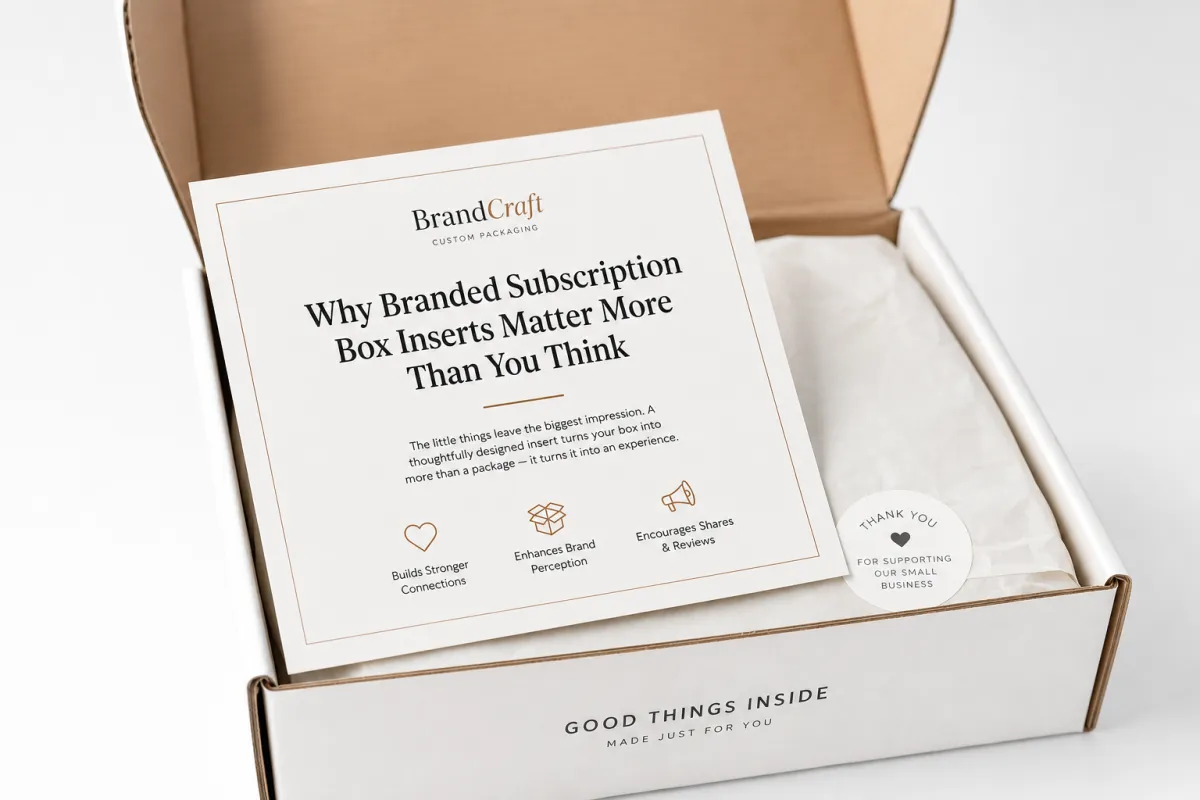
The surprising part is how often the insert becomes the item most likely to be read. The outer mailer gets opened, the tissue is folded back, and then the customer lands on a card or leaflet that explains the month’s theme, points toward the next action, or simply says thank you in a way that feels human. That makes branded subscription box inserts a high-value brand touchpoint, especially when the rest of the pack is busy with product, fill, and protective materials.
In practice, branded subscription box inserts do three jobs at once. They reduce confusion by telling the customer what is inside or what to do next. They reinforce the monthly theme so the box feels curated instead of random. They create a small but real moment of premium feel, because a well-printed insert signals that the brand paid attention to details most people notice only after the box is in hand.
The business value is just as practical. A subscription brand can use branded subscription box inserts to push cross-sells, ask for reviews, guide first-time users, promote a referral program, or direct customers to a landing page with a QR code. None of that requires a new carton, a different fill pattern, or a more complex pack-out. It only requires a message that is clear enough to work in seconds.
That last part matters. A lot of teams treat inserts as decorative, but the better way to look at them is operational. If a customer opens a box and wonders which item is which, what the care instructions are, or how to redeem a limited offer, the insert becomes a support tool. In other words, branded subscription box inserts sit inside customer service as much as they do inside marketing.
The best insert does not feel like an ad. It feels like part of the box the customer expected to open.
See how that plays out in real packaging programs by reviewing our subscription packaging case studies. The strongest examples usually share the same pattern: one message, one action, and a layout that fits the physical box rather than fighting it.
Branded Subscription Box Inserts: What They Are and How They Work
At the simplest level, branded subscription box inserts are printed pieces placed inside a subscription shipment to communicate, persuade, educate, or delight. They can be as lean as a postcard or as layered as a folded guide with multiple panels. What makes them useful is not the format alone, but the way the format supports the message.
The most common versions include thank-you cards, welcome cards, product guides, coupon cards, referral inserts, seasonal story sheets, and QR-driven callouts. Some brands use one insert that changes each month. Others keep a base card and swap only the offer or theme panel. Both approaches work, but branded subscription box inserts tend to perform best when the content fits the customer moment instead of trying to carry too many ideas at once.
Placement changes how the insert feels. If it sits on top of the products, the customer sees it immediately and reads it before anything else. If it is tucked around tissue or folded into a reveal, the message feels more curated. If it is nested with void fill or inside a tray, it can act like a small discovery piece. The right choice depends on whether the insert should lead, guide, or surprise.
Timing matters just as much as placement. A strong insert moves the customer from curiosity to action by pairing one message with one next step. That could mean scanning a code, redeeming a discount, learning product care, sharing a referral link, or discovering the month’s featured item. The most effective branded subscription box inserts usually answer a question the customer already has before that question turns into a support ticket.
From a packaging point of view, the best inserts follow the unboxing sequence. The headline should be visible quickly, the supporting copy should be easy to scan, and the call to action should sit where a hand naturally lands. If the insert fights the box layout, it is probably not helping the customer at the right moment.
For a brand that wants structure, consistency, and a better read on production choices, a packaging partner that understands print can be a useful place to start. The right spec is usually simpler than people expect, but it still has to fit the physical pack.
Design Factors That Shape Effective Inserts
Good design starts with hierarchy. Every one of these branded subscription box inserts should answer a simple question within the first three seconds: what must the customer notice first, what should they read second, and what action should they take last? If that order is not obvious, the piece becomes a pretty object instead of a working print component.
Size and format come next. A small 4 x 6 card is fast, inexpensive, and easy to pack. A folded leaflet gives room for instructions, a mini editorial, or a bundled offer. A larger insert can carry more story, but it also takes more carton space and usually requires a cleaner pack-out plan. In many programs, branded subscription box inserts work best when the format matches the complexity of the message instead of defaulting to the biggest available size.
Material choice changes the feeling immediately. An uncoated stock around 14pt or 16pt can feel warm and tactile, especially for a lifestyle brand that wants a human, less glossy impression. A coated sheet, such as a C2S artboard or a coated text stock, sharpens color and protects the surface from scuffing. If the insert includes product photography, dense color fields, or bright callouts, coated stock often holds up better. If the brand wants a softer, handwritten, or editorial tone, uncoated stock may be the better fit. That is one reason branded subscription box inserts should be chosen with texture in mind, not only price.
Finish is where a lot of brands either add polish or add noise. Matte lamination creates a quieter surface. Gloss can make color punch harder, but it can also feel more promotional. Soft-touch lamination adds a velvet feel that some premium brands love, though it raises cost and can pick up fingerprints if handled carelessly. Spot UV can highlight a logo or a single phrase, and foil can signal premium positioning if used sparingly. Die-cut shapes can be memorable, but only if they still pack and stack efficiently. The best branded subscription box inserts use finish to support the brand personality, not to shout over it.
Typography and color accuracy matter more than many teams expect. A subscription insert is usually read quickly and under imperfect light, so type needs enough size and contrast to hold up in the home. Body copy smaller than 7.5 to 8 pt is risky unless the audience is very comfortable reading fine print. QR codes need a proper quiet zone and enough white space around them, or scanning gets frustrating fast. And if the brand color is a key identifier, it should be checked against the actual paper stock, because color can shift between coated and uncoated sheets.
Accessibility should not be an afterthought. Strong contrast, simple language, and a clean visual path make branded subscription box inserts easier to use for everyone. If a customer has to hunt for the offer code, decipher a cramped paragraph, or search for the QR code under decorative graphics, the insert is doing too much design and not enough communicating.
One practical standard I always like to keep in mind is transit and handling. If the insert is going through a fulfillment center, then a durability mindset helps. For broader package testing references, the ISTA test procedures are worth knowing, especially if the insert is part of a larger pack configuration that needs to hold together through shipping and storage.
Production Process, Timeline, and Turnaround for Inserts
The production path for branded subscription box inserts is straightforward when the brief is clear. It usually runs in this order: brief, copy approval, layout, proofing, material selection, printing, finishing, cutting, folding, and final packing. Each step sounds simple, but one late approval can push the entire schedule, especially if the insert has special finishing or a custom shape.
Most delays happen in the same few places. Artwork arrives late. The team changes the offer after proofing. The QR code sends to a page that is not live yet. The chosen finish needs extra setup time, such as foil stamping, die cutting, or a second pass through a laminating process. Even branded subscription box inserts that look small on the page can become schedule-sensitive the moment they include a specialty feature.
Paper choice and format influence turnaround more than many buyers realize. Standard sizes on common stocks usually move faster because the printer can slot them into familiar press and finishing workflows. Custom dimensions, unusual folds, and specialty coatings often add setup time. A simple one-sided card might ship faster than a multi-panel leaflet, but the right answer depends on the volume, the press sheet layout, and whether the job can gang with other work.
Proofing is the checkpoint that saves money. Check the trim. Check the bleed. Check the fold alignment. Check the barcodes and QR codes at actual size. Check the color against the chosen stock, not the monitor. A screen proof may show the intention, but it does not tell you how a deep blue will sit on a natural uncoated sheet or how black body copy will read after press gain. This is where a careful buyer earns their keep with branded subscription box inserts.
A realistic timeline often looks like this: simple inserts on standard stock may land in roughly 7 to 10 business days after proof approval, while folded pieces with finishing can take 12 to 15 business days or more, depending on press load and complexity. Add another day or two if the job needs freight coordination or special fulfillment packaging. The exact number depends on the plant, but the pattern is consistent: simpler construction means faster movement.
There is also a fulfillment reality that gets missed. The insert does not just need to be printed before the campaign launch date. It needs to arrive before the pack-out window, sorted correctly, counted accurately, and ready for the subscription line. If the cartons are scheduled to be packed on Monday, shipping the insert on Friday is not a plan. It is a risk. That is why branded subscription box inserts should be scheduled backward from the fulfillment date, not forward from the creative deadline.
Cost, Pricing, MOQ, and Quote Considerations
Pricing for branded subscription box inserts is driven by a handful of variables: sheet size, paper stock, print coverage, number of sides, finishing, folding, die cutting, quantity, and shipping. The more the job departs from a standard card on a common stock, the more setup and handling influence the final number.
MOQ matters because small runs carry more setup cost per piece. A 1,000-piece run usually looks expensive on a unit basis compared with 5,000 or 10,000 pieces, even if the design is simple. That does not mean a lower quantity is wrong. It just means the economics of branded subscription box inserts tend to improve when the program has stable messaging and predictable monthly volume.
There are also costs buyers do not always see on the first quote. Design revisions after proofing can add time. Plates or setup charges may appear depending on the process. Freight can move the total more than expected if the insert is traveling across the country. Storage, kitting, or pre-insertion for fulfillment can also change the budget. For that reason, comparing quotes for branded subscription box inserts means comparing the whole job, not only the printed unit price.
| Insert Type | Best Use | Typical Spec | Typical Unit Cost at 5,000 pcs | Notes |
|---|---|---|---|---|
| Postcard | Thank-you note, single offer, QR code | 4 x 6, 14pt C1S, 4/0 or 4/4 | $0.08-$0.15 | Fast to produce; strong for short messages |
| Folded leaflet | Instructions, storytelling, seasonal theme | 8.5 x 5.5 folded to 4 pages or 8 pages | $0.16-$0.30 | More room for detail; needs careful fold control |
| Coupon or referral card | Repeat orders, referrals, retention offers | 3.5 x 8.5, coated or uncoated card stock | $0.10-$0.22 | Works well with variable codes and clean tracking |
| Premium die-cut insert | Launches, premium branding, gift-like presentation | Custom shape, soft-touch or foil accent | $0.30-$0.65 | Stronger shelf feel; higher setup and finishing cost |
Those numbers are not universal, but they are a useful starting point. If a quote looks far outside that range, check the stock, the number of printed sides, the quantity break, and whether finishing is included. A fair quote for branded subscription box inserts should clearly show what paper is being used, what the press sheet size is, how the piece is finished, and whether freight is part of the price or not.
Sometimes the smartest way to save money is to simplify the insert itself. Reduce the size. Drop an extra coating. Use a cleaner layout that prints with less ink. Replace a specialty fold with a standard fold. A simpler structure can preserve the customer message while trimming production cost. That is often better than forcing a premium finish into a job that does not need it.
There is also a sustainability angle worth considering. If the paper is carrying a responsible sourcing claim, ask about FSC certification and whether the chosen stock is available with verified chain-of-custody documentation. Buyers who care about material sourcing often include that requirement in the quote request for branded subscription box inserts, and for good reason: it keeps the message consistent with the brand promise.
Step-by-Step Guide to Planning Your Insert Program
Start with the goal. That sounds obvious, yet it is the step teams skip most often. Do you want the insert to educate, convert, retain, collect reviews, or promote a seasonal offer? Once that answer is clear, the rest of the branded subscription box inserts plan becomes easier to build because the message structure has a job to do.
Choose the format after the goal, not before it. A short thank-you plus one QR code may only need a postcard. A welcome series or care guide may need a folded leaflet with more space. A referral push may work better as a bold, pocket-sized card that is easy to keep. The right format keeps branded subscription box inserts from becoming cluttered or over-designed.
I like to keep the message focused on one customer action. Scan. Redeem. Review. Share. Learn. Pick one. If a single insert tries to do all five, the customer often does none of them. That is one of the quietest failures in subscription packaging, and it is easy to avoid once the insert has a single purpose.
- Define the business goal and primary metric.
- Match the message length to the insert format.
- Lock the CTA before layout begins.
- Check how the insert sits in the box with tissue, tray, or fill.
- Review a printed proof under real lighting.
- Run a small pilot and measure response.
Then build around the physical pack-out. If the insert lands on top of the products, the headline should do the heavy lifting. If it is hidden slightly for a reveal, the top panel should reward the customer for opening the box. If it sits under tissue or around a tray, it needs enough contrast and structure to be spotted quickly. The physical sequence matters because branded subscription box inserts are read inside a package, not on a desktop.
Proof against actual samples whenever possible. A mockup on screen can be misleading. The paper may be warmer or brighter than expected. The logo may shrink once the fold is added. The code may sit too close to the trim. Real samples make those issues obvious before the full run starts. In my experience, a short sample review saves more money than another round of design comments.
A pilot run is worth serious consideration if the insert will become part of the monthly routine. Print a small quantity first, then track QR scans, coupon redemptions, customer feedback, and repeat-order behavior. That data tells you whether the offer, message, or design needs adjustment. The best branded subscription box inserts are rarely the first draft. They are the version that got improved after the brand saw what customers actually did with it.
For teams that want more real-world examples of how inserts behave inside a larger packaging system, our packaging case study library can help frame the choices. It is much easier to plan a good insert when you can compare formats, finishing, and response paths against work that has already gone through production.
Common Mistakes and Expert Tips for Better Results
The biggest mistake is trying to say too much. I see it often: the brand wants a thank-you, a promotion, a product story, a referral request, and three social media prompts on a single card. The result is not more value. It is less clarity. Strong branded subscription box inserts usually win because they make one idea unavoidable and one next step obvious.
Paper choice can go wrong in both directions. A thin sheet may curl, feel cheap, or get lost among tissue and product. A heavy stock may feel awkward if the insert is supposed to be a simple reminder card. A finish that looks attractive in a presentation deck can also fight the tactile identity of the brand. The stock should support the message and the box, not just the design file.
Tracking is another weak spot. If the insert has no QR code, no coupon code, no landing page, and no clear response path, it is hard to know whether it is working. That is a missed opportunity. You do not need a complicated analytics plan. One measurable action is enough to tell you whether branded subscription box inserts are creating movement or just adding print volume.
Artwork approval errors are also common. Trim marks get ignored. The fold line is not checked. The barcode lands too close to a seam. The color profile is not optimized for press output. These are basic production issues, but they still show up in rushed projects. A careful prepress review catches them early and protects both budget and timing.
Here are a few expert tips that usually improve results fast:
- Use one headline and one primary CTA.
- Test a shorter version against a more detailed version.
- Align the insert theme with the month or season.
- Make the offer code large enough to scan or type easily.
- Keep the brand mark visible, but not so large that it crowds the message.
One more practical tip: treat the insert as a series, not a one-off. The first version teaches you about customer behavior, but the second and third versions improve response. That is where branded subscription box inserts start to earn real operational value, because each run becomes a sharper version of the one before it. Honestly, that is how the strongest subscription programs stay fresh without reinventing the whole pack.
Next Steps: Build and Test Your First Insert
If you are starting from scratch, keep the next move simple. Define the goal, choose the format, write the message, and gather the box dimensions before asking for quotes. That alone will save time. A supplier can spec branded subscription box inserts much more accurately when they know the inside dimensions, the pack-out sequence, and the content length.
Ask for a printed proof on the actual stock whenever possible. Color, contrast, and surface feel can change a lot from screen to paper, especially if the piece uses uncoated material or a specialty finish. A sample in real lighting tells you more than a mockup ever will. It also helps you spot whether the insert feels right beside the other items in the box.
Set one tracking method before launch. A unique QR code, a dedicated landing page, or a single offer code is enough for the first run. You want real data, not a pile of guesses. Once that data is in hand, you can decide whether the message needs tightening, the offer needs strengthening, or the design needs more contrast.
Do not compare suppliers on price alone. Turnaround, MOQ, paper options, finishing capability, proofing support, and fulfillment help all matter. The cheapest quote can become the most expensive if it misses the schedule or creates extra handling. Well-planned branded subscription box inserts usually come from a clean brief and a supplier who understands print, pack-out, and timing together.
The smartest approach is to think of the insert as part of the full subscription journey. If the creative idea, the print spec, and the pack schedule all point in the same direction, the insert feels natural in the box and useful to the customer. That is the real advantage of branded subscription box inserts: they make the experience clearer without making the operation harder.
FAQ
What are branded subscription box inserts used for?
They are used to welcome customers, explain products, promote offers, request reviews, and guide the next action after unboxing. They also help subscription brands create a more polished experience without redesigning the entire package, which is why branded subscription box inserts are such a useful part of the pack.
How do I choose the right size for subscription box inserts?
Start with the box interior and the amount of information you need to communicate, then match the format to the pack-out space. A smaller card works for one message, while a folded insert fits instructions, storytelling, or multiple panels. In practice, branded subscription box inserts work best when the size fits the message instead of forcing the message to fit the size.
What affects the cost of branded subscription box inserts?
Quantity, paper stock, print coverage, finishing, folds, die cuts, and shipping all affect pricing. Custom sizes and specialty finishes usually raise setup time and unit cost, so the simplest version of branded subscription box inserts is often the best place to begin a pilot program.
How long does production usually take for branded subscription box inserts?
The timeline depends on design approval, proofing, stock availability, and finishing complexity. Simple jobs on standard materials move faster than custom pieces with folds, foil, or special coatings. For many projects, branded subscription box inserts can move in roughly 7 to 10 business days after proof approval, while more complex builds may need 12 to 15 business days or more.
How can I track whether my insert is working?
Use one clear tracking method such as a unique QR code, coupon code, landing page, or referral offer. Compare response rates, repeat orders, and customer feedback before changing the design or message. That is the cleanest way to judge whether branded subscription box inserts are driving behavior or just taking up space in the carton.
If you want the shortest path to a better insert program, start with one measurable action, one proof on the final stock, and one print format that matches the actual box. That three-part check keeps branded subscription box inserts useful, readable, and production-friendly instead of merely decorative.