Buyer Fit Snapshot
| Best fit | Subscription Box Inserts Supplier projects where brand print, material claims, artwork control, MOQ, and repeat-order consistency need to be specified before quoting. |
|---|---|
| Quote inputs | Share finished size, material target, print colors, finish, packing count, annual reorder estimate, ship-to region, and any compliance wording. |
| Proofing check | Approve dieline scale, logo placement, barcode or warning zones, color tolerance, closure strength, and carton packing before bulk production. |
| Main risk | Vague material claims, crowded artwork, missing packing details, or unclear freight terms can make a low unit price expensive after revisions. |
Fast answer: Subscription Box Inserts Supplier: Board, Finish, Dieline, and Unit Cost should be specified like a repeatable production item. The safest quote records material, print method, finish, artwork proof, packing count, and reorder notes in one written spec.
Production checks before approval
Compare the actual filled-product size with the drawing, then confirm tolerance on folds, seals, hang holes, label areas, and retail display edges. Reserve space for logos, QR codes, warning copy, and material claims before decorative graphics fill the panel.
Quote comparison points
Review material grade, print process, finish, sampling route, tooling charges, carton quantity, and freight assumptions side by side. A quote is only useful when the supplier can repeat the same color, closure quality, and packing count on the next order.
Subscription Box Inserts Supplier: How to Choose Wisely
A single insert can move a subscription box from forgettable to worth waiting for. A weak one can make a premium box feel rushed, and that is why choosing the right subscription box inserts supplier matters far more than many brands want to admit. The piece may be small, yet it sits where print quality, packaging cost, kitting speed, and customer perception all meet.
That last part gets missed a lot. Brands often treat inserts as a decorative extra, yet a well-planned insert can support retention, drive referrals, explain a product, or nudge a subscriber toward another purchase. A poor one does the opposite: it looks generic, feels last-minute, and quietly lowers the value of the whole box. A strong subscription box inserts supplier understands that the insert is part of the brand experience, part of the margin story, and part of the next order.
If you are comparing vendors, the real question is not “Who can print a card?” The real question is which subscription box inserts supplier can handle recurring production without creating chaos every cycle.
What a Subscription Box Inserts Supplier Really Does
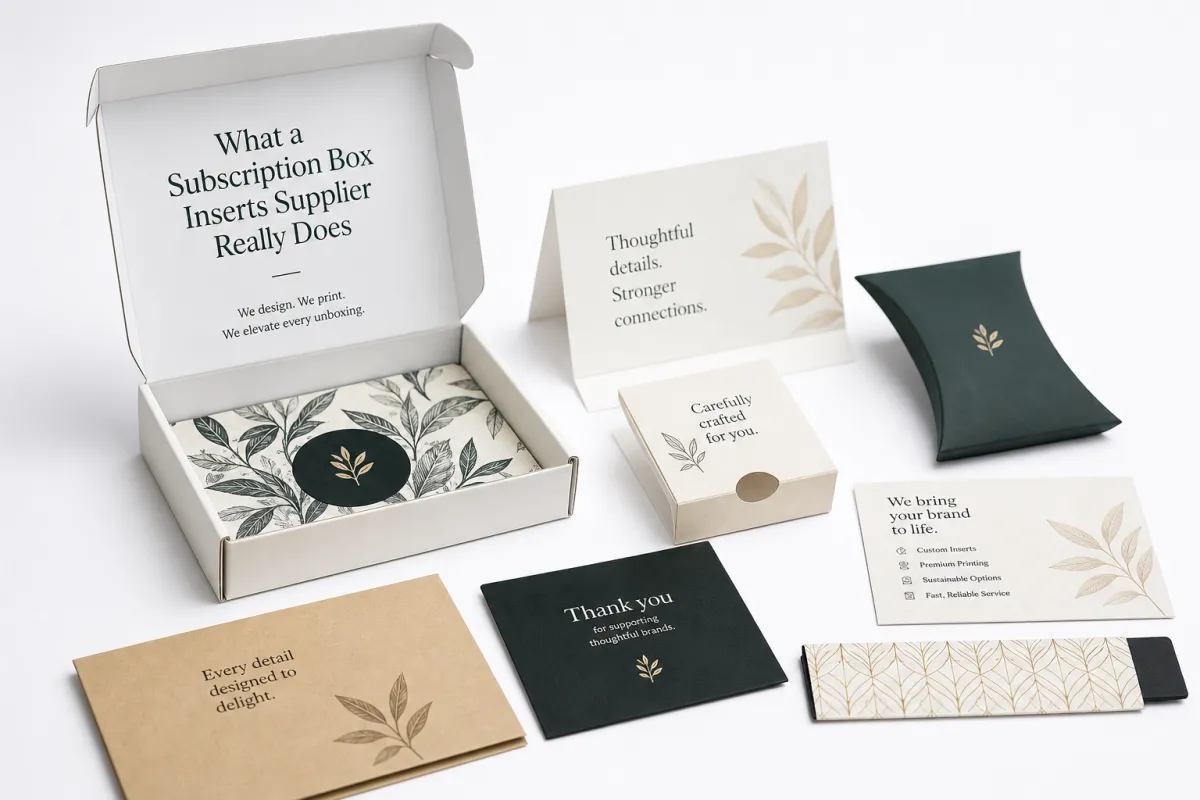
A capable subscription box inserts supplier does much more than run sheets through a press. They help turn a marketing idea into a physical piece that can survive production, packing, shipping, and repeated monthly use. That means thinking through size, stock, finish, fold behavior, die-cutting, ink coverage, and how the insert will sit inside the box beside the product.
From a packaging buyer’s point of view, the best supplier removes guesswork. They can recommend paperboard grades, suggest whether a one-sheet card or folded leaflet fits the brief, and flag production issues before they become expensive reprints. A good subscription box inserts supplier also understands kitting compatibility. If your fulfillment team needs inserts to stack flat, feed cleanly, or fit a specific tray, that matters just as much as the artwork.
There is also a coordination role that gets underestimated. Subscription brands run on recurring deadlines, and one late file can throw off an entire shipping schedule. A dependable subscription box inserts supplier knows the work is not finished at proof approval; it is finished only when the completed pieces arrive on time, in count, and in a format the fulfillment line can use without slowing down.
That wider role matters because inserts do more than decorate the box. They can support:
- Retention through product education and brand storytelling.
- Upsells with coupon codes, bundles, or refill reminders.
- Referrals through shareable offers or QR code prompts.
- Post-purchase education that lowers confusion and returns.
- Protection when the insert helps cushion or stabilize smaller items.
There is a clear difference between a general print vendor and a subscription box inserts supplier that works inside recurring box logic. A general vendor may give you a decent quote for a single run. The supplier with subscription experience asks sharper questions: How often will this repeat? Will the artwork change monthly? Are the inserts going into a hand-packed kit or an automated line? Do you need serialized couponing or batch-specific messaging?
That is the difference between buying print and buying a process.
“If the insert cannot survive the kitting line, it is not a finished product.”
That sentence sounds blunt, but it is the kind of bluntness buyers should want from a subscription box inserts supplier. The prettier the insert, the more painful a production mistake becomes. I have seen gorgeous pieces arrive with a fold in the wrong place, and once that happens, the conversation shifts from brand value to salvage mode pretty quickly.
Process and Timeline: What Happens After You Request a Quote
A quote request is the beginning, not the finish line. The best subscription box inserts supplier will usually walk through a short but important sequence: brief intake, spec review, proofing, sample approval if needed, production, and shipment. Each step has its own failure points, and most delays happen before the press even starts running.
Here is the workflow most subscription brands should expect:
- Inquiry and brief. You share size, quantity, target ship date, box dimensions, artwork status, and any folding or finishing requirements.
- Spec review. The subscription box inserts supplier checks whether the requested stock, coating, and format match the job.
- Quote and options. You receive pricing tiers, lead times, and notes on setup, shipping, and finishing.
- Proofing. Digital proofs confirm layout, trim, bleed, and copy placement.
- Sample or prototype. Useful for high-value jobs, tight color work, unusual folds, or any insert that must fit into a specific cavity.
- Production. Printing, cutting, folding, and finishing happen in sequence.
- Shipment and receipt. The inserts arrive for kitting or direct insertion into the box stream.
For a straightforward run, a subscription box inserts supplier may quote 10-15 business days from proof approval to shipment. Add Custom Die Cuts, foil, soft-touch lamination, or heavy fold complexity, and the timeline can stretch. Sampling can add 2-5 business days. Freight can add another 2-7 business days depending on distance and method.
Where do delays usually happen? Three places. First, artwork is often not final. Second, dielines are missing or incorrect. Third, the brand changes the insert format halfway through quoting. A solid subscription box inserts supplier can recover from one of those problems. Two at once is where schedules slip.
That is why planning ahead matters more than many buyers expect. If your box ships monthly, lock the insert brief earlier than the product order. If it ships biweekly, build a repeatable template and only change the message area. If the campaign is seasonal, leave room for proofing errors, freight delays, and a second round of samples. The tighter the recurring cycle, the less room there is for improvisation.
A useful rule of thumb: for a recurring subscription line, start the quote conversation at least 3-4 weeks before you need finished inserts in hand. If the job is simple and the supplier stocks the substrate, a subscription box inserts supplier may move faster. Speed and control are not the same thing, and subscription brands need control.
For transit-sensitive kits, ask whether the finished insert and outer shipper should be evaluated against an ISTA distribution profile. That is especially useful if the insert doubles as a protector or if the box will travel through rough parcel networks. The goal is not to over-engineer every job. The goal is to know where the risk lives.
Cost, Pricing, MOQ, and What a Subscription Box Inserts Supplier Quotes Really Mean
Price is where many brands get surprised, usually because the quote looks simple on the surface and complicated in the details. A good subscription box inserts supplier will separate print cost, setup cost, finishing cost, and freight. A weaker quote may bury those items inside a single number, which makes comparison harder than it should be.
The main price drivers are easy to name but easy to underestimate:
- Size of the insert and how efficiently it nests on press sheets.
- Stock, such as 14pt C1S, 16pt SBS, kraft, recycled paper, or specialty board.
- Ink coverage, especially if the design uses full-bleed color on both sides.
- Finishing, including aqueous coating, soft-touch lamination, foil, embossing, or spot UV.
- Die cuts and folds, which usually add setup time and tooling cost.
- Quantity, since per-unit cost usually drops as the run gets larger.
- Packaging configuration, especially if inserts must be kitted in a particular order.
MOQ matters because a subscription box inserts supplier usually needs a minimum run to cover setup and press efficiency. For custom inserts, MOQ often sits around 1,000 to 5,000 pieces, though some jobs can go lower and some premium pieces go much higher. Lower quantities are useful for tests or short campaigns, but the unit price usually climbs fast. That is not a markup trick; it is how setup math works.
| Insert Type | Typical MOQ | Indicative Unit Price | Common Use Case |
|---|---|---|---|
| 14pt C1S postcard | 1,000-5,000 | $0.09-$0.18 | Coupon, short message, QR prompt |
| 16pt SBS folded insert | 2,500-10,000 | $0.14-$0.27 | Education, product guide, launch story |
| Kraft single-color insert | 1,000-5,000 | $0.11-$0.22 | Natural or eco-focused brand presentation |
| Soft-touch + foil premium piece | 5,000+ | $0.28-$0.65 | High-end campaigns, VIP boxes, special promotions |
Those are not fixed prices. They are planning bands, nothing more. A subscription box inserts supplier may quote lower or higher depending on sheet size, coverage, shipping distance, and whether the job needs custom tooling. Even within the same stock, a small artwork change can shift the total. A dense black back panel costs differently from a light one-color design. A die-cut hang tag costs differently from a flat card.
Here is the part many brands miss: a cheaper unit price is not always cheaper overall. If an insert saves $0.03 per unit but creates a weaker customer response, the savings can disappear fast. One extra retention point on a monthly box can outweigh a few cents in print cost. From a packaging buyer’s point of view, the right subscription box inserts supplier helps you compare cost against function, not just cost against cost.
Ask for tiered pricing so you can compare startup runs, test batches, and recurring monthly volumes. That gives you a clearer picture of how price behaves as volume changes. It also helps you see whether the supplier rewards consistency. A brand that orders 3,000 inserts one month and 15,000 the next should know how the cost curve shifts before committing.
Also ask what is included. Does the quote cover proofs? Does it include trimming? Does freight sit inside or outside the number? Are overs and unders allowed? A clear subscription box inserts supplier will answer those questions without making you decode the estimate line by line.
Key Factors to Compare Before You Choose a Subscription Box Inserts Supplier
Once quotes are on the table, comparison gets more interesting. Two suppliers can give similar prices and still deliver very different results. That is why the best buying decision is rarely the lowest number. It is usually the best fit between print quality, service, reliability, and recurring production habits. A strong subscription box inserts supplier should make that fit easy to see.
Start with print quality. Subscription boxes are tactile, and subscribers notice flaws faster than they would on a flyer. Color drift, fuzzy type, uneven coating, and crooked trim all create the impression that the brand is cutting corners. If possible, request samples from prior jobs or ask the subscription box inserts supplier to show a live proof on the same substrate you plan to use.
Color consistency matters more than many marketers realize. If you are reordering the same design each month, ask what tolerance the supplier targets between runs. Some buyers ask for a Delta E range under 2 or 3 for critical brand colors. That sounds technical, but it is practical. A subscriber may never hear the term Delta E, yet they will notice when a once-rich green shifts toward dull blue. A disciplined subscription box inserts supplier should be able to explain color control in plain language.
Material choice should match the job. Cardstock is often ideal for inserts that carry a coupon or short message. SBS board works well when you need a cleaner, brighter print face. Kraft gives a warmer, more natural tone, while recycled sheets can support a lower-impact brand story. Corrugated is better when the insert helps with protection or spacing. The best subscription box inserts supplier will not push one substrate for every use case.
Sustainability claims deserve careful reading. If a vendor says “eco-friendly,” ask what that means in practice. Is the paper FSC-certified? Is the coating recyclable in your target market? Is the design using less ink coverage to reduce coating load? Could the insert be made from a single material stream instead of a composite? For reference, FSC certification is one of the clearest ways to validate responsible sourcing claims. A trustworthy subscription box inserts supplier will not hide behind vague green language.
Support is another quiet differentiator. Subscription brands need vendors who can handle recurring updates without turning every small change into a project. If a supplier takes three days to answer a simple specification question, that is a warning sign. If they can keep version control straight across monthly runs, that is a strong sign. A dependable subscription box inserts supplier should feel more like an operational partner than a one-off printer.
“A beautiful insert that arrives late is still a problem.”
That line is worth keeping in mind because subscription packaging is a timing business. Quality matters, but timing decides whether quality ever gets used. I have watched more than one team spend hours approving foil and finishing details, only to learn that the packing schedule could not absorb a late delivery. Pretty does not help if it misses the window.
Finally, check kitting compatibility. Inserts that arrive curled, over-scored, too glossy, or too thick can slow a packing line. The supplier should be able to tell you whether the chosen format is likely to stack flat, feed cleanly, and sit correctly in the box. That is the practical edge of working with a subscription box inserts supplier instead of a general print shop.
Step-by-Step: Choosing a Subscription Box Inserts Supplier
If the buying process feels messy, simplify it. A good decision usually comes from a short sequence of disciplined steps. That is especially true for a subscription box inserts supplier, because recurring jobs reward structure more than impulse.
Step 1: Define the job. Decide what the insert must actually do. Education? Retention? Referral? Cross-sell? Packaging protection? Storytelling? A subscription box inserts supplier can suggest the right format only if the goal is clear. A coupon card and a foldout guide solve different problems.
Step 2: Set your volume and cadence. Monthly, biweekly, and seasonal programs do not behave the same way. A one-time campaign may tolerate longer setup time, but a recurring box needs repeatable specs. Tell the subscription box inserts supplier how often the design may change and how much buffer you need for reorders.
Step 3: Build a shortlist. Do not collect twenty quotes. Pick three to five vendors that actually fit your format, stock preference, and budget band. A focused shortlist makes the subscription box inserts supplier comparison better because you are judging like-for-like options rather than random numbers.
Step 4: Send a complete brief. Include dimensions, target quantity, artwork status, trim needs, fold style, color references, deadline, and shipping address. If you know the box size, include that too. A complete brief is the fastest way to help a subscription box inserts supplier price the job correctly the first time.
Step 5: Ask for proof and sample options. Even if the insert looks simple, a sample can expose problems you will not see on a screen. Fold direction, stock feel, ink density, and cut accuracy all show up in the hand. A careful subscription box inserts supplier will encourage this step rather than treat it like an inconvenience.
Step 6: Compare the quote line by line. Look for setup fees, plate costs, die charges, finishing fees, shipping, and any allowed waste or overage. A good subscription box inserts supplier quote should help you understand the whole landed cost, not just the printed sheet price.
Step 7: Select for repeatability. The cheapest supplier today may not be the easiest supplier next month. If the box program is ongoing, choose the vendor that can repeat the job cleanly, answer quickly, and adjust without drama. That is how a subscription box inserts supplier becomes part of your operating rhythm instead of a recurring headache.
A quick shorthand helps here:
- Choose for print clarity if the insert is highly visual.
- Choose for stock stability if the box is sensitive to thickness or curling.
- Choose for fast reorders if your program changes often.
- Choose for sustainability proof if your brand story depends on it.
- Choose for kitting ease if the fulfillment team is already tight on labor.
That is the practical filter I would use if I were sitting in a packaging buyer’s chair. A subscription box inserts supplier should help remove friction from the schedule, not add it.
Common Mistakes When Working with a Subscription Box Inserts Supplier
The fastest way to waste money is to treat inserts like filler. That happens more often than brands want to admit. They spend time perfecting the product and shipping box, then rush the insert because it seems small. In practice, that small piece carries a lot of brand meaning. A careless subscription box inserts supplier cannot fix a careless brief.
The first mistake is approving artwork before checking the dieline. A card that looks fine on a screen may fold into the wrong area, hide copy in the trim zone, or misalign with the product cavity. A responsible subscription box inserts supplier will flag bleed, fold, and panel order, but the brand should still review everything on the actual layout.
The second mistake is shopping only on price. A low quote is attractive, especially for a startup, yet the cheapest option may also be the most brittle. Slow communication, weak quality checks, and poor restock flexibility can cost more than a slightly higher unit price. A smart buyer treats the subscription box inserts supplier as a reliability decision, not a discount hunt.
The third mistake is overcomplicating the finish. Foil, embossing, soft-touch lamination, spot UV, and custom die cuts all have a place. They also create more setup, more lead time, and more chances for mismatch. If your insert is mostly informational, an elegant stock choice may do more than a heavy finish package. A seasoned subscription box inserts supplier will tell you when restraint is the better move.
The fourth mistake is poor version control. Subscription brands often update offers, coupon codes, or legal copy at the last minute. If those changes are not tracked tightly, the wrong version can go to print, and that means rework. A disciplined subscription box inserts supplier should ask for final approval in writing, and the brand should keep a single source of truth for the file set.
The fifth mistake is ignoring the kitting team. An insert can look fantastic and still be awkward to pack. If it curls, sticks, or arrives in a format that slows hand insertion, the fulfillment cost rises. A practical subscription box inserts supplier will help you think through not only print spec, but also how the piece behaves once it reaches the line.
One more problem deserves attention: brands sometimes assume sustainability is just about choosing recycled paper. It is more nuanced than that. A thick recycled stock that creates more waste in shipping may not be the better option. A better path may be a lighter FSC-certified sheet, smarter ink coverage, or a format that uses less material while still delivering the message. A thoughtful subscription box inserts supplier can help sort those tradeoffs without greenwashing.
For a broader view on print and packaging efficiency, the Packaging School / Packaging Professionals network offers useful industry context on design, materials, and production thinking. That kind of reference point helps brands ask better questions before they approve a run.
“Most insert failures are not print failures. They are planning failures.”
Expert Tips and Next Steps for Better Inserts
Good inserts are not accidental. They usually come from a clear goal, a realistic production calendar, and a subscription box inserts supplier that understands the difference between marketing copy and manufacturable work.
First, design for one action. Not three. A subscription insert that asks a subscriber to scan, share, save, reorder, and follow all at once often ends up doing none of those things well. Decide what the piece is supposed to trigger. If the goal is retention, keep the message focused on value and next-step clarity. If the goal is referral, make the incentive obvious. A good subscription box inserts supplier can print the piece, but the brand still has to set the behavior target.
Second, test two versions if volume allows it. Split a small portion of your subscriber base between two insert styles: one coupon-led, one story-led; or one with a QR code, one without. Compare scan rates, redemptions, support tickets, and unsubscribes. A subscription box inserts supplier that can handle small controlled runs gives you room to learn before you scale a design across the entire base.
Third, lock the artwork earlier than you think you need to. The production calendar should give the supplier space for proofing, corrections, and reorders. For a recurring box, the cleanest system is usually the one where the insert deadline sits well ahead of the ship date. That extra buffer gives the subscription box inserts supplier time to catch problems without forcing express charges.
Fourth, build a simple scorecard. I like four categories: communication, color accuracy, timing, and kitting friendliness. After each shipment, rate the supplier 1-5 in each area and note one thing to improve next time. That turns the relationship into an operating system. A capable subscription box inserts supplier will respond well to that kind of feedback because it is specific and measurable.
Fifth, keep a spare copy of every approved file, proof, and spec sheet. If a reorder is needed fast, clean records save hours. They also prevent version confusion. The more frequent the cycle, the more valuable that archive becomes. A reliable subscription box inserts supplier will appreciate being handed one source of truth instead of a stack of conflicting attachments.
Here is the practical checklist I would use before the next run:
- Shortlist two or three vendors that match your format and volume.
- Request samples that reflect the real stock and finish.
- Compare quotes line by line, not just by headline price.
- Confirm lead times for proofing, production, and freight.
- Verify whether the insert is compatible with the kitting workflow.
- Approve the best subscription box inserts supplier for the next cycle only after you understand the reorder path.
That last point matters. A first run is useful, but recurring success depends on the second and third run. The best subscription box inserts supplier is the one that can repeat quality, protect timing, and adapt when the message changes. That is what keeps a small insert from becoming an invisible expense and turns it into a measurable part of retention.
If you review results after every shipment, the relationship improves quickly. The insert gets sharper, the process gets cleaner, and the box starts to feel more deliberate. The practical takeaway is simple: choose the subscription box inserts supplier that can prove repeatability on paper, in sample form, and on the second reorder, because that is where the real test lives.
FAQ
How do I choose the right subscription box inserts supplier?
Start with sample quality, color consistency, and communication speed. Then check whether the subscription box inserts supplier understands recurring schedules, not just one-off print jobs. A vendor that can explain lead times clearly, quote transparently, and support reorders without confusion is usually the safer choice.
What MOQ should I expect from a subscription box inserts supplier?
MOQ depends on stock, size, and finishing complexity. For many custom jobs, a subscription box inserts supplier may quote anywhere from 1,000 to 5,000 pieces as a starting point, with higher thresholds for specialty finishes. Lower quantities are useful for tests, but the per-unit price usually rises.
How long does production usually take for subscription box inserts?
Simple jobs can move in roughly 10-15 business days after proof approval, while more complex work may take longer. A good subscription box inserts supplier will separate sampling, approval, production, and shipping so you can see where time is being spent. That breakdown helps you plan around a fixed ship date.
Which insert materials work best for subscription boxes?
Cardstock and paperboard are strong all-around choices for message cards, coupon inserts, and folded education pieces. Kraft and recycled stocks work well for brands with a natural look, while corrugated is better when the insert needs protection. The best subscription box inserts supplier will match material to function instead of pushing one option for every box.
How can I reduce costs without hurting quality?
Simplify finishes, standardize sizes, and reduce unnecessary color coverage where possible. Ask a subscription box inserts supplier for tiered pricing so you can compare test runs against larger recurring orders. Small batch testing is often cheaper than reprinting a full cycle after a design mistake.