Buyer Fit Snapshot
| Best fit | branded tissue paper sheets supplier for packaging buyers comparing material specs, print proof, MOQ, unit cost, freight, and repeat-order risk where brand print, material, artwork control, and repeat-order consistency matter. |
|---|---|
| Quote inputs | Share finished size, material target, print colors, finish, packing count, annual reorder estimate, and delivery region. |
| Proofing check | Approve dieline scale, logo placement, barcode or warning zones, color tolerance, and any recyclable or compostable wording before bulk production. |
| Main risk | Vague material claims, crowded artwork, or missing packing details can create delays even when the unit price looks attractive. |
Fast answer: Branded Tissue Paper Sheets Supplier: Sustainable Buying should be specified like a repeatable production item. The safest quote includes material, print method, finish, artwork proof, carton packing, and reorder notes in one written spec.
What to confirm before approving the packaging proof
Check the product dimensions against the actual filled item, not only the sales mockup. Ask for tolerance on folds, seals, hang holes, label areas, and retail display edges. If the package carries a logo, QR code, warning copy, or legal claim, reserve that space before decorative graphics fill the panel.
How to compare quotes without losing quality
Compare board or film grade, print process, finish, sampling route, tooling charges, carton quantity, and freight assumptions side by side. A lower quote is only useful if the supplier can repeat the same color, closure quality, and packing count on the next order.
A Branded Tissue Paper sheets supplier does far more than print a logo onto lightweight paper. The real work is finding a partner who can balance appearance, cost, lead time, and sustainability without leaving the finished sheet thin, muddy, or awkward to pack. That balance matters because tissue paper is often the first thing a customer touches after opening a parcel, and that first touch tends to shape the rest of the impression. I have seen a beautifully packed product lose a little of its polish because the tissue looked tired before the product even came into view.
That is why a Branded Tissue Paper sheets supplier sits higher on the packaging list than many buyers expect. A good sheet adds softness, creates a cleaner unboxing moment, and quietly signals that the brand cares about details. A poor one wrinkles badly, transfers ink, or looks like an afterthought that made it into the box because nobody had time to question it. Customers notice that difference right away, even if they never name it. The effect is subtle, but it is definitely there.
For brands and packaging teams, the useful question is not whether tissue can be printed. It is whether the branded Tissue Paper Sheets supplier can produce consistent sheets that suit the pack style, stay inside budget, and support a packaging story that feels thoughtful instead of forced. Once that standard is set, the buying decision becomes much clearer.
Why a branded tissue paper sheets supplier matters
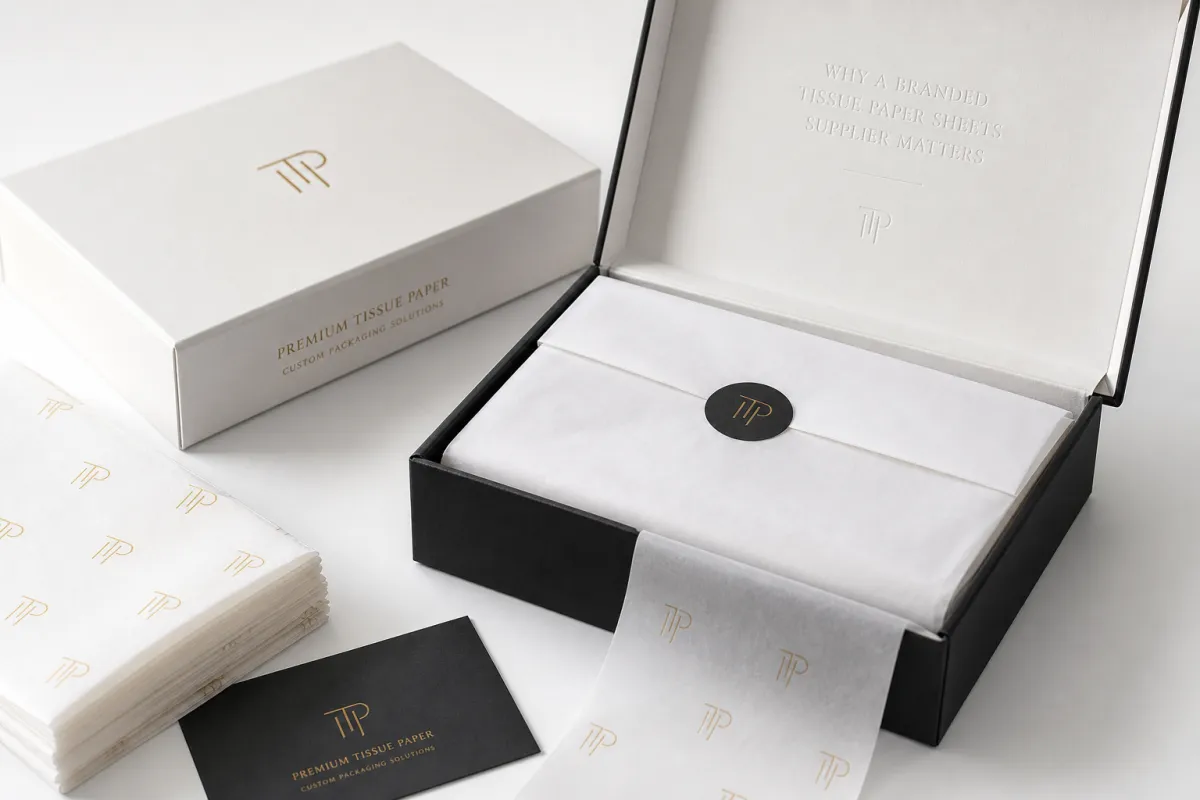
Pack a premium product with the wrong tissue and the whole presentation can fall flat. The customer opens the lid, sees a sheet that looks dull instead of soft, and the perceived value drops before the item itself has a chance to shine. That is the quiet power of a branded Tissue Paper Sheets supplier: the sheet is part protection, part branding, and part stagecraft, all at once.
Tissue paper does a lot with very little material. A single sheet can add colour, pattern, or a seasonal mark without adding much weight to the parcel, which is useful for brands trying to keep packaging light and efficient. A thoughtful branded tissue paper sheets supplier will help you choose a stock that looks refined without drifting into wasteful over-specification. That matters more than it sounds, especially when the tissue is used at scale. A sheet that looks elegant in a sample pack but falls apart in a busy packing room is not helping anybody.
Brand consistency is another reason the supplier matters. The paper has to sit comfortably alongside the box, label, insert card, and outer mailer. The logo placement has to read properly whether the sheet is flat, folded, layered, or wrapped around a product. A strong branded tissue paper sheets supplier understands that tissue is not a poster. It is a translucent, flexible surface that changes once it is creased or tucked into a pack.
That is why buyers should pay attention to opacity, sheet size, fold style, and print coverage. A design that looks clean on a screen can vanish into a 17gsm sheet once it is folded around a product. Heavy ink coverage can also make the tissue stiffer than expected. A reliable branded tissue paper sheets supplier will say that plainly instead of pretending every artwork file is ready for production.
There is a tradeoff here, and it is worth being honest about it. If you push for more opacity, you usually give up a little softness or pay a little more. If you push for heavier print coverage, the sheet may feel less airy and take longer to dry. None of that is a dealbreaker, but it does mean the best spec is usually the one that fits the packaging job instead of trying to impress everybody at once.
A tissue sheet should support the packing process, not complicate it. If it fights the packer, sheds ink, or looks muddy in the box, it has already failed the job.
The sustainability side deserves attention too. Tissue is light-touch by nature, so the environmental footprint depends heavily on stock choice, ink load, waste levels, and how efficiently the supplier packs and ships. Ask for FSC-certified stock if that fits your programme, and read the documentation rather than relying on a polished sales line. If you want a solid reference point for responsible sourcing, the FSC site is useful for chain-of-custody basics. A serious branded tissue paper sheets supplier should be able to speak clearly about those claims, not just wave a brochure around and hope the question goes away.
Tissue paper also reaches beyond e-commerce. It appears in retail wraps, gift sets, PR mailers, subscription boxes, and seasonal promotions, and each use case puts pressure on the sheet in a slightly different way. The job changes, but the supplier question stays the same: can this branded tissue paper sheets supplier make the sheet behave consistently without pushing cost, lead time, or packaging waste out of line?
How a branded tissue paper sheets supplier turns artwork into sheets
Most buyers see the finished sheet and assume the process was straightforward. It usually is not. A branded tissue paper sheets supplier begins with artwork, turns that artwork into a repeatable print file, and then adjusts it for the realities of thin paper. That middle step matters more than it first appears, because tissue is unforgiving. Fine lines, tiny type, and delicate gradients can break apart or disappear if the file is handled carelessly.
The first job is file setup. Vector artwork is the safest route because it scales cleanly and keeps edges sharp. Send a logo as a low-resolution JPEG and the supplier can still print it, but the result may look soft or fuzzy, especially on pale tissue. A good branded tissue paper sheets supplier will usually ask for a repeat pattern, a one-colour logo file, or layered artwork that is ready for press setup. If the supplier never asks about file type, that is not evidence of simplicity. It usually means the problems will show up later.
For tissue work, I usually look for a supplier that can talk comfortably about vector files, Pantone references, and minimum line weights without sounding stiff about it. That kind of detail matters because tiny marks can disappear fast on porous stock. If the art has fine hairlines or dense text, the supplier should flag it early rather than pretending it will all print perfectly. That honesty saves everyone a headache.
Proofing comes next. This is the stage where the supplier shows how the design sits on the sheet, how many repeats are needed, and whether the logo lands in the right place once folding is taken into account. A repeat pattern often gives better value than one large centred logo because it hides small registration shifts and makes the sheet feel deliberate instead of over-specified. A seasoned branded tissue paper sheets supplier will often steer the artwork toward a cleaner repeat if the design is crowded.
Printing method matters as well. Sharper graphics usually require more controlled ink application, while lighter coverage keeps the sheet softer and often easier to handle in packing. Heavy flood printing can make tissue feel less airy and may add drying time. A practical branded tissue paper sheets supplier will explain whether the job calls for flexo, screen, or another process based on coverage, detail, and run size. For a broader view of packaging material handling and testing culture, ISTA is worth reading, especially if the tissue is part of a larger transit-sensitive pack.
Sheet format comes after that. Common sizes include 50 x 75 cm and 20 x 30 inches, but the right size depends on how the team packs orders. A retail wrap may need a larger sheet with extra margin. A box liner may work better with a tighter trim size so the operation is not throwing away usable material. The branded tissue paper sheets supplier should also confirm fold style, bundle count, and how the sheets are stacked or packed. A 500-sheet pack suits some warehouses. Others do better with 250-sheet packs because they reduce handling damage and keep the sheets flatter.
Quality control is where the stronger suppliers separate themselves from the merely busy ones. Ask how they check registration, edge accuracy, ink rub, and flatness. The surface should feel clean rather than powdery or blotchy, and the print should hold through normal handling without moving onto hands, labels, or product surfaces. A competent branded tissue paper sheets supplier knows a sheet can pass a visual check and still fail in the packing room if it curls, tears too easily, or sheds when folded twice.
Handled like a real pack station would handle it, a sample tells you a lot. Fold it. Ruffle it. Wrap it around a corner. Leave it under light pressure for a day. If the tissue still looks good, the branded tissue paper sheets supplier likely understands production use rather than just sample-room polish.
Cost, pricing, MOQ, and unit cost for branded tissue paper sheets supplier orders
Pricing for a branded tissue paper sheets supplier order is mostly a story about setup. The paper itself is inexpensive compared with the work required to prepare artwork, print, dry, cut, pack, and ship it. That is why small orders carry a higher unit cost. If you only need a few hundred sheets, the supplier is still doing nearly the same setup work as for a much larger run.
The main price drivers stay fairly consistent: paper weight, sheet size, print colours, print coverage, finishing, and packaging style. A 17gsm single-colour repeat on a standard size will usually cost less than a 22gsm sheet with full-bleed coverage and custom retail packing. A knowledgeable branded tissue paper sheets supplier should be able to break those variables out clearly. If the quote is just one lump sum with no detail, comparison gets messy very quickly.
The cheapest quote is often the least useful one. Freight, plates, proofs, packing changes, and import costs may be left out, and by the time they are added the low number no longer looks low. Ask for landed pricing if possible. At the very least, compare the same specs from each branded tissue paper sheets supplier so the numbers mean something real rather than becoming a spreadsheet trick.
These pricing bands are not fixed market rates, because region, paper grade, and shipping route all change the maths, but they are useful as planning numbers.
| Order Type | Typical Spec | Best For | Rough Unit Range | What Affects The Price Most |
|---|---|---|---|---|
| Stock tissue with simple logo print | 17gsm, 1 colour, standard size | Small retail runs, starter kits | $0.05-$0.12 per sheet | MOQ, print setup, packing format |
| Custom repeat pattern | 17-20gsm, 1-2 colours, repeated artwork | E-commerce, gift boxes, subscription packs | $0.07-$0.16 per sheet | Coverage, repeat complexity, sheet count |
| Premium stock with higher opacity | 20-22gsm, lighter print, custom size | Luxury retail, presentation packs | $0.10-$0.22 per sheet | Paper grade, trim size, packaging add-ons |
MOQ deserves proper attention. Many buyers hear minimum order and assume the supplier is being difficult. Usually it is just economics. A branded tissue paper sheets supplier has to cover make-ready, waste, and press time before the paper starts looking inexpensive. For simple stock-based jobs, MOQ may sit in the few-hundred range. For custom sizes, multiple colours, or special packaging, the minimum can rise into the low thousands. That is normal, not insulting.
If the aim is to hold cost down, simplify the design before arguing over pennies. Use fewer print colours. Reduce ink coverage. Choose a standard size close to the one you need instead of creating a new trim dimension without a clear reason. Repeat orders also help because the branded tissue paper sheets supplier can reuse setup, and setup is where a surprising amount of cost sits. One-off custom jobs always cost more. That is how setup-heavy production works.
Sustainability can nudge pricing too. Recycled content, FSC-certified stock, and lower-impact inks may raise the cost a little, though usually not dramatically. Across larger runs, that small difference can matter. The tradeoff is clearer documentation and a more credible material story, which often makes procurement easier later. If a buyer, sustainability team, or retailer asks for proof, a branded tissue paper sheets supplier with the right paperwork saves time and prevents avoidable back-and-forth.
A useful buying move is to ask for the same quote in two or three versions. One with standard white stock, one with FSC-certified stock, and one with a heavier gsm will usually show where the money actually goes. A careful branded tissue paper sheets supplier will not hide from that comparison.
Production process and lead time for branded tissue paper sheets supplier orders
Lead time is where optimistic packing plans often run into reality. A branded tissue paper sheets supplier can move quickly, but only if the artwork is clean, the specification is locked, and the stock is available. If any of those pieces are vague, the schedule stretches. That is not the supplier being slow. It is production refusing to guess.
The usual timeline starts with the brief, then moves into artwork review, proofing, sample approval if required, production, packing, and shipping. Straightforward jobs can move through proofing in a few business days. Production commonly takes about 2-4 weeks, depending on run size and complexity. Shipping is a separate clock, and it can take longer than buyers expect, especially when the order crosses borders. A decent branded tissue paper sheets supplier will tell you where the timeline is firm and where it still depends on conditions outside the factory.
What slows things down? Artwork revisions, unclear sheet size, missing logo files, special inks, and packed calendars at the factory. Seasonal demand adds pressure too. If everyone wants holiday tissue at the same time, the schedule tightens fast. A smart buyer gives the branded tissue paper sheets supplier enough lead time to absorb one round of revisions without turning the order into a rush job.
There is also the hidden buffer that rarely gets enough space in the plan: transit delays, customs checks, and final delivery into the warehouse or packing site. If the tissue has to land before a launch, a trade show, or a gift campaign, leave another week beyond the quoted ship time. The caution is deliberate. The branded tissue paper sheets supplier cannot control weather, port congestion, or a carrier that suddenly becomes difficult.
A practical process order for most jobs looks like this:
- Confirm sheet size, gsm, print method, and pack format.
- Send clean artwork and approved brand colours.
- Review the supplier proof and ask for changes only if needed.
- Approve the final proof and lock quantity.
- Move into production and request updates at agreed checkpoints.
- Check packing, freight terms, and delivery window before dispatch.
That sequence sounds basic, but skipping one step usually causes trouble later. The proof stage is not just paperwork. It is the last chance to catch a logo that sits too close to the edge, a repeat that looks awkward, or a size that wastes more tissue than planned. A competent branded tissue paper sheets supplier should welcome that scrutiny because it reduces rework.
If the tissue has to survive heavier handling inside mailers or gift kits, think about the broader shipping environment too. A finished pack that gets dropped, stacked, or vibration-tested should not rely on the sheet alone to carry the protection story. Print, fold, and transit need to be considered together. A practical branded tissue paper sheets supplier will be comfortable talking through that relationship.
Step-by-step: choosing a branded tissue paper sheets supplier
Start with the actual use case, not the marketing story. If the tissue is for retail wrapping, it has to look elegant on the sales floor. If it is for a mailer insert, it has to survive packing speed and parcel handling. If it is for a gift box, it needs to open cleanly and still look polished after folding. A good branded tissue paper sheets supplier will ask those questions before quoting because the answers change the spec.
Next, build a sourcing brief that gives every supplier the same facts. Include sheet size, gsm, print colours, coverage percentage, finish, sustainability requirements, pack count, and target budget. If one supplier gets a vague email and another gets a detailed spec sheet, the quotes will not mean much. A proper branded tissue paper sheets supplier comparison only works when the inputs match.
Then compare like for like. Ask for the same quantity, same stock, same shipping terms, same proofing format, and same packaging method. Request the landed cost if possible. That makes it easier to see whether one supplier is genuinely efficient or simply leaving out the items you still have to pay for. A lot of buyers get caught by a polished number and a confident tone, and the issue only appears after the order is already moving.
Samples matter, and so does proofing. A sample tells you about feel, opacity, print clarity, and handling. A proof tells you whether the artwork is positioned correctly. Both are useful, and neither should be treated like decoration. If the tissue is going into a high-value unboxing, test it with the actual box and insert set. A branded tissue paper sheets supplier that cannot work from real use conditions is not the supplier you want for repeat work.
Then test the sheet in three ways:
- Tear test: Does it tear too easily during folding, or does it hold just enough?
- Color transfer test: Does the ink rub onto hands, product surfaces, or other sheets?
- Presentation test: Does it still look clean after a second fold, a tuck, or a light crumple?
Lock the order with the details that make reordering easier. Save the approved artwork, note the exact gsm and size, document the print method, and confirm whether the supplier can repeat the job without starting from scratch. A good branded tissue paper sheets supplier should make the second order easier than the first. If they do not, you are paying for confusion twice.
For brands that want to see how packaging decisions translate into real-world execution, the Case Studies page is a useful place to study how structure, print, and finish behave in similar jobs. Context matters, especially when the tissue has to support a larger packaging system rather than standing alone. That is the kind of detail a serious branded tissue paper sheets supplier conversation should include.
Common mistakes when buying branded tissue paper sheets
The first mistake is plain enough but still common: chasing the lowest price and then acting surprised when the result looks cheap. Thin paper, weak print, and delayed delivery are not accidents. They are often what the quote paid for. A branded tissue paper sheets supplier can only hit a bargain number by making tradeoffs somewhere. The real question is whether those tradeoffs harm the customer experience.
The second mistake is using too much ink coverage. Heavy coverage can make tissue stiffer, reduce the airy feel, and complicate drying or handling. It can also push the price up because more ink and more process control are involved. A lighter repeat pattern often looks more refined anyway. A good branded tissue paper sheets supplier will usually say that politely, but the point stays the same: more print is not automatically more premium.
The third mistake is ignoring how the tissue gets packed. If sheets are folded badly, handled too much, or stuffed into a loose carton, the final presentation suffers before the customer ever sees the product. Edge damage, crumpling, and corner dents are all avoidable. A careful branded tissue paper sheets supplier should explain the packing format and how it protects the sheets during transit.
Another common miss is skipping documentation. If the brand claims recycled content, FSC certification, or responsible sourcing, written proof is necessary. A line on a quote is not enough. A nice phrase in an email is not enough either. If the supplier cannot provide evidence, the claim should stay off the packaging. A trustworthy branded tissue paper sheets supplier will not leave you guessing.
Over-customisation creates its own problems. Buyers sometimes request a special size, a special fold, a special print layout, and a special pack count all at once. Then they wonder why the order is expensive and slow. Every extra variable adds setup time or waste. Keep the format close to what the team already uses. That is one of the fastest ways to keep a branded tissue paper sheets supplier order manageable.
Finally, do not order without a re-run plan. If the first batch goes well and the second batch has to match it, make sure the spec is saved cleanly. The worst situation is a successful launch followed by a scrambled reorder because nobody kept the approved file, size, or print standard. A dependable branded tissue paper sheets supplier should help archive that information, but the buyer still needs to ask for it.
Expert tips and next steps for your branded tissue paper sheets supplier order
Keep the design simple if the goal is lower cost and cleaner production. That is not a stylistic preference dressed up as advice. It is just how thin paper behaves. A restrained logo repeat or a subtle brand pattern usually gives a more premium result than a crowded artwork file. With tissue, less ink often means better handling. A seasoned branded tissue paper sheets supplier will say that plainly.
Use repeat patterns whenever possible. They hide small press variation better than a large centred graphic, and they often look more intentional in the box. If the brand wants a seasonal version, change the pattern or accent colour rather than rebuilding the entire sheet from scratch. That keeps the order faster and usually cheaper. A smart branded tissue paper sheets supplier can keep a repeat formula on file for future runs, which is handy when the same packaging needs to roll out again six months later.
Ask every supplier the same core questions so the answers can be compared fairly: What is the stock weight? What print method do you use? What is the MOQ? What is the lead time to production and delivery? What does the landed cost include? Those questions are basic because they need to be basic. They reveal more than a glossy sample ever will. If a branded tissue paper sheets supplier cannot answer clearly, move on.
Think about the packing team too. The best sheet is not the fanciest one. It is the one staff can use quickly without tearing, wrinkling, or hunting for the fold direction. If the tissue slows packing, it adds labour cost even if the unit price looks fine on paper. That is why the practical branded tissue paper sheets supplier choice is often the one that fits the workflow instead of fighting it. I have watched more than one clean-looking spec turn into a nuisance simply because the sheets were too large for the pace of the line.
For sustainable buying, ask for the evidence that matters: FSC certification if required, recycled content details, and clear ink or coating information. If a lower-impact option is needed, ask whether the supplier can reduce waste with a standard size and lighter coverage. Sustainability claims are easy to print. The documentation is the real test.
One useful final move is to request three comparable quotes, then ask for one sample run before volume. That gives you a price benchmark, a quality benchmark, and a reality check in one go. It is a small amount of extra effort compared with fixing a full production mistake later. A good branded tissue paper sheets supplier will see that as standard professional buying, not as a nuisance.
When the time comes, build a one-page sourcing brief, compare options using the same spec, and keep the first run simple enough to learn from. A capable branded tissue paper sheets supplier should make the next order easier, not harder. If they do that, you have a partner worth keeping.
FAQ
What gsm should I ask a branded tissue paper sheets supplier for?
Most brands use about 17-22gsm for standard wrapping and box lining. If you want more opacity or a slightly more premium hand feel, move toward the upper end of that range. Heavier stock usually costs more, and gsm alone does not tell you how the sheet will fold, tear, or print. Ask for a sample before you commit to a full run with a branded tissue paper sheets supplier.
How do I keep branded tissue paper sheets supplier pricing under control?
Use fewer print colours, lower the ink coverage, and keep the sheet size close to a standard format. Compare quotes on the exact same spec, including freight and setup fees, or the numbers do not mean much. Repeat orders also help because the setup cost gets spread out. That is where a branded tissue paper sheets supplier can become cheaper on the second run.
What MOQ is normal for branded tissue paper sheets supplier orders?
MOQs often range from a few hundred to several thousand sheets, depending on size, stock, and print complexity. Special sizes, heavy coverage, or unusual packing formats usually push the minimum higher. If you only need a small run, ask for stock tissue with a simple print. That is usually the most sensible way to keep branded tissue paper sheets supplier setup costs under control.
How long does production usually take with a branded tissue paper sheets supplier?
Sampling and proofing can take a few days if the artwork is ready and the design is straightforward. Production commonly runs about 2-4 weeks, and shipping adds its own clock on top. Rush orders are sometimes possible, but only if the supplier already has the right stock and your artwork is final. A branded tissue paper sheets supplier can move fast only when the job is clean.
How do I judge whether a branded tissue paper sheets supplier is sustainable?
Ask for recycled content details, FSC or similar certification, and clear information on inks or coatings. Check whether the supplier can reduce waste with standard sheet sizing and efficient packing. Most of all, make sure the eco claim matches the actual spec. Vague green talk is cheap, and paper is not. A credible branded tissue paper sheets supplier should be able to back up the claim in writing.
The simplest path is usually the best one: write a one-page brief, ask each branded tissue paper sheets supplier for the same spec, compare landed cost rather than headline price, approve a physical sample, and archive the final size, gsm, print method, and artwork so the next reorder is clean instead of chaotic.