Buyer Fit Snapshot
| Best fit | Branded Tissue Paper for Packaging projects where brand print, material claims, artwork control, MOQ, and repeat-order consistency need to be specified before quoting. |
|---|---|
| Quote inputs | Share finished size, material target, print colors, finish, packing count, annual reorder estimate, ship-to region, and any compliance wording. |
| Proofing check | Approve dieline scale, logo placement, barcode or warning zones, color tolerance, closure strength, and carton packing before bulk production. |
| Main risk | Vague material claims, crowded artwork, missing packing details, or unclear freight terms can make a low unit price expensive after revisions. |
Fast answer: Branded Tissue Paper for Packaging: Uses, Cost, Results should be specified like a repeatable production item. The safest quote records material, print method, finish, artwork proof, packing count, and reorder notes in one written spec.
Production checks before approval
Compare the actual filled-product size with the drawing, then confirm tolerance on folds, seals, hang holes, label areas, and retail display edges. Reserve space for logos, QR codes, warning copy, and material claims before decorative graphics fill the panel.
Quote comparison points
Review material grade, print process, finish, sampling route, tooling charges, carton quantity, and freight assumptions side by side. A quote is only useful when the supplier can repeat the same color, closure quality, and packing count on the next order.
A customer can judge a parcel before the product shows up. One sheet of Branded Tissue Paper for packaging changes the whole read of the shipment, and often the perceived value more than a louder box ever could. That is why brands use it for apparel, cosmetics, gifts, and light accessories: it is small, but it does two jobs at once. Presentation and light protection. Not bad for a piece of paper.
If you source Custom Packaging Products, tissue usually sits near the top of the list because it is easier to standardize than custom printed boxes and more expressive than plain filler. Used well, Branded Tissue Paper for packaging can make retail packaging feel deliberate, even when the outer carton is plain kraft. Used badly, it looks like somebody forgot to finish the job. The difference is rarely the logo. It is usually the material, the fold, and the packout discipline.
I have watched good products arrive looking cheap because the inner wrap was an afterthought. I have also seen modest products feel premium because the tissue was cut cleanly, printed well, and packed with a bit of care. That gap is real. And yes, customers notice it.
What Branded Tissue Paper for Packaging Is
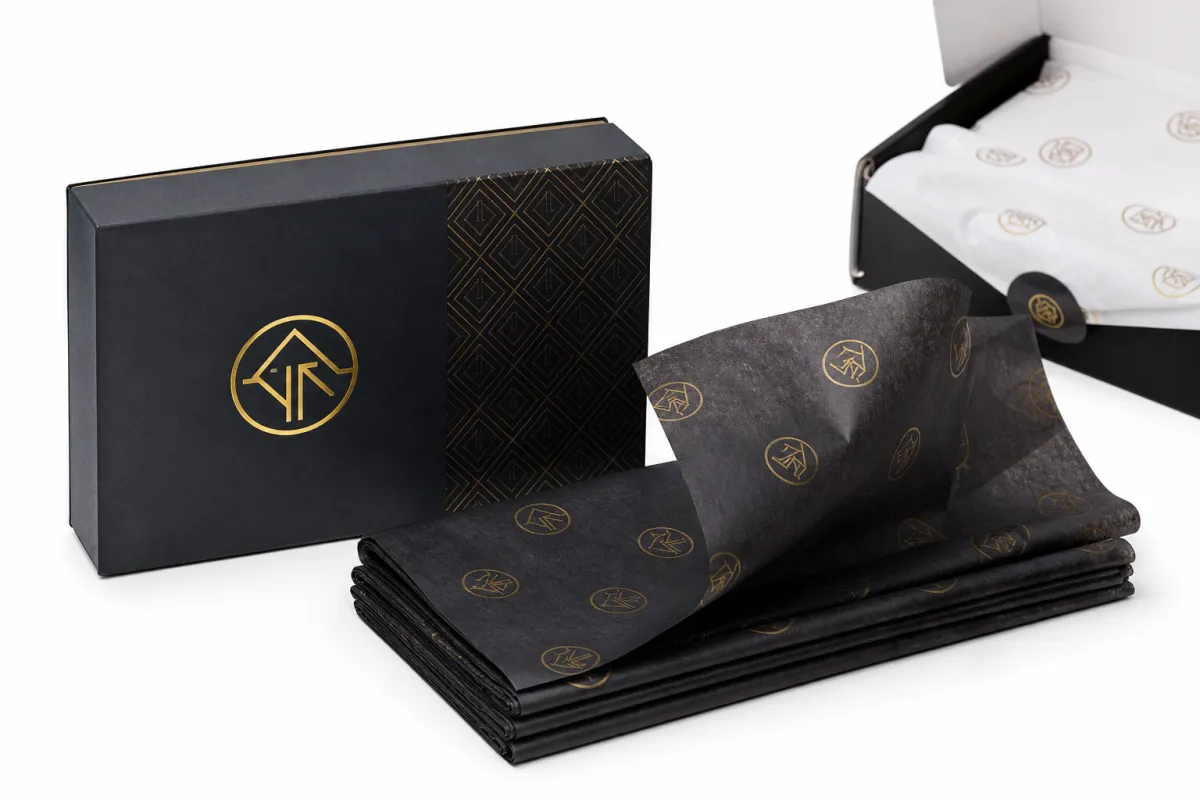
Branded Tissue Paper for packaging is printed or custom-colored tissue used to wrap, separate, cushion, or present products inside boxes, mailers, shopping bags, and gift packs. In plain language, it is the thin paper layer that creates the first reveal. It can carry a repeating logo, a pattern built from brand colors, or a full custom print that carries identity beyond the carton.
The material is usually lightweight tissue in the 17gsm to 28gsm range, though some brands choose heavier stock for a more substantial feel. A 17gsm sheet folds easily and keeps costs down. A 24gsm or 28gsm sheet resists tearing better and hides more of the product underneath. That matters when the product shape is irregular, or when the unboxing moment needs to feel polished instead of flimsy.
From a packaging buyer's point of view, Branded Tissue Paper for packaging serves two jobs at once. First, it acts as a soft barrier between product and box. Second, it carries package branding in a way customers can see before they touch the item. That makes it especially useful in product packaging and retail packaging where first impressions drive repeat orders. Apparel brands use it to keep folded garments tidy. Beauty brands use it to create a cleaner, more giftable reveal. Gift retailers use it to make even modest items feel considered.
The real comparison is not tissue versus nothing. It is tissue versus other finishing layers. Plain kraft paper reads practical and earthy. Void fill is functional but rarely elegant. Sticker seals and insert cards help, but they do not wrap the product in a visual signature. Branded tissue paper for packaging sits in that useful middle ground: more expressive than filler, less expensive than fully custom cartons, and easier to deploy than a structural redesign.
That is why it belongs in the broader conversation about branded packaging and packaging design. It is not just decoration. It is a logistics choice with brand consequences. A box can be structurally fine and still feel cold. Tissue can fix that feeling fast, especially when the customer opens the package in one motion and sees the logo repeat exactly where the brand intended.
One practical point gets overlooked: branded tissue paper for packaging works best as a layer in a system. It needs to fit the box size, insert design, tape, void fill, and order picking habits. If those parts fight each other, the tissue does not save the presentation. If they line up, the whole package reads more premium without a huge materials budget.
How Branded Tissue Paper for Packaging Works in Transit
Branded tissue paper for packaging is thin, but it does real work during shipping. It wraps products, keeps dust off surfaces, reduces minor scuffs, and helps hold folded items together so they do not shift as much inside the carton. It is not structural cushioning. That distinction matters. Tissue can improve presentation and reduce light abrasion, but it should not be treated like foam, corrugate inserts, or molded pulp for fragile shipments.
In transit, the biggest value often shows up before the box is even opened. A well-wrapped item stays cleaner. A shirt stays folded. A candle box stays centered. A cosmetics kit does not look like it was tossed loose into a mailer. That orderly feeling affects customer trust. People notice when the inside of the package matches the promise on the outside, and branded tissue paper for packaging is one of the quickest ways to create that continuity.
The packing sequence matters. In many fulfillment operations, the tissue is used after the product is placed in a secondary pouch or sleeve, but before inserts or void fill close the shipment. For some kits, it becomes the final top layer before the box is sealed. That placement creates a staged reveal. Customers lift the lid, see the logo pattern, then open the wrap, then reach the product. Each step slows the moment down in a good way.
That reveal is part of the sales math. A shipment that feels neat and intentional is more likely to be photographed, shared, and remembered. It is also more likely to support package branding across the whole order, not just on the outer carton. In practice, branded tissue paper for packaging can be the difference between a shipping experience that feels transactional and one that feels planned.
A box can be dimensionally correct and still feel unfinished.
There are limits, and they should be stated clearly. Tissue does not replace edge protection for glass. It does not stop compression damage from heavy goods. It does not solve void space in a loose carton. For items with sharp corners, unusual weight, or breakable components, the smarter setup is tissue plus structural protection plus the right box size. When teams ignore that, the tissue tears, the product shifts, and the premium effect disappears.
Testing helps. Brands often run a simple drop check, a vibration check, or an abrasion check before scaling a format. That does not need to be complex. A trial using the actual product, actual tissue, and actual packout speed can reveal whether the sheet rips at the fold, whether the ink scuffs, and whether the reveal still looks orderly after handling. For transport validation, the methods published by ISTA are a useful reference point.
If the tissue is chosen and packed well, the result is quiet but noticeable. The product arrives cleaner. The inside of the box looks intentional. The customer sees evidence that the brand cared about the details, and that care tends to travel farther than most people expect. Branded tissue paper for packaging does not do the heavy lifting of shipping, but it absolutely shapes how shipping feels.
Branded Tissue Paper for Packaging Costs and Pricing Drivers
The price of branded tissue paper for packaging is rarely just a paper price. It is a combination of sheet size, paper weight, print method, ink coverage, color count, folding style, order quantity, and freight. A simple repeat pattern on standard white tissue will usually cost far less than a dense, full-coverage print on a custom-colored sheet. The question is not “What does one sheet cost?” The question is “What does it cost per packed order, including waste and labor?”
Here is the part buyers sometimes miss: setup matters. If the artwork requires multiple colors, tight registration, or a custom repeat that uses more press time, the unit price climbs. The same is true when the tissue must match a difficult brand color or sit on a nonstandard sheet size. A small change in repeat length can move the price enough to matter at scale.
| Option | Typical MOQ | Indicative Price Range | Best Use | Main Trade-Off |
|---|---|---|---|---|
| Plain white tissue, unprinted | 2,500-5,000 sheets | $0.02-$0.05 per sheet | Basic wrapping, dust protection, budget packouts | Lowest brand impact |
| One-color repeat logo | 5,000-10,000 sheets | $0.05-$0.10 per sheet | Light branded packaging, apparel, gift items | Simple print limits |
| Two- to three-color repeat | 5,000-10,000 sheets | $0.08-$0.16 per sheet | Stronger retail packaging presence | Higher setup and color match risk |
| Custom color stock with dense print | 10,000+ sheets | $0.12-$0.24 per sheet | Premium unboxing, gift programs, seasonal launches | More inventory and cash tied up |
Those numbers are directional, not fixed. Freight can add more than people expect, especially on bulky tissue orders where the sheets themselves are light but the cartons are large. Storage matters too. A brand that buys a six-month supply may secure a better sheet price, but it also commits warehouse space and cash. For smaller teams, the landed cost per packed order can be higher than the sheet price suggests because of spoilage, miscounts, and rework.
There is also the comparison to other brand layers. Branded tissue paper for packaging is usually cheaper than custom printed boxes and more visible than a logo sticker. That is why many brands use it as a first step in their packaging upgrade path. It lets them improve product packaging without retooling the whole carton spec. If the business later moves into custom cartons, the tissue still works as a secondary brand cue.
For an ecommerce brand packing 5,000 orders a month, even a small difference adds up. A move from $0.06 to $0.10 per sheet looks minor on paper, but if one order uses two sheets and the brand ships 10,000 wrapped units monthly, the gap becomes meaningful. That is why a quote should include the full picture: tissue, packing labor, freight, expected waste, and the number of sheets used per order.
A practical buying question is simple: how many orders does one roll, carton, or pallet support? If the supplier cannot answer that clearly, the quote is incomplete. The best pricing discussions treat branded tissue paper for packaging as part of an operating system, not an isolated item. That makes it easier to compare against box upgrades, insert cards, and other custom printed boxes alternatives.
For teams reviewing packaging options, a broad reference on certified fiber and sourcing standards can help frame the conversation. The FSC site is a useful place to start if recycled content, responsible sourcing, or chain-of-custody claims matter to the buying decision.
My honest view: the cheapest sheet is not always the cheapest program. If the low-cost option tears often, prints poorly, or slows the line, the true cost is higher. Branded tissue paper for packaging should be priced like a brand tool with operations consequences, because that is exactly what it is.
Step-by-Step Process and Timeline for Branded Tissue Paper for Packaging
The cleanest projects start with a basic brief. Before artwork, before mockups, before quote comparisons, define the product size, the packout environment, the number of sheets per order, and the look you want the customer to see. A 10x8x4 mailer for jewelry does not need the same tissue format as a 14x10 apparel box. If those inputs are vague, everything downstream slows down.
For branded tissue paper for packaging, artwork is usually prepared as a repeat pattern. That means the logo cannot live alone on the page; it has to survive folds, overlaps, and sheet trimming. Repeat size matters. A repeat that looks elegant on a computer screen may disappear once it is folded around a product. This is where a physical proof earns its keep. Screens do not show opacity, fiber texture, or how the print behaves across a fold line.
A typical process looks like this:
- Gather size, quantity, sheet count, and packout details.
- Build the repeat artwork and set color targets.
- Review digital proofs for logo placement and spacing.
- Approve a physical sample if the project is color sensitive.
- Run production, finish, count, and pack the sheets.
- Ship with enough lead time for warehouse intake and launch prep.
That timeline is usually measured in business days, not hours. A straightforward order can move from proof approval to shipment in roughly 12-20 business days, depending on the printer, the finishing steps, and freight method. More complex work, such as dense coverage, special colors, or a larger MOQ, can take longer. Seasonal demand changes the picture too. The closer the order sits to a gift season or a campaign launch, the more likely it is to hit a production queue.
Branded tissue paper for packaging also has a dependence chain that many teams underestimate. If the color needs to match a carton, insert card, or ribbon, the approval cycle becomes slower. If the artwork changes after proofing, the schedule stretches again. A late revision can force a reproof, and a reproof can push the shipment beyond the original restock window. That is not drama. It is normal production behavior.
Sampling deserves special attention. A sample may reveal that the print reads too dark once the tissue is folded twice. It may show through more than expected. It may crease where the brand wants a clean reveal. Those are not cosmetic details. They affect whether the tissue still feels premium when a customer receives it. For brands that want to compare alternatives, this is a strong moment to review Case Studies and see how other packout decisions were handled.
Production itself is usually simple from a buyer's perspective, but the finishing stage matters. Sheets are trimmed, counted, stacked, wrapped, boxed, and labeled. If the packaging on the tissue cartons is weak, warehouse handling can bend corners or pick up moisture. That can hurt the presentation before the first order is packed. In other words, the production timeline is not just about print. It is about how the finished sheets arrive in usable condition.
One thing I always tell teams: build in a little slack. Not because anyone likes delays, but because tiny changes pile up fast. A revised logo placement, a darker ink target, or a different carton spec can add days. If the launch date is fixed, the schedule should be a little conservative. That's just common sense, not pessimism.
Key Factors to Choose the Right Branded Tissue Paper for Packaging
Choosing branded tissue paper for packaging starts with paper weight. Lighter tissue can be easier to fold, faster to pack, and cheaper to source. Heavier tissue tends to feel more substantial and hides the product better, but it can take more effort to fold cleanly. A 17gsm sheet may work for a soft garment line. A 24gsm or 28gsm sheet is often more suitable when the brand wants a richer feel or needs better resistance to tearing.
Opacity is the next decision. A sheet that is too transparent can make the print look weak and the product underneath too visible. That is a common problem with pale stock and narrow ink coverage. If the business wants a strong reveal, the tissue should be tested against the actual product color, not just against a white background. Packaging looks different in real use than it does in a proof PDF.
Size matters more than most teams expect. A 20x30 sheet may be ideal for clothing, while a smaller 15x20 sheet could work better for jewelry or gift items. The fold pattern should fit the packout motion. If the sheet is too large, it slows packing. If it is too small, the edges of the product can show through or the wrap ends up looking improvised. Branded tissue paper for packaging should save time, not create extra handwork.
Print compatibility is another practical filter. Ink systems behave differently on uncoated tissue than on coated paper. Fine lines can break up. Pale colors can vanish. Heavy ink coverage can make sheets feel stiffer. That is why color accuracy matters so much in package branding. A logo that shifts slightly from the brand palette can make the whole packout feel off, especially for beauty and fashion labels where visual consistency is part of the promise.
Sustainability is worth a direct question, not a vague promise. Ask whether the paper is FSC-certified, whether the inks are recyclable-friendly, and whether the stock can fit the buyer's local disposal rules. The right answer may vary by region and by ink load. A heavily printed tissue is not always handled the same way as plain tissue. If sustainability is a brand claim, the supplier should be able to explain the material honestly and in writing.
Storage and handling are the last filter, and they are easy to ignore. Tissue can pick up humidity, curl under compression, or crease when cartons are stacked badly. Dust can cling to bright white sheets. A warehouse that is too damp can affect print quality before the sheets ever reach the box line. That means the right tissue choice is not only about design. It is also about how your facility stores and picks it.
If you want a quick purchasing checklist, use this:
- Match sheet size to the product and fold motion.
- Choose weight based on product shape and tear resistance.
- Test opacity with the actual item inside the wrap.
- Confirm ink and color expectations before production.
- Ask for storage guidance and packing quantity per carton.
That kind of discipline makes branded tissue paper for packaging feel like part of the system rather than a decorative add-on. The result is more predictable, which is exactly what operations teams want.
Common Mistakes With Branded Tissue Paper for Packaging
The first mistake is choosing a sheet that is too thin for the product. A fragile sheet may look fine on a sample board and fail immediately in real use. It tears at the corners, shows too much of the product, and makes the shipment look underbuilt. That is a bad trade. If the point of branded tissue paper for packaging is to improve perceived quality, thin stock that exposes everything does the opposite.
The second mistake is designing for the logo first and the fold pattern second. A beautiful repeat can disappear when the sheet is wrapped twice around a garment or tucked under an insert. That is not the printer's fault. It is a design issue. The artwork needs to work after folding, not just on a flat screen. Packaging teams that understand this end up with better packaging design decisions and fewer reprints.
The third mistake is underestimating lead time. A team may approve a design late, then rush the final proof because launch day is close. That pressure often leads to two outcomes: acceptance of a color that is slightly off, or a shortage that forces the team to ship without tissue for the first wave of orders. Neither outcome is ideal. A safe buffer is usually easier than an apology email.
The fourth mistake is the gap between marketing and operations. Marketing wants the tissue to look beautiful. Operations wants it to fold fast, count cleanly, and survive storage. If those goals are not aligned, the project can look great in a mockup and still slow the line by several seconds per pack. Across thousands of orders, those seconds matter. Branded tissue paper for packaging should earn its place by improving both presentation and throughput.
Another issue is failing to test against real conditions. Abrasion, scuffing, humidity, and minor impact can all alter the result. A sheet that looks perfect on day one can wrinkle badly after transit or leave visible rub marks on darker fabrics. For brands shipping apparel or beauty products, that is a real concern. A simple transit check based on the product's actual shipping lane is often more revealing than any mockup review.
There is also a common pricing mistake: comparing only sheet price. That misses freight, breakage, overage, and labor. It also ignores the cost of poor packout speed. If a lower-priced sheet takes longer to fold or tears in the pack line, the real program cost rises. That is why experienced buyers evaluate branded tissue paper for packaging by landed cost and outcome, not by price alone.
Finally, teams sometimes ignore the rest of the package. Tissue cannot make a loose box feel secure. It cannot fix an oversized mailer. It cannot compensate for a weak insert or poor void fill. The best use of tissue is as part of a balanced system that includes the right carton, the right protective layer, and a repeatable packout method. If you need a broader refresh, the issue may be the whole product packaging stack, not just the tissue itself.
Expert Tips and Next Steps for Branded Tissue Paper for Packaging
If you want a low-risk starting point, test branded tissue paper for packaging on one high-volume SKU first. Choose the item that ships often, has steady dimensions, and already has a clear packout process. That gives you real data on print quality, folding speed, and customer response without asking the entire operation to change at once. A controlled pilot is much easier to judge than a full rollout.
Use real products, not placeholders. Real hands, real cartons, and real transit conditions reveal more than a studio mockup ever will. A team can discover that the tissue needs a slightly different size, a darker logo repeat, or a heavier stock before scaling. Those are small fixes when the run is still small. They become expensive problems after a full production order lands at the warehouse.
Get sharper quotes by supplying a better brief. Include sheet dimensions, target quantity bands, brand colors, artwork files, delivery date, and the number of sheets used per order. If the supplier knows the packout context, the quote gets more useful. It also becomes easier to compare branded tissue paper for packaging with other branding layers like carton print, tape, or an insert card. For many teams, that comparison is where the decision gets clear.
Ask suppliers to show samples side by side. Do not judge from a digital mockup alone. Compare opacity, color consistency, fold visibility, and the feel of the paper in the hand. Then check whether the landed cost works against the value it creates. A cheaper sheet that disappoints in use is not a bargain. A slightly higher-priced sheet that looks crisp, folds well, and keeps the packout moving may be the better buy.
One more practical move: check how the tissue sits beside the rest of your Custom Packaging Products. If the outer box is already branded, the tissue can either echo that system or clash with it. The best programs align the inner and outer layers so the customer gets a coherent reveal. That is how branded tissue paper for packaging supports retail packaging without trying to do every job by itself.
For brands that want to compare formats, review your current packout against your best three product categories. Apparel may need a soft, opaque wrap. Beauty may need cleaner color control and stronger surface protection. Gifts may need heavier tissue or more elaborate repeat artwork. The right answer depends on the product, the line speed, and the brand promise. There is no one-size-fits-all sheet, and that honesty saves money.
If you are ready to move forward, gather the specs, request samples, and quote branded tissue paper for packaging against your current packout. Then compare the result with your existing carton, filler, and labor cost. That exercise usually makes the answer obvious: either the tissue is a smart upgrade, or the packaging needs a different fix first.
The practical takeaway is simple: pick one real SKU, test two paper weights, and run a live packout before you place a full order. That single test will tell you more than a glossy mockup ever could, and it keeps you from buying a warehouse full of something that only looked good on a screen.
FAQ
How much does branded tissue paper for packaging cost per sheet?
Pricing usually depends on sheet size, paper weight, number of print colors, and order volume. A simple unprinted sheet can sit near the low end of the range, while a dense custom print with a larger MOQ costs more. Ask for landed cost per packed order, not just sheet price, so freight and waste are included in the decision. For many brands, branded tissue paper for packaging becomes more economical as quantities rise.
Is branded tissue paper for packaging strong enough for shipping?
It is best used as a wrap, dust barrier, and presentation layer, not as primary cushioning. For heavier or fragile products, pair it with corrugate, inserts, or void fill. It works especially well for apparel, gifts, beauty products, and light accessories. In those categories, branded tissue paper for packaging adds polish without pretending to replace structural protection.
What paper weight works best for branded tissue paper for packaging?
Lighter tissue is easier to fold and more economical, but it can show through more easily. Heavier tissue usually feels more premium and resists tearing better during packing. A lot depends on product shape, handling speed, and the look you want customers to see. For a wrap that must survive more touch points, branded tissue paper for packaging in a heavier stock is often the safer choice.
How long does branded tissue paper for packaging take to produce?
Timeline depends on artwork approval, proofing, print production, and freight method. A straightforward order may move in roughly 12-20 business days after proof approval, but revisions and seasonal demand can extend that window. Build extra buffer for color matching and last-minute changes. That protects both launch plans and reorder schedules for branded tissue paper for packaging.
Can branded tissue paper for packaging be recycled?
Often yes, but it depends on the fiber, ink system, coatings, and local recycling rules. Simple uncoated tissue with minimal ink is usually easier to recycle than heavily printed stock. If sustainability matters, ask the supplier for material and disposal details in writing. That is the cleanest way to confirm whether branded tissue paper for packaging fits your claims and your region's rules.
Does branded tissue paper for packaging work for small businesses?
Yes, especially if you start with a focused test run instead of a huge order. Small brands often get the best payoff because tissue changes the unboxing feel without forcing a full carton redesign. I have seen lean teams use it as their first real step into consistent package branding. The key is to match the sheet size and print style to the actual SKU, not to the mood board.
For Custom Logo Things, the practical takeaway is simple: branded tissue paper for packaging is small enough to test quickly, but important enough to affect the whole customer experience. Treat it as part of your packaging system, compare it against your current packout, and use samples to confirm the feel before you scale. Done well, branded tissue paper for packaging can sharpen brand recall, clean up the reveal, and make ordinary shipments feel more deliberate.