Buyer Fit Snapshot
| Best fit | Branded Tissue Paper with Logo projects where brand print, material claims, artwork control, MOQ, and repeat-order consistency need to be specified before quoting. |
|---|---|
| Quote inputs | Share finished size, material target, print colors, finish, packing count, annual reorder estimate, ship-to region, and any compliance wording. |
| Proofing check | Approve dieline scale, logo placement, barcode or warning zones, color tolerance, closure strength, and carton packing before bulk production. |
| Main risk | Vague material claims, crowded artwork, missing packing details, or unclear freight terms can make a low unit price expensive after revisions. |
Fast answer: Branded Tissue Paper with Logo: Material, Print, Proofing, and Reorder Risk should be specified like a repeatable production item. The safest quote records material, print method, finish, artwork proof, packing count, and reorder notes in one written spec.
Production checks before approval
Compare the actual filled-product size with the drawing, then confirm tolerance on folds, seals, hang holes, label areas, and retail display edges. Reserve space for logos, QR codes, warning copy, and material claims before decorative graphics fill the panel.
Quote comparison points
Review material grade, print process, finish, sampling route, tooling charges, carton quantity, and freight assumptions side by side. A quote is only useful when the supplier can repeat the same color, closure quality, and packing count on the next order.
Branded Tissue Paper with logo is often the first branded surface a customer touches, and that small sheet can shift the whole feel of a package before the product is even visible. Used well, it becomes one of the most economical ways to make an order feel deliberate, giftable, and worth remembering.
Packaging is rarely judged in neat layers. A customer does not inspect the carton, then the insert, then the tissue in sequence. The reaction happens fast, through the first visual cue and the first tactile cue. If the reveal feels polished, the rest of the order benefits from that impression. If it feels generic, every other detail has to carry more weight.
For a packaging buyer or brand team, the real question is not whether tissue can carry a logo. It is whether Branded Tissue Paper with logo supports the brand story at a cost, timeline, and print quality that make sense for the business. That is the practical conversation, and the one that usually leads to better buying decisions.
One useful way to think about Branded Tissue Paper with logo is as a small packaging system with outsized influence. It can sit inside a retail box, line a gift set, pad a mailer, or create a reveal moment in subscription shipping. The format is simple. The impact is not.
I have seen brands spend a lot more on outer packaging and still miss the mark because the inside felt unfinished. A clean sheet of custom tissue can close that gap without turning the project into a full packaging redesign, which is kinda the sweet spot for many teams.
"The tissue sheet is the first promise a package makes. If it looks considered, the rest of the experience starts from a stronger position."
What Branded Tissue Paper With Logo Really Does
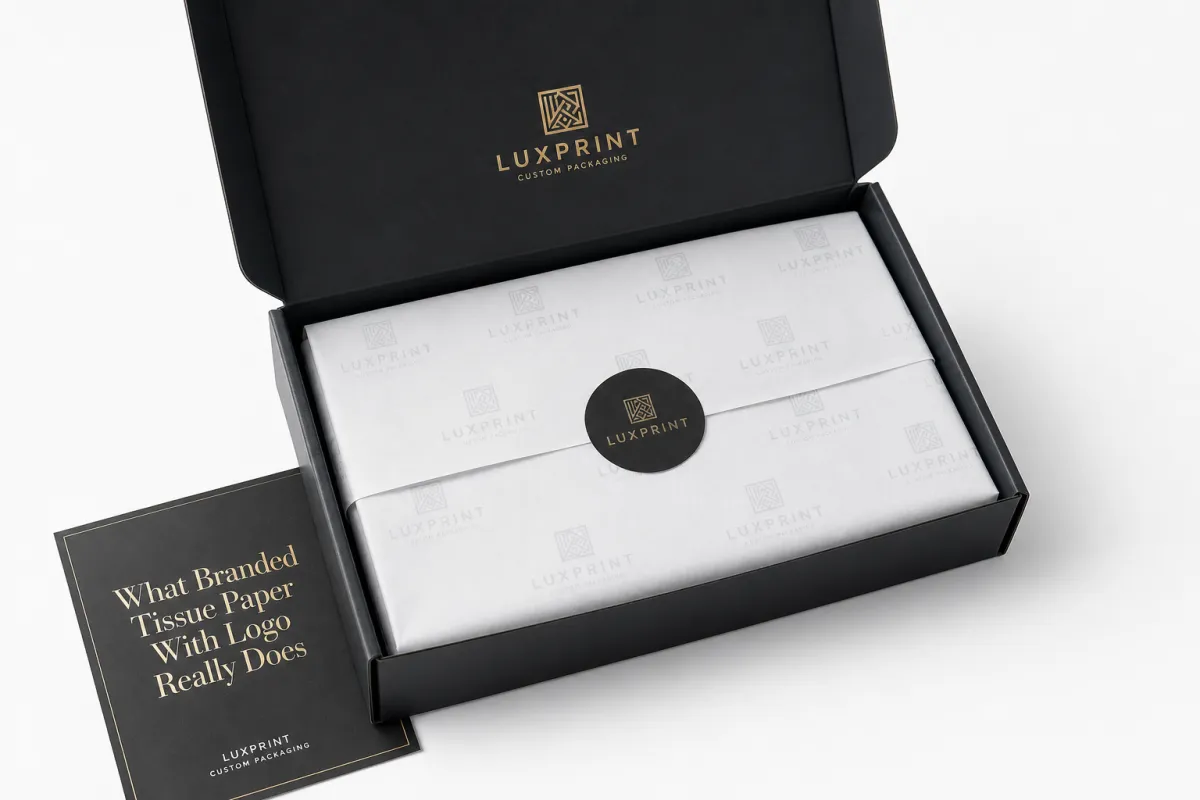
Branded tissue paper with logo is custom-printed tissue used as wrap, fill, or a reveal layer in retail boxes, gift sets, subscription mailers, and e-commerce shipments. Plain tissue still protects and separates items, yet it does not say much. Custom tissue says, very quickly, that somebody cared enough to design the inside as well as the outside.
That distinction sounds small. It is not. A folded sheet of white tissue with no mark can feel like a generic supply item. The same sheet, printed with a repeat logo, can feel like a brand asset. The physical paper may cost only a little more, but the perceived value shifts in a way that matters to buyers, recipients, and social media viewers alike.
From a packaging buyer's point of view, branded tissue paper with logo earns its keep in three places: brand recall, presentation, and consistency. Brand recall is obvious. Presentation is the subtle one. Consistency is the expensive one if you get it wrong, because a premium box with an unbranded inside often feels unfinished. Customers notice that mismatch immediately.
The business case is stronger than many teams expect. A rigid box upgrade can add real cost fast. A foil-stamped carton, custom insert, or specialty closure can push spend upward before the product margin even gets a vote. Branded tissue paper with logo usually gives a premium cue at a much lower entry point, which is why it often appears in beauty, apparel, gourmet gifting, and small-batch consumer goods first.
There is also a useful psychological effect. Tissue introduces a reveal. Reveal matters. Humans like a sequence: lift, unfold, discover. When the brand marks that sequence with branded tissue paper with logo, the package feels staged rather than stuffed. That is a subtle distinction, but in retail packaging subtle is often where the premium perception lives.
Here is the simplest contrast: plain tissue is functional, while branded tissue paper with logo is functional plus intentional. One does the job. The other helps sell the idea that the product deserves attention. In categories where image and giftability influence repeat purchase, that extra signal can be worth more than the material delta.
Branded tissue paper with logo also helps brands maintain a visual rhythm across channels. The logo on the tissue can echo the website, the sticker, the outer shipper, and the email campaign. That continuity makes the whole unboxing feel cohesive. Buyers may not articulate why the package feels "more premium," but they absolutely register the consistency.
For examples of packaging programs that use inside-the-box branding well, review our packaging case studies. It is often easier to judge a tissue decision once you see how it performs inside a complete packaging set.
How Branded Tissue Paper With Logo Is Printed and Used
Branded tissue paper with logo is commonly produced through flexographic, offset, or digital workflows. Each method changes the economics and the visual result. Flexographic printing is often used for repeat patterns and larger quantities because setup can be efficient once plates are approved. Offset can deliver strong registration and cleaner detail on certain jobs, while digital printing is useful when flexibility, short runs, or frequent artwork changes matter more than absolute unit cost.
The print method affects more than color. It changes minimum order quantity, lead time, setup cost, and how much brand detail survives the transfer to tissue stock. Tissue is not coated board. It behaves differently. Ink sits differently, folds differently, and shows transparency differently. Designers who expect paperboard behavior often end up surprised by the final result.
Branded tissue paper with logo also comes in several usage formats. Flat wrap works well for apparel, footwear, and gift sets. Layered reveal is common in mailer boxes and subscription kits. Cushioning format matters when the tissue is doing double duty as protection and presentation. A heavier or larger sheet may be better for a fragile product, while a lighter sheet can create a softer reveal for beauty or accessory items.
Design placement is a bigger decision than many teams realize. A centered logo creates one visual rhythm. A dense all-over repeat creates another. Edge-to-edge patterns can feel energetic and modern, while sparse marks often read more restrained and luxury-oriented. Branded tissue paper with logo should not be designed in isolation; it should be designed around the folding behavior of the final package.
Color selection matters because tissue is semi-transparent and often uncoated. That means ink density, paper tone, and fold layering can shift the appearance quite a bit. A light gray logo may disappear on ivory tissue if the repeat is too sparse. A strong black mark may look elegant on one stock and harsh on another. The same artwork can behave very differently across paper shades.
It also helps to be honest about the limits of the material. Tissue will never hold the same crispness as a coated label or a printed box, and that is fine. The point is not perfect rigidity. The point is a clean, legible mark that still looks good after the sheet has been folded, tucked, and handled a few times.
| Print Method | Best For | Typical Setup Profile | Common Price Impact | Notes |
|---|---|---|---|---|
| Flexographic | Repeat logos, larger runs, simple color counts | Plate setup, efficient once approved | Lower unit cost at scale | Good for consistent branded tissue paper with logo across ongoing orders |
| Offset | Cleaner detail, more controlled color work | More prepress attention and press setup | Moderate to higher setup cost | Useful when brand color accuracy matters more than ultra-low unit cost |
| Digital | Short runs, quick changes, pilot programs | Low setup, fast artwork changes | Higher unit cost on larger volumes | Can be smart for testing branded tissue paper with logo before committing to scale |
The real test is durability through folding, shipping, and handling. If the print cracks at the fold line, smears under pressure, or looks dull after wrapping, the packaging moment loses power. Branded tissue paper with logo should survive normal warehouse handling and still look considered when the customer opens the box.
One practical point: ask how the tissue will be packed. Reams, interleaves, folded stacks, and custom carton counts all change warehouse behavior. A design can be technically correct and still be awkward to use if the format does not match the picker, packer, or fulfillment line.
Branded Tissue Paper With Logo Pricing: What Changes the Cost
Branded tissue paper with logo pricing is driven by sheet size, paper grade, number of ink colors, total print coverage, order quantity, and artwork setup. Those factors interact. A small sheet with a simple one-color repeat may be straightforward. A large sheet with edge-to-edge artwork and multiple ink hits is a different commercial equation entirely.
The easiest way to compare pricing is to think in tiers. At smaller quantities, setup cost can dominate the quote. At larger quantities, material and press efficiency matter more, so the unit price drops. That is why a quote for 1,000 sheets can look surprisingly high per unit, while 5,000 or 10,000 sheets look much more efficient even though the total invoice is larger.
Branded tissue paper with logo is usually cheaper when the artwork is simple. One-color repeats are often the baseline. Two-color work may still be practical. Gradients, photographic effects, and tiny linework raise the complexity and can increase waste during proofing. If the goal is a premium look without overspending, a restrained logo repeat usually wins on both cost and clarity.
Hidden costs matter too. Buyers often focus on the sheet price and miss the rest: proofing, prepress, freight, carton configuration, storage, and over-ordering because the wrong size was selected. A run that looks affordable on paper can become expensive once shipping and warehouse inefficiency are added. Branded tissue paper with logo should be budgeted as part of the whole order, not treated like a loose stationery item.
Here is a practical comparison that packaging buyers can use when reviewing quotes:
| Scenario | Typical Quantity | Relative Unit Cost | Best Fit | Budget Note |
|---|---|---|---|---|
| Pilot run | 500-1,500 sheets | Highest | Testing branded tissue paper with logo before a launch | Good for learning, not for chasing the lowest unit price |
| Core production | 2,500-7,500 sheets | Moderate | Most small and mid-sized brands | Often the best balance of setup and inventory risk |
| Scale order | 10,000+ sheets | Lowest | Ongoing retail or subscription programs | Best when artwork and packaging spec are already locked |
For budgeting, I prefer cost per shipment rather than cost per sheet. That forces the right question: what does branded tissue paper with logo add to the finished order experience, and how much of the order value does that premium cue justify? In a giftable category, a few cents per order can be rational. In a low-margin commodity category, the same spend may be harder to defend.
The most common pricing mistake is buying the wrong size. Too small, and the wrap feels stingy. Too large, and waste climbs fast. Over a few thousand orders, that waste becomes real money. I have seen brands save more by correcting sheet dimensions than by shaving a minor print cost.
Another underappreciated factor is storage. Tissue is light, but it is bulky. If the order arrives in a format that eats shelf space or requires extra repacking, the logistics cost rises quietly. Branded tissue paper with logo is cheapest when it fits the fulfillment process instead of fighting it.
Process and Timeline for Branded Tissue Paper With Logo
The process for branded tissue paper with logo usually starts with artwork submission and ends with shipping, but the real schedule is shaped by proof approval. If the files are clean, the repeat is clear, and the color targets are realistic, the project moves faster. If the logo needs rebuilding or the repeat pattern is still undecided, every day of hesitation extends the timeline.
Suppliers usually want vector artwork, brand color references, exact sheet dimensions, and repeat preferences. A logo file built for a website is not always enough. Print teams often need AI, EPS, or a high-quality PDF with outlined type. They also need to know whether the logo should repeat evenly, align to one corner, or float sparsely across the sheet.
The proofing step is where many projects win or lose time. A digital proof can confirm layout, logo scale, and repeat spacing. A physical sample is better for checking opacity, fold behavior, and the overall impression of branded tissue paper with logo inside a real box. If the brand is sensitive to color, a sample is worth the extra step.
A realistic timeline often looks like this:
- Artwork cleanup and file submission: 1-3 business days if the files are ready.
- Digital proof and approval: 1-2 business days for a simple repeat.
- Sampling or press confirmation: several extra days if color matching is critical.
- Production and finishing: often 7-15 business days, depending on quantity and print method.
- Packing and shipping: 2-7 business days domestically, longer for freight or international moves.
That timeline can stretch when special inks, larger runs, or holiday demand enter the picture. Branded tissue paper with logo is often tied to launch calendars, gifting windows, and seasonal promotions, which means late approvals are expensive. A delay of three days at proof stage can become a missed ship date later on.
Seasonality deserves more attention than it gets. Gifting spikes, quarter-end promotions, and product launches all crowd capacity. If your tissue is supporting a campaign with a fixed ship date, build in buffer. From a fulfillment perspective, a packaging component that arrives late is not a small issue. It can hold back the whole order.
For brands comparing suppliers, ask how proofing is handled, how many revisions are included, and whether the team can support reorders without recreating the setup from scratch. The most efficient branded tissue paper with logo programs are the ones where the spec is documented clearly enough to repeat without rework.
Step-by-Step: Choosing the Right Branded Tissue Paper With Logo Specs
Start with use case. Branded tissue paper with logo for retail boxes is not specified the same way as tissue for influencer kits, mailers, or luxury gift packaging. Retail boxes often need clean folds and a presentable first reveal. E-commerce orders need durability and fast packout. Gift sets may justify a softer, more decorative design. Influencer kits may prioritize memorability and camera-friendly contrast.
Then choose the sheet size based on the product shape and fold style. A compact accessory may need a smaller sheet or a lighter basis weight. A shoe box or apparel bundle may need a larger format with more coverage. Weight matters too. Tissue that is too thin tears easily. Tissue that is too heavy loses some of the airy, elegant feel people expect from the format. The sweet spot depends on the product and the packout method.
Branded tissue paper with logo should also match brand positioning. A bold all-over repeat usually signals confidence and visibility. It works well for brands that want the logo to be seen immediately. A restrained mark can feel more upscale, especially for boutique labels, premium apparel, and direct-to-consumer brands that want the interior packaging to whisper rather than shout.
Color choice deserves a practical check. White tissue with black or dark navy print usually gives the clearest read. Ivory tissue can feel warmer and more elevated, but it changes how print contrast behaves. Colored tissue can look striking, yet it also narrows the design options. The cleaner the logo repeat, the easier it is to keep branded tissue paper with logo looking sharp across a whole production run.
Before ordering, lock the approval process. Confirm the exact sheet size, the placement logic, the paper tone, the quantity per carton, and the reorder trigger. That sounds administrative, but it prevents expensive mistakes later. A missing spec can create uneven inventory, inaccurate reorders, and packaging drift from one shipment to the next.
Many brands also benefit from a simple spec sheet that captures the following:
- Artwork file version and logo lockup.
- Repeat pattern style and spacing.
- Sheet dimensions and paper weight.
- Ink color references and acceptable tolerances.
- Packaging format, carton count, and storage requirements.
That kind of documentation turns branded tissue paper with logo from a one-off purchase into a repeatable asset. It is easier to reorder, easier to audit, and easier to keep aligned with the rest of the packaging stack. If you want examples of how packaging specs get organized across product programs, the Case Studies section is a useful place to start.
One last decision point: do not specify tissue in isolation from the outer packaging. The logo size, fold, and contrast should work alongside the box, the tape, the sticker, and any insert card. The most effective branded tissue paper with logo programs are usually part of a complete visual system, not a lone branded object.
A quick internal test I like is to place the tissue next to the box on a table and step back five feet. If the materials still feel like they belong together, you are in good shape. If one piece shouts while another fades, the system needs another pass.
Common Mistakes That Make Custom Tissue Look Cheap
The fastest way to weaken branded tissue paper with logo is to use artwork that was made for a screen, not print. Low-resolution files blur. Thin lines break up. Tiny text gets mushy. Tissue is not forgiving, so the logo should be simplified if needed before the run starts.
Overcomplicated designs are another trap. Too many colors can make the sheet look busy. Too much type can make it feel promotional instead of premium. A repeat that tries to communicate everything ends up communicating less. For tissue, restraint often looks more expensive than decoration.
Paper choice can also make a design look cheaper than it is. Ultra-thin stock may tear or wrinkle too easily, which creates a flimsy impression even if the print is good. Overly opaque tissue can lose the soft, airy character that makes the format appealing in the first place. Branded tissue paper with logo should feel delicate without feeling fragile.
Alignment mistakes are surprisingly common. Teams approve a flat proof, then discover that the logo lands awkwardly when the tissue is folded or crumpled inside the box. That is why physical samples matter. A sheet that looks balanced on a monitor may look too crowded or too sparse in the hand.
Brand mismatch is the final problem. Tissue, tape, box, insert, and sticker should belong to the same family. If one piece is loud, one is minimalist, one uses warm neutrals, and one uses a bright promotional color, the package starts speaking in fragments. Branded tissue paper with logo is strongest when it reinforces the same visual message as the rest of the packaging.
There is also a storage mistake that gets overlooked. Some brands over-order because the unit cost looked attractive, then find that the tissue does not fit current demand or seasonal fulfillment patterns. That creates waste in space, time, and cash. A better approach is to match the run size to realistic order volume and reorder cadence.
For sustainability-minded brands, material sourcing matters as well. Look for paper origin and recycling guidance that can be explained clearly. The FSC system at fsc.org is one of the cleaner references for responsible fiber sourcing, while the packaging resources at packaging.org can help teams think about material selection in a broader context. A good supplier should be able to talk through recyclability, ink choices, and any coatings or treatments used on the tissue.
For distribution performance, it is also wise to think in the style of ISTA testing: compression, vibration, and repeated handling matter. A beautiful sheet that scuffs in transit is still a weak packaging component. Branded tissue paper with logo has to survive the path from packing bench to customer unboxing, not just the art review.
If you want a more packaging-system view of what works and what does not, more packaging case studies can help you compare tissue choices against the full order experience, not just the print proof.
Expert Tips and Next Steps
Test branded tissue paper with logo inside a real shipment or gift box before you place a full order. That simple step catches problems that proofs do not show: how the fold sits, how the logo appears after wrapping, how the color reads under warehouse lighting, and how the unboxing moment feels in the hand.
Create a packaging spec sheet that lives longer than the campaign. It should lock sheet size, logo placement, paper weight, ink count, color reference, quantity, and reorder threshold. That document becomes the playbook for future runs. It also reduces the chance that the next order drifts away from the first one.
Start with a pilot run if the product line is new or the packaging is still evolving. Then measure response. Did customers share the unboxing? Did retail staff like the packout? Did the tissue hold up during shipping? A small pilot can reveal more than a dozen internal opinions. Branded tissue paper with logo is a packaging decision, but it also behaves like a marketing touchpoint, so feedback matters.
Think in systems. The tissue should support the box, the insert, the sticker, and the exterior shipping format. If the package is meant to feel premium, every layer should agree. If the brand is positioned as practical and modern, the tissue should be quieter, cleaner, and easier to pack. Branded tissue paper with logo works best when it is one part of a coherent visual sequence.
Here is a sensible rollout plan:
- Review your current packaging and identify where the inside reveal feels weak.
- Request samples from suppliers that can explain print method, sheet size, and material specs clearly.
- Compare quotes by shipment cost, not just sheet price.
- Approve a proof only after checking fold behavior and color contrast.
- Schedule reorder timing before the next campaign or launch window opens.
If you compare brands that handle packaging well, you will notice a pattern: they do not treat inside packaging as an afterthought. They treat it as a cue. That is the real opportunity with branded tissue paper with logo. It is small enough to stay affordable, visible enough to shape perception, and flexible enough to fit many product categories without a full packaging redesign.
For teams that want a practical, low-risk upgrade, branded tissue paper with logo is often the best place to start. It can sharpen unboxing, support repeat recognition, and create a more polished customer experience without forcing a complete structural change. The smart move is to specify the right sheet size, print method, and repeat style for the way your business actually ships, then hold that spec steady long enough to build consistency.
FAQ
Is branded tissue paper with logo worth it for small businesses?
Yes, if unboxing and repeat impressions matter to your brand. Branded tissue paper with logo can add a premium cue without the cost of redesigning boxes or inserts. Small brands often get the best return by using it on higher-margin or giftable orders first, then expanding once they see how customers respond.
What is the usual cost of branded tissue paper with logo?
Pricing depends on sheet size, paper weight, print coverage, ink count, and quantity. In most cases, the unit cost drops as the run gets larger, but setup and freight can influence the total more than buyers expect. The best comparison is usually cost per shipped order, not cost per sheet. That gives a clearer view of what branded tissue paper with logo adds to the packaging experience.
How long does branded tissue paper with logo take to produce?
The schedule usually includes artwork cleanup, proof approval, production, finishing, and shipping. If files are clean and approvals are fast, the process can move efficiently. Revisions, sampling, special inks, and larger volumes add time. Holiday demand can extend the schedule further, so it is smart to build buffer around any launch that depends on branded tissue paper with logo.
What logo file works best for branded tissue paper with logo?
Vector artwork is usually the safest choice because it scales cleanly and keeps edges sharp in print. Suppliers often also need brand color references, repeat preferences, and exact placement instructions. Tiny text and ultra-fine details are risky on tissue, so simplify the design if needed before approving branded tissue paper with logo.
Can branded tissue paper with logo be sustainable?
It can be, depending on fiber sourcing, ink choice, and how much material the design uses. Ask suppliers about paper origin, recyclability, and any coatings or treatments applied. Sustainability is strongest when branded tissue paper with logo supports right-sized packaging instead of adding unnecessary filler or waste.


