Buyer Fit Snapshot
| Best fit | Branded Unboxing Boxes for Ecommerce projects where brand print, material claims, artwork control, MOQ, and repeat-order consistency need to be specified before quoting. |
|---|---|
| Quote inputs | Share finished size, material target, print colors, finish, packing count, annual reorder estimate, ship-to region, and any compliance wording. |
| Proofing check | Approve dieline scale, logo placement, barcode or warning zones, color tolerance, closure strength, and carton packing before bulk production. |
| Main risk | Vague material claims, crowded artwork, missing packing details, or unclear freight terms can make a low unit price expensive after revisions. |
Fast answer: Branded Unboxing Boxes for Ecommerce: Board, Finish, Dieline, and Unit Cost should be specified like a repeatable production item. The safest quote records material, print method, finish, artwork proof, packing count, and reorder notes in one written spec.
Production checks before approval
Compare the actual filled-product size with the drawing, then confirm tolerance on folds, seals, hang holes, label areas, and retail display edges. Reserve space for logos, QR codes, warning copy, and material claims before decorative graphics fill the panel.
Quote comparison points
Review material grade, print process, finish, sampling route, tooling charges, carton quantity, and freight assumptions side by side. A quote is only useful when the supplier can repeat the same color, closure quality, and packing count on the next order.
Branded unboxing boxes for ecommerce pull more weight than most teams want to admit. They are not just a shell with a logo slapped on top. They are the first physical proof that the brand meant what it said at checkout.
That matters. Branded unboxing boxes for ecommerce shape the customer's opinion before the product is even in hand. They cut down on doubt, keep the item protected in transit, and turn a normal delivery into something worth remembering. If you buy packaging for a living, that combination is hard to beat: practical, visual, and measurable. I have seen good packaging rescue a slightly nervous first-time buyer more than once, and I have also seen a weak box make a strong product look kinda cheap. Not a great trade.
"A box either supports the sale, or it quietly subtracts value."
Direct-to-consumer brands, subscription businesses, premium accessories, cosmetics, apparel, and giftable products all have skin in this game. Branded unboxing boxes for ecommerce can influence how the product gets judged before the customer opens the lid. That is not hype. That is packaging psychology mixed with shipping math and a little operational discipline. The packaging is part of the product experience now, whether teams budget for it that way or not.
What these boxes actually do
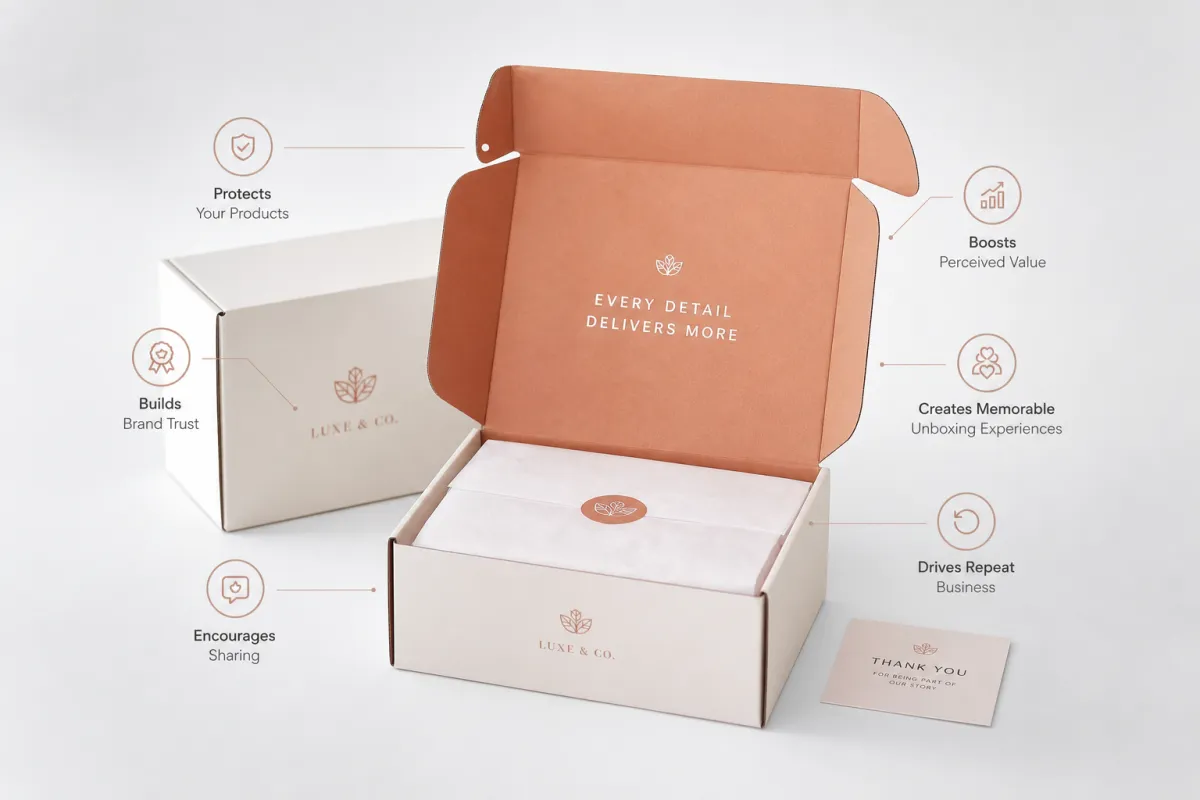
Branded unboxing boxes for ecommerce can be mailers, folding cartons, rigid boxes, or ship-ready structures with brand cues on the outside and inside. The phrase covers a lot of ground. A kraft mailer with one-color print counts. So does a rigid box with interior art, a paperboard sleeve, or a corrugated shipper with a custom reveal panel.
The job is bigger than decoration. Branded unboxing boxes for ecommerce set expectations at the door, signal quality before the product is touched, and reduce buyer doubt. If the packaging looks intentional, the item feels more credible. If it looks thrown together, customers notice. They may not say it out loud, but they notice. I keep seeing brands spend heavily on product photography and then send the order out in a box that says, "we ran out of time."
That reaction is not abstract. In practice, branded unboxing boxes for ecommerce can do four useful things at once: protect the item, organize the opening sequence, support repeat purchase behavior, and create a shareable moment that might show up in a review or on social media. Nothing is guaranteed. The odds just get better when the packaging is clear, well-fitted, and built for the actual shipping route instead of a fantasy one.
The brands that benefit most are usually the ones selling presentation as part of the product value. Skincare, jewelry, premium apparel, specialty foods, stationery, and subscription kits all get judged fast. Branded unboxing boxes for ecommerce help the package do some of the selling before the customer ever tests the item.
There is a tradeoff, because there always is. The more custom the experience, the more decisions you need to make about board grade, print coverage, coating, inserts, assembly, and budget. That is why branded unboxing boxes for ecommerce should be handled as a system, not a one-off design exercise. If the box looks beautiful but blows up fulfillment time, the math gets ugly fast.
The cleanest way to think about the function looks like this:
- Protection keeps the product usable and presentable.
- Recognition tells the buyer the package belongs to your brand.
- Confidence lowers friction after checkout.
- Experience makes the delivery feel deliberate instead of random.
Those four outcomes are why branded unboxing boxes for ecommerce can matter almost as much as the item itself in premium categories. Not always. But often enough that ignoring them gets expensive.
How they work
The customer journey starts before the box arrives. After checkout, the buyer expects a confirmation, a realistic delivery window, and a package that matches the promise made on the product page. Branded unboxing boxes for ecommerce fit into that chain by turning digital brand cues into something the customer can actually hold. If the site feels polished and the parcel shows up in a plain oversized carton with loose fill rattling around, the experience drops fast.
The journey usually has five stages: order confirmation, packing, transit, delivery, and reveal. Branded unboxing boxes for ecommerce need to perform at every stage, not just the last one. A box that photographs well but crushes in transit is not an asset. It is a problem with better lighting.
- Checkout to confirmation: the buyer forms an expectation about care and reliability.
- Packing: the team needs a box that fits quickly and consistently.
- Transit: the structure has to survive drop, vibration, compression, and weather exposure.
- Doorstep: visible branding creates recognition before opening.
- Reveal: interior design and product fit shape the final impression.
Visual hierarchy matters more than most teams think. On branded unboxing boxes for ecommerce, the first thing seen should be the strongest cue: logo, pattern, or a short message. After that, the eye should move naturally to the opening point and then to the interior reveal. Too many elements fight each other, and the box starts feeling busy instead of premium.
The operational side is just as important. Dielines, inserts, sizing, and sealing method determine whether branded unboxing boxes for ecommerce scale cleanly across a real fulfillment line. A beautiful mockup that takes twice as long to pack is a bad packaging decision. The best specs are the ones that can be repeated by staff moving fast through hundreds of orders.
Perception also changes how customers judge price. A premium-looking box can make the item feel more substantial, especially for lightweight goods where the product itself is easy to discount. That does not mean packaging can hide weak value. It means branded unboxing boxes for ecommerce can elevate a strong product story when the materials and finish support the positioning.
For transit testing, many teams use ISTA methods such as drop, vibration, and compression checks. That matters because packaging is not only visual; it is mechanical. A box that passes a style review but fails a shipping test is still a failure, just a prettier one.
One practical detail gets ignored too often: product fit, tamper evidence, and clear opening points all reinforce trust. A box that opens in one obvious direction feels deliberate. A box with a loose flap, weak adhesive, or no clear seam feels improvised. In branded unboxing boxes for ecommerce, tiny flaws have a way of looking bigger than they are.
Design factors that matter
Structure comes first. Mailer boxes, tuck-end cartons, rigid boxes, and sleeve systems each create a different opening experience and cost profile. Branded unboxing boxes for ecommerce that ship through parcel networks usually start with corrugated board, often E-flute for lighter premium mailers or B-flute where extra stiffness is needed. Heavier items may need stronger board, better caliper, or a tighter fit to avoid corner crush.
There is no universal best structure. A subscription brand shipping apparel every month may want a compact mailer that packs quickly and stacks efficiently. A fragrance brand may need a rigid box with a controlled reveal. Branded unboxing boxes for ecommerce should follow product weight, fragility, and the margin left after freight. If the package is overspecified, you're paying for cardboard theater. Fun in a pitch deck, less fun in the P&L.
Materials and finishes
Materials send a message before the box is even opened. Corrugated board feels practical and protective. SBS paperboard feels cleaner and more retail-like. Kraft stock suggests restraint and sustainability, while soft-touch coating tends to read as premium because it changes how the box feels in hand. Branded unboxing boxes for ecommerce can also use foil, spot UV, embossing, or debossing, but each finish adds cost and production complexity.
Here is the part many teams miss: finish choices should match the way the product is sold. If the website uses clean typography and muted colors, a box packed with bright gradients and several special effects can feel off. Branded unboxing boxes for ecommerce work best when the visual system stays consistent across the site, shipping confirmation, and packaging itself. Customers do notice the mismatch, even if they cannot explain why.
Print strategy
Full-bleed art makes a strong first impression, but restrained branding often feels more premium. A single-color logo on kraft stock can look more intentional than a crowded four-color design. That is especially true for brands that want the box to feel reusable or giftable. Branded unboxing boxes for ecommerce do not need to shout to be remembered.
Interior printing is one of the highest-return upgrades because it adds a reveal moment without changing the outer shipping footprint. A simple message inside the flap, a pattern on the interior walls, or a printed thank-you line can create a clear emotional lift. For many brands, that is a better investment than a second specialty finish on the outside.
Insert and interior design
Inserts are not only for protection. Paperboard dividers, molded pulp trays, tissue wraps, and printed reveal cards all help frame the product. They stop items from shifting, but they also guide the eye. Branded unboxing boxes for ecommerce feel more composed when the interior has a clear sequence: open, reveal, lift, inspect.
There is a cost tradeoff here. A molded pulp insert can be excellent for protection and sustainability, but it may not deliver the polished look a luxury box needs. Paperboard dividers are lighter and often cheaper. Tissue is low-cost and elegant, but it does not solve impact protection by itself. The right choice depends on weight, fragility, and the experience you want to create.
Consistency across the brand system
Typography, color, iconography, and tone should echo the product page and post-purchase emails. If the website uses sharp minimalism and the box uses playful cartoon graphics, the packaging feels disconnected. Branded unboxing boxes for ecommerce are strongest when the customer feels the same brand voice at every touchpoint.
For teams building their first spec set, it helps to compare packaging directions alongside actual product needs. Our Custom Packaging Products page is useful for mapping structure choices to the way a product ships, stores, and opens in the hand.
Here is a simple rule that saves trouble: choose one hero detail and let the rest support it. A strong insert. A great inside print. A clean exterior with one tactile finish. Branded unboxing boxes for ecommerce usually look better when they are edited, not when every surface is fighting for attention.
Cost and pricing for branded unboxing boxes for ecommerce
Price depends on five main drivers: box size, board grade, print coverage, finish selection, insert complexity, and quantity. Branded unboxing boxes for ecommerce get cheaper per unit as volume rises because setup, tooling, and plates are spread over more pieces. That is why a small run often feels expensive in a way that catches teams off guard.
Small runs are not automatically a mistake. They are just more expensive per box because the fixed work has to be absorbed quickly. A 1,000-unit order may carry a noticeably higher unit cost than a 5,000-unit order, even if the design is the same. For branded unboxing boxes for ecommerce, that difference often matters more than the difference between one finish and another.
Simple kraft mailers with one-color print can be relatively modest. Fully Custom Rigid Boxes with interior print, specialty coating, and inserts can climb fast. Freight, warehousing, damage rates, and labor are the costs people forget. If a box saves five seconds of packing time across thousands of orders, that can be worth more than shaving a few cents off board stock. If it adds five seconds, the math goes the other way. I have seen both outcomes, and the ugly one usually starts with "we'll just make it a little nicer."
| Box option | Typical unit cost | Best use case | Main watchout |
|---|---|---|---|
| Plain kraft mailer with one-color print | $0.55-$1.20 | Lightweight products, subscription kits, starter runs | Limited premium feel if the artwork is too minimal |
| Full-color folding carton with custom dieline | $0.70-$1.50 | Cosmetics, small accessories, retail-ready presentation | Needs secondary protection for shipping-heavy items |
| Corrugated mailer with interior print and insert | $1.20-$2.40 | DTC parcels that need protection and presentation | Design must balance packing speed and visual polish |
| Rigid box with custom insert | $2.50-$6.50 | Premium gifting, high-margin products, luxury presentation | Higher freight cost and more space in storage |
| Magnetic rigid box with specialty finish | $5.00-$12.00 | High-value launches and prestige unboxing moments | Can overshoot the product if the item itself is modest |
Those ranges are broad on purpose. A box with more print coverage, more custom structure, or more labor-intensive assembly can move outside them. Branded unboxing boxes for ecommerce should always be priced against the full landed cost, not just the box quote. A cheap freight bill on paper or a high damage rate in practice can wipe out the savings from a lower unit price.
One useful budgeting framework is to split the box into three buckets. The protection layer: board, fit, and transit strength. The customer-facing layer: print, finish, and interior reveal. The operational layer: packing time, inventory handling, and shipping cost. Branded unboxing boxes for ecommerce usually win when the customer-facing upgrades land where people will actually see them.
If sustainability matters to your buyers, ask for fiber-based options and review the certification chain carefully. The FSC system is one way to track responsible sourcing. That does not make a box automatically sustainable; it only makes the sourcing clearer. Recyclability still depends on coatings, adhesives, local collection systems, and whether the package combines too many materials.
Process and timeline for branded unboxing boxes for ecommerce
The standard workflow is simple enough: brief, concept, dieline review, prototype, approval, production, and delivery. Branded unboxing boxes for ecommerce move faster when the product size is fixed and the artwork is already organized. They slow down when the team is still arguing over dimensions, inserts, or what the opening experience should feel like. That part always takes longer than the spreadsheet says it will.
Timeline variables matter more than many buyers expect. A simple printed mailer may move through approval and production in roughly 10-15 business days after artwork is signed off, depending on supplier capacity. Custom Rigid Boxes, especially with specialty finish or multi-part inserts, often need several weeks from approved proof to shipping. Branded unboxing boxes for ecommerce with multiple size variants can stretch even further because each SKU needs its own checks.
Prototype work is where the real packaging decisions happen. That is the point to test product fit, check fold lines, validate opening sequence, inspect ink appearance under normal light, and confirm that the inserts actually hold the item in place. A box that looks strong on a screen can behave very differently once a real product is inside it. And yes, it can still look fine in the PDF while being a pain in the hand.
To reduce delays, lock structural dimensions before the art gets too polished. Approve the dieline early. Keep copy changes to a minimum after proofing starts. Most delays are not technical. They are coordination problems. Branded unboxing boxes for ecommerce can stall when marketing wants one more line, operations wants one more test, and the calendar is already tight. Been there. It is not cute.
If you need inspiration from real packaging programs, our Case Studies page shows how different formats support different shipping and presentation goals. That is usually more useful than browsing generic mockups, because the hard part is not making a pretty box. It is making a box that survives the job you actually need it to do.
A practical test plan usually includes:
- Drop tests on edges, corners, and faces.
- Compression checks for stacked inventory and parcel handling.
- Fulfillment timing with the actual packing team.
- Opening review from the customer's point of view.
That is where branded unboxing boxes for ecommerce stop being theory and start being useful. The right sample does not only look right; it packs quickly, ships safely, and opens in a way that supports the brand story without slowing the line.
Common mistakes with branded unboxing boxes for ecommerce
Overdesign is the first trap. Too many colors, messages, and effects can make the box feel busy instead of premium. Branded unboxing boxes for ecommerce work better when the design has breathing room. White space is not wasted space; it often makes the logo, the pattern, or the reveal feel more valuable.
Fit problems are another expensive mistake. Oversized boxes increase shipping costs, increase void fill, and make the experience feel careless. Even a small amount of unused space can push a parcel into a pricier dimensional-weight calculation, especially for lightweight goods. Branded unboxing boxes for ecommerce should be sized to the product, not to the design template somebody happened to have on hand.
Durability gaps are harder to forgive. Thin board, weak edges, or poor adhesives can damage the item and erase the branding payoff in one transit event. If the product arrives damaged, the customer is not evaluating the foil or the interior print. They are evaluating whether the brand can handle the basics.
Branding mismatches are equally damaging. If the site feels high-end but the box looks cheap, or if the post-purchase emails feel polished while the packaging feels generic, trust slips. Branded unboxing boxes for ecommerce should feel like the same company wrote the product page, packed the order, and answered the support email.
Sustainability mistakes can also backfire. A box with unnecessary laminates, mixed materials, or too much void fill may look thoughtful on a pitch deck and still perform poorly in the waste stream. The better move is usually simpler: use recyclable fiber where possible, keep coatings modest, and design for the actual packing method. Branded unboxing boxes for ecommerce should not create a sustainability story the operations team cannot support.
One more point many brands miss: the box is not the only thing customers see. Tape, labels, stickers, return inserts, and outer shippers all contribute to the impression. If one piece looks polished and the rest looks random, the experience feels uneven. A complete package system does a better job than a single impressive box.
Expert tips
Build a reveal sequence on purpose. The outside branding should create recognition, the interior should reward opening, and the product presentation should feel like the final answer. Branded unboxing boxes for ecommerce are strongest when each layer has a job. The outer box identifies the brand. The inner layer builds anticipation. The product tray or insert makes the item feel secure and ready.
Test with fulfillment staff, not just designers. That sounds obvious, but it is one of the most overlooked steps. The people who pack orders will tell you if a flap catches, if an insert slows down packing, or if the box collapses before the tape is set. Branded unboxing boxes for ecommerce only work at scale if the operations team can use them without drama.
Choose one hero detail. A smart insert, an interior message, or a tactile exterior finish usually does more than three half-baked embellishments. If the budget is tight, put the money where the customer will actually notice it. Branded unboxing boxes for ecommerce often look most premium when one detail is excellent and the rest is disciplined.
Measure the business outcome, not just the aesthetics. Track repeat purchase rate, social shares, support tickets, and damage claims. If a new box lowers damage and improves reviews, that is a tangible win. If it photographs beautifully but creates more packing labor, the math may not work. Branded unboxing boxes for ecommerce should earn their keep on both the brand side and the operations side.
Think like a packaging system. Tape, labels, inserts, tissue, seals, and outer mailers should work together visually and mechanically. The most convincing packages are usually the ones that look like every component was planned as part of one decision. That is usually a good sign the brand takes the customer experience seriously.
If you want to see how that thinking translates into real projects, browse the Case Studies page and compare how different products use different structures. The lesson is usually the same: the best branded unboxing boxes for ecommerce are not the flashiest. They are the ones that fit the product, the margin, and the workflow at the same time.
Next steps
Start with an audit. Compare your current package against the product category, target margin, shipping method, and buyer expectations. Branded unboxing boxes for ecommerce should be judged against the job they do, not against a generic premium box from another brand in another category.
Then build a short must-have list. Protection. Brand recognition. Packing speed. Target unit cost. Once those are clear, the rest becomes easier to sort. Branded unboxing boxes for ecommerce improve faster when the team knows what cannot be compromised and what can stay flexible.
Request one structural sample and one print sample. The structural sample tells you whether the box fits, closes, and protects properly. The print sample tells you whether the color, finish, and brand cues look right in real light. Together, they answer different questions. Branded unboxing boxes for ecommerce need both checks before the order scales.
Pilot the packaging with a small order batch, then compare damage rates, packing time, and customer feedback. The best improvement is the one that shows up in numbers and in comments. If the box is easier to pack, safer in transit, and better received by customers, the spec is working.
For brands planning their next run, our Custom Packaging Products page can help narrow down the right structure before artwork is finalized. That saves time later, because branded unboxing boxes for ecommerce are easier to approve when the box style matches the shipping reality from the start.
Most teams do not need a dramatic packaging overhaul. They need a cleaner spec, a tighter fit, a better reveal, and a clearer budget. Branded unboxing boxes for ecommerce become much more effective once the system is repeatable and the decisions are documented for the next production run.
If you treat branded unboxing boxes for ecommerce as a repeatable system instead of a one-off flourish, the box stops being an afterthought and starts doing real work: protecting margin, reinforcing trust, and making the delivery feel intentional. The practical takeaway is simple: start with fit, then move to structure, then spend on one detail customers will actually notice. Everything else is noise.
What are branded unboxing boxes for ecommerce used for?
They create a stronger first impression when the package arrives, protect the product during transit, and reinforce brand identity at the moment the customer is most receptive to it. In practical terms, branded unboxing boxes for ecommerce help a delivery feel intentional instead of generic.
How much do branded unboxing boxes for ecommerce usually cost?
Cost depends on size, board type, print coverage, finishes, inserts, and order quantity. Simple kraft mailers are usually far cheaper than rigid boxes with interior printing or specialty coatings, and freight plus packing labor can be a meaningful part of the total cost.
How long does it take to produce custom branded ecommerce boxes?
Basic printed mailers may move faster than fully custom structures. Prototype approval, artwork changes, and sampling rounds are the biggest timeline variables, and branded unboxing boxes for ecommerce with inserts or specialty finishes often need more lead time than teams first expect.
What materials work best for branded unboxing boxes for ecommerce?
Corrugated board works well for shipping-heavy products and better protection. Paperboard and rigid board suit premium presentation and lighter items. The best material depends on shipping method, product weight, and the image you want the packaging to project.
How do I make branded unboxing boxes for ecommerce feel premium without overspending?
Focus on one visible high-impact detail, such as the outside print, interior message, or insert design. Keep the structure efficient so you are not paying for oversized packaging or unnecessary extras, and test a few sample versions before scaling. That is usually the most reliable path to branded unboxing boxes for ecommerce that feel polished, perform well, and stay inside budget.