A quote for brown Kraft Paper Bags wholesale pricing can look simple and still miss the real cost once freight, storage, packing time, and reorders are included. Buyers often compare only the unit price and miss how the bag will actually perform in the operation.
The better metric is landed cost per filled bag. That includes the bag itself, the time needed to pack it, the space it occupies before use, and the freight needed to receive it. A cheaper bag that slows packing or arrives in awkward cartons can cost more than a sturdier option that moves cleanly through the workflow.
Brown kraft is usually strongest where the product is light to medium weight, the handoff is fast, and presentation still matters. It is not the right answer for every order, but it is often the most efficient option for buyers who need volume, consistency, and predictable storage.
The useful comparison is not unit price alone. It is unit price plus freight, handling, and the risk of buying the wrong spec.
Why brown kraft bags often beat cartons on landed cost
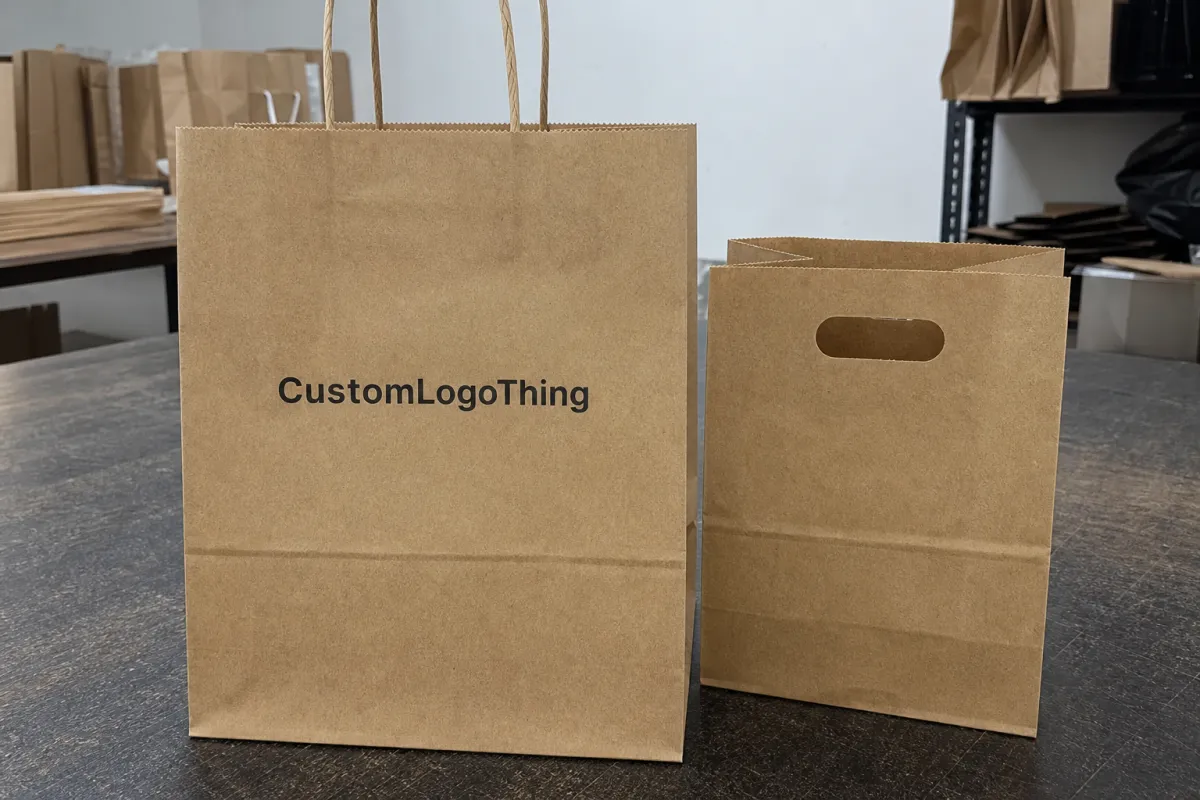
Corrugated cartons earn their place in packaging, but they are not always the lowest-cost format once the operation is running. Boxes occupy more storage volume, usually ship with more trapped air, and often need extra assembly or void fill. A flat-packed kraft bag takes less room, is easier to stage at a counter, and can be handed off faster.
That speed matters. The difference between a bag that loads in a few seconds and a carton that needs taping, folding, or fillers is easy to ignore in a quote. Over thousands of transactions, those seconds turn into labor, and labor can outweigh a small bump in unit price.
A bag also makes sense when the product does not need crush protection. Apparel, bakery items, takeout meals, dry goods, small retail purchases, and inserts are common fits. Cartons still win for breakables, stacked e-commerce orders, and anything that needs rigid compression resistance.
If the order has to move quickly across a counter, or if space behind the counter is tight, bags tend to outperform boxes on total operating cost. If the item is fragile, oddly shaped, or likely to be stacked, the carton may be cheaper in the long run even if its unit price looks higher.
Choose the right bag style, handle, and finish for the job
The fastest way to overspend is to buy a bag built for a different job. A premium twisted-handle shopping bag looks polished, but it can be unnecessary for a bakery counter. A plain no-handle sack keeps the bill down, but it may frustrate customers if they are carrying more than a light order.
Most buyers narrow the choice to four common constructions: SOS grocery bags, twisted-handle shopping bags, flat-handle takeaway bags, and plain no-handle carry bags. Each one behaves differently in storage, packing, and presentation.
| Bag style | Best use case | Typical spec signal | Quote impact |
|---|---|---|---|
| SOS grocery bag | Bakery, groceries, counter service | Flat bottom, stand-up base, efficient loading | Usually the lowest-cost format for simple carryout |
| Twisted-handle shopping bag | Retail checkout, gifting, branded carryout | Heavier paper, better presentation, more print visibility | Higher unit price, especially with multicolor artwork |
| Flat-handle takeaway bag | Foodservice, grab-and-go, cafe programs | Fast stacking, quick fill, easy handoff | Middle-ground pricing with strong throughput value |
| No-handle carry bag | Light retail items, inserts, simple takeaway | Minimal construction, lower material use | Lowest cost, but limited carry comfort |
Finish changes both appearance and cost. Natural kraft has the most utilitarian look and usually fits brands that want a grounded, recycled-material feel. Bleached kraft is brighter and cleaner, but it can cost more and sometimes works against a rustic identity. A restrained print on brown kraft often reads better than a heavily covered bag because it keeps the material visible and reduces ink coverage.
Print complexity matters too. A single-color logo is generally easier to run than a full wrap with tight registration. Larger print areas can mean more setup, more inspection, and more waste during the start of the run. That is one reason simple brand marks often outperform decorative artwork in wholesale programs.
Material claims need the same discipline. FSC-certified fiber, recycled content, and compostability are not interchangeable labels. One tells you about sourcing, another about recovered content, and the last depends on the whole structure, including coatings and inks. If the claim matters to procurement, ask for documentation rather than leaning on a phrase in a sales sheet. The FSC site is a solid reference point for chain-of-custody questions.
Paper weight, dimensions, and load ratings that affect performance
A useful spec sheet gives more than the outer size. It should include width, gusset, height, basis weight or gsm, handle type, reinforcement, print coverage, carton pack count, and any special coating or finish. Without those details, two quotes can look comparable while hiding very different performance levels.
Paper weight is one of the first numbers to check. Lightweight bakery bags often sit around 60-80 gsm. Retail carry bags tend to move into the 90-120 gsm range, and heavier-duty programs can go beyond that. The right number depends less on total weight and more on how the load behaves.
Load ratings deserve caution. A bag that handles 5 kg in a balanced load may fail early if the contents are uneven, wet, sharp-edged, or shifted to one side. Handle adhesion and bottom fold quality are easy to overlook until a bag tears at the wrong moment. Side seam alignment also matters because it affects stress points even when the bag looks fine at first glance.
That is why samples are worth the time. A supplier sample reveals how the bag stands, whether the mouth opens cleanly, how the handle feels in the hand, and whether the base is stable enough for the product mix. Buyers should also ask for the actual carton count, since pack density affects receiving time, pallet fit, and storage footprint.
If the bags will travel farther than a store counter, ask whether the supplier references transit or drop testing based on ISTA methods. That is not essential for every retail bag, but it becomes relevant when the order moves through distribution or sits in mixed cartons for a while.
Brown kraft paper bags wholesale pricing: what drives MOQ and unit cost
MOQ usually reflects how the bag is made, not just how many you would like to buy. Paper weight, size, handle type, print count, and run volume all affect how efficiently the line can operate. A plain unprinted bag is simpler than a custom-printed one, and a standard size is easier to repeat than a special dimension.
Volume generally pushes the unit price down, but it increases inventory exposure. Order too little, and the bag costs more per unit while reorders happen too often. Order too much, and cash sits in cartons. The right MOQ is the one that matches real consumption, not the one that makes the quote look strongest on the page.
| Typical run | Print level | Ballpark unit price | What usually moves the quote |
|---|---|---|---|
| 3,000-5,000 bags | No print or simple one-color logo | $0.08-$0.18 | Setup fees, paper weight, carton count |
| 5,000-10,000 bags | One-color to two-color print | $0.14-$0.32 | Handle type, ink coverage, freight method |
| 10,000-25,000 bags | Higher coverage or heavier paper | $0.20-$0.48 | Plate charges, packing format, proof revisions |
| 25,000+ bags | Custom print and repeat spec | Project-based | Volume breaks, storage, and lane stability |
Those numbers only help if they are quoted on the same basis. A unit price that excludes freight, samples, or setup can look better and still cost more after receiving. Ask whether the quote includes plates, prepress, pack-out, palletization, and delivery to your ZIP code.
Lower MOQ requests are usually easier to solve by simplifying the spec. Fewer print colors, a standard size, and a basic handle keep the line efficient. That does not make the bag generic; it means the design respects the production process instead of fighting it.
Buyers also should be suspicious of quotes that swing too widely between suppliers without a clear explanation. Often the difference is not the bag itself but the print method, paper source, or freight assumption hiding underneath.
Production steps, proofing, and turnaround from approval to shipment
Most delays happen before production starts. The path usually runs from quote to artwork review, digital proof, sample approval, production, packing, and shipment. If each stage is clean, the order moves. If artwork is messy or the spec changes after proofing, the timeline stretches quickly.
Missing dielines, low-resolution logos, unlabelled Pantone matches, and late requests to change dimensions are common problems. A file that looks fine on a screen can still fail at press scale. Vector artwork is the safer starting point, and clear color definitions reduce back-and-forth.
For planning, simple one-color runs can often move from proof approval into production in roughly 10-15 business days. More complex print coverage, heavier paper, or premium finishes can stretch that to 15-25 business days or longer. Freight adds its own clock, so the in-hand date should separate approval time, manufacturing time, and shipping time.
Seasonal changes, store openings, and packaging refreshes deserve early booking. Production capacity is easier to secure before the schedule gets crowded, especially for custom print runs that cannot be substituted as easily as stock bags.
Quality controls and reorder consistency that protect margin
Repeat orders are where a packaging program either stabilizes or starts to drift. The important checks are basic but non-negotiable: color consistency, handle adhesion, print alignment, carton count, and the condition of the bags at arrival.
Lot traceability matters more than small brands often expect. If one shipment arrives with a slightly different brown tone or a minor shift in logo placement, the difference is obvious across multiple locations. Saved specs, repeatable paper sourcing, and documented print settings reduce reproof charges and rework.
Reorder consistency also protects margin. If the supplier can hold the same paper grade, print layout, and carton pack count over multiple runs, your receiving team knows exactly what is arriving. That makes inventory planning easier and reduces the odds of an emergency replacement buy at a worse price.
Buyers also ask for recycled content or a higher post-consumer waste percentage for sustainability reporting. That can be smart, especially in branded retail or foodservice programs where the bag is visible to customers. The key is documentation.
Quality control is not just cosmetic. It is a margin tool. A bag that arrives on spec, packs quickly, and repeats cleanly across orders saves more money than a slightly cheaper alternative that drifts over time.
How to compare suppliers on freight, sample policy, and hidden fees
Suppliers can look similar until the quote is broken into parts. A fair comparison starts with the same request sent to each vendor. Ask for bag dimensions, paper weight, handle type, print count, quantity, carton count, sample policy, freight method, and delivery ZIP code.
Hidden charges tend to appear in the same places. Split shipments add freight. Storage fees can appear if goods sit too long. Reproof charges show up after artwork changes. Some suppliers quote the bag attractively but make palletization, rush production, or special packing an extra line item.
Sample policy deserves attention because a bag can look acceptable in a rendering and still feel wrong in the hand. If a supplier offers samples or a proof charge, ask whether that cost is credited against the order. Freight method matters too. Air solves time pressure, but it can erase the savings from an otherwise good unit price.
A useful supplier behaves like a spec partner, not a loose estimate machine. The quote should read like a production document, not a placeholder. That is the difference between a number that can be ordered and a number that only looks ordered.
A low quote is not automatically a low-cost program. Freight, reproofs, and packing changes can erase the savings before the bags are even used.
What to send for a quote and how to lock in your spec
Fast quoting depends on complete information. The best request includes target size, quantity, handle style, print colors, delivery location, and the date the bags need to be in hand. If there is a current sample or a product photo, include that too.
These details keep the process tight:
- Bag width, gusset, and height
- Paper weight or gsm target
- Handle style and reinforcement preference
- Print colors, logo file, and coverage area
- Quantity and preferred MOQ tier
- Freight ZIP code and receiving constraints
- Sample approval needs and in-hand date
It also helps to specify whether the order should become a repeatable spec. That matters for growth, seasonal reorders, and multi-location programs. A saved spec reduces back-and-forth on the next run and cuts the chance of pricing surprises when the bags are reordered later.
Most buyers do not need the most complex bag. They need the bag that performs, ships cleanly, and does not create extra handling. Read brown Kraft Paper Bags wholesale pricing as a complete program cost, not a sticker price, and the right quantity usually becomes easier to identify.
What MOQ should I expect for brown kraft paper bags wholesale pricing?
MOQ depends on size, print complexity, and handle style. Plain unprinted bags often allow lower minimums than custom-printed runs. Tiered pricing is useful because it shows how much the unit cost changes as volume increases.
How does printing change brown kraft paper bags wholesale pricing?
More colors, larger coverage, and tighter registration usually raise setup and run costs. One-color logos are typically the most efficient starting point for buyers focused on unit cost. If price matters most, compare limited-coverage artwork against heavier print coverage on the same spec.
Can I get samples before placing a bulk order?
Yes, and buyers should ask for them when fit, weight, or handle strength matters. A sample shows how the bag opens, carries, and stands on its own. If there is a sample or proof charge, confirm whether it is credited back on the order.
What details do you need to quote brown kraft paper bags wholesale pricing accurately?
Provide bag dimensions, paper weight, handle style, print count, quantity, and shipping ZIP code. Include artwork files or a logo mockup so setup costs are estimated correctly. A complete spec reduces quote revisions and keeps the comparison honest.
How long does wholesale production usually take?
Lead time depends on proof approval, quantity, print complexity, and current factory load. Simple runs may move from approval into production in 10-15 business days, while more complex orders can take 15-25 business days or longer. Freight time should be added separately.

