Bucket Hats Print Method Comparison gets complicated because the product is not flat, the decoration area is small, and the seams often sit right where the logo wants to go. A method that looks clean on a mockup can become awkward once it meets a curved crown, a narrow panel, and real production tolerances.
The useful question is not which method sounds best in theory. It is which one fits the hat, the artwork, the quantity, and the delivery window without creating avoidable cost or quality problems. For buyers, the decision usually comes down to appearance, durability, lead time, and how much setup the decoration requires.
The same logo can perform very differently across methods. What works on cotton twill may not work on nylon. What looks premium on a retail style may be too expensive for a promo run. The right choice comes from matching the method to the job.
What bucket hats print method comparison actually means
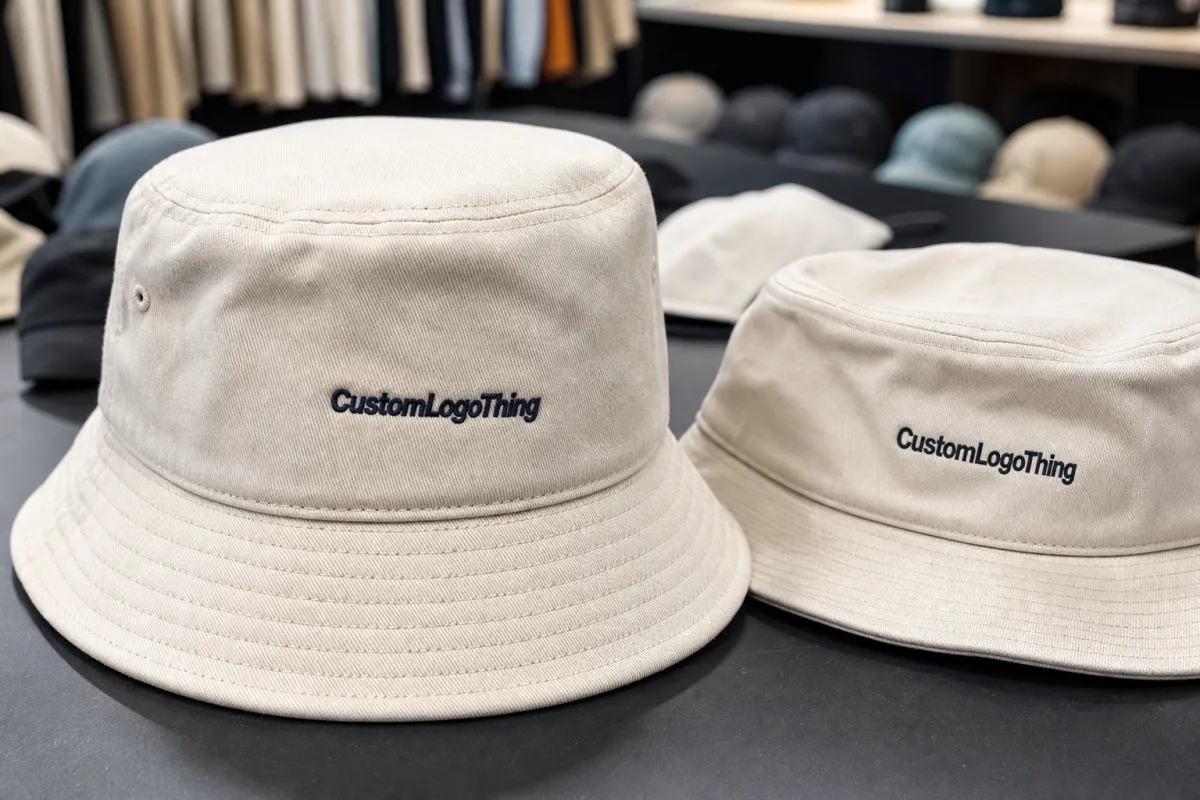
Bucket hats are harder to decorate than many caps because the branding area is smaller and less forgiving. The front panel can look generous in a flat sketch, then shrink once the actual pattern is sewn. If the logo ends up too close to a seam or too large for the crown, the final hat can look crowded or off-center.
A bucket hats Print Method Comparison is really a tradeoff analysis. Which method keeps the logo readable? Which one preserves the hand feel? Which one survives wear, sweat, and washing? And which one fits the order size without unnecessary setup cost?
The main options are embroidery, screen print, heat transfer or DTF, woven patches, appliqued or rubber patches, and sublimation on compatible fabrics. Each one behaves differently on cotton twill, nylon, polyester, and blends. A method that delivers sharp results on one fabric can fail quickly on another.
It helps to define the brief before comparing methods: fabric, panel count, logo size, quantity, target price, and shipping deadline. A summer promo bucket hat and a retail streetwear style are both bucket hats, but they do not need the same decoration strategy.
How the main decoration methods work on bucket hats
Embroidery stitches thread into the fabric, which usually gives the strongest premium impression. On cotton twill and heavier blends, it can look excellent for short wordmarks, simple icons, and logos with enough open space. Its limits show up with tiny type, thin lines, and dense stitch fills, which can close up or cause puckering on softer crowns.
Screen print places ink on top of the fabric. It is a good fit for bold graphics, simple spot-color logos, and larger runs where setup can be spread across volume. It is often one of the most economical methods, but seams, curves, and textured fabrics can distort the print if placement and ink control are not handled carefully.
Heat transfer and DTF print the design separately and then apply it to the hat. This approach handles small text, fine detail, and multi-color artwork better than standard embroidery or many screen print setups. It is useful when the logo includes gradients or complex artwork, but the finish has to be clean. A thick or glossy transfer can make the hat feel more promotional than retail.
Woven patches and appliqued patches create a badge-like look with sharper edges than embroidery alone. They work well when the brand wants clearer small text or a structured, premium feel without forcing every detail into thread. Sublimation is narrower in use: it requires compatible polyester surfaces and usually lighter colors, so it makes sense only when the material and the artwork support it.
In practice, embroidery and patches usually feel more premium, screen print is often strongest on cost and speed, and transfers are the most flexible for detail. The right answer depends on what the hat needs to communicate at first glance.
Which method fits your fabric, panel count, and artwork
Fabric is the first filter. Cotton twill is the most forgiving surface for embroidery and patches because it has enough body to support stitching and attachment. Nylon needs more caution with heat and pressure, especially if the surface has a coated finish. Polyester blends open up more transfer and sublimation options. If a supplier says every fabric works equally well with every method, that is a warning sign.
The artwork comes next. A one-color icon is easy to decorate. A logo with tiny type, hairline strokes, gradients, or layered crests narrows the choices fast. If the design has to stay readable at a small size, embroidery may lose detail and screen print may struggle near seams. Transfers or woven patches often handle that scale better.
Panel count matters more than many buyers expect. Some bucket hats have a roomy front panel; others have tighter construction, more topstitching, and a front section that is smaller than it looks in a catalog image. If the logo crosses a seam, a thick embroidered mark can pucker and a transfer can wrinkle at the edge. The actual pattern should be checked, not just the flat mockup.
Use the end use as the final filter:
- Event and promo use: prioritize cost, speed, and acceptable durability.
- Retail use: prioritize hand feel, logo clarity, and perceived value.
- Hot weather and sweat: prioritize stable attachment and wash resistance.
- Fashion drops: prioritize finish, clean edges, and controlled branding.
That is why a useful bucket hats Print Method Comparison weighs art, fabric, and use case together. Two hats can look similar in a line sheet and still need very different decoration methods.
Cost, pricing, and MOQ: what drives the quote
Most quotes include setup fees, digitizing or artwork prep, decoration cost, quantity-based unit pricing, and extras such as labels, patches, packaging, or special finishing. Small art changes can move the price more than buyers expect. A simple one-color mark is cheap to run; a detailed crest with many thread colors or a complex placement is not.
Embroidery often looks expensive at low quantity and more reasonable at scale because the fixed work is front-loaded. Digitizing, machine setup, and sampling do not disappear on a small order. Screen print follows the same logic: simple art and larger volume improve the unit cost, while extra colors, oversized graphics, or specialty inks push it higher.
| Method | Typical bulk unit cost | Best for | Main tradeoff |
|---|---|---|---|
| Embroidery | $0.95-$2.75 | Premium logo look, durable branding | Small text can fill in |
| Screen print | $0.45-$1.10 | Bold art, simple spot color logos | Less forgiving on seams and curves |
| Heat transfer / DTF | $0.85-$2.40 | Fine detail, gradients, CMYK art | Feel may read less premium |
| Woven patch | $0.70-$1.90 | Badge-style branding, sharper edges | Attachment method adds complexity |
| Sublimation | $0.60-$1.50 | Polyester surfaces, all-over color | Material and color limits |
MOQ changes the math too. A decoration system that works well at 1,000 pieces may be awkward at 100. Smaller runs often shift toward transfers or patches because setup is lighter, but unit price rises to cover the extra handling. That is the tradeoff, not a hidden charge.
For retail programs, ask whether the quote includes hang tags, woven labels, polybags, carton pack-out, and warehouse prep. Those details can move the budget more than the decoration itself. If the product needs transit testing, check whether the carton spec follows ISTA practices. If the packaging story matters, FSC sourcing may matter too.
Process and lead time: how bucket hats move from art to shipment
The workflow is familiar: brief intake, artwork cleanup, method recommendation, proofing, sampling, bulk production, finishing, packing, and shipment. The delays usually happen before production starts, not during sewing or printing. Missing measurements, vague placement notes, and late artwork changes are the most common causes.
Fast decisions help more than fast chasing. If the supplier still has to confirm logo size, thread colors, or panel placement after the proof is issued, the schedule will slip. Fabric sourcing can also add time if the exact color or hat style is not in stock.
Typical lead times after art approval often fall into these ranges:
- Embroidery: 10-15 business days.
- Screen print: 7-12 business days.
- Heat transfer / DTF: 7-10 business days.
- Patches with attachment: 12-18 business days.
Three questions prevent most surprises: when the production clock starts, whether the sample is digital or physical, and how many revision rounds are included before the order is locked. If the order also needs special carton drops or warehouse requirements, that should be clear before approval, not after production has started.
Common mistakes that make bucket hats look cheap
The first mistake is oversizing the logo. Bucket hats have limited decoration space, and a graphic that feels balanced in a mockup can overwhelm the finished hat. Bigger does not automatically improve visibility; on this product, it often makes the hat look crowded.
The second mistake is forcing too much detail into the wrong method. Fine type, thin strokes, and subtle gradients rarely survive embroidery well and can also look muddy in a weak print. If the logo only works under ideal conditions, the method is wrong for the artwork.
The third mistake is weak contrast. Dark thread on dark fabric, pale ink on washed-out cloth, or a patch that blends into the crown all reduce readability. Bucket hats are worn outdoors and in motion, so what looks refined in a studio can disappear in daylight.
If the logo needs a ruler to read, the hat probably needs a different decoration method.
The fourth mistake is skipping a real sample check. Curved surfaces change how the design reads. A flat proof will not show how a seam interrupts the mark, whether the logo sits too low, or whether stitching causes rippling. A sample costs less than a production mistake.
Expert tips for cleaner decoration and better sell-through
Choose the method for the buyer, not for the render. Retail programs can justify a more premium finish, while promo orders usually need discipline on cost and durability. A buyer will accept a slightly simpler logo faster than a hat that peels, cracks, or puckers after a few wears.
Keep the artwork controlled. One strong icon, one readable wordmark, and enough negative space usually work better than a crowded layout on curved headwear. Squeezing in slogans, dates, and tiny supporting graphics rarely helps sell-through.
Ask for method-specific mockups. A useful supplier should show how stitch direction, print size, or patch placement behaves on the actual bucket hat shape, not on a flat template. If the preview is vague, the production result will probably be vague too.
Before approval, run the hat through a quick check:
- Appearance: does the logo read clearly from a few feet away?
- Feel: does the finish match the price point?
- Durability: will it survive wear, sweat, and washing?
- Unit cost: does the method fit the margin?
- Turnaround: can the calendar absorb sampling and setup?
That kind of bucket hats Print Method Comparison keeps the decision practical. It replaces preference with visible tradeoffs, which is usually what buyers need before placing the order.
Next steps: brief your supplier and compare samples
Before requesting quotes, gather the basics: hat material, panel style, color count, logo size, target quantity, packaging needs, and the real price ceiling. Suppliers quote more accurately when the brief is specific.
Ask for two or three methods on the same artwork. That side-by-side view shows how each option changes clarity, hand feel, and cost. A price difference of a few cents can disappear the moment a method looks wrong in hand.
Request a sample or proof on the exact bucket hat style you plan to order. The same logo can behave very differently across crown depth, brim width, and panel construction. A comparison based only on screenshots is weak evidence.
Use the result to choose the method that balances branding impact, durability, and cost. If one option looks cheaper but reads weaker or fails earlier, that is not savings. It is deferred waste.
Which bucket hat print method lasts the longest?
Embroidery usually lasts the longest because the design is stitched into the fabric rather than sitting on top of it. High-quality woven patches can also wear well if the edge finish is tight and the attachment is secure. For repeated wear, heavy sun, and sweat, avoid fragile transfer films unless the supplier can show clear wash and abrasion performance.
Is embroidery better than screen printing for bucket hats?
Embroidery usually looks more premium and tends to hold up better over time, but it is not ideal for very small text or thin linework. Screen printing works better for bold graphics, simple art, and lower-cost orders. If the logo includes gradients, fine detail, or small type, a transfer method or patch may be the better fit.
What is the cheapest way to decorate bucket hats?
The lowest-cost option is usually a simple one-color screen print or a basic patch, depending on quantity and setup fees. At smaller quantities, a transfer can sometimes cost less overall because it avoids heavier setup. Cheap is not the same as smart. If the decoration looks weak or fails quickly, the real cost is higher.
How do seams affect bucket hat print methods?
Seams can interrupt the logo, distort fine text, and limit where the artwork can sit. Embroidery may handle small placements better than some print methods, but dense stitching near a seam can still pucker the fabric. Always check the exact panel layout before approving the artwork, because a flat mockup will hide seam issues.
How do I choose the right method for a bulk bucket hat order?
Start with the artwork, then match the method to the fabric, budget, and timeline. Compare the options on durability, hand feel, unit cost, and lead time rather than judging by sample photos alone. If the choice is unclear, ask for two sample methods on the same hat style and compare them side by side before placing the full order.


