Custom Clothing Store Paper Bags: Print Method Comparison sounds straightforward until the first sample comes back and the logo is too soft, too glossy, or already weakening at a fold. A custom clothing store Paper Bags Print Method Comparison is really a check on durability, color control, and presentation under retail use, not just a visual preference exercise. The wrong method can make a bag look inexpensive even when the stock is decent, and the wrong stock can make a strong print process look underpowered.
The question is not which method looks best in a mockup. It is which method survives real handling, respects the paper you chose, and fits the quantity you need. That means the print process, bag construction, and artwork all have to line up. On clothing store bags, the main choices are flexographic, offset, digital, and screen printing, with foil, varnish, or embossing added only when the budget and timeline allow it. Each method behaves differently on brown kraft, white coated stock, and recycled paper, so the same design can produce very different results from one spec to the next.
Custom clothing store paper bags print method comparison: start here
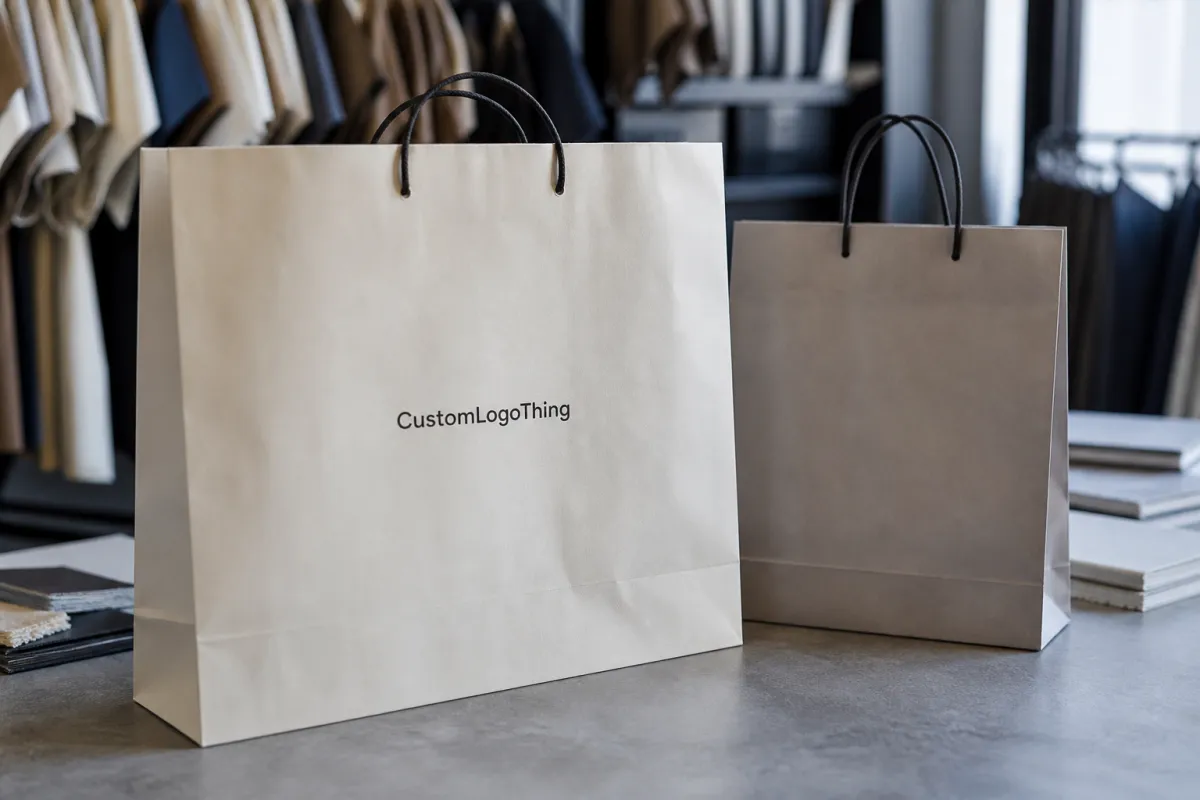
Retail buyers usually want two things from a paper bag: a clean branded look and a cost that makes sense across the full season. Those goals often clash. A boutique may want a premium finish that supports apparel pricing, while a higher-volume store needs a bag that can go out with every sale without becoming a margin problem. That is why this decision matters more than it first appears.
The first surprise for many buyers is how much paper stock changes the result. A design that looks sharp on a coated white bag can look muted on natural kraft. Thin lines can fill in, pale colors can disappear, and heavy solid areas can crack or show uneven absorption if the paper surface is rough. A simple one-color mark on a strong substrate often performs better than a more complex design on the wrong paper. That is not a compromise. It is good production sense.
Here is the practical shortcut:
- Flexographic printing suits repeat orders and simple graphics at scale.
- Offset printing is better for sharp detail, fine type, and multi-color artwork.
- Digital printing works well for shorter runs and artwork that may change.
- Screen printing is strong for bold spot colors and heavy ink coverage.
If the bag must look clean from arm’s length, hold up through folding and stacking, and still read clearly on the exact paper you ordered, the fanciest method is not always the best one.
How the common paper bag print methods actually work
Flexographic printing uses flexible plates and fast press setups. That makes it efficient for repeated artwork, especially when the design stays stable across reorders. It is commonly used for packaging that needs consistent output and lower unit cost at volume. On paper bags, flexo tends to work best with one to three solid colors, bold logos, and clean shapes. It is less forgiving if the artwork relies on tiny type or delicate gradients.
Offset printing is the better choice when the design needs tight registration, crisp detail, or a richer color build. It performs well on smoother paper surfaces and coated sheets, where ink sits more evenly and the image stays sharp. If the bag design includes fine lines, small lettering, or softer tonal transitions, offset often gives the most polished result. It usually suits premium retail packaging, but it asks more of the paper and the prepress setup.
Digital printing avoids the plate stage, which makes it useful for short runs, fast approvals, test programs, and seasonal artwork that may change. It is the most flexible option when a store needs a small order quickly. The tradeoff is that some digital systems do not handle rough kraft as well as coated stock, and heavy coverage can look less uniform than buyers expect. For a run of 250 to 1,000 bags, digital is often the most practical route.
Screen printing pushes ink through a stencil, laying down thick, opaque color. It has a distinct look that suits large logos and simple branding. The heavier ink film can feel premium on kraft, but it is not the right answer for detailed illustrations or very small text. Screen printing shines when the design is bold and the brand wants strong contrast rather than a photographic finish.
Paper construction changes every one of these results. Fiber direction, paper weight, coating, and bag folds affect how ink transfers and how fast it dries. A natural kraft bag absorbs differently from a white SBS or coated sheet, and that changes both tone and sharpness. Practical suppliers ask for the exact bag spec before recommending a method, because print performance is tied to the substrate, not just the press.
Special finishes add another layer. Foil stamping, spot varnish, matte lamination, gloss varnish, and embossing can raise the perceived value of the bag, but they also add setup, inspection points, and potential delays. They work best when they support the artwork rather than compete with it. A clean print on good paper usually does more for a clothing store than a crowded design with too many finishing effects.
What to compare beyond the logo: paper, color, finish, and durability
The logo is only one variable. Clothing Store Paper Bags are handled by staff, customers, and storage rooms, so the substrate and construction matter just as much as the artwork. A simple mark can look expensive on a dense white paper with a matte finish, while the same mark can look flat on a loose recycled sheet. That is why the bag spec must come before final approval, not after it.
Paper color changes how a print method behaves. White stock gives the widest color range and the strongest contrast. Natural kraft softens light colors and can make metallic inks less vivid. Recycled paper often has visible fiber variation, which gives the bag a more natural feel, but it also makes fine detail harder to control. If the artwork depends on saturated reds, deep blues, or very small typography, test those colors on the actual paper rather than on a screen.
Durability is easy to overlook until the bags start moving through a store. Paper bags are folded, stacked, loaded into carts, carried in damp weather, and reopened by staff. If the print cracks at a crease or rubs off at the gusset, the whole bag reads as lower quality. Ask about abrasion resistance, flex cracking, and how the print behaves on the bottom panel and side folds. Those are the places where weak execution shows first.
Structure matters too. Twisted paper handles, flat handles, rope handles, and cutout handles all send different signals. Reinforced top folds and gussets improve carrying performance and help the bag keep its shape. For apparel, that presentation is part of the package, especially if the store also uses coordinated product packaging across labels, tissue, and custom printed boxes.
Material specs should be specific. Many Clothing Store Paper Bags fall in the 120 to 200 gsm range, depending on size and carry weight, though heavier formats may be used for premium garments or larger formats. Handle reinforcement, gusset width, and paper caliper can change the feel as much as the print itself. If the bag is meant to carry folded denim or a boxed item, ask whether the chosen stock has enough stiffness to stay upright without buckling.
Sustainability claims deserve the same scrutiny as the print finish. If FSC certification matters to the brand, the chain of custody should be documented rather than assumed. FSC explains how responsible sourcing is tracked through the supply chain: FSC certification guidance. The same standard applies to recycled content claims. A strong label on the bag is only credible if the paper spec can support it.
Cost, pricing, MOQ, and unit cost: where quotes really change
Price comparisons get messy fast because the numbers are often built on different assumptions. Setup charges, plate costs, screen preparation, proofing, and finishing steps all change the real cost. A 500-piece digital order and a 5,000-piece offset order are not competing on the same cost structure. They may not even be solving the same problem.
As volume rises, flexo and offset often become more efficient because the setup is spread across more units. Digital typically wins on low setup cost and short-run flexibility. Screen printing can sit in the middle, especially for simple one- or two-color designs, but the final cost depends heavily on coverage area and color count. A large solid logo across a tall bag costs more to produce than a small mark near the top fold, even if the artwork looks simple.
| Method | Best fit | Typical order profile | Cost behavior | Watch-outs |
|---|---|---|---|---|
| Digital printing | Short runs, variable art, fast approval cycles | About 100 to 1,000 bags | Higher unit cost, low setup cost; often $0.55-$1.40 per bag depending on size and coverage | Less forgiving on rough kraft and large solid areas |
| Flexographic printing | Repeat orders, simple logos, larger quantities | About 1,000 bags and up | Higher setup cost, lower unit cost at volume; often $0.18-$0.65 per bag | Small type and fine detail need careful prepress control |
| Offset printing | Fine graphics, premium retail presentation | Mid to large runs on smoother stock | Good value at scale; often $0.20-$0.75 per bag depending on paper and finish | Best on white or coated paper, less consistent on rough kraft |
| Screen printing | Bold spot colors, heavier ink coverage | Small to mid-size runs | Moderate setup, strong visual impact; often $0.30-$1.10 per bag | Not ideal for fine detail or complex color blends |
Those ranges are directional. Bag size, paper weight, handle style, print area, color count, coating, and delivery destination all move the number. A small logo on a standard apparel bag is a very different job from a large-format fashion bag with full-panel coverage and a matte finish. Add foil, spot varnish, or embossing, and the price changes again.
Minimum order quantities matter just as much as unit cost. A printer may quote a low per-bag rate on a large run, but if the MOQ is far beyond what the store can store or sell through, the savings evaporate. For a seasonal brand or a retailer testing a new look, a smaller run at a higher unit cost may be the safer decision. A reorderable spec sheet often saves more money than chasing the lowest first quote.
Shipping should not be treated as an afterthought. Bags are light, but they are bulky, and cartons can crush if the outer packaging is not sized well. For long-distance shipping or warehouse storage, carton strength and stack stability deserve attention. Packaging groups often point to transit-test standards such as ISTA when they are validating shipping performance; their resources are a useful baseline: ISTA packaging testing resources. Not every order needs formal lab testing, but every order does need realistic packing assumptions.
Process, timeline, and lead time: from proof to delivery
The production path is usually simple on paper and less simple in practice. It starts with file review and dieline confirmation, then moves to stock selection, proofing, approval, setup, printing, finishing, packing, and shipping. Each step can add time if the artwork changes or the specs are not fully locked. A small shift in logo placement or print color can require a revised proof and push the schedule back.
Digital printing often moves faster because it avoids plate production. Offset and flexo usually need more prepress work, which adds time before the first production sheet is approved. That is normal, not a delay by itself. What usually stretches lead time is incomplete artwork, late revisions, or uncertainty around finishes. If a bag needs varnish, foil, or embossing, expect extra setup and inspection time.
Many orders land somewhere around 10 to 20 business days after proof approval, though simple digital runs can finish sooner and premium multi-step jobs can take longer. That range is not a promise; it is a planning window. If the bags need to arrive before a launch, holiday floor reset, or store opening, build in a buffer for transit and receiving. A bag arriving late is effectively a missed order.
Sequence matters in retail packaging. If the store is coordinating bags with tissue, hang tags, or custom printed boxes, one delayed item can throw off the rest of the rollout. The safest orders are the ones that account for the full chain, not just the print run. The bag has to arrive in the right format, the right quantity, and the right condition.
Step-by-step comparison guide: common mistakes to avoid
Start with equal inputs. Confirm the quantity, bag size, paper weight, handle style, artwork complexity, finish expectations, and delivery date before comparing quotes. If one supplier is pricing a 150 gsm white bag with a two-color logo and another is pricing a lighter kraft bag with a single-color mark, the comparison is meaningless. Good procurement begins with identical specs.
- Match the artwork to the method. Use digital for flexibility, offset for detail, flexo for repeated runs, and screen for bold spot color.
- Lock the paper first. Kraft, white paper, recycled stock, and coated stock each change color, sharpness, and drying behavior.
- Ask for a printed proof. A screen or PDF never shows how ink behaves on the real substrate.
- Judge at arm’s length. That is the distance customers and staff usually see the bag.
- Check the reorder plan. The first order is only part of the cost if the bag becomes a regular item.
One common mistake is approving a design that looks good on a monitor but breaks down on kraft because the type is too small or the colors are too close to the paper tone. Another is choosing the print method before the paper is finalized. That can force a redesign later, especially if the chosen stock cannot hold the level of detail the artwork needs. Buyers also underestimate how much one more color, one more finishing pass, or one more revision can change the timeline.
There is also the quiet issue of handling tolerance. Bags may look perfect on a sample sheet and still underperform once folded, stacked, and shipped. Ask how the printer checks registration, color consistency, and scuff resistance before cartons leave the floor. A good bag should survive normal retail handling without obvious wear, even if it is not meant for heavy-duty carry.
Expert tips and next steps for ordering better bags
Request a printed sample on the exact paper stock whenever possible. That one step gives more useful information than a polished mockup. It shows coverage, line sharpness, color density, and whether the ink sits cleanly on the fibers. For apparel packaging, that matters because the bag becomes part of the store’s visual signal, not just a container.
Build a one-page spec sheet and keep it for reorders. Include dimensions, paper weight, handle type, color count, finish, and target quantity. That keeps future quotes comparable and reduces spec drift over time. It also helps when packaging formats change seasonally, because the printer can see exactly what changed and what stayed consistent.
Ask about production tolerances before approval. Registration variation, paper shade variation, and slight color movement are part of manufacturing, even on well-run jobs. A credible supplier will explain the acceptable range and where the finish may vary. That honesty is more useful than a promise of perfect uniformity across every sheet.
For most clothing stores, the best decision is the one that balances print quality, lead time, and reorder economics. A short-run digital quote can make sense for a launch, while a flexo or offset run may be smarter once the design is stable and demand is clearer. If the store uses packaging as a brand cue, the method should support the bag’s job in the space, on the street, and in the stockroom. That is the real value of a custom clothing store Paper Bags Print Method Comparison: a decision grounded in how the bag will actually be used, not just how it looks on screen.
Which print method is best for custom clothing store paper bags with a small order?
Digital printing is often the most practical choice for short runs because it avoids plate costs and handles quick artwork changes well. If the design is simple and uses only one or two solid colors, screen printing can still work, but the setup has to justify the quantity. A printed sample on the actual bag stock is the fastest way to check color, coverage, and readability.
How do I compare pricing for custom clothing store paper bags print method comparison quotes?
Compare setup charges, per-bag pricing, proofing, plates, screens, and any finishing costs on the same bag spec. Make sure each quote uses the same dimensions, paper weight, handle style, print area, and color count. Also check reorder pricing, because the lowest first order is not always the cheapest way to buy the bag over time.
Why does paper type change print quality so much on clothing store bags?
Paper texture and color change how ink sits, spreads, and dries. White or coated stock usually gives stronger contrast and finer detail, while natural kraft can mute pale colors and soften small type. Recycled stock may have more visible fiber variation, which looks natural but can make print consistency harder to hold.
How long does the print process usually take for custom retail paper bags?
Simple digital runs can move faster because they skip plate production, while offset and flexo often need more prepress time. A typical lead time after proof approval often falls around 10 to 20 business days, but finishes, artwork changes, and shipping can push that longer. If the bags are tied to a launch or opening, leave extra room.
What is the biggest mistake in a custom clothing store paper bags print method comparison?
The biggest mistake is choosing on price alone and ignoring how the design behaves on the actual paper. A second common mistake is approving artwork on screen instead of checking a printed proof. The safest comparison looks at method, material, timeline, and total cost together.

