A bulk knit Beanies Embroidery Cost guide should help buyers compare quotes with a clear head, not chase the lowest starting number and discover later that digitizing, setup, rush handling, and freight were all separate. The real question is not whether embroidered beanies can be affordable. It is whether the quote is built on the right inputs so the unit cost still makes sense after the order is approved, stitched, packed, and shipped.
Embroidered knit beanies are one of the more efficient branded winter items to buy in volume. The decoration area is compact, the logo is easy to see, and a folded cuff gives the embroidery a stable surface. That combination works well for employee kits, trade-show giveaways, retail bundles, and seasonal programs. The economics are straightforward: larger runs spread setup over more pieces, while smaller runs feel the impact of each production step more sharply.
Why embroidered knit beanies are a strong bulk buy
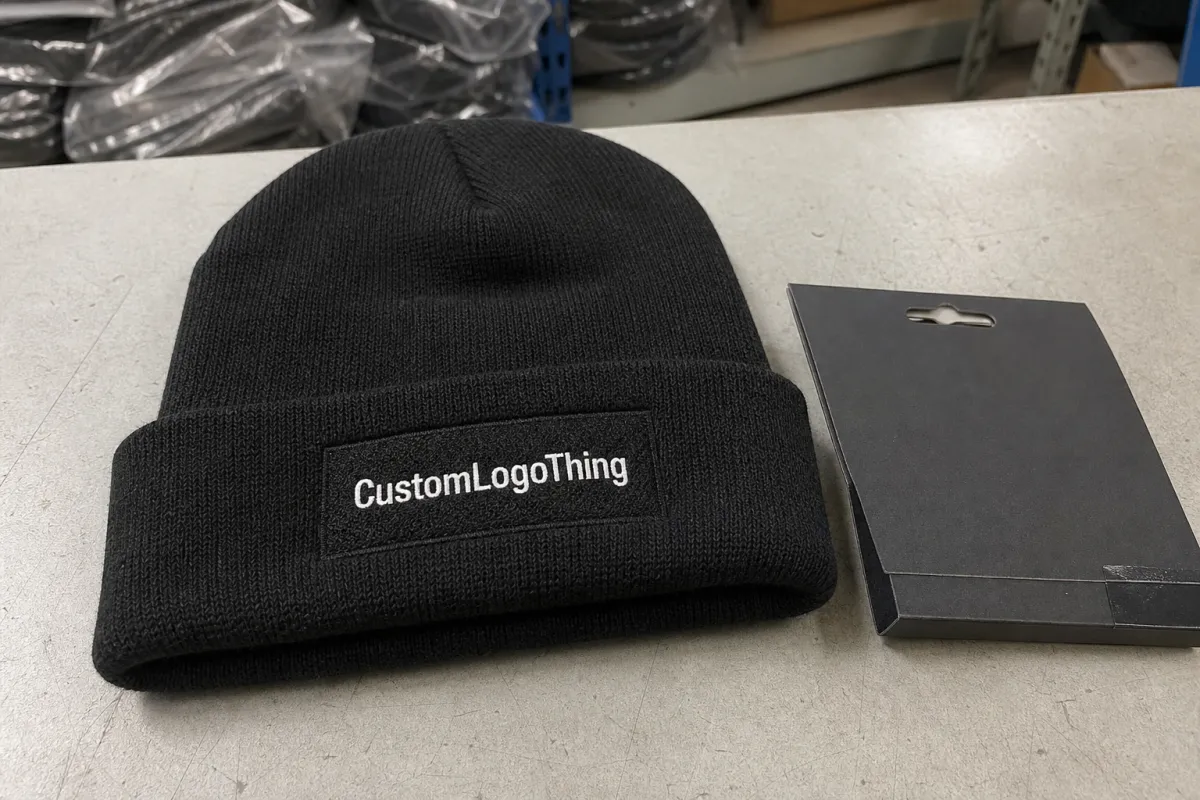
A cuffed beanie gives buyers a surprisingly efficient branding surface. The logo sits where people actually look, the decoration area is usually small, and the base product is easy to source in standard colors. That makes the buying process more predictable than many winter accessories. If the artwork is already clean and vector-ready, the quote process gets even smoother because there are fewer variables that can move the price.
The strongest use cases are the ones where the same item needs to reach many people quickly. Employee welcome kits need consistency. Trade-show merch needs the logo to read from a distance. Retail bundles need a product that looks good at a glance and still leaves room for margin. Holiday programs often favor beanies for a practical reason: the gap between a blank knit hat and an embroidered one is usually easier to justify than the jump from a blank item to a high-ticket jacket or blanket.
Most quote differences come down to three inputs: quantity, logo size, and beanie construction. The beanie itself is only part of the equation. A standard cuffed beanie with a clean logo usually costs less to decorate than a very soft, loose knit that needs extra stabilization. Experienced buyers compare the inputs first, then the headline number. That is usually the only way to tell whether a quote is truly competitive or merely incomplete.
If a program will be reordered later, the savings get better. The artwork file can be stored, the placement can be repeated, and the spec can stay consistent from one season to the next. Reorders often move faster because the first round already solved the decoration questions.
What the beanie style changes: yarn, knit, cuff, and fit
Yarn choice affects hand feel, warmth, consistency, and cost. Acrylic is usually the easiest option for larger programs because it is stable, widely available, and straightforward to quote. Wool blends can feel warmer and more premium, but they can also introduce higher material cost and more variation in texture. Recycled yarn can be a smart choice for sustainability goals, though it often comes with a narrower color range and more discussion around minimums. For buyers focused on budget control, standard acrylic or an acrylic blend is usually the most practical place to start.
Knit structure matters as much as fiber content. A tighter rib knit tends to hold embroidery better because the surface is less likely to shift under the needle. Cuffed beanies are generally the safest decoration choice because the cuff gives the logo a flatter zone and helps keep placement consistent from piece to piece. Cuffless styles can work, but the logo has less natural support. If the knit is very soft or loose, the embroidery may sit a little unevenly, which can force a larger stitch field or a simpler mark to keep the finish clean.
Fit is another hidden variable. A one-size adult beanie covers most corporate and event needs, but youth sizing can matter for school merch, family programs, or retail assortments. Higher-stretch knits help because they fit more heads without splitting the order into multiple SKUs. That kind of flexibility reduces inventory friction later. Stock colors usually quote faster than custom-dyed or heathered yarns, and heathered options can also introduce color variation that complicates approvals when color matching is important.
The practical question is not whether one yarn is always better. It is whether the construction supports the decoration method and the end use. A hat that looks good in a sample photo can still create problems if the knit is too loose for the logo size, or if the yarn texture makes the stitching sink too far into the fabric. Small structural differences can change both the look and the price.
Embroidery specs that affect stitch count and durability
Embroidery pricing becomes easier to understand once the spec sheet is in front of you. The main levers are logo width and height, stitch density, thread color count, backing, and digitizing format. A larger mark usually means more stitches. More stitches mean more machine time. A design that looks simple on screen can still cost more if it covers a wide area or uses dense fill stitching.
Single-location decoration is the simplest and usually the most economical. Once a buyer adds a side logo, back detail, or second placement, production time rises quickly. The amount varies by artwork, but the pattern is consistent: extra placements increase both setup and run time. If you are comparing vendors, ask whether the quoted price includes one placement only. That detail often gets buried in the fine print and changes the final total more than buyers expect.
Knit fabric also limits what embroidery can do well. Tiny text, thin lines, gradients, and highly detailed art can blur on a soft surface. A line that reads clearly on a screen may disappear once the stitches settle into the yarn. Clean logos with thicker strokes usually perform better and cost less to produce because they need fewer stitches and fewer revisions. Buyers often save money by simplifying the artwork before production instead of paying to fix it after proofing starts.
The most useful habit is to request a proof that shows placement, final size, and stitch count before anything goes to production. A good proof should answer three questions quickly: where the logo sits, how large it appears, and whether the art has been simplified enough to stitch cleanly. That proof is not a formality. It protects both the budget and the finished result.
If the logo still needs cleanup, handle that before price comparisons. A clean vector file usually beats a larger budget every time.
For orders that move through multiple destinations or retail pack-outs, shipping and carton strength matter too. A hat can be decorated perfectly and still arrive damaged if the fulfillment plan is weak. If shipping is part of the program, ask how cartons are packed and whether the route requires extra protection. For broader packaging standards, the ISTA transit testing guidance is a useful reference point.
Bulk knit beanies embroidery cost guide: what changes the quote
Here is the part most buyers want most: what actually moves the number. A realistic quote is usually built from five pieces: blank beanie cost, digitizing or setup, embroidery labor, finishing, and shipping. Some vendors separate those items clearly. Others blend them together. If the quote is blended, ask for a line-item version so you can see how much of the price is tied to the product and how much is tied to production work.
MOQ has a direct effect on cost per piece. A small run of 24 or 50 hats has to absorb the same art setup, machine prep, and proofing overhead as a much larger order. That pushes the unit cost up. Once the order reaches 100, 250, or 500 pieces, the same setup is spread further and the price per hat usually drops. The savings are not dramatic or mysterious. They are mechanical.
There are also add-ons that can quietly increase the total. Extra thread colors, rush fees, private labeling, and split shipping destinations are the most common. None of those are unusual. They simply need to be visible from the start. Buyers who ask for tiered pricing at 50, 100, and 250 units usually get a clearer read on value because they can see where the price curve starts to flatten.
| Order profile | Typical blank beanie | Setup / digitizing | Embroidery labor | Planning cost per piece |
|---|---|---|---|---|
| 50 pieces | $1.90-$3.20 | $35-$75 total | $2.00-$3.50 | $4.60-$7.95 |
| 100 pieces | $1.75-$2.90 | $30-$65 total | $1.50-$2.80 | $3.55-$5.75 |
| 250 pieces | $1.40-$2.50 | $25-$60 total | $1.10-$2.20 | $2.65-$4.40 |
Those figures are planning numbers, not guarantees, but they show the pattern clearly. Higher volume lowers the unit cost because setup charges stop dominating the invoice. If a vendor offers a very low number on a 50-piece run but hides digitizing or shipping, the final total may end up higher than a cleaner 100-piece quote from a different supplier.
The comparison that matters is not the cheapest quote. It is the complete quote. A fair side-by-side review should make it obvious whether you are paying for the blank, the stitch file, the labor, the packaging, and the freight. That is the only way to compare bulk pricing with confidence.
For recurring apparel programs, a stable wholesale relationship can also help with repeat pricing and faster reorders. Our Wholesale Programs page is built for that kind of order flow, where the same decoration spec comes back again and again.
Production workflow, approvals, and lead time
The production flow is usually simple, but the schedule depends on how quickly approvals move. It starts with art review, then digitizing, then proofing, then production, then quality check, then shipment. Each step is standard. What changes is the amount of back-and-forth before the order is released. If the logo file is unclear, the review takes longer. If the proof needs revisions, the schedule shifts. That is why lead time should always be discussed in two parts: proof turnaround and production turnaround.
For a standard run, a buyer can often expect a proof quickly if the art file is clean. Production then depends on order size and current capacity. Peak season changes the picture. A November order can move very differently from a spring replenishment, even if the product is identical. The most common delay points are missing vector art, unclear Pantone references, and slow approval on the final mockup. All three are avoidable.
Rush jobs are possible, but they only work if the buyer is ready to move quickly. That means approving the proof promptly, keeping the logo simple, and avoiding midstream changes. If the program has a hard deadline, say so early and ask what must be locked before the order enters the queue. The more stable the spec, the better the odds that the slot holds.
Quality control should not be vague. A solid vendor should inspect placement, stitching consistency, and beanie count before packing. For orders that move through a wider distribution network, it is smart to ask how cartons are packed and whether the ship plan accounts for transit stress. If packaging is part of the program, FSC-certified cartons or inserts may make sense; see FSC guidance for chain-of-custody and certification basics.
That workflow explains why one buyer can move from quote to delivery with almost no friction while another gets delayed for days. The difference is usually not the product. It is the quality of the artwork and the speed of approval. A clean file shortens the path more than almost any other single decision.
How to keep bulk orders consistent across every batch
Consistency is the real benefit of buying in volume. Once the spec is locked, the decoration file can be saved, the placement can be repeated, and the same beanie style can be reordered without rebuilding the program from scratch. That matters for uniforms, retail merch, event giveaways, and employee gifts because nobody wants a second batch that looks slightly off from the first.
The simplest way to protect consistency is to insist on transparency. Ask for line-item pricing, clear lead times, and proof revisions that show logo scale in the same position every time. If a vendor is vague about one of those points, the risk usually shows up later as a surprise charge or a delayed shipment. Buyers who need continuity should keep the spec sheet just as detailed as the artwork file.
There is also a real operational benefit. Once the stitch file is tuned and saved, reorders tend to move faster. That can reduce friction on seasonal programs, especially if the same beanie color and placement are used again. Many buyers underestimate how much time they save on the second order because the artwork no longer needs to be rebuilt from zero.
For organizations with recurring needs, the best purchasing model is simple: lock the product, lock the decoration size, then reuse the same approved spec. That is far more efficient than negotiating every order as if it were a one-off. If the program will repeat, treat the first order as the master reference, not just a single shipment.
Ordering mistakes that quietly raise your beanie cost
The biggest budget inflator is oversized artwork. A logo that spreads too far across the cuff can raise stitch count, slow production, and increase the chance of puckering on the knit. The second problem is thread color overload. More colors are not always better. Each color change adds time, and at smaller volumes the cost impact becomes easy to see. Complex artwork on a small knit surface often costs more and looks worse than a simplified mark that was planned properly from the start.
File quality is another silent issue. Raster art, low-resolution images, and poorly prepared files can trigger extra digitizing work or more proof rounds. That does not just add cost. It slows the schedule. A clean vector file saves everyone time, which is why buyers who send organized art usually get cleaner answers and fewer revisions. If the logo needs cleanup, handle it before the quote stage, not after.
Budget surprises also hide in logistics. Labeling, packaging, freight, and re-shipment can move the final number more than buyers expect. A strong production quote can still become expensive if the order has to split across multiple sites or be repacked for retail. That is especially true when a buyer compares only the product line and ignores the rest of the fulfillment chain.
The lowest per-piece number is not always the cheapest order. If revisions drag on, rush fees appear, or shipping gets reworked, the total can pass a cleaner quote that looked higher at first glance. Buyers should treat quote comparison as a full-cost exercise, not a sticker-price contest.
What to send for a fast, accurate quote
If you want the quote to be accurate on the first pass, send five things: quantity tiers, beanie color, logo file, preferred placement, and delivery deadline. Quantity tiers matter because they show how the unit cost changes at different volumes. Beanie color matters because stock colors are easier to source than custom shades. The logo file matters because vector art reduces digitizing questions. Placement matters because front cuff, side, and back placements do not price the same way. Deadline matters because rush capacity changes the whole calculation.
Ask for the quote to separate setup, unit cost, and shipping. That makes it much easier to compare against another supplier. If the logo is complicated, request at least two decoration options. A simplified version may save more than expected. If the order is small, that comparison matters even more because setup charges have a bigger effect on the final number.
A short buyer note: the best quotes usually come from people who know what they want and what they can flex. If the logo can be simplified, say so. If the color can be standard, say so. If the deadline is firm, say so. That is how a supplier can return a realistic number instead of a padded guess.
For a clean buying decision, keep the spec tight, compare line items, and look at the total landed cost instead of the first number in the email. That is the core of a useful bulk knit Beanies Embroidery Cost guide: it shows where the price comes from, where it rises, and where a buyer can keep control without sacrificing quality.
Frequently asked questions
How much do bulk knit beanies with embroidery usually cost per piece?
Price depends on quantity, beanie style, stitch count, and how many thread colors the logo uses. Smaller runs carry a higher cost per piece because setup is spread over fewer hats, while larger runs usually lower the unit price. A clean one-color logo on a standard cuffed beanie is typically the easiest to keep in budget.
What MOQ is common for embroidered knit beanies?
Minimums vary by style and decoration complexity, but many bulk programs start around 24 to 100 pieces. Lower-MOQ orders are possible, but the unit cost is usually higher because setup does not spread as far. Some vendors also set different minimums for special yarns, custom colors, or multi-location embroidery.
How long does bulk knit beanie embroidery take after proof approval?
Timing depends on digitizing, proof approval speed, order size, and current production volume. A clean file and a simple placement move faster. Rush timelines are possible, but the buyer needs to approve artwork quickly and keep the spec simple. Peak season can add several days even when the order itself is straightforward.
Can a small logo be embroidered cleanly on a knit beanie?
Yes, but the artwork should be simplified so thin text, fine lines, and gradients do not disappear in the knit texture. A slightly larger logo with fewer stitches usually looks cleaner and costs less to produce. Very small marks can also raise the risk of puckering or uneven edges on softer knits.
What do you need to quote custom embroidered knit beanies accurately?
Send a vector logo, quantity tiers, beanie color, decoration placement, and your delivery deadline. If you want the fastest pricing, include whether you need labeling, polybags, or split shipping. The more specific the brief, the less likely the quote will need to be revised later.