The double layer Beanies Embroidery Cost guide matters because a beanie is carrying two different kinds of value at once: warmth and branding. A double-knit construction changes how thread sits on the fabric, how the logo reads from a distance, and how much risk a buyer takes on a production run. A hat that looks ordinary on a spreadsheet can turn expensive once stitch count, setup, packing, and freight are all counted properly.
Buyers who source branded headwear often discover that the blank is only one part of the equation. The embroidery method, placement, and yarn construction can shift the final price more than a small change in the garment itself. A clean quote makes those variables visible. A weak one hides them in the total.
That is why this topic deserves more than a basic price table. The real issue is fit, finish, and the practical cost of getting a logo to behave on a knit surface that stretches, folds, and wears differently from flat apparel.
Why double-layer beanies change the embroidery conversation
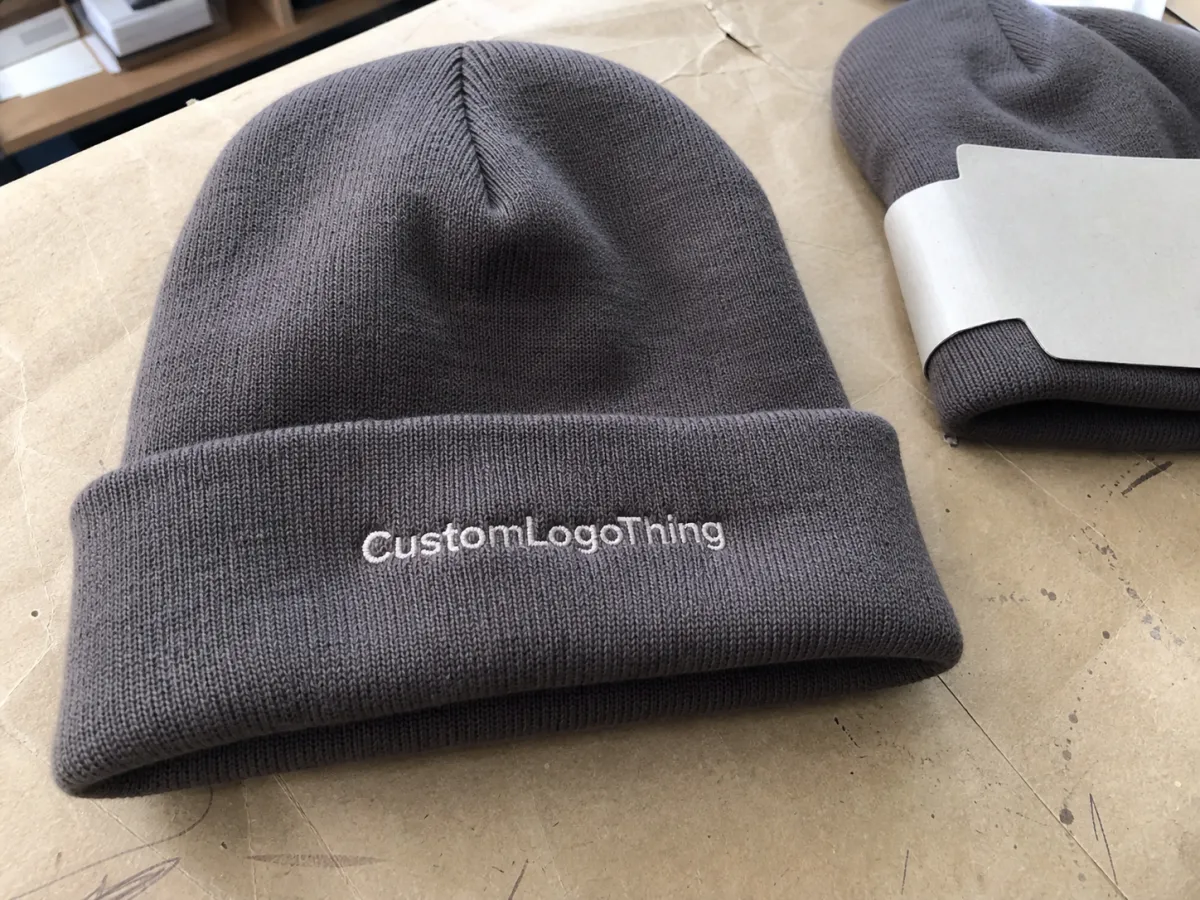
On a thin single-layer knit, embroidery can show through the fabric, pull the knit out of shape, or leave the backing scratchy against the forehead. A double-layer beanie gives the decoration more structure. The inside layer helps hide backing, supports the stitches, and usually makes the finished hat feel more substantial in hand.
That does not mean every design becomes easy. Dense fills still stress the knit. Tiny letters still disappear. But the extra layer gives the digitizer a better starting point, which often means a cleaner result and fewer unpleasant surprises after production starts. In practical terms, the logo has a better chance of holding its shape after repeated wear and stretch.
For branded merchandise teams, the choice is less about the hat alone and more about how the hat will present the mark. A staff uniform, retail accessory, or winter promo item all have different expectations. A patch-like graphic that would look fine on a woven label may look fuzzy in thread. A small, readable logo on a double-layer cuff usually performs better than the same artwork squeezed onto a light knit with too little surface stability.
Suppliers who understand knit headwear will usually ask the right questions early: where the logo sits, how wide it should be, whether the cuff is folded, and how much room is available before a seam or edge interrupts the design. Those details affect the quote. They also affect whether the first sample is useful or merely expensive.
There is another reason buyers prefer double-layer construction. It gives a little more tolerance for imperfections. The fabric can still pucker if the embroidery is too dense, but the surface is less likely to telegraph every stitch mistake. That is one reason many teams pay slightly more for the blank when the decoration needs to look crisp.
What comes standard in a double-layer beanie order
Most double-layer beanies are cuffed, with a folded brim that creates the main embroidery zone. That cuff is usually flatter than the crown, easier to position in the hoop, and easier to read at retail distance. Acrylic remains the most common fiber because it is affordable, warm, and forgiving in production. Acrylic-wool blends feel heavier and can present a more premium hand, while recycled yarn options are increasingly common where sustainability claims matter and the buyer can verify the source.
The standard decoration choice is still direct embroidery, but not every logo belongs in thread. Simple wordmarks, initials, compact icons, and short brand names usually translate well. Fine lines, tiny lettering, and complex crests are where knit headwear starts to lose clarity. If the artwork depends on delicate detail, a woven label, badge, or patch may preserve the identity better than forcing embroidery to do work it cannot do cleanly.
Placement matters just as much as artwork. Center-front cuff embroidery is the most common because it balances readability and production efficiency. Side embroidery can feel more fashion-driven, but it reduces the available area and can be harder to approve from a proof alone. Crown embroidery is possible, though it often raises the risk of visible backing or interior discomfort unless the design is intentionally minimal.
Most buyers underestimate the value of a plain, readable logo. On winter headwear, the best results often come from moderate scale and controlled stitch count, not from trying to reproduce every detail of a brand system. The more complex the art, the more likely the supplier will need to simplify or recommend a different decoration method. That is a useful warning, not a rejection.
Specs that affect stitch quality, fit, and wear
Three specs drive most of the outcome: yarn content, knit gauge, and cuff depth. A tighter knit gives embroidery a steadier base and usually reduces distortion. A looser knit can still work, but it often needs more careful digitizing to avoid tunneling or sink-in around the stitches. When the knit is too open, the thread can look heavy even if the logo is small.
Cuff depth is easy to overlook and hard to fix later. A shallow cuff leaves very little room for placement, especially if the logo has more than one line of text. A deeper cuff gives the embroidery room to breathe and usually improves the visual balance of the hat. Buyers comparing samples should ask for finished measurements, not just “one size fits most,” because a small difference in width or height can change how a logo sits on the wearer.
Stretch recovery matters too. A beanie that snaps back well after being pulled tends to keep the logo aligned. A softer, looser knit may feel comfortable, but it can also drift out of shape and make the embroidery seem off-center after use. That is not always a defect. It is a construction tradeoff. Still, a buyer should know whether they are ordering a fashion-forward slouchy fit or a more structured promotional knit.
Thread choice influences the final look more than many people expect. Matte thread often reads better on winter accessories than a glossy finish because it feels more textile-friendly and less reflective under shop lighting. Thick, highly saturated thread can be attractive, but it can also exaggerate the stitched texture. For a premium retail program, a controlled thread sheen usually looks more refined than a bright, shiny finish.
Color matching deserves a separate conversation. Pantone references help, but embroidery thread is not paint and will never match a brand color perfectly across every lighting condition. A good proof should show the closest available match and explain where the thread will visually shift on the knit. If the program is large enough, a stitched strike-off on similar fabric is worth more than a flat digital rendering. It is also the fastest way to catch a mismatch before the bulk run starts.
Packaging and transit can affect the result more than expected. A well-embroidered beanie can still arrive flattened, marked, or distorted if the carton spec is weak. For larger programs, buyers sometimes ask whether packaging and carton handling meet recognized shipping test protocols such as ISTA. If paper inserts or care cards are part of the kit, FSC-certified stock may matter as well: FSC.
Double layer beanies embroidery cost guide: pricing, MOQ, and unit cost
This is the section where most quotes separate into “looks affordable” and “actually is affordable.” The blank price matters, but embroidery setup, stitch count, logo size, number of colors, packing, and freight all shape the real landed number. A simple logo on a stable knit can stay economical. A dense design with multiple locations can push the total up fast.
Digitizing is one of the easiest costs to miss. If a logo is being converted from scratch, the file setup may be charged once, then amortized over the order. A $75 digitizing fee adds $0.75 per unit on a 100-piece run, but only $0.15 per unit on 500 pieces. The smaller the order, the more setup bites into margin. That is why low MOQ programs often feel much more expensive than the per-hat blank price suggests.
Approximate pricing for a simple one-location embroidered double-layer beanie often falls into these ranges:
| Order size | Typical quote structure | Likely unit cost | Common setup impact |
|---|---|---|---|
| 100-149 pcs | Blank, embroidery, and digitizing are often listed separately | $6.25-$9.10 per piece | $55-$150 in setup charges can materially move the price |
| 300-499 pcs | Usually the first range where bulk pricing improves noticeably | $4.80-$6.80 per piece | Setup is still there, but the per-piece share drops fast |
| 1,000+ pcs | Tighter rates are common if artwork and placement are stable | $3.90-$5.60 per piece | Digitizing and proofs matter less per unit, more in total control |
Those ranges are not a promise. Fiber content, blank weight, logo complexity, and packaging can push them up or down. A heavy acrylic-wool blend with a deep cuff and a large stitched mark will not price like a basic acrylic promotional beanie. If a quote seems unusually low, the first thing to inspect is what was left out: freight, setup, or a realistic stitch count.
Unit cost should always be viewed alongside the intended resale or internal transfer price. If the landed cost is already close to the wholesale target, the margin can disappear once the carrier bill, customs fees, or a small defect allowance are added. A good double layer Beanies Embroidery Cost guide should help a buyer understand how much room is left after the visible quote is paid.
Practical rule: if the supplier will not separate blank cost, embroidery, setup, and add-ons, the quote is difficult to audit and even harder to compare.
Process and timeline: from art file to shipped goods
The production flow is usually straightforward on paper: quote request, artwork review, digitizing, proof approval, sample or strike-off, bulk production, inspection, and shipment. The friction appears in the middle. A logo redraw, a color correction, or a placement adjustment of even a quarter inch can add days. On headwear, small changes are not small in production terms.
For a simple order with stock blanks and a clean logo, proof approval to shipment often lands somewhere around 2 to 4 weeks. Larger runs, multiple embroidery locations, or custom pack-outs can take longer. If the beanies need hang tags, retail labels, or individual polybags, packing becomes a second production line and may end up determining the real lead time.
Rush production narrows options. The supplier may have to substitute blank colors, reduce proof rounds, or trim embellishment choices. That can be acceptable for a basic giveaway order. It is less acceptable when the logo is intricate or the buyer is aiming for a premium retail finish. A slightly longer timeline often prevents a much more expensive correction later.
Inspection deserves more attention than it gets. A supplier that checks alignment, tension, color consistency, and loose threads before shipment is doing real work, not just promising it. On larger programs, a written checklist is better than a verbal assurance. Even a simple internal spec sheet can catch the errors that become obvious only after boxes are opened at the destination.
Seasonality also matters. Orders placed late in the fall compete with other winter programs, which can affect blank availability and stitch line capacity. A beanie that is easy to produce in August can become difficult to source in November. That is not a theory; it is a recurring supply-side constraint that shows up every year.
How to compare supplier quotes without hidden surprises
The cleanest quote comparison starts with making the products truly identical. Confirm the same blank weight, same fiber content, same logo size, same stitch count, same placement, same thread color count, and same pack-out method. If one supplier is pricing a 120g beanie and another is quoting a 90g version, the lower number is not really lower. It is a different product.
Hidden charges are common enough to plan for. Digitizing may be included by one supplier and billed separately by another. Freight may be built into the total or left out entirely. Relabeling, split sizes, second proofs, individual polybags, and carton markings can all add cost. On a mid-size run, those differences can move the bill by hundreds of dollars.
A low quote only stays low if the blank, stitch count, placement, proofing, and packing method are identical.
Placement deserves special attention because it affects both cost and comfort. Cuff embroidery is usually the most efficient option. Crown embroidery can require more handling and can feel different on the inside of the hat because the backing sits closer to the head. If the supplier does not clearly state where the decoration will sit, ask for a revised quote before comparing numbers.
Another warning sign is vague language around sample approval. A supplier who says the sample is “close enough” may be signaling that the process is loose. A supplier who explains what is being checked, what can change, and what will remain locked is offering a much better path to a predictable bulk run.
Communication quality is often a more reliable indicator than the opening price. Clear assumptions, fast replies, and specific limitations suggest a production team that understands what can go wrong. A quote that is suspiciously cheap and strangely vague usually deserves more scrutiny than praise.
What separates a reliable embroidery partner from a cheap one
The first difference shows up in proofing discipline. A reliable partner will look at how the logo behaves on knit fabric, not just how it appears in a flat mockup. Knit headwear stretches, curves, and compresses; flat artwork cannot predict all of that. If the supplier has real headwear experience, they will usually flag unrealistic logo widths before production starts.
Ask how they handle seam interference, placement drift, and tension changes. Those are the small technical issues that can make a batch look inconsistent even when the logo file is correct. A cheap partner may quote quickly and produce quickly, but that speed often comes with weaker control on the details that are expensive to fix later.
Thread consistency matters too. Dye lots can shift slightly, and production runs can drift if machines are overused or poorly monitored. A dependable supplier catches those shifts, documents the correction, and keeps the next run close to the first. That consistency is especially valuable on seasonal programs, where a reorder needs to match the earlier shipment rather than becoming a new interpretation of the same logo.
There is also a practical after-sale test. Good partners can explain why a logo was simplified, why a stitch count was changed, or why a second embroidery location will add labor. Cheap partners often promise everything and reveal the limitation only after the sample arrives. One path lowers risk. The other shifts it onto the buyer.
For knit headwear specifically, the most trustworthy suppliers tend to talk about constraints before they talk about price. That is usually a better sign than a too-easy yes.
What to prepare before you request a quote and start production
Clear requests create cleaner pricing. Send vector artwork if possible, along with quantity, preferred placement, target logo width, color references, and any packaging or labeling requirements. If you want both front and side decoration, say so. If the order needs hang tags, retail cards, or custom polybags, include that from the start. Vague briefs create vague quotes, then more back-and-forth later.
Decide whether you need a digital proof, a stitched sample, or a straight bulk run. A digital proof is faster and cheaper, but it cannot reveal every issue on a knit surface. A stitched sample takes longer, though it gives a better read on stitch density, thread sheen, and distortion. On a larger order, the sample cost is often easier to justify than a correction across the full quantity.
Request an itemized quote. The best version separates blank cost, embroidery, setup, freight, and optional extras. That makes comparison easier and gives you room to trim features if the number is too high. It also reveals where the supplier is making margin and where they may have built in hidden buffers. Buyers do not need to guess at the structure when the structure can be stated plainly.
Before approval, confirm the final art, quantity split, thread colors, placement, and timeline. Then check the proof for scale and legibility rather than just color. A logo that looks fine on screen may be too small to read on knit. Approval should mean the product still works as a product, not merely that the artwork looks familiar.
That is the practical core of the double layer Beanies Embroidery Cost guide: know the decoration surface, isolate the real cost drivers, and do not let a tidy headline price hide the decisions that determine the final result.
What is the usual MOQ for double-layer beanies with embroidery?
Many suppliers price most competitively at 100 to 300 pieces, depending on logo size, stitch count, and blank availability. Smaller runs are possible, but setup charges take a larger share of the total and raise the unit price quickly. Ask whether the MOQ applies per colorway, per logo, or across mixed sizes before you compare quotes.
Does a double-layer beanie cost more to embroider than a single-layer style?
The blank may cost a little more, but the main price drivers are still stitch count, placement, and setup work. A double-layer knit often improves the finished look because it hides backing more cleanly than a thin hat. If the logo is dense or uses more than one location, expect the embroidery line item to rise.
Can I embroider both the cuff and crown on the same beanie?
Yes, but each extra location adds labor and can change the way the hat feels inside. Ask for a stitch test if the second placement sits close to seams, fold lines, or another high-stretch area. A patch or woven label may deliver a cleaner result if interior comfort matters more than direct embroidery.
How long does production usually take after proof approval?
Simple orders often move from proof approval to shipment in about 2 to 4 weeks, depending on quantity and blank stock. Larger runs, custom packaging, and multiple decoration locations usually take longer. Fast artwork approvals and clear instructions are the easiest ways to shorten the schedule.
What file should I send for an embroidery quote on double-layer beanies?
Vector files such as AI, EPS, or PDF are best because they let the supplier size and digitize the logo accurately. Include Pantone or CMYK references plus the target logo width and placement on the beanie. If you only have a JPG or PNG, expect the artwork to be redrawn or digitized before the final price is locked.

