Buyer Fit Snapshot
| Best fit | Bulk Mailing Bags for Retailers projects where brand print, material claims, artwork control, MOQ, and repeat-order consistency need to be specified before quoting. |
|---|---|
| Quote inputs | Share finished size, material target, print colors, finish, packing count, annual reorder estimate, ship-to region, and any compliance wording. |
| Proofing check | Approve dieline scale, logo placement, barcode or warning zones, color tolerance, closure strength, and carton packing before bulk production. |
| Main risk | Vague material claims, crowded artwork, missing packing details, or unclear freight terms can make a low unit price expensive after revisions. |
Fast answer: Bulk Mailing Bags for Retailers: Specs, Pricing, MOQ should be specified like a repeatable production item. The safest quote records material, print method, finish, artwork proof, packing count, and reorder notes in one written spec.
Production checks before approval
Compare the actual filled-product size with the drawing, then confirm tolerance on folds, seals, hang holes, label areas, and retail display edges. Reserve space for logos, QR codes, warning copy, and material claims before decorative graphics fill the panel.
Quote comparison points
Review material grade, print process, finish, sampling route, tooling charges, carton quantity, and freight assumptions side by side. A quote is only useful when the supplier can repeat the same color, closure quality, and packing count on the next order.
Bulk Mailing Bags for Retailers look unglamorous. Fine. Packaging rarely wins a popularity contest. It does, though, win budget battles when the bag matches the product, the packing bench, and the freight profile. That is the part people notice after the first invoice lands and everybody starts asking why shipping got weird.
Apparel lines, accessories, subscription bundles, and replenishment orders all move well in bulk mailing bags for retailers. Soft goods do not need a box just to feel serious. A well-chosen mailer keeps the order clean, cuts down on handling, and gives the customer a tidy package at the door without sending corrugate into the mix for no good reason.
The real test is practical. Packaging should fit the item, the labor model, and the shipping cost. Too thin and the bag fails. Too heavy and the budget gets sloppy. Too large and the process slows down because every order carries extra air and extra expense. I have watched teams lose hours to that kind of "small" mistake.
For a lot of retailers, this is where the shipping room gets honest. The best packaging is rarely the prettiest. It is the one that keeps the line moving, protects the product, and does not make the finance team squint at the numbers.
Why bulk mailing bags for retailers solve common shipping problems
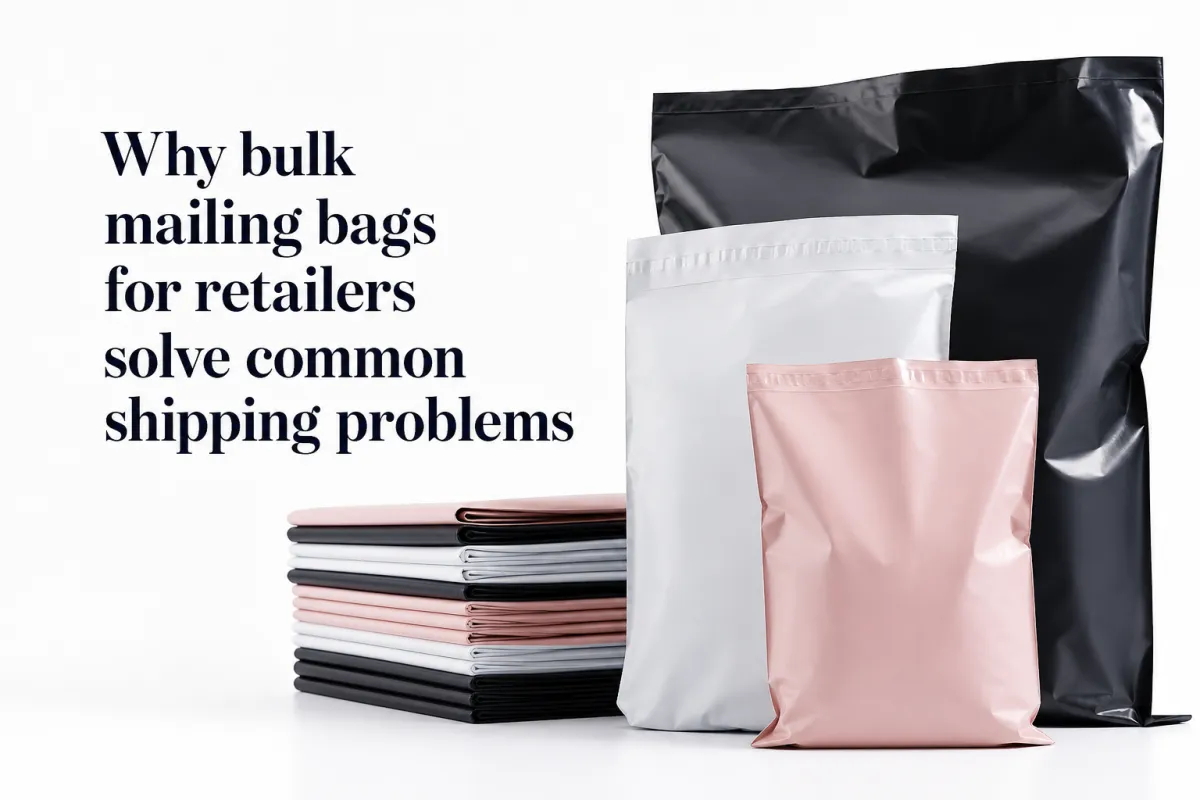
Retail shipping problems usually show up as small inefficiencies, not dramatic failures. Oversized cartons eat dimensional weight. Extra filler burns labor. Too many packout options make the table messy. Bulk mailing bags for retailers solve those headaches by narrowing the package to the product.
Soft goods benefit the most. A folded tee, knitwear, socks, scarves, or a lightweight accessory does not need a rigid box for ordinary parcel handling. Bulk mailing bags for retailers create a protective layer that blocks dirt, helps against light moisture, and reduces snagging. The pack stays lighter, the table stays cleaner, and the order does not need cardboard theater to get shipped.
Freight is easier to live with too. Cartons trap air. Air gets billed. A mailer wraps to the item, so the shipment stays tighter and usually wastes less space. That matters in apparel, beauty, accessories, direct-to-consumer replenishment, and store-to-customer programs where the product already has enough structure on its own.
Operational control matters just as much. Bulk mailing bags for retailers make inventory planning more predictable because the format stays consistent. A team can train on one mailer size, one closure style, and one label layout instead of juggling different cartons, inserts, and void fill. Fewer choices at the packing bench usually mean fewer mistakes. That is kinda the whole point.
The rule is plain: if the item does not need crush protection and the retailer wants a lighter, faster, cleaner ship format, bulk mailing bags for retailers are usually the better choice. Shoes with rigid boxes, fragile hard goods, or mixed kits may need more structure. Soft goods and secondary packaging? The case is strong.
Practical rule: pick the smallest mailing bag that still allows easy insertion, a reliable seal, and enough space for the product to lie flat. Extra room looks harmless right up until freight cost and pack speed start telling the truth.
Retailers also use bulk mailing bags for retailers to keep brand presentation under control. A white or black poly mailer with a clean logo panel can look polished without turning the shipper into a vanity project. Buyers usually want Packaging That Works first and advertises second. Sensible, really.
Think of bulk mailing bags for retailers as a control tool. The bag sets the packout size, the seal sets the line speed, and the film quality sets the risk. Line those three up and the shipping room becomes easier to run. Miss one of them and the warehouse notices fast.
Bulk mailing bags for retailers: material and product details
Co-extruded polyethylene is the standard material for bulk mailing bags for retailers. It gives the bag flexibility, puncture resistance, and sane pricing. Co-extrusion lets the inner and outer layers do different jobs, so the exterior can print cleanly while the bag still holds up during sorting and parcel handling.
Lightweight film has a place. Lower-value items and tightly controlled pack environments can use thinner material and keep unit cost down. The tradeoff is strength. Once zippers, buttons, edges, or firmer inner packaging enter the picture, thin film starts looking optimistic. That is when bulk mailing bags for retailers need an actual spec instead of a shrug.
Recycled-content options matter too, especially for retailers working toward packaging reduction goals or public sustainability claims. Post-consumer and post-industrial recycled polyethylene can support those goals, although the exact blend, color, finish, and print result depend on the supplier and the use case. Programs that care about consistency need sample approval. No shortcuts there.
Buyers usually compare four features first: self-seal closure, tear resistance, opacity, and flexibility. Self-seal closure cuts tape out of the workflow and keeps the seal point consistent. Tear resistance matters because a bag can look fine on a table and fail once it gets stacked, dragged, or squeezed in transit. Opacity gives the package privacy and a cleaner retail look. Flexibility lets the bag conform to the item instead of fighting it.
That is why bulk mailing bags for retailers are not just plastic bags with a shipping label. The better ones are built as a shipping format. Some use a glossy exterior for a sharper brand look. Others go matte because it photographs well and hides scuffs. Some teams want a plain face with a one-color logo. Others want a message panel, return instructions, or a barcode zone. The right call depends on how the order moves, not on whatever trend is floating around this week.
Print needs discipline. A logo can sit cleanly on one side, but it should stay clear of the seal edge, fold lines, and any area that will be buried under labels. Bulk mailing bags for retailers that need an address label, scan code, or handling icon should leave those zones open. Production cares about readability. Mockups do not ship packages.
There is a point where a mailer stops being the right format. If the item needs real crush protection, if the product has sharp corners, or if the brand wants a rigid premium presentation, a padded mailer or carton can make more sense. For moisture resistance, dirt protection, and efficient shipping of soft goods, bulk mailing bags for retailers usually beat heavier pack formats on cost and speed.
Retailers comparing packaging families can look at our Custom Poly Mailers alongside other shipping options and judge the bag against the product, the seal, and the freight class. The best choice is rarely the most expensive one. It is the one that fits the item with the fewest compromises.
Bulk mailing bags for retailers: specifications that affect performance
Specs are where bulk mailing bags for retailers either become a dependable system or turn into a steady source of waste. The first numbers to request are width, length, flap allowance, film thickness, and closure type. Those details sound basic because they are basic. They also decide whether the product drops in cleanly and seals without fuss.
Width and length should be based on the finished packed item, not just the product itself. A folded garment may measure one way on a rack and another way once tissue, inserts, or inner packaging are added. Bulk mailing bags for retailers need enough room for easy insertion, but not so much room that the item slides around and makes the shipment look sloppy. That balance protects presentation and saves labor at the table.
Film thickness, usually measured in mils or microns, affects puncture resistance and load stability. Thicker film costs more, yes, but it can pay back when items include hardware, trims, or sharper edges. Many soft goods do fine with mid-range film. Mixed contents and heavier bundles are safer in thicker construction. Bulk mailing bags for retailers should match the actual contents, not a generic assumption pulled out of thin air.
Load stability gets ignored until it causes a problem. A retail packout may look light, but if the bag gets stacked, slid into totes, or dropped into cartons for outbound consolidation, the film still has to hold up. That matters in high-throughput environments where the same bag style gets used across multiple shifts and nobody has time to babysit weak material.
Fit usually starts with product family. Tees and lightweight knits work in slim mailers. Accessories such as belts, socks, and small soft goods may fit shorter or narrower bags. Light footwear is trickier because the shape creates pressure points. Multi-item bundles need testing because the corner of one item can change the whole pack. Bulk mailing bags for retailers should always be tested with the real packout, not a lookalike.
Opacity deserves attention too. A clear or semi-clear bag may work in a few controlled cases, but most retailers prefer privacy and a more polished look. Opacity hides the contents, keeps the brand presentation cleaner, and lowers the chance of visual mismatch in transit. For bulk mailing bags for retailers, that one detail affects both security and perception.
Closure style also matters. Self-seal adhesive is common because it moves quickly. Some programs use a peel-and-stick strip with a tamper-evident closure. Others need a double seal or a return-friendly flap. The seal has to hold through parcel handling without making operators fight the bag on every order.
Before a full run, sample packs should be tested in real conditions. That means more than holding the bag in one hand and nodding at it. The same team that will pack orders should use the sample, then check seal reliability, label placement, scan visibility, and cart or shelf storage. Bulk mailing bags for retailers that pass a real packing trial are far less likely to surprise the buyer later.
A few outside references can help during evaluation. Shipment testing often draws on ISTA methods, while material and recyclability discussions may reference guidance from the EPA. Those sources do not replace product-specific trials, but they give procurement teams a shared language for performance and disposal expectations.
In packaging reviews, I usually push teams to think past the quote sheet. A bag that saves a fraction of a cent but tears twice a week is not "cheap." It is expensive in the most annoying way possible.
| Mailing bag option | Typical use | Typical unit price range | Typical MOQ | Best fit |
|---|---|---|---|---|
| Stock white poly mailer | General apparel, low-complexity shipments | $0.08-$0.16 | 1,000-5,000 | Fast start, simple reorders |
| Custom printed poly mailer | Retail branding, DTC shipments, seasonal campaigns | $0.14-$0.30 | 5,000-10,000 | Brand consistency and repeat use |
| Heavier-gauge custom mailer | Mixed soft goods, sharper edges, multi-item orders | $0.18-$0.38 | 5,000-10,000+ | Higher puncture resistance |
| Recycled-content mailer | Sustainability-driven programs | $0.16-$0.34 | 5,000+ | Environmental positioning with clear specs |
That table is directional, not universal. Supplier structure, artwork coverage, film availability, and carton pack quantity all change the price. Even so, it gives procurement teams a realistic starting point. Bulk mailing bags for retailers should be judged on landed cost, not just the quote line that looks attractive in a spreadsheet.
Pricing and MOQ for bulk mailing bags for retailers
Pricing for bulk mailing bags for retailers comes down to a handful of variables that are easy to name and easy to underestimate. Material type, film thickness, bag size, print coverage, color count, and order quantity all move the number. Standard stock construction and fully custom builds also land in different places. No surprise there.
The smallest order usually costs the most per unit. That is setup overhead doing what setup overhead does. As volume rises, unit price usually drops and the program becomes easier to keep steady across locations. For bulk mailing bags for retailers used in multiple stores or fulfillment centers, larger runs often make more sense because the spec stays fixed and purchasing can forecast replenishment without guesswork.
MOQ varies by program, but a practical planning range for Custom Printed Mailers is often 5,000 to 10,000 pieces, with some stock-style runs available lower. The right threshold depends on size, print method, and whether the bag is a standard format or a custom size. Bulk mailing bags for retailers do not have one universal minimum. Buyers should ask for MOQ and the price breaks that come with it.
Total landed cost matters more than the sticker price. A low unit price can turn into a bad deal if the carton count is high, freight is expensive, or storage gets awkward. Spoilage also shows up in the budget when film is too thin and replacement bags are needed. Bulk mailing bags for retailers should be priced as part of the whole system: product, storage, freight, and labor.
For example, a retailer might compare three options:
- Option A: stock mailers with no print, lower startup cost, faster availability, but limited branding.
- Option B: one-color custom mailers, moderate MOQ, good balance of price and presentation.
- Option C: heavier custom mailers with higher print coverage, better protection, and a higher per-bag cost.
That kind of comparison helps buyers separate what they want from what they actually need. Bulk mailing bags for retailers should not be picked just because they look premium. They should be picked because the operation can move them at the right cost per shipment.
Startup costs deserve their own line item in the quote review. Sample development, artwork prep, and any plate or tooling charges should sit apart from repeat pricing so the launch order and the reorder get judged correctly. A common mistake is comparing a first run against a steady-state reorder and blaming the supplier for being expensive. The setup is sitting right there in the math.
Retailers should also ask how freight is quoted. The packaging quote can look fine while shipping changes the answer. Bulk mailing bags for retailers are light compared with cartons, but pallet count, carton pack density, and the shipping lane still matter. Buyers who understand those assumptions compare suppliers more fairly and avoid fake savings.
If the program covers multiple channels, it may help to look at our Wholesale Programs alongside the mailer spec. That is especially useful for chains or multi-location retailers that need predictable replenishment and a cleaner way to budget across seasons.
Honestly, the best price is rarely the lowest quote. It is the one that delivers the right film, the right seal, the right count per carton, and the right reorder rhythm without creating chaos in the warehouse. That is the standard buyers should hold for bulk mailing bags for retailers.
Production process and timeline for bulk mailing bags for retailers
The production flow for bulk mailing bags for retailers should be straightforward, provided the brief is clear. A clean order usually moves through spec review, quote confirmation, artwork check, sample approval, production, quality inspection, packing, and shipment. Each step sounds ordinary. Each step can also save the buyer from delay if it is handled carefully.
Timelines depend on whether the bag is stock-style or fully custom, how complex the artwork is, and whether the film color or size is already in production. A basic mailer with simple branding usually moves faster than a multi-color build with special sizing. Bulk mailing bags for retailers are easier to schedule when the supplier has the full picture at the start instead of chasing changes halfway through.
Before asking for pricing, the retailer should have a few things ready: finished dimensions, expected monthly or annual volume, target MOQ, print files, packing requirements, and the date the bags need to be live. That list is basic because it needs to be basic. If the product size is still changing, the mailer spec is not ready yet.
Late artwork changes are a classic source of delay. So is vague size approval. Saying "make it a little bigger" is not a production spec. The supplier needs the actual finished pack dimensions, the seal overlap, and any space needed for a branded insert or return material. Bulk mailing bags for retailers should be signed off against the final packed item, not a rough estimate scribbled in a meeting.
Quality control is another part of the timeline that matters more than many teams expect. A good run should include film checks, print alignment checks, seal performance checks, and carton packing verification before shipment leaves the facility. For bulk mailing bags for retailers, a neat print line is nice, but a reliable seal and consistent bag count are what keep the operation stable.
Retail teams often ask for lead time in plain language, and the useful answer is usually framed in business days after artwork and sample approval, not in vague promises. The fastest path is to send the bag dimensions, quantity, branding needs, and target ship date together. Once those details are locked, the production plan gets much easier to confirm.
Scheduling samples early has a real payoff. The sample tells the buyer whether the bag opens easily, whether the seal grabs cleanly, and whether the finished pack looks right in the hand. Bulk mailing bags for retailers that are approved only on paper can still fail on the pack line. Physical approval is worth the extra day or two. Usually worth it. Always when the line is busy.
Why Custom Logo Things fits retailer mailers
Custom Logo Things is a strong partner for bulk mailing bags for retailers because the packaging conversation stays tied to specifications, not sales fluff. That matters. Retail buyers usually know what they need in broad terms. They need a supplier who can turn that into a working bag with consistent film quality, repeatable print placement, and a clear path from sample to production.
For retailer programs, consistency is the real asset. One run of bulk mailing bags for retailers should match the next run closely enough that the pack line does not have to relearn the process. When film gauge, seal behavior, and print registration stay stable, the warehouse can train once and keep moving. That kind of predictability pays off across stores, central fulfillment, and direct shipments.
A fact-based buying conversation helps too. Retailers do not need a packaging speech full of buzzwords. They need the right size, the right thickness, the right MOQ, and a price that works at volume. Custom Logo Things can support that kind of decision-making by helping buyers compare formats, sample options, and reorder planning without shoving them toward a one-size-fits-all answer.
Multi-SKU retail programs benefit from that approach. One mailer size may need to serve several product lines, and that only works if the spec is built around actual packed dimensions and real throughput. Bulk mailing bags for retailers have to do more than look branded. They have to fit multiple use cases without wasting film or causing friction at the line.
For brands that care about presentation, custom printing can stay clean and functional. A one-color logo, a simple message panel, or a restrained branded face usually does more than a crowded layout. The strongest bulk mailing bags for retailers are the ones that look intentional without becoming expensive marketing props. That balance keeps margins sane.
Program support matters too. Retailers that reorder seasonally or across several locations need a supplier who can manage repeat specs, not just one-off quotes. Bulk mailing bags for retailers work best in a replenishment rhythm, and the packaging partner should support that rhythm with clear communication on quantity, artwork, and lead time.
For teams building a broader packaging plan, the value gets even clearer. A retailer can source mailers, printed labels, and related shipping materials under one framework, then use the same approval logic across the board. That keeps the operation cleaner and reduces the chance of fragmented packaging decisions. Bulk mailing bags for retailers fit that structure because the format is simple enough to standardize and flexible enough to scale.
In plain terms, the goal is dependable supply, clean presentation, and a mailer that performs at volume. That is what buyers should expect from bulk mailing bags for retailers, and that is the standard Custom Logo Things is set up to support.
Next steps for ordering bulk mailing bags for retailers
The fastest way to move a project forward is to start with three inputs: product dimensions, target monthly volume, and branding requirements. Once those are defined, the material, closure style, and print structure usually become much easier to narrow down. Bulk mailing bags for retailers are a simple format, but the right spec still depends on the actual product.
Requesting a sample or a spec match before placing a large order is a smart move. A retailer can confirm fit, seal performance, print placement, and packout speed in a real working environment, not just in a mockup. That step matters even more if the product includes an insert, tissue, or secondary package that changes the finished dimensions.
Buyers should also confirm MOQ, production window, freight assumptions, and reorder lead time in the same conversation. Those details affect inventory planning just as much as unit price does. Bulk mailing bags for retailers are easiest to manage when the launch order and the repeat order are both understood before production starts.
If the first run proves the spec, the next step is simple: scale it. That is where bulk mailing bags for retailers stop being a shipping supply and start acting like a repeatable operating standard. A good mailer reduces decisions, holds the brand line, and keeps the warehouse moving without extra weight or waste.
For retailers that need packaging to be practical first and polished second, bulk mailing bags for retailers are a strong place to begin. Get the dimensions right, confirm the seal, check the print, and order enough volume to make the price work. That is the path to a packaging program that earns its keep.
Frequently Asked Questions
What size bulk mailing bags for retailers should I choose?
Choose the smallest bag that comfortably fits the folded product plus any insert or tissue, because extra empty space adds cost and can create a loose packout. Measure the finished packed item, not just the product itself, and allow room for closure overlap and easy insertion at the packing table.
Are bulk mailing bags for retailers strong enough for apparel shipments?
Yes, for most apparel and soft goods, a properly specified poly mailer provides enough strength, moisture protection, and tear resistance for normal parcel handling. If items have sharp trims, bulk, or mixed contents, ask for a thicker film or test a sample before committing to production.
What is a typical MOQ for bulk mailing bags for retailers?
MOQ depends on size, print method, and film type, so the minimum can vary by program rather than by a single universal number. Retailers should ask for both MOQ and pricing breaks, then compare the first-order cost against the repeat-order cost to plan inventory correctly.
Can bulk mailing bags for retailers be printed with a logo?
Yes, custom printing is common, and it can include logos, brand messaging, handling notes, or simple one-color artwork. Keep the design clear, high-contrast, and away from sealing areas so the finished bag stays readable and production-friendly.
How long does it take to produce bulk mailing bags for retailers?
Lead time depends on approval speed, order size, artwork complexity, and whether the bag is stock or fully custom. The fastest path is to send dimensions, quantity, artwork, and a target ship date together so the production plan can be confirmed early.
For most retail programs, the best results come from a clear spec, a real sample check, and a supplier that knows how to keep bulk mailing bags for retailers practical at scale. If the bag fits the product, the seal holds, and the price works across reorders, the packaging has done its job. The actionable takeaway is simple: define the finished packed size first, then test one sample in the real packout before you place the bulk order.


