Buyer Fit Snapshot
| Best fit | Bulk Poly Mailers for Startups projects where brand print, material claims, artwork control, MOQ, and repeat-order consistency need to be specified before quoting. |
|---|---|
| Quote inputs | Share finished size, material target, print colors, finish, packing count, annual reorder estimate, ship-to region, and any compliance wording. |
| Proofing check | Approve dieline scale, logo placement, barcode or warning zones, color tolerance, closure strength, and carton packing before bulk production. |
| Main risk | Vague material claims, crowded artwork, missing packing details, or unclear freight terms can make a low unit price expensive after revisions. |
Fast answer: Bulk Poly Mailers for Startups: Film, Print, MOQ, and Carton Packing should be specified like a repeatable production item. The safest quote records material, print method, finish, artwork proof, packing count, and reorder notes in one written spec.
Production checks before approval
Compare the actual filled-product size with the drawing, then confirm tolerance on folds, seals, hang holes, label areas, and retail display edges. Reserve space for logos, QR codes, warning copy, and material claims before decorative graphics fill the panel.
Quote comparison points
Review material grade, print process, finish, sampling route, tooling charges, carton quantity, and freight assumptions side by side. A quote is only useful when the supplier can repeat the same color, closure quality, and packing count on the next order.
Bulk Poly Mailers for startups do more than carry a product from point A to point B. They set the tone for the shipment, shape freight cost, and tell customers something about the brand before the package is even opened. That matters a lot in the early days, when every order feels expensive and every mistake gets a spotlight. A torn mailer, a sloppy seal, or a resend does not just waste packaging. It eats margin and makes the team look less put together than it probably is.
For a packaging buyer, the job is not mysterious. Pick a mailer that looks clean, ships without drama, and does not trap cash in inventory that sits around collecting dust. That is exactly why Bulk Poly Mailers for startups deserve real attention. Buying in bulk lowers unit cost, cuts down on emergency reorders, and keeps the customer experience steady from the first parcel to the thousandth. The real work is Choosing the Right size, film thickness, seal strength, and print format before the first carton shows up.
People like to talk about cost per unit. Fine. That number is neat, but it is not the whole story. A cheaper mailer that causes label failure, extra tape, or a carrier damage claim is not cheap. A better-specified mailer can save money in materials, labor, and replacements at the same time. That is the practical case for bulk poly mailers for startups. I have watched teams shave a cent or two off the unit price, then spend the savings three times over fixing the fallout. Very tidy. Very silly.
Bulk Poly Mailers for Startups: Why the First Carton Matters
Most startups do not begin with a packaging team and a procurement dashboard. They begin with a product, a few dozen orders, and one person doing five jobs badly because the day is already full. In that setup, bulk poly mailers for startups become the first packaging choice that actually matters. The first carton matters because it shapes how much time gets burned on fulfillment and how often shipping turns into damage control. Weak adhesive slows packing. Thin film splits on corners. The wrong size folds badly and wastes postage. None of that is glamorous, and all of it is expensive.
The business case shows up fast. Packaging problems do not stay isolated. One damaged order becomes a replacement. One replacement becomes a support ticket. A support ticket can become a bad review, and bad reviews have a nasty habit of costing more than the original mistake. That is why bulk poly mailers for startups are not some tiny line item to skim past. They are part of customer experience and margin protection, whether the spreadsheet wants to admit it or not.
Bulk buying changes the math because the startup buys predictability instead of scrambling for whatever is left on a retail shelf. A team can lock in a lower unit rate, keep backup stock, and ship from the same spec week after week. Consistency matters. A plain white 6 x 9 mailer with a clean self-seal strip sends a very different message than a wrinkled substitute pulled from a panic order at 4:45 p.m. For a lot of brands, the mailer is the first branded surface the customer touches.
Storage still matters. No startup should buy a year of packaging just because the volume discount looks pretty in a quote. Bulk poly mailers for startups need a sane balance. The right order is large enough to lower the unit cost and small enough to fit current storage and cash flow. In practice, that usually means a three- to six-month supply, not a heroic warehouse fantasy.
I have seen founders order too little because they were trying to stay nimble, then spend more on freight and rush fees than they would have spent on a sensible first run. That is not agility. That is a parking ticket with worse branding.
Packaging rule of thumb: the cheapest mailer is not the one with the lowest invoice. It is the one that arrives intact, seals cleanly, fits the product, and does not create a second shipment.
Packaging groups have been saying the same thing for years, just with more formal language. The guidance from packaging.org points toward fit-for-purpose packaging, and that idea fits bulk poly mailers for startups perfectly: use the lightest, simplest format that still protects the item through normal handling.
Choosing the Right Bulk Poly Mailers for Startups
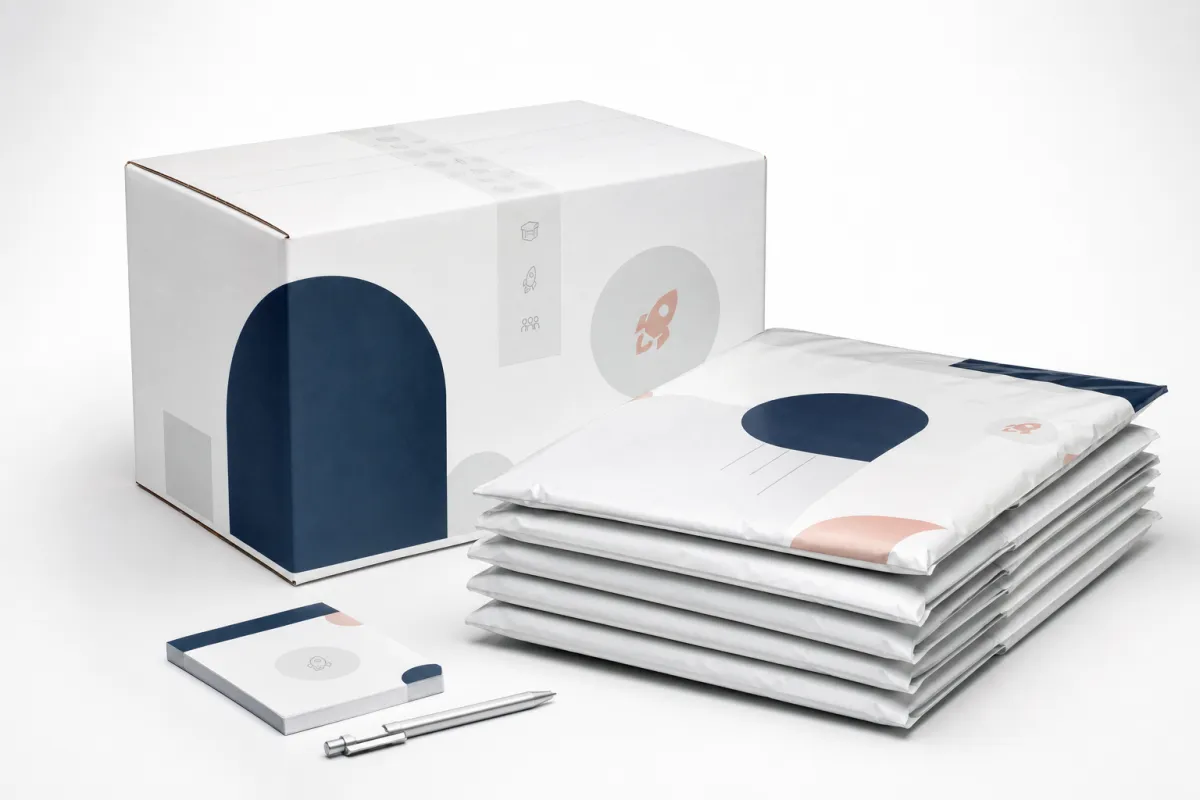
Three paths show up most often: standard poly mailers, padded poly mailers, and custom-printed mailers. Standard poly mailers are the workhorse for apparel, soft goods, and flat accessories. They are light, inexpensive, and easy to store. Padded poly mailers add a little cushion and make more sense for items that need edge protection, like small electronics, cosmetics in rigid containers, or accessories with sharp corners. Custom-printed versions turn the mailer into a brand surface, which starts to matter once repeat orders begin stacking up.
Bulk poly mailers for startups should be chosen by product profile, not by habit. A T-shirt brand does not need the same packaging as a candle company. A subscription starter kit does not need the same setup as a jewelry seller. Apparel usually fits standard film mailers with a self-seal strip. Hard goods may need thicker film or a padded option. If the product scratches easily, the interior feel and surface friction matter just as much as the outside look.
Closure strength gets ignored way too often. A good adhesive strip should close once and stay closed under normal parcel handling. That sounds basic because it is basic, yet weak adhesive is one of the first reasons bulk poly mailers for startups get tossed after testing. Water resistance matters too. Poly film usually sheds light moisture better than paper packaging, which is one reason so many small brands use it for direct-to-consumer shipping.
Size selection is another easy place to save money. Oversized mailers create slack, which makes the parcel look untidy and can raise dimensional weight if the mailer is paired with a box or insert. Too small, and the product stresses the seam or wrinkles the print area. The best starting point is the smallest mailer that safely fits the item plus any insert, hang tag, tissue, or folded garment. That keeps packing fast and the shipment neat.
Brand positioning matters too, because packaging is part utility and part signal. A startup selling at a premium price point may want custom printing, a darker tint, or a matte finish that reads cleaner in photos. A leaner operation may prefer plain neutral mailers and a branded sticker until order volume proves itself. Neither path is magically superior. The right answer depends on margin, storage, and how much value the brand puts on the unboxing moment. That is why bulk poly mailers for startups need both operational and branding input.
If you are comparing options across a supply list, start with clear specs and then move into wholesale pricing. Our Custom Poly Mailers page and Wholesale Programs are built for that kind of decision-making, while broader packaging needs can be matched through Custom Packaging Products.
Testing should not live in theory land. Many buyers also look at carrier and transport handling standards like ISTA test methods. A useful reference point is ISTA, because vibration, drop behavior, and parcel handling matter more than a glossy product sheet. The same mailer can pass in one lane and fail in another. Shipping is rude that way.
In practice, bulk poly mailers for startups work best when the item fit is checked by hand and then run through the actual workflow: pack it, label it, shake it, and see whether the seal holds and the label stays readable. If it looks borderline in the test, it is gonna look worse after a carrier route has chewed on it for two days.
Specifications That Affect Shipping Costs and Performance
The spec sheet will tell you more than the sales pitch ever will. For bulk poly mailers for startups, the biggest measurable variable is film thickness, usually listed in mils. Thicker film generally improves puncture resistance and tear strength, but it also raises material cost. The tradeoff is not always dramatic. A small jump in thickness can solve a failure problem without pushing the order into a much higher price band. Moving from 1.5 mil to 2.0 mil, for example, can be worth it if the product has sharp edges or the team keeps seeing seam splits during testing.
Size ranges matter just as much. A 10 x 13 mailer may be perfect for folded apparel, while the same size is wasteful for a small accessory. A 6 x 9 mailer can be efficient for compact items, yet too tight for a folded sweater or a retail insert. Since postage and handling react to weight and dimensions, bulk poly mailers for startups should be matched to the smallest reliable format across the most common SKU mix. That keeps packing speed up and waste down.
Seam strength, opacity, and finish all have practical consequences. Strong seams reduce split risk during conveyor handling and loading. Opacity protects contents and cuts down on clutter showing through the parcel. Finish affects label adhesion and appearance. A glossy surface can make labels or marker writing harder to place cleanly, while a softer finish often gives a better grip for labels. The right finish supports the workflow, not just the photo shoot.
Print specifications need care if the order is custom. One-color print usually costs less and turns faster than full-color coverage. Large solid areas can add setup complexity, and artwork with gradients or dense ink coverage can need more proofing. For bulk poly mailers for startups, print area limits also change the finished look. A compact logo near the flap can feel sharper and cost less than a full-bleed layout, especially on the first run.
Testing still matters, even when a supplier says the material is “strong enough.” ASTM standards for film properties, including tensile behavior, help when comparing claims, though suppliers do not always present data the same way. Ask for comparable test results if the shipment includes heavier goods, retail inserts, or repeated handling. That is where packaging stops being an opinion and turns into math. A mailer that looks fine on a sample table can behave very differently after ten thousand trips through real-world shipping.
A few mistakes show up over and over:
- Choosing a film that is too thin for the product’s weight or edges.
- Buying a size larger than the item really needs.
- Selecting a glossy finish that slows down label application.
- Using custom print coverage that adds cost before volume can support it.
- Ignoring the carrier route and the way parcels are actually handled.
For startups that want a better sustainability lens, the EPA has useful recycling guidance on plastic film and packaging behavior at epa.gov. That matters because not every poly mailer setup behaves the same way after use. Some are built for reuse, some create curbside confusion, and some belong in commercial collection streams. Bulk poly mailers for startups should fit disposal reality as well as shipping needs.
Clear specs keep margins steadier. The more precisely you define thickness, dimensions, closure, and print coverage, the less likely bulk poly mailers for startups are to become a hidden cost. A vague quote looks fine right up until the reorders start.
Pricing, MOQ, and Where Bulk Poly Mailers for Startups Save Money
Unit price drops as volume rises, but that is only part of the story. The number that actually helps is total landed cost per shipped order. For bulk poly mailers for startups, that means the mailer itself, freight to your location, damage allowance, defect replacement, and the cost of holding inventory. A $0.18 mailer that ships with high freight and sits for a year may be worse than a $0.24 mailer that arrives faster and takes up less space.
The cost drivers are not a mystery. Larger sizes use more material, so size pushes price up. Thicker film uses more resin, so thickness matters. Print coverage adds setup and production time. More colors usually means more cost. Custom work usually costs more than stock inventory because the print step, proofing, and setup are built into the order. That is why bulk poly mailers for startups often begin with stock packaging and move into custom once volume stops being guesswork.
MOQ, or minimum order quantity, is where cash flow meets warehouse reality. If a supplier wants 1,000 units, the startup needs enough monthly volume to move through that stock before the strategy changes. If the MOQ is 5,000 units, the buyer needs to know whether storage, cash, and reorder timing can handle it. Bulk poly mailers for startups only work as an economic win if the order turns over at a healthy pace. Slow-moving packaging ties up capital that could go into paid acquisition, product development, or support.
| Mailer Type | Typical Unit Price at Volume | Best Use | Main Tradeoff |
|---|---|---|---|
| Stock poly mailers | $0.12-$0.24 | Fast launch, basic apparel, low-risk items | Limited branding |
| Custom-printed poly mailers | $0.18-$0.38 | Repeat orders, stronger brand presentation | Higher MOQ and longer lead time |
| Padded poly mailers | $0.22-$0.46 | Light hard goods, cosmetics, accessories | More material and more cost |
That table is not a promise. It is a practical range, and reality can move around based on artwork, size, film thickness, shipping lane, and whether the order is stock or custom. Even so, it shows why bulk poly mailers for startups can save money once the team knows what actually sells. A brand shipping 300 orders a month may be better off with a smaller first run. A brand shipping 3,000 orders a month can usually earn better pricing through volume.
Hidden costs show up fast if nobody watches them. Replacement units for defects add up. Reordering too often burns staff time. Paying rush freight for emergency stock wipes out the discount you thought you won. Many teams choose a first run that covers one normal replenishment cycle plus a cushion for promos or seasonality. That is the point: bulk poly mailers for startups should be sized to demand swings, not just this week’s sales.
A simple decision framework helps:
- Use stock mailers to launch quickly and test real demand.
- Move to custom bulk mailers once repeat volume and brand recognition justify the change.
- Increase thickness only where product damage, seam failure, or route handling make it necessary.
- Recheck landed cost whenever the SKU mix changes.
That sequence keeps capital flexible. It also keeps the startup from buying packaging for the business it hopes to have instead of the one it actually runs. That distinction matters a lot for bulk poly mailers for startups, where the wrong inventory choice can sit in a warehouse for months and glare at you every time you walk by.
Ordering Process and Timeline From Quote to Delivery
The ordering process should feel orderly, not like a scavenger hunt. For bulk poly mailers for startups, the path is usually straightforward: request a quote, confirm dimensions and print details, review a proof, approve the final spec, pay, then move into production and shipping. The place startups lose time is rarely production itself. It is decision drift. Someone changes the logo file. Someone else questions the size after the proof arrives. A third person wants a different shade. None of that is rare, but it all adds days.
The quote stage gets faster when the supplier receives the right information on the first pass. Send product dimensions, expected monthly volume, mailer type, print file format, number of colors, and the delivery zip code. If the team already knows the shipping method or carrier preferences, include those too. The more complete the quote request, the less likely bulk poly mailers for startups will stall in back-and-forth email threads that accomplish nothing except creating new inbox clutter.
Stock inventory usually moves faster than custom production because it skips print setup and proof approval. Custom orders take longer because artwork review, layout confirmation, and production scheduling all take a bite. A realistic window for custom work is often 12-15 business days after proof approval, though the actual timeline depends on factory load, order size, and freight mode. Stock orders can move faster, but only if inventory is actually on hand. That is why startups should ask whether the quoted lead time starts from proof approval, payment, or purchase order receipt. Those details matter a lot more than people like to admit.
Good process control saves headaches. One approval owner cuts delays. A prepared artwork folder keeps the team from hunting for files at the last minute. A clean spec sheet avoids the classic “I thought we were ordering a different size” problem. For bulk poly mailers for startups, the fastest purchase is usually the one where product fit and print direction were already decided before pricing even started.
Receiving deserves planning too. Pallet deliveries need dock access or a clear handoff point. Carton counts should be checked before the shipment is signed off. If the order is large, the team should know where the cartons will live and how they will move into fulfillment. A good reorder threshold is based on lead time plus a safety buffer. If replenishment takes two weeks, do not wait until the last carton is open before placing the next order. That is how a boring packaging line turns into a shipping emergency.
For startups comparing packaging lanes, it helps to keep the process tied to the rest of the supply chain. The same sourcing discipline that applies to a logo bag or carton also applies to bulk poly mailers for startups: clear specs, fixed approvals, and a reorder point that protects sales momentum. Not sexy. Just useful.
Why Choose Us for Bulk Poly Mailers for Startups
Reliability is usually the first thing buyers want, even if price gets asked about first. Consistent material quality matters because a startup cannot afford to discover that one reorder feels different from the last. Bulk poly mailers for startups should arrive with stable dimensions, predictable seal performance, and print that matches the approved proof. That is not a premium feature. That is the baseline.
Startup-friendly flexibility matters too. A good supplier should be able to support a launch with stock mailers, then move the account into a custom program once order volume grows. That is the practical route because the first phase of selling usually tests product-market fit more than brand theater. Later, when repeat orders matter more, custom packaging can carry more weight. This staged approach fits bulk poly mailers for startups because it avoids locking into a bigger commitment too early.
Support should be specific, not vague. Buyers need help choosing the smallest safe size, confirming the closure style, and understanding what MOQ means for storage and cash flow. They also need someone who can review the proof with a real eye for label area, print placement, and film opacity. That kind of support cuts waste. It also helps ensure that bulk poly mailers for startups look the same from the first shipment to the next reorder, which sounds boring until one bad batch ruins the nice pattern.
Turnaround and clarity are part of the value. Straightforward quoting makes planning easier. Predictable production lowers the odds of a stockout. Responsive issue resolution protects the schedule if something needs a correction. From the buyer’s side, that is what makes a supplier useful. Not a slogan. Fewer surprises.
Consistency matters more than many brands realize. A startup may ship from one warehouse this month and a 3PL next month. The packaging still has to look the same. That continuity is one reason bulk poly mailers for startups are worth sourcing carefully. Packaging consistency reduces friction across teams, channels, and fulfillment partners.
Our approach stays grounded in practical buying. We help match mailer specs to the product, not the other way around. We keep the conversation focused on thickness, MOQ, print coverage, and turnaround. And we treat bulk poly mailers for startups as a margin decision as much as a branding decision, because that is what they are.
Next Steps for Ordering the Right Bulk Poly Mailers
The cleanest path forward is not complicated. Measure the product. Add the insert if one is used. Estimate monthly ship volume. Decide whether stock or custom makes more sense. If branding is part of the plan, gather artwork before requesting pricing. Those steps sound basic because they are basic, but they save time and cut rework. For bulk poly mailers for startups, clarity at the start usually leads to a better first order.
If the product line includes several sizes, do not buy every possible mailer dimension on day one. Start with one or two core sizes that cover most orders. That keeps inventory lean and makes training easier for the packing team. A startup shipping tees, socks, and small accessories may need one primary size and one backup. A brand with bottles or boxed items may need a thicker structure or a padded option. The right answer is the one that fits the current SKU mix, not the imaginary catalog that might exist next year.
Sample testing is worth the time. Order a small test set or a short run before committing to larger volume, especially if the startup ships mixed products or uses multiple fulfillment methods. Test the seal, label placement, print contrast, and handling. If possible, run the packed mailer through the same workflow your team uses every day. That is where bulk poly mailers for startups reveal their actual strengths and weak spots.
Cost comparison should always be done per shipped order. A slightly more expensive mailer may reduce packing time, failure risk, or label problems enough to pay for itself. Reorder thresholds should be set before the last carton is opened, not after. Buffer stock is cheaper than a rushed emergency order. Small decisions like that keep growth from turning into a mess.
If you are ready to move, ask for a quote, review the spec sheet, and confirm the approval path. The sooner those pieces are locked in, the sooner packaging stops being a question mark and starts acting like a reliable part of the operation. For bulk poly mailers for startups, that is the point: a packaging line that protects margin, supports the brand, and stays out of the way of sales.
What size bulk poly mailers for startups should I order first?
Start with the smallest size that fits the product plus any insert or fold-over margin. Pack a real sample, apply a label, and move it through your standard workflow before buying in volume. If you sell multiple SKUs, one or two core sizes usually work better than stocking every possible dimension.
How thick should bulk poly mailers for startups be?
Use a thickness that matches the item weight, the risk of sharp edges, and the amount of handling the parcel will see. Light apparel can often use standard film, while denser or sharper products may need a thicker gauge. The best thickness balances durability with postage and material cost.
What is a typical MOQ for bulk poly mailers for startups?
MOQ varies by size, print method, and whether the mailer is stock or custom. Custom printing usually carries a higher minimum than plain stock inventory. The right MOQ is the one your cash flow, storage space, and reorder cycle can support without creating slow-moving packaging.
Are custom bulk poly mailers worth it for startups?
They make sense once repeat orders and brand recognition matter more than the lowest possible unit price. Custom mailers can strengthen presentation and reduce the need for extra stickers or inserts. If volume is still uncertain, start with stock mailers and move to custom after the shipping pattern settles.
How long do bulk poly mailers for startups take to arrive?
Stock mailers are usually faster because they do not require print setup or proof approval. Custom orders take longer because artwork review, proofing, and production all add time. Keep buffer stock on hand so a delayed shipment does not interrupt fulfillment during a sales spike.
For a startup, packaging is never just packaging. It is cost control, presentation, and operational stability packed into one decision. Bulk poly mailers for startups work best when the team treats them as a measurable buying choice: fit, thickness, closure, MOQ, timeline, and landed cost all matter. Start with one or two core sizes, test them in the real packing flow, and set the reorder point before the last carton disappears. That is the cleanest way to keep shipping boring, which is exactly what you want.