What Static Cling Oil Change Stickers Actually Solve
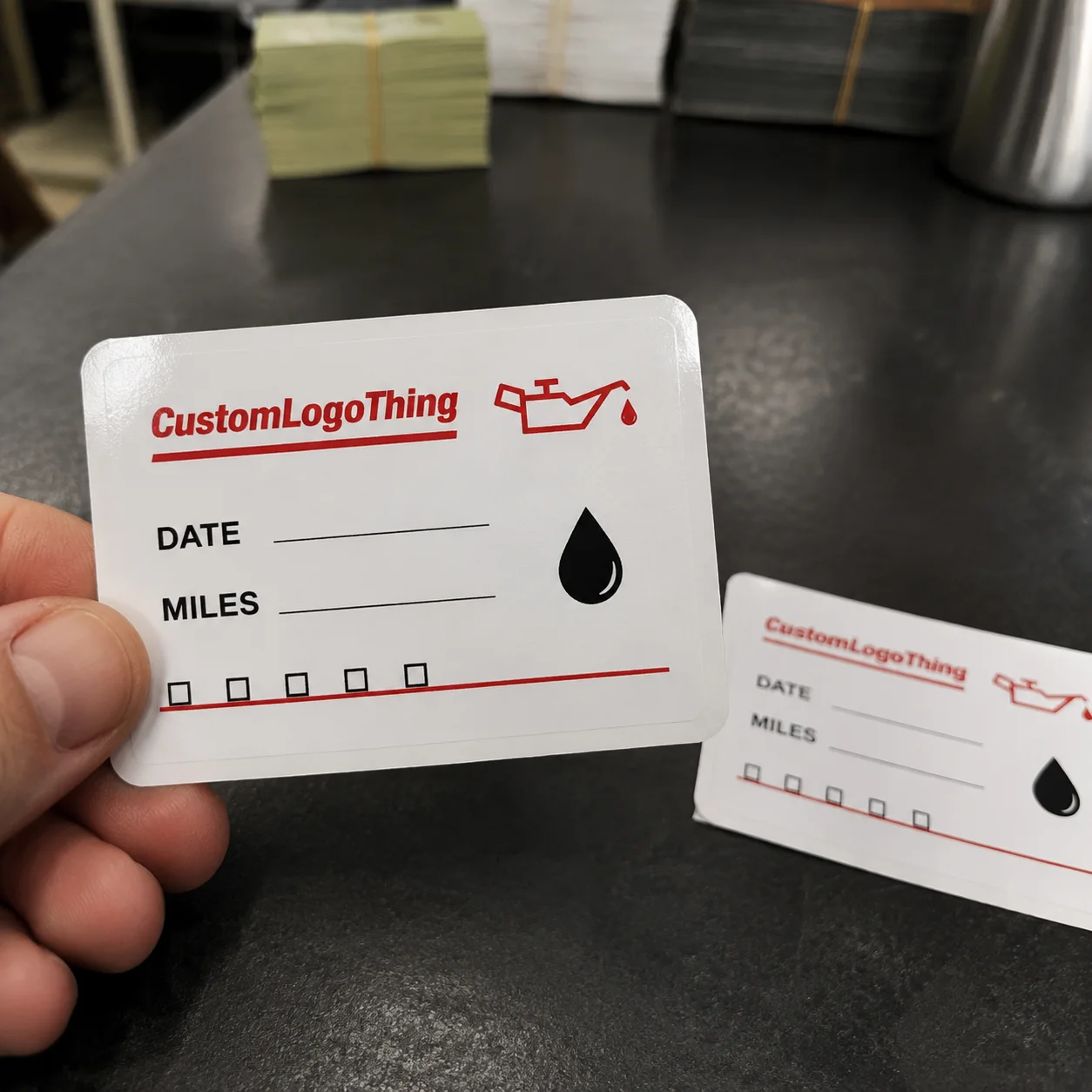
A windshield reminder gives the customer one fast answer: “When do I come back?” It shows the next service mileage, due date, shop name, phone number, and sometimes a QR code for booking. No app download. No login. No folded invoice lost under a floor mat.
Custom static cling Oil Change Stickers are used by quick-lube shops, dealerships, independent garages, fleet service teams, tire shops, and mobile technicians. A dealership group may order 20,000 pieces for multiple service lanes. A mobile mechanic may start with 500 to 1,000 because storage and cash flow matter. Fleet teams may need unit numbers or service categories so the windshield reminder matches the maintenance record.
The buying criteria are simple: visibility, clean removal, writable performance, and repeatable ordering. Artwork matters, but function wins. If the technician cannot write the mileage clearly, or the customer cannot read the date from the driver’s seat, the design failed.
These reminders sit near the same branding logic as Custom Labels & Tags. They are not retail packaging, yet they identify the business, repeat a visual cue, and carry useful information at the exact moment a customer is thinking about service.
Practical rule: If the sticker cannot be read at arm’s length and filled out in under 10 seconds, simplify it before ordering.
How the Cling Format Works on Glass
Static cling film grips smooth glass through electrostatic attraction, not adhesive. That is why it removes cleanly without glue residue, scraping, or solvent. For oil change reminders, this is the main advantage over adhesive labels.
Most reminders are placed on the inside of the windshield, usually near the upper left, upper right, or driver’s side edge depending on shop preference and local visibility rules. Interior placement protects the print from rain, wipers, road grit, and most abrasion. It also lets the technician update the reminder without walking around the vehicle.
A typical layout includes the shop logo, next service mileage, next service date, phone number, website, and one or two service notes. QR codes are common for appointment booking, review requests, or loyalty programs. Keep QR codes about 0.6 to 0.8 inches wide at minimum, with a clear quiet zone around the code. Very small QR codes may look fine on a proof but fail on curved, reflective glass.
Cling works best on clean, smooth, dry glass. Dust, smoke film, detailing residue, silicone, heavy tint edges, and constant repositioning can reduce the hold. Temperature swings also matter. A car baking in a sunny lot, then cooling overnight, stresses film more than a vehicle parked indoors.
- Best surface: smooth interior windshield glass, cleaned before placement.
- Risky surface: dusty glass, textured plastic, heavy tint bands, or tight curved corners.
- Best placement: readable from inside the vehicle without blocking safe visibility.
- Best use: one clean application, not constant peeling and repositioning.
If your customers drive work trucks, off-road vehicles, rideshare cars, or fleet vans exposed to dust and cleaning chemicals, test material before buying a large run. A small sample test can reveal curling, edge lift, glare, and marker problems before you commit to thousands of pieces.
Material, Size, and Print Choices That Matter
The most common materials are clear or white vinyl static cling films, often around 7 mil to 10 mil thick. Thinner film can cost less, but it may curl, feel flimsy, or be harder for technicians to handle with gloves. Thicker film usually sits flatter and feels more substantial, but it costs more.
Grip strength depends on the film, glass condition, print coverage, cut shape, and handling. Heavy ink coverage can change stiffness. Narrow die-cut shapes may lift at the edges faster than simple rectangles. For most automotive shops, a rectangle or square with rounded corners is the safer buy.
Common finished sizes are 2 x 3 inches, 2.5 x 3.5 inches, or 3 x 4 inches. Smaller sizes work for mileage and date only. Larger sizes make sense for QR codes, service type, technician initials, bilingual copy, or fleet fields. Bigger is not automatically better because the sticker still lives on the windshield.
| Option | Typical Use | Tradeoff |
|---|---|---|
| 2 x 3 inch rectangle | Basic mileage and date reminder | Lowest clutter, limited branding space |
| 2.5 x 3.5 inch rounded rectangle | Logo, phone, date, mileage, small note | Good balance for most shops |
| 3 x 4 inch layout | QR code, service notes, fleet fields | More readable, uses more windshield space |
| Custom die-cut shape | Brand-heavy design or promotion | Higher setup cost and more edge-lift risk |
Leave write-in boxes tall enough for real handwriting, not perfect design-studio handwriting. Use numbered fields if technicians fill out stickers quickly: 1 for mileage, 2 for date, 3 for notes. Add plain labels such as “Next Service Due” instead of relying on internal shorthand.
Print options usually include spot color, full-color process, clear areas, or white backing. Clear cling can look clean on glass, but light ink may disappear against bright backgrounds. White backing improves readability and gives logos more contrast. If your palette uses pale blue, gray, yellow, or light green, test it on glass before approving the run.
Writable performance needs the same attention as color. Some shops use fine-tip permanent markers. Others use ballpoint pens because that is what is already at the counter. Ask which writing tools the surface supports. Glossy finishes can smear. Matte write-in panels may behave better but change the look of the piece.
Ask whether the print needs extra UV resistance. Interior windshield placement already protects the sticker more than exterior use, but hot climates and outdoor fleet yards can still punish ink and film. If sustainability or sourcing matters to your broader branded packaging program, organizations such as the Forest Stewardship Council are useful references for paper-based materials, though static cling film itself is usually vinyl or another synthetic material.
Cost, Pricing, and MOQ for Custom Static Cling Oil Change Stickers
Pricing moves with six main variables: size, quantity, color count, shape, variable data, and turnaround. Unit cost usually drops at higher quantities because setup, proofing, print prep, cutting, and packing are spread across more pieces.
For simple rectangular Oil Change Reminder Stickers, rough planning ranges often look like this: 500 pieces may land around $0.35 to $0.75 each, 2,500 pieces may fall around $0.18 to $0.38 each, and 10,000 pieces may drop to around $0.08 to $0.22 each. These are planning ranges, not a universal price list. Full coverage color, heavier film, rush timing, special packing, proof samples, and unusual shapes can change the quote.
Minimum order quantity depends on the printer, material, and production method. Some suppliers start around 250 to 500 pieces. Others prefer 1,000 or more because setup time does not shrink much for a smaller order. If you need multiple branch locations, ask whether versions can be ganged together: same size and layout, different phone numbers, addresses, or appointment URLs.
Variable data adds cost and proofing time. Sequential fleet numbering, unique QR codes, VIN-related fields, or location-specific URLs may require spreadsheet setup, proof checks, and barcode verification. Send clean data and allow a longer review cycle.
| Quantity | Typical Unit Range | Best Fit | Watch For |
|---|---|---|---|
| 500 pieces | $0.35-$0.75 | New shop, design test, mobile technician | Higher setup cost per unit |
| 2,500 pieces | $0.18-$0.38 | Independent garage or steady quick-lube lane | Storage and reorder timing |
| 5,000 pieces | $0.12-$0.30 | Multi-bay service shop | Artwork changes after ordering |
| 10,000+ pieces | $0.08-$0.22 | Dealership, fleet program, multi-location use | Version control and overstock risk |
To prevent quote creep, send exact dimensions, quantity, print colors, artwork, writable area requirements, and delivery target in the first request. If you need matching Custom Packaging Products such as service envelopes, hang tags, counter cards, or custom printed boxes for parts kits, say that early. Related items may price separately, but grouping the discussion keeps artwork and brand control cleaner.
Production Steps and Turnaround: From Proof to Shipment
A normal order follows a predictable path: send specs, review the quote, submit artwork, receive a proof, approve the proof, print, cut, inspect, pack, and ship. Simple rectangular orders with clean artwork may move through production in about 7 to 12 business days after proof approval. Larger orders, custom shapes, special materials, or variable data can push that to 12 to 20 business days or more.
Proofing is where you catch phone number errors, QR codes pointing to the wrong page, fields that are too small, and logos that print too dark. For windshield reminders, proofing matters because the item is functional. A good-looking sticker that cannot be written on is still a bad order.
Ask for a digital proof at minimum. For larger orders, a physical sample or production proof can be worth the extra time. Check readability at arm’s length, marker compatibility, and cling performance on actual windshield glass. Do not approve based only on a monitor; screens glow, while windshields glare.
- Send specs: size, quantity, material preference, and target delivery date.
- Submit artwork: vector files such as AI, EPS, or print-ready PDF work best.
- Review proof: check type size, fields, QR codes, trim lines, and version details.
- Approve production: the production clock usually starts after approval, not after the first email.
- Inspect and ship: cartons should protect the cling sheets from curling, crushing, and edge damage.
Rush production can help only when artwork is ready and the buyer responds quickly. For grand openings, seasonal promotions, or fleet rollouts, build in at least one extra week beyond the quoted production time for shipping, receiving, and internal distribution.
Packaging matters. Static cling sheets can curl or pick up dust if packed loosely. Flat stacks, protective sleeves, shrink-wrapped bundles, or well-fitted cartons usually travel better than loose sheets in an oversized box. Standards from organizations such as ISTA are useful references for transit testing and packaging performance, especially when orders ship to several locations.
Quality control should include count accuracy, color consistency, cut alignment, writable surface checks, and a quick cling test. For multi-location orders, each version should be labeled clearly before cartons leave production.
Common Ordering Mistakes That Cause Reprints
The most common mistake is making the design too small, too dark, or too crowded. A sticker that looks clean at 200% zoom can look like a postage stamp on a windshield. Keep body text around 8 to 10 points minimum, depending on font, and make handwritten fields much larger. Mileage and date should be obvious within one second.
The second mistake is forgetting the writable area. A buyer approves a logo-heavy design, receives the order, then realizes there is nowhere practical to write “68,250 miles” or “service due.” Leave at least 0.35 to 0.5 inches of vertical space for handwritten entries. If technicians wear gloves or write quickly, go bigger.
Another avoidable problem is choosing a finish that does not accept the intended marker. Some glossy surfaces smear with ballpoint pen. Some coatings need permanent marker. Some writable panels perform well only after the ink dries for a few seconds. Test the actual writing tool your team uses.
- Skipping proof review: leads to typos, wrong phone numbers, and bad QR codes.
- Ignoring tint placement: can make clear designs hard to see or reduce cling performance.
- Ordering exact quantity only: leaves no extras for training, damaged pieces, or replacements.
- Using thin strokes: makes logos and small type disappear against daylight.
- Changing artwork too late: causes delays, reproofing fees, or full reprints.
Order extras. A practical overage is 5% to 10% for most small and mid-size runs. If you train new technicians often, run multiple service bays, or have several locations pulling from one inventory box, lean closer to 10%.
Also test on actual vehicle glass. A sample stuck to a flat office window tells you something, but not enough. Windshields are curved, tinted, dusty, hot, cold, cleaned with unknown chemicals, and touched during normal shop work.
Expert Tips Before You Request a Quote
Before requesting a quote, gather the essentials in one place: finished size, quantity, artwork file, number of print colors, writable fields, preferred material, target delivery date, and any location-specific versions. If you do not know the ideal size, ask for pricing on two options, such as 2.5 x 3.5 inches and 3 x 4 inches. The price difference may be small enough to justify better readability.
For artwork, send vector files when possible. A clean PDF with outlined fonts is usually acceptable. Low-resolution screenshots, copied website logos, and fuzzy JPEGs create delays. If your logo is part of a wider branded packaging system, keep colors consistent with service forms, decals, product packaging, and customer-facing materials.
Match the sticker format to your workflow. Quick-lube shops usually need fast write-in fields and bold return mileage. Dealerships may need brand compliance, service department phone numbers, and appointment URLs. Fleet teams may need sequential numbering, vehicle class fields, or QR codes tied to maintenance records. Mobile technicians may want a compact layout with a direct booking link and a review prompt.
If you are unsure, order a sample or short test run first. Check whether the cling stays flat, whether the print reads through glare, and whether the writable coating behaves with your marker. A sample round may add a few days, but it can prevent a full reprint.
The cleanest repeat orders use the same approved dieline and only update small details when needed. That keeps future production faster and reduces version mistakes. The strongest oil change reminder is the one the technician can fill out quickly, the customer can read without squinting, and the shop can reorder without rebuilding the file from scratch.
FAQ
How long do custom static cling oil change stickers stay on a windshield?
They can stay put for weeks or months when the glass is clean and the sticker is placed on a smooth interior windshield surface. Heat, dust, smoke film, detailing residue, and frequent repositioning can weaken the hold, so clean application matters more than many buyers expect.
Can I write on static cling oil change stickers?
Yes, if the design includes a writable area or compatible coating. Use a fine-tip permanent marker or ballpoint pen only if the material is made for that tool, then test the finish first so the ink does not smear during normal shop handling.
What size is best for oil change reminder stickers?
Common sizes usually fall around 2 x 3 inches to 3 x 4 inches, depending on how much information you need to show. Choose a size that leaves room for readable type, service notes, and handwritten mileage without crowding the windshield.
Do static cling stickers work on tinted or curved glass?
They work best on smooth glass and may struggle on rough, dusty, heavily curved, or heavily tinted surfaces. Test placement near tint lines before committing to a full run, because not every windshield behaves the same.
What should I send for a quote on custom static cling oil change stickers?
Send the finished size, quantity, print colors, artwork file, write-in field needs, and target delivery date. If you need numbering, multiple shop versions, a QR code, a proof sample, or a special shape, say so up front to avoid quote surprises.