Buy Custom Oil Change Reminder Stickers That Last Longer
The smallest printed item in an auto shop may be the one customers see most often. Custom oil change reminder stickers sit in the driver’s line of sight for months, doing a job that texts, emails, apps, and counter cards often fail to do: remind the customer who serviced the car and when to come back.
They look simple. Usually, they are not.
A good oil service reminder sticker has to survive hot glass, cold mornings, windshield cleaner, detailing spray, UV exposure, marker ink, and the customer who picks at one corner every time they clean the inside of the windshield. From a print buyer’s perspective, this is closer to a small-format performance label than a throwaway sticker.
What Custom Oil Change Reminder Stickers Actually Do
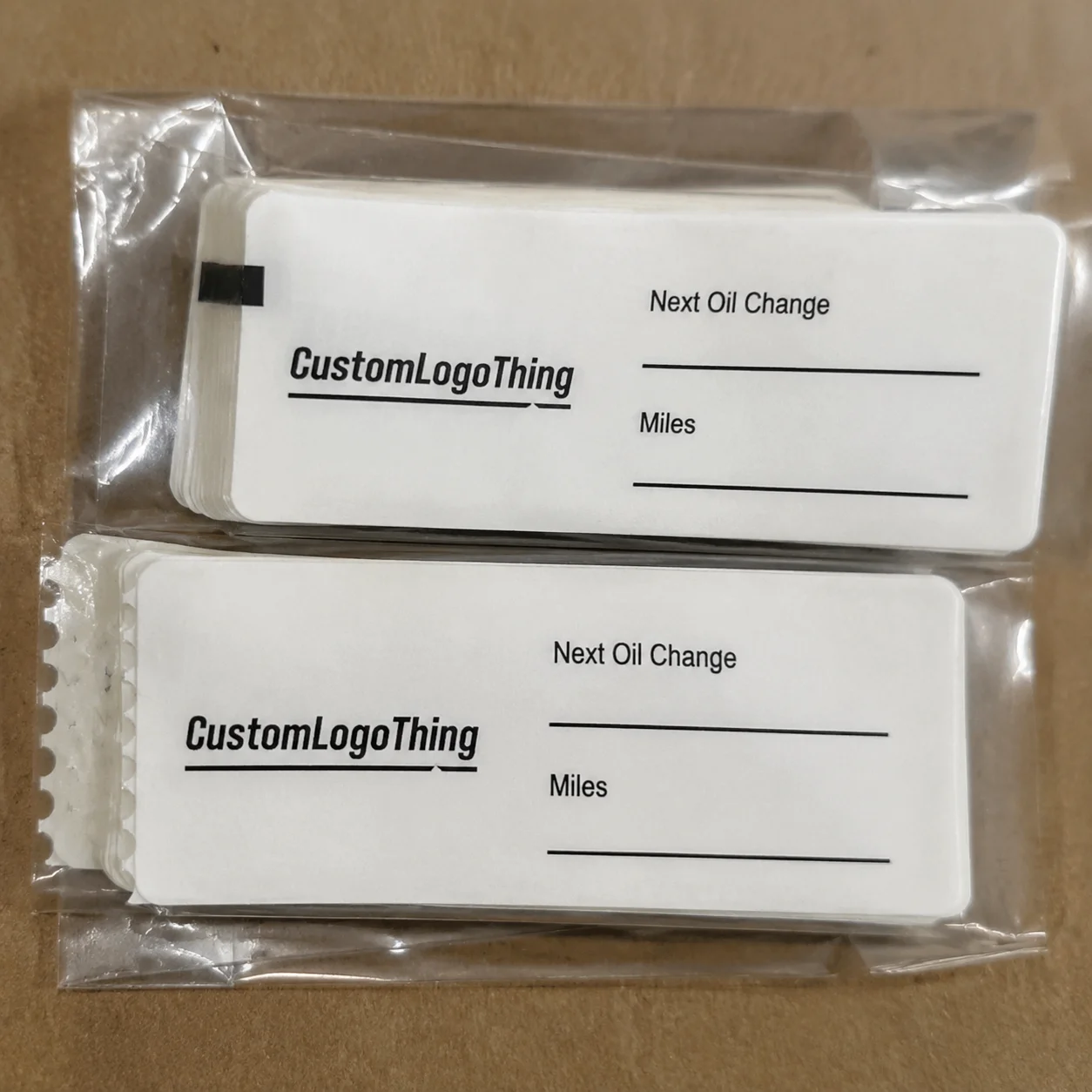
At the basic level, oil change reminder stickers are low-tack windshield, side-window, or dashboard labels printed with the next service mileage, date, shop logo, phone number, website, QR code, or maintenance note. Some are blank write-in labels. Others are preprinted with service intervals such as 3,000, 5,000, 7,500, or 10,000 miles. Larger operators may use variable-data formats tied to a location, fleet account, service package, or maintenance program.
Operationally, they reduce guesswork. A driver does not need to search an email receipt, open an app, or remember what the service advisor said at pickup. The number is right there. For the shop, that matters because oil changes are recurring revenue, and recurring revenue depends on timing. Miss the interval by six months and the customer may go elsewhere because the nearest quick-lube shop was more visible at the exact moment they remembered.
They also work as a retention device. That may sound like marketing language, but the mechanics are plain. A windshield sticker gives the brand repeated exposure at almost zero ongoing media cost. Digital reminders can be filtered, ignored, lost to a changed phone number, or buried under 80 other notifications. A sticker is passive. Persistent. Annoyingly effective.
Typical users include oil change chains, independent repair shops, dealerships, mobile mechanics, fleet maintenance teams, quick-lube centers, tire shops, and car wash businesses that add basic service packages. Even brands focused on Custom Labels & Tags, retail packaging, or broader package branding can learn from this format: the best printed pieces often win because they appear exactly where the customer makes the next decision.
Practical rule: if the customer cannot read the mileage, date, and shop name in less than two seconds, the sticker is underperforming.
How Oil Service Reminder Stickers Work on Glass and Dashboards
An oil service reminder sticker works by adhering lightly to glass, a side window, or a dashboard surface while displaying the next oil change mileage, date, or service interval. Most shops place it in the upper driver-side windshield corner or another consistent position that stays visible without blocking the road. Placement rules vary by jurisdiction, so staff should be trained to avoid any area that could obstruct the driver’s view.
The first major choice is static cling versus removable adhesive. Static cling film uses surface contact and electrostatic attraction rather than glue. It is clean, easy to remove, and well suited to smooth glass. Its weakness is contamination. Fingerprints, dust, silicone-based detailing spray, or tight windshield curvature can reduce hold.
Removable adhesive film uses a light glue engineered to peel away without residue. It generally holds better over longer intervals, but the adhesive specification matters. Too aggressive and the customer complains about cleanup. Too weak and the corners curl before the vehicle reaches the next service date.
Write-on performance is the second major variable. Many service bays still rely on technicians using permanent markers, ballpoint pens, grease pencils, or thermal transfer printers. A glossy surface may look sharp but reject ink. A matte writable coating usually accepts handwriting more reliably, though it can slightly mute brand colors. If technicians use different pens across locations, test them before the full run. Marker compatibility is not a detail to leave to chance.
Common formats include blank write-in stickers, preprinted mileage interval stickers, QR-enabled stickers, branded templates for multiple locations, and variable-data stickers that include store codes or fleet account details. QR codes can link to scheduling pages, review forms, loyalty programs, maintenance records, or coupons. They need enough quiet space around the code and should be tested under glare, because windshields are not friendly scanning environments.
Surface prep sounds boring until it costs you. A quick wipe with a clean, dry cloth often improves adhesion. Heavy glass cleaner residue can do the opposite. Application instructions should be short enough for a busy bay: clean, dry, apply flat, press edges, avoid touching the adhesive or cling surface.
Key Specs That Decide Whether Reminder Stickers Stay Useful
The material choice controls most of the customer experience. Vinyl is common because it is flexible, printable, and available with removable adhesive systems. Static cling film is popular for clean removal. Clear polyester gives a cleaner windshield appearance and better dimensional stability, but it can be less forgiving on curved surfaces. White film improves contrast, especially for handwritten mileage and date fields. Specialty removable materials are useful where high heat, outdoor parking, or longer service intervals are expected.
Adhesive strength needs a narrow target. I usually describe it as “polite but dependable.” A reminder sticker should stay flat for three to six months in normal use, sometimes longer for synthetic oil programs, yet peel off without scraping. In hot climates, glass temperatures can climb far above the air temperature inside a parked vehicle. That heat can soften cheap adhesive or make low-grade film shrink. In cold climates, poor tack can show up on the first freezing morning.
Finish changes both appearance and usability. Matte finishes improve writability and reduce glare. Gloss finishes make logos and brand colors look more saturated. Clear materials create a lighter look on the windshield, but small text may lose contrast unless backed with white ink or designed with heavy, simple typography. For a sticker that carries mileage, date, phone number, and QR code, clarity beats decoration.
| Material Option | Best Use | Watch-Out | Typical Buyer Priority |
|---|---|---|---|
| Static cling film | Clean windshield glass and easy removal | Can fail on dusty or treated glass | No-residue customer experience |
| Removable white vinyl | General oil change reminder programs | Adhesive must be tested for residue | Readable writing and dependable hold |
| Clear polyester | Cleaner visual presentation | Lower contrast without smart design | Brand appearance on glass |
| Writable matte film | Manual mileage and date entry | Marker compatibility varies | Fast technician use |
Size is another quiet decision with real consequences. A 1.5 x 2-inch sticker can look neat, but it may force tiny text. A 2 x 3-inch format gives more room for a logo, QR code, and service notes. Larger formats can work for fleets, dealerships, or multi-service reminders, but drivers dislike anything that feels intrusive. The design should respect the windshield.
Ink durability matters because many vehicles spend every day outdoors. UV-resistant inks and protective coatings help prevent fading. The ASTM library includes many test methods used across materials and print performance evaluation, while packaging teams often apply similar durability thinking to labels, product packaging, and branded packaging that must survive storage and handling. Not every sticker order needs lab testing. Still, buyers should ask how the selected ink and film behave under sunlight, humidity, heat cycling, and repeated handling.
Quality-control checks should be practical. Confirm the die cut is clean, corners release from the liner without tearing, color remains consistent across the run, text is sharp at final size, and writable fields accept the intended marker. If the sticker includes a QR code, scan samples from the printed batch, not just the PDF proof. A perfect digital code can become unreliable after scaling, coating, or printing on clear stock.
Pricing, MOQ, and Unit Cost Drivers for Service Stickers
Pricing for custom oil change reminder stickers is usually driven by material, size, print colors, coating, quantity, die shape, adhesive type, writable surface, and whether variable data is required. A plain one-color write-in sticker costs less than a full-color clear film version with white ink, QR code, and multiple store variations.
Minimum order quantity matters because setup costs do not disappear just because the sticker is small. Artwork review, proofing, press setup, die preparation, material staging, finishing, packing, and quality checks all take time. As quantity rises, those fixed costs are spread across more units. That is why a 500-piece order can feel expensive per sticker, while a 10,000-piece order may fall into a more attractive unit range.
For planning, many small-format custom service stickers land around $0.06 to $0.20 per unit at mid-to-high quantities, depending heavily on material, size, print coverage, and finishing. Lower-volume runs may sit closer to $0.25 to $0.60 per unit. Specialty constructions, split shipments, multiple designs, rush production, Custom Die Cuts, or extra proof rounds can push the number higher. These are broad market ranges, not a quote. The final cost depends on the exact specification.
A small independent shop may prioritize flexibility: 1,000 to 2,500 stickers, one design, standard size, writable matte surface. A multi-location chain may reduce unit cost by standardizing artwork and ordering 25,000 or 50,000 pieces at a time, possibly split by location. Fleet maintenance teams may care less about logo size and more about durable writing fields, asset IDs, and service intervals.
| Order Scenario | Common Quantity | Likely Cost Behavior | Best Buying Move |
|---|---|---|---|
| Single repair shop | 1,000-2,500 | Higher unit cost, lower inventory risk | Use one standard template |
| Busy quick-lube location | 5,000-10,000 | Better unit cost from scale | Forecast monthly usage before ordering |
| Regional chain | 25,000+ | Lower unit cost, more version control risk | Standardize design and manage location data |
| Fleet program | Variable | Depends on data and durability needs | Prioritize writable fields and asset tracking |
Good quote requests are specific. Include size, quantity, material preference, adhesive type, artwork files, number of versions, desired delivery date, and application surface. If you are not sure about material, say that. A supplier can guide you better with “inside windshield, writable marker field, hot climate, six-month hold” than with “send sticker pricing.”
The retention math is surprisingly persuasive. If a $0.12 sticker helps bring back even a small fraction of customers for another $60 to $120 oil service, it can outperform many higher-cost reminder channels. Not every driver will respond. But the cost-to-visibility ratio is hard to ignore.
Process and Timeline From Artwork to Finished Stickers
The production flow is straightforward on paper: gather specs, submit artwork, confirm material, review a digital proof, approve production, print, finish, quality check, pack, and ship. The friction appears in small decisions. Is the QR code final? Is the phone number correct? Should the date field be larger? Does the logo still read at 1 inch wide? Has anyone tested the marker?
Artwork should be supplied as vector files when possible, typically AI, EPS, or production-ready PDF. Raster logos pulled from websites often fail at small sizes because edges soften and colors shift. Use proper bleed if the design runs to the edge. Keep contrast high. A dark blue logo on a black background may look tasteful on a monitor and useless on glass.
Proofing deserves more attention than buyers often give it. Check phone numbers digit by digit. Scan QR codes from the proof. Confirm URLs, store addresses, service intervals, and any disclaimers. If the sticker has writable boxes, make sure the boxes are large enough for real handwriting, not the designer’s perfect sample text. Service bays move quickly, and technicians do not write like fonts.
Lead times vary by supplier and specification. A standard printed run may take about 7 to 12 business days after proof approval, plus shipping. Specialty removable films, custom dies, multiple versions, variable data, heavy order volume, or physical sampling can extend that to 15 to 25 business days. Rush production may be available, but it can raise cost and compress the review window. That is risky if the artwork has store-level details.
Timeline planning matters because running out of stickers changes behavior. Technicians start rationing them. Advisors skip the reminder. Customers leave without a visible prompt. The process looks tiny, yet the operational signal is clear: the shop’s follow-up system has a hole in it.
A practical ordering rhythm is simple. Count monthly oil changes. Add seasonal spikes. Keep one unopened backup box. Reorder when that backup box becomes the active box. For shops already buying Custom Packaging Products such as service envelopes, key tags, custom printed boxes, or promotional print, reminder stickers can often be planned in the same purchasing calendar to reduce last-minute freight decisions.
Common Mistakes That Make Oil Change Stickers Fail Early
The first mistake is using a general-purpose label instead of a removable windshield or static cling material. Ordinary labels may curl, yellow, leave residue, or fuse to glass after heat exposure. They may be fine for a shipping carton. They are not automatically suitable for a vehicle interior.
The second mistake is unreadable design. Tiny fonts, low-contrast colors, crowded layouts, and oversized logos bury the information the customer actually needs. Mileage and date should dominate. Brand elements should support the reminder, not fight it. Many service stickers are designed backward: the logo is treated as the hero, while the service interval is treated as an afterthought.
Weak writable surfaces create another failure point. Some coatings smear. Others bead ink. A few look good for the first week and fade badly after sun exposure. If a chain has 12 locations using three marker brands, test all three. The cheapest marker in the bay often becomes the real print system.
Bad placement habits damage both performance and perception. Crooked stickers, blocked sightlines, and inconsistent locations make the shop look careless. A small printed item can signal process discipline. Or the lack of it. Staff training should include where to place the sticker, how to write the date and mileage, and how to remove the old sticker cleanly before applying the new one.
QR codes need testing beyond the screen. A code that scans perfectly from a PDF may struggle once printed small, placed behind angled glass, and hit with sunlight. Use a useful destination: online scheduling, maintenance records, fleet portal, coupon, or review page. Sending customers to a generic homepage wastes the scan.
Over-ordering can also backfire. Buying 50,000 stickers before a phone number, logo, service package, or offer changes creates waste. The same pattern shows up across packaging design, product packaging, and package branding: bulk pricing is attractive until the brand asset changes. For many shops, a three- to six-month inventory position is safer than chasing the absolute lowest unit price.
Next Steps Before You Order Your Reminder Sticker Run
Before requesting a quote, make five decisions. Choose the surface: windshield, side glass, dashboard, or mixed use. Pick static cling or removable adhesive. Define the size. Decide which fields technicians must write in. Confirm whether the layout needs QR codes, store versions, fleet data, or service-specific intervals.
- Surface: clean windshield glass usually works well for cling or removable adhesive; dashboards may need a different construction.
- Size: compact formats look cleaner, while larger formats support QR codes and multiple service fields.
- Writable area: test marker, pen, grease pencil, or thermal transfer compatibility before scaling the order.
- Brand content: include logo, phone, website, and scheduling prompt only after mileage and date remain easy to read.
- Inventory: order enough for normal volume, seasonal peaks, proofing time, production, shipping, and a small safety buffer.
Run a quick in-shop audit. Count monthly oil changes. Look at failed stickers on customer vehicles. Ask technicians which writing tools they actually use. Ask front-desk staff what customers mention. If customers complain about residue, curling, or unreadable dates, that is specification data, not casual feedback.
Design should follow two priorities. First, make the mileage and date readable from the driver’s seat. Second, use the remaining space for logo, phone number, web address, QR code, or service message. That hierarchy may feel blunt, but it protects the purpose of the item. A reminder sticker is not a miniature billboard. It is a service instruction with branding attached.
Request material guidance rather than defaulting to the cheapest option, especially for hot climates, outdoor parking, long synthetic oil intervals, or fleet vehicles. If sustainability claims matter to your broader print program, ask suppliers what materials, liners, inks, and waste practices they can document. For wood-fiber packaging and paper-based programs, standards from groups such as the Forest Stewardship Council can be relevant, though windshield films and liners need their own material-specific review.
Finally, build a reorder trigger. A reminder sticker program fails less often because of design theory and more often because the final box gets opened without anyone noticing. Set a minimum inventory level and assign ownership. The best custom oil change reminder stickers are not just attractive; they match the adhesive, writing method, size, and ordering schedule to the way the service bay actually operates.
FAQ
What material is best for custom oil change reminder stickers?
Static cling is useful for clean glass and easy removal, while removable adhesive film is better when the sticker needs a stronger hold. Writable matte vinyl or polyester options are often preferred when technicians manually add mileage and date information. The best choice depends on windshield placement, climate, marker type, and how long the reminder needs to stay readable.
How much do oil change reminder stickers usually cost?
Cost depends on size, quantity, material, color count, finish, adhesive type, and whether the order needs custom shapes or variable data. As a broad planning range, low-volume custom runs may cost around $0.25 to $0.60 per sticker, while larger standardized runs may fall closer to $0.06 to $0.20 per unit. For an accurate quote, provide artwork, dimensions, quantity, material preference, and delivery deadline.
Can custom service reminder stickers include QR codes?
Yes, QR codes can link to online scheduling, review pages, maintenance records, coupons, or fleet portals. The QR code should be large enough to scan through glare and should be tested on the exact printed proof or sample. Avoid placing QR codes too close to curved edges, heavy graphics, or handwritten service fields.
What size should automotive reminder stickers be?
The ideal size balances visibility with driver comfort; it should show mileage and date clearly without blocking the windshield view. Many shops choose compact rectangles or squares with a dedicated write-in area and a small logo zone. If adding QR codes, phone numbers, or multiple service fields, allow more space instead of shrinking the text.
How far ahead should shops order custom oil service stickers?
Order before current inventory gets low so there is time for artwork review, proof approval, production, quality checks, and shipping. Standard runs may take roughly 7 to 12 business days after proof approval, while special materials, multiple artwork versions, Custom Die Cuts, or rush-season demand can extend turnaround. Track monthly oil change volume and reorder when backup inventory reaches a preset minimum.