Buyer Fit Snapshot
| Best fit | packaging buyers who need clearer specs, stronger internal paths, and repeatable quote decisions where brand print, material, artwork control, and repeat-order consistency matter. |
|---|---|
| Quote inputs | Share finished size, material target, print colors, finish, packing count, annual reorder estimate, and delivery region. |
| Proofing check | Approve dieline scale, logo placement, barcode or warning zones, color tolerance, and any recyclable or compostable wording before bulk production. |
| Main risk | Vague material claims, crowded artwork, or missing packing details can create delays even when the unit price looks attractive. |
Fast answer: Buy Eco Friendly Packaging Supplies for Your Business should be specified like a repeatable production item. The safest quote includes material, print method, finish, artwork proof, carton packing, and reorder notes in one written spec.
What to confirm before approving the packaging proof
Check the product dimensions against the actual filled item, not only the sales mockup. Ask for tolerance on folds, seals, hang holes, label areas, and retail display edges. If the package carries a logo, QR code, warning copy, or legal claim, reserve that space before decorative graphics fill the panel.
How to compare quotes without losing quality
Compare board or film grade, print process, finish, sampling route, tooling charges, carton quantity, and freight assumptions side by side. A lower quote is only useful if the supplier can repeat the same color, closure quality, and packing count on the next order.
Why Businesses Buy Eco Friendly Packaging Supplies
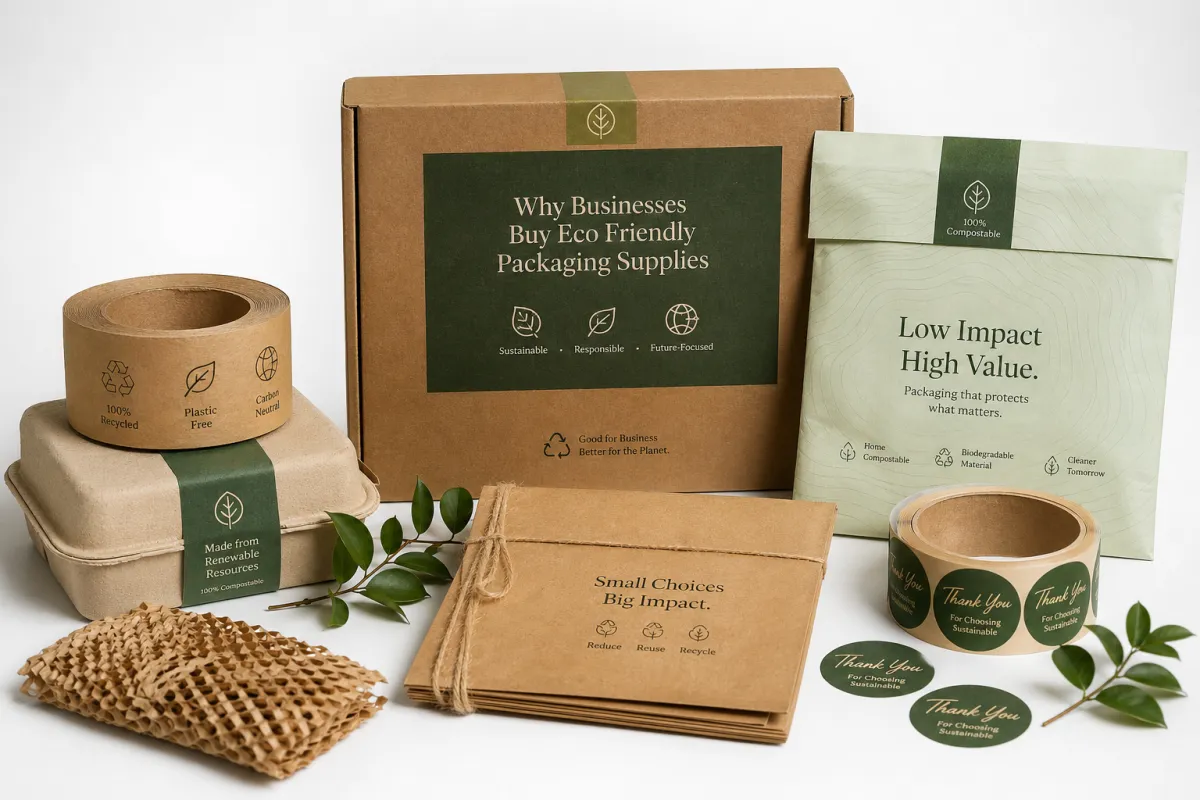
I still remember a small fulfillment floor outside Columbus, Ohio, where six people were reworking a pallet of returns because one carton dimension was off by 3 mm and the old mailer liner held too much moisture after a 48-hour cold storage hold. They had come to me trying to buy Eco Friendly Packaging supplies for what sounded like a simple brand refresh. The right carton board, a 32 ECT corrugated spec, and a cleaner liner did more than improve the shipment's appearance. They kept 8,000 units out of the scrap bin and saved the team from a reprint that would have burned through roughly $4,200 in labor, freight, and replacement stock over two weeks. That is the part people kinda miss. Eco packaging is not just a nicer-looking outside layer. It is a production choice, a freight choice, and sometimes a rescue mission when a line is already under pressure. It also shapes how a buyer reads your brand before the product is even touched.
People search for buy Eco Friendly Packaging supplies because they need packaging that actually earns its place on the line. A 2 oz reduction per parcel sounds tiny until you multiply it by 50,000 shipments. Suddenly that becomes 6,250 lb of freight weight that never has to move, which can trim a regional truck lane by about 1.1 pallets per load. On a route leaving a Midwest warehouse three times a week, the difference shows up fast in the bill. I have watched brands save on dimensional weight, cut packing labor by 12 to 18 seconds per unit, and improve shelf presentation with the same purchase order. Clean fiber, recycled content, and right-sized formats do not look flashy on a sales sheet. They matter in the dock, on the conveyor, and at the customer's front door. They also matter when a buyer is comparing recycled-content board, kraft mailers, and compostable mailers against the real cost of returns.
I still see companies begin with the slogan and hope the material behaves. Better buyers reverse that order. They ask whether the mailer closes cleanly after 25 open-close cycles, whether the carton stacks to 40 pallets without crushing, whether the ink will scuff after a 72-hour transit test, and whether the package still looks polished after a cold-chain or cross-dock trip through Atlanta, Georgia, or Dallas, Texas. Honestly, that is the only sane way to do it. If you want to buy Eco Friendly Packaging supplies, you have to think about the product, the shipping lane, and the brand image at the same time. A paper-based solution can carry a lower impact and still survive a 24-inch conveyor drop, but only if the caliper, board grade, and adhesive are chosen with discipline and checked against the actual humidity in the plant, which is often 55% to 70% in summer.
The phrase buy eco friendly packaging supplies also attracts serious procurement teams because it signals a purchase decision, not a mood. A marketing manager may care about the story, but an operations manager wants the exact dimensions, the pallet count, and the reorder schedule. I visited a skincare co-packer in Toledo, Ohio last winter and their biggest issue was not the outer box at all. A soft tissue wrap was shedding dust into a heat-sealed pouch and slowing the line by 14 minutes every hour, which translated to almost 4 lost labor hours per shift. They moved to a tighter, cleaner sheet stock and the so-called green option also became the faster one. That is what real packaging work looks like. Less romantic, more useful. Also less likely to make everyone on the floor mutter under their breath at 6:15 a.m.
The value proposition is plain enough: better brand presentation, fewer shipping problems, stronger shelf appeal, and materials that fit real production lines in cartons, mailers, bags, wraps, and inserts. If you want to buy eco friendly packaging supplies that survive warehouse handling and still feel premium in a customer's hands, start with the use case, not the slogan. The rest of this page is built for buyers who need usable options, clear specifications, and quote-ready information before they place an order. That usually means a board spec, a closure method, a ship-to region, and a delivery target that can survive an actual calendar, not just a hopeful spreadsheet.
Eco Friendly Packaging Supplies: Products to Compare
If you plan to buy eco friendly packaging supplies for a real production schedule, the product family matters as much as the print. A corrugated shipping box behaves very differently from a kraft mailer, and a molded fiber tray is not the same thing as a recycled paper insert. I have stood on lines where a brand tried to force one generic packaging format across three SKUs in Shenzhen, Guangdong and Louisville, Kentucky. The result was 11% more void fill, slower pack times, and a higher damage rate. The right answer is usually a mix of products, each matched to the weight, finish, and shipping channel of the item inside.
Here is the breakdown I use with buyers who want to buy eco friendly packaging supplies without paying for features they do not need:
- Corrugated shipping boxes: Best for apparel, consumer goods, subscription kits, and e-commerce parcels that need stack strength and print-ready surfaces.
- Kraft mailers: A strong fit for flat goods, documents, books, light accessories, and branded retail packaging that needs a neat first impression.
- Compostable or recycled-content bags: Useful for soft goods, apparel, produce-adjacent packs, and items where a lighter-format closure saves space.
- Recycled paper inserts: Ideal for cushioning, partitioning, and product presentation when you need protection without foam.
- Molded fiber trays: Common in electronics, personal care, and food-adjacent packaging where shape retention and nesting matter.
- Tissue and protective void fill: Helpful for unboxing presentation, scratch prevention, and small dunnage needs across branded packaging runs.
Material differences deserve a close look. Recycled fiber content, post-consumer content, plant-based films, and compostable structures all carry different performance and end-of-life implications. A paper mailer with 40% post-consumer fiber can still be very sturdy, but the coating and adhesive need to support the disposal claim you want to make. If you buy eco friendly packaging supplies for a retail program, check whether the structure can handle shelf wear, corner rub, and stacking from the back room to the front table. If the product is shipping through a fulfillment center, ask about machine feedability, seal consistency, and how the format behaves at 300 parcels per hour. A molded fiber tray made in Suzhou, Jiangsu may handle compression better than a soft paper insert, while a kraft mailer printed in Brampton, Ontario may be better for retail presentation and lower freight weight.
I also like to compare customization options before I quote anything. Print coverage, sizing, closure style, coatings, and insert compatibility all affect price and performance. A plain kraft box may be perfect for one client, while another needs a fully branded package with two-color flexo, a matte aqueous coating, and a fitted paper insert that locks a glass bottle in place. If you are trying to buy eco friendly packaging supplies for seasonal bundles, I would rather see a smart standard size with a custom belly band than a fully bespoke box that costs too much to store. A 350gsm C1S artboard sleeve with a 1-color logo can often do the same visual work as a heavier custom carton, but at a lower tool cost and a 7 to 10 day faster setup. I have seen "simple" turn into "why is this costing more than the product inside?" more times than I care to admit.
| Product Type | Best Use | Typical Spec | Illustrative Price | Notes |
|---|---|---|---|---|
| Corrugated shipping box | E-commerce, kits, heavier goods | 32 ECT, 200# test, custom print | $0.15 per unit at 5,000 pieces | Strong for stacking, easy to brand |
| Kraft mailer | Flat products, apparel, books | 250-400 gsm board, self-seal closure | $0.27 per unit at 10,000 pieces | Good for low-labor packing lines |
| Molded fiber tray | Protective presentation, inserts | Custom cavity, recycled fiber blend | $0.41 per unit at 10,000 pieces | Works well for premium unboxing |
| Recycled paper insert | Cushioning, partitions, retail kits | Caliper matched to product weight | $0.08 per unit at 20,000 pieces | Lightweight and easy to recycle |
| Compostable bag | Soft goods, light retail packaging | Plant-based film or paper composite | $0.19 per unit at 10,000 pieces | Check seals, heat tolerance, and claim language |
I used to walk one supplier's converting room in the Midwest and watch a crew test a recycled paper insert against a bottle of olive oil, a set of glass jars, and a blister-packed vitamin SKU. The insert looked almost too simple on the bench, yet it cut breakage by 9% because the cavity depth matched the neck and shoulder profile exactly. That is the kind of detail that separates a packaging purchase from a packaging gamble. If you want to buy eco friendly packaging supplies that actually perform, compare these categories against product weight, transit path, and line speed, not against a generic sustainability slogan. A 1.8 mm insert that nests cleanly in a 10 x 8 x 4 inch box can outperform a heavier, sloppier insert every time.
Specs to Check Before You Buy Eco Friendly Packaging Supplies
The buyers who do best when they buy eco friendly packaging supplies are the ones who treat specs as guardrails. I do not mean a vague one-page sheet with a size and a logo note. I mean usable numbers: dimensions, caliper, basis weight, burst strength, ECT, seal type, temperature tolerance, and print limitations that reflect the actual substrate. If you ship a 14 oz jar in a 250 gsm mailer designed for apparel, you are asking for tears at the seam. If you print a heavy flood coat on a board that was meant to stay uncoated, you can lose fold integrity and scuff resistance in one run. And then everyone gets to stare at the packing table like it personally offended them.
Start with product weight and shipping method. A package going by pallet to a retail back room does not need the same structure as a box moving through a parcel network with four transfers and a conveyor drop. I have seen buyers choose a beautiful box with a low board grade, then discover the inserts buckle under cold-room humidity or a warehouse humidifier set at 72%. That is why I always ask whether the pack will be stacked, tumbled, chilled, or fed through automation. If the answer involves a high-velocity line, the spec has to respect that environment. A carton that passes a 24-inch drop test in Atlanta may fail after two hours in a 90% humidity dock in Miami, Florida.
Sustainability claims need the same discipline. If you plan to buy eco friendly packaging supplies and talk about recycled content, ask for the exact percentage and whether it is pre-consumer or post-consumer fiber. If you want compostable packaging, ask which certification applies and whether the adhesive, ink, or barrier layer changes the claim. FSC chain-of-custody matters too; the paperwork is not decoration. I often point buyers to the Sustainable Packaging Coalition at packaging.org for industry context and to fsc.org when they need a cleaner conversation about responsible fiber sourcing. For a 350gsm C1S artboard sleeve or a 24pt SBS carton, those documents should match the actual mill certificate, not a generic line in a sales deck.
Here are the details I would not skip:
- Dimensions and tolerances: Ask for inner and outer dimensions, plus a tolerance band such as +/- 1.5 mm.
- Strength metrics: For corrugated, ask for ECT or burst test values; for flexible packs, ask for seal strength or puncture data.
- Closure method: Self-seal strips, tuck flaps, adhesive tabs, and heat seals each behave differently on the line.
- Environmental claims: Recyclable, recycled content, compostable, or FSC-certified should be supported in writing.
- Print limits: Spot colors, registration tolerance, and coating options should be confirmed before approval.
Sampling is not optional if the packaging is new. I would rather spend 2 days on a physical sample round than fix 20,000 bad units after the first press run. One beverage client I worked with wanted to buy eco friendly packaging supplies for a paper belly band on a chilled bottle pack. On paper, the idea looked fine. On the cold shelf at 38 degrees Fahrenheit, the adhesive crept after 8 hours and the band loosened. We changed the adhesive system, tested it again in a Houston, Texas walk-in cooler, and solved a problem that would have embarrassed the brand at retail. Good specifications prevent that kind of headache, protect margin, and keep the order moving instead of bouncing back for rework.
Pricing, MOQ, and Total Cost Considerations
Price is where the conversation gets real. When clients ask me to buy eco friendly packaging supplies, I never stop at a unit number. Material type, print complexity, custom sizing, certification work, tooling, and freight all move the quote. A plain recycled mailer with no print may land at $0.27 per unit for 10,000 pieces, while a custom printed box with a matte finish and a die-cut insert can sit closer to $0.89 per unit for 5,000 pieces, even if the outer size looks similar. The press time, setup, and sheet yield change the economics fast, especially when the print line is running in Chicago, Illinois or Monterrey, Nuevo Leon with different labor and board costs.
Minimum order quantity is another piece people underestimate. MOQ exists because a converting line has setup costs, a print run has spoilage allowance, and custom tooling needs to be spread across enough units to make sense. If you buy eco friendly packaging supplies in a 1,000-unit pilot, the per-unit cost will almost always be higher than a 10,000-unit run. That does not mean the first order is wrong. It means the buyer should understand the tradeoff and ask for tiered pricing across 1,000, 5,000, and 10,000 units so the budget can be planned with open eyes. A lot of suppliers will show a 22% step-down between 5,000 and 10,000 pieces, and that gap matters if you are launching in a single quarter.
I always push teams to compare total landed cost, not just the factory quote. Freight, storage, damage risk, and reorders all matter. A cheaper carton that crushes at the corner can cost more once you count return shipping and labor to repack the failure. I sat in a client meeting where a purchasing manager wanted to save $0.07 per unit by switching to thinner board. The test pallets looked fine until one stretch of warehouse stacking hit a humid afternoon in Greensboro, North Carolina and the bottom tiers bowed. That "savings" turned into a rework bill and 3 lost shipping days. The lowest quote is not always the lowest cost, which is a lesson that seems obvious until the spreadsheet starts sparkling and everyone gets excited too early.
For budget-minded teams, I usually suggest this sequence:
- Start with a standard size whenever the product fits, because custom dimensions add setup cost.
- Use one or two print colors before moving to heavy coverage, foil, or specialty finishes.
- Reserve fully custom structures for high-volume SKUs or flagship retail packaging.
- Ask for alternate substrates, such as recycled content board versus virgin fiber, to compare price and performance.
- Request freight estimates to your warehouse zip code before you approve the final PO.
Transparent pricing builds trust, and that is especially true when a buyer needs to buy eco friendly packaging supplies quickly while still protecting margin. I appreciate vendors who say, "The 5,000-unit price is $0.41, but the 10,000-unit price drops to $0.29 if you accept a 12-15 business day production window from proof approval." That kind of detail helps procurement, marketing, and operations line up without three extra meetings. It also gives you a fair basis for comparing a plant in Brampton, Ontario with one in Dongguan, Guangdong, where freight, lead time, and tooling can land differently even when the board spec looks identical.
One more thing: if you are comparing multiple suppliers, ask them to quote the same spec sheet. I have seen apples-to-oranges quotes where one vendor priced 32 ECT board and another priced a lighter 200# material, then the buyer thought they had found a bargain. They had not. They had bought confusion. If you want to buy eco friendly packaging supplies with confidence, insist on identical dimensions, identical artwork assumptions, the same delivery terms, and the same pallet configuration on every quote. A 40 x 48 inch pallet loaded 6 high is not the same as a 48 x 48 inch pallet loaded 4 high, even if both numbers fit neatly on a page.
Ordering Process and Production Timeline
The cleanest orders I have handled all followed the same rhythm: brief, specification review, quote, proof, sample approval, production, quality check, and freight booking. If you want to buy eco friendly packaging supplies without friction, that sequence matters. It keeps the project moving and gives each department a chance to catch a mistake before it becomes a pallet problem. A good vendor should tell you exactly where the hold points are, because that is where delays usually hide. For a custom carton printed in Suzhou, Jiangsu or a mailer converted in Pune, Maharashtra, those checkpoints can save a full week if they are handled early.
Most delays come from four places: late artwork, unclear measurements, certification questions, and last-minute substrate changes after proof approval. I watched one brand lose 9 business days because the label team sent a logo file in the wrong color space and the print house had to rebuild the proof twice. Another client thought their box measured 9 x 6 x 3 inches, but the product actually required 9.25 x 6.5 x 3.2 once the insert was installed. A quarter inch sounds harmless until you are loading a 12-cavity tray into a rigid carton and everything binds at the fold. That is the kind of small miss that can turn into a 600-unit delay in one afternoon.
For timing, stocked items can move quickly, while custom work usually needs more patience. A plain kraft mailer can ship in 3 to 5 business days if it is on the shelf. A fully branded carton with custom die cutting, two-color print, and a fitted insert usually needs 12-15 business days from proof approval, depending on plant capacity and material availability. If you are trying to buy eco friendly packaging supplies for a launch, that timing difference matters. It is the reason I advise teams to place packaging on the critical path, not as the last checkbox after the marketing deck is already pretty. A launch calendar in Los Angeles, California will not forgive a proof that sits untouched for 4 days.
Here is the order packet that speeds things up in the real world:
- Product dimensions: Include the item size, any accessories, and the final packed weight.
- Quantity by SKU: Break out pilot volume, quarterly usage, and expected reorder bands.
- Ship-to details: Warehouse address, dock requirements, and whether liftgate service is needed.
- Artwork files: Vector logo, Pantone targets, and any copy restrictions.
- Compliance notes: Recyclability, compostability, FSC, or food-contact concerns if applicable.
A clean milestone schedule is more than a courtesy. It lets procurement coordinate inventory, launch dates, and promotions without guessing. I have worked with brands that had seasonal volume swings of 3x between their quiet months and their peak months. For them, the production calendar had to be blunt and specific: proof by Tuesday, sample by Friday, production start next Wednesday, freight pickup on the following Monday. When a supplier communicates dates clearly, buyers can buy eco friendly packaging supplies with less stress and fewer last-minute expediting fees. That clarity matters just as much in a Kansas City warehouse as it does at a co-packer in Toronto, Ontario.
Why Choose Custom Logo Things for Eco Packaging
Custom Logo Things is a practical partner for buyers who care about both the look and the mechanics of packaging. That is the short version. The more useful version is that the team understands cartons, liners, inserts, wraps, and branded packs from the factory floor up, not just from a polished presentation deck. I respect that. The best suppliers know how a board folds at 400 units per hour, how a liner behaves in 65% humidity, and how a print spec looks once it has passed through a real converting line in Dongguan, Guangdong or Brampton, Ontario. If you want to buy eco friendly packaging supplies with fewer surprises, that hands-on mindset matters.
Material knowledge is one of the strongest reasons I would put Custom Logo Things on the shortlist. Buyers need honest guidance on what is recyclable, what is compostable, what is lower-impact, and what claims are too loose to defend. I have sat across from teams that wanted to call everything "eco-friendly," but the substrate, adhesive, and finish did not support that language. A supplier who can say, "This one is recyclable in most curbside streams, but this one needs industrial composting," helps the customer avoid a future complaint and protects the brand's credibility. If the project uses a 350gsm C1S artboard carton sleeve or a 24pt SBS mailer, that distinction should be in the quote, the proof, and the final spec sheet.
I also like that the right supplier helps balance appearance, protection, and cost instead of chasing one attribute at the expense of the others. A premium skincare brand may need soft-touch paper, a tight insert, and a crisp two-color logo, while a warehouse subscription kit may care more about fast assembly and pallet efficiency. The point is not to overspend on packaging design. The point is to choose the right package branding for the job and still keep the line moving. That is where Custom Packaging Products can be a smart starting point, especially if you need several formats reviewed side by side. A well-fitted 10 x 7 x 2 inch mailer can save more labor than a fancy finish ever will.
Sampling and specification review should feel like a normal part of the process, not an exception. I once watched a supplier rush a box order without a proper sample check, and the fold lines were off by enough to force a hand adjustment on every tenth unit. That does not sound dramatic until you multiply it by 18,000 cartons, which is 1,800 manual corrections no one budgeted for. Good vendors protect you from that kind of waste. They confirm the details, communicate production status, and help you buy eco friendly packaging supplies with a lower risk of rework, less back-and-forth, and a clearer path from quote to delivery.
There is also a practical brand benefit that gets overlooked. When the package arrives cleanly, opens neatly, and protects the product on the first try, customers notice. I have seen that effect in retail packaging, subscription kits, and Custom Printed Boxes for direct-to-consumer brands in Austin, Texas and Vancouver, British Columbia. The result is not just a prettier unboxing. It is fewer support tickets, fewer replacements, and a stronger first impression that does not depend on a loud marketing claim. If your goal is to buy eco friendly packaging supplies that support both operations and brand perception, that combination is hard to beat.
Next Steps to Buy Eco Friendly Packaging Supplies
If you are ready to buy eco friendly packaging supplies, start with the numbers you already have. Gather product dimensions, monthly volume, the packing method on the line, and the sustainability claim you actually need to support. A team that knows whether it needs recycled content, FSC-certified fiber, or a compostable structure will get a much cleaner quote than a team asking for "something green" and hoping the answer arrives fully formed. If your product ships from a facility in Nashville, Tennessee or Burlington, North Carolina, include that warehouse zip code too, because freight can move the final number by 8% to 14%.
I suggest requesting 2 or 3 quote scenarios before you make a decision. Compare stock versus custom, compare two material constructions, and compare two MOQ levels. One of those quotes might use a standard size with a light custom print, while another uses a bespoke spec with a heavier board and a tighter insert. That side-by-side view makes it easier to buy eco friendly packaging supplies with a budget and a timeline that actually fit the project. The clearest comparisons usually show one option with a 7-day faster ship date and another with a 16% lower unit price; both numbers matter, but not always in the same order.
Prepare artwork files, shipping targets, and any compliance notes before the first call. If the supplier has your Pantone target, ship-to zip code, and product weight from day one, the quote is more accurate and the production calendar is easier to trust. I have watched buyers lose nearly a week because they needed to chase a label file or confirm a certification name after the first draft was already in circulation. The strongest orders start with clean inputs, not a pile of "we'll fix it later" notes in somebody's inbox. A simple file named `brand_logo_v4.ai` can save more time than a conference call in the wrong time zone.
Before you place the order, review the current packaging failure points. Is the issue scuffing, crushed corners, bad fit, slow packing, or a brand presentation problem? Then collect a sample set and test it against the actual conditions: a drop from 24 inches, a 4-hour humidity cycle, a 15-pound stack load, or a conveyor pass through your warehouse. That is the practical way to buy eco friendly packaging supplies and avoid the kind of guesswork that costs time later. If the sample passes in a 78 degree room in Cleveland, Ohio, test it again after a 38 degree cold chain hold before you sign off.
My advice is simple: if you need to buy eco friendly packaging supplies that protect products, support your brand, and hold up in production, ask for the spec sheet, the sample, and the quote all at once. That gives you a real basis for comparison and a cleaner path to purchase. If you are ready to buy eco friendly packaging supplies for the next run, send over the dimensions, the quantity, and the artwork files, then compare the options by price, lead time, and fit instead of by promise alone. A good supplier should be able to answer in one email with a price, a lead time, and a proof schedule, not a page of generalities.
What Should You Check Before You Buy Eco Friendly Packaging Supplies?
Check the dimensions, weight capacity, closure method, print needs, and disposal claim before you place the order. Those five pieces tell you whether the packaging fits the product, the line, and the message you want customers to see. If the material is paper-based, recycled-content, or compostable, ask for the exact spec in writing so you know what the packaging can and cannot support. I always tell buyers to request a sample or a short test run before they commit to a full order, especially if they are switching from plastic to paper-based packaging. One bad fit can turn an ordinary Thursday into a very long Friday, and one off-by-4 mm carton can cost 2 extra hours of hand packing.
Are eco friendly packaging supplies more expensive than standard options?
They can cost more per unit at low quantities, especially if the order uses custom print, specialty board, or a compostable film. Still, total cost often improves at volume, and better-sized packaging can cut freight and damage costs by a meaningful amount. Compare landed cost rather than just unit price, because storage, shipping, and rework can change the real number quickly. I have seen a cheaper box become the expensive one after two bad shipments, a 6% damage rate, and a pile of returns that needed another truck to clear.
What MOQ is typical when I buy eco friendly packaging supplies?
MOQ depends on the product type, the print method, and whether the item is stock, semi-custom, or fully custom. Unprinted stock items usually have lower minimums than branded packaging that needs tooling or color matching. Ask for tiered pricing so you can see where the best value sits across pilot runs and larger production orders. That way you are not squinting at one quote and pretending it tells the whole story. A quote that moves from 1,000 to 5,000 to 10,000 pieces should show a clear step-down, not a mystery.
How long does it take to get custom eco friendly packaging supplies?
Stock items can ship quickly, while custom packaging usually takes longer because of proofing, approval, and production setup. Artwork approval, material availability, and order size are the biggest timeline variables, and those can shift by several business days if the spec is still changing. A good supplier should give you a milestone schedule so you can plan inventory and launch dates with confidence. If they cannot, I would ask a few more questions before signing anything. A realistic window for custom work is often 12-15 business days from proof approval, plus freight time to your dock.
Can I print my logo on recyclable or compostable packaging?
Yes, many recyclable and compostable structures can be printed, but the ink, coverage, and finishing options depend on the material. The vendor should confirm whether the print method affects recyclability or compostability claims before you approve the proof. Request a material-specific recommendation so the final pack performs well and stays aligned with your claim language. I would rather hear a cautious answer than a cheerful one that turns into a compliance mess later, especially if the pack uses a 350gsm C1S artboard sleeve, a matte aqueous coat, or a water-based flexo print run.