For a candle launch, a candle ribbon Handle Paper Bags unit cost review should answer one question: what are you paying for, and what risk does that price leave behind? The cheapest quote can still be the wrong choice if the handle fails, the base caves in, or the finish makes the bag look tired on shelf.
Buyers usually need a clear read on four things: specs, MOQ, lead time, and landed cost. Decoration matters, but only when it supports the sale. A bag that looks premium and ships badly is expensive in the only way that matters.
What drives candle ribbon handle paper bags unit cost
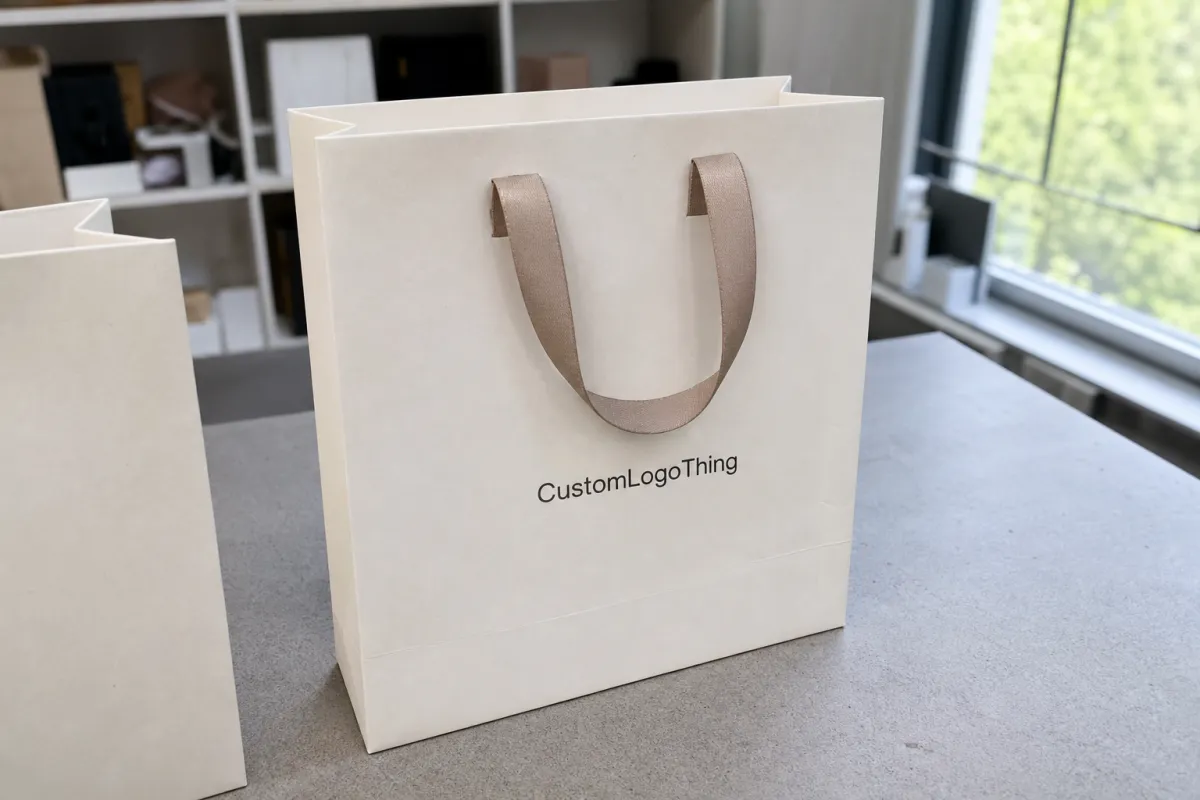
Size alone does not determine price. Two bags with the same dimensions can land in very different cost bands if one uses a simple handle and the other uses ribbon, reinforcement, and full-face print. The build is what changes the quote.
Handle construction is often the biggest swing factor. Ribbon handles need more labor than twisted paper handles, and the attachment method matters as much as the ribbon itself. Glued inserts, sewn reinforcement, knot-through fixing, and eyelet-style attachments all affect line speed and reject risk.
Candle bags also carry more weight than many gift bags. A glass jar candle, a set with filler, or a seasonal bundle needs a stronger base and better handle retention. If the bag has to look upscale and hold weight, the lowest quote is usually not the safest buy.
Paper grade and finish add another layer. A lighter art paper with basic lamination will not price the same as a heavier board-backed bag with soft-touch film, foil, or embossing. A simple one-color logo may be cheaper than a full-coverage design, but special finishes often add more cost than extra ink colors because they slow production and increase setup work.
Typical cost movement usually comes from these inputs:
- Handle style: ribbon type, width, and attachment method.
- Paper build: GSM, paper grade, lining, and base reinforcement.
- Print complexity: color count, coverage, foil, embossing, or UV.
- Order scale: setup cost spread across quantity tiers.
- Freight and packing: carton count, palletization, and destination charges.
The practical takeaway is simple: unit cost only matters if the bag still carries the candle safely and presents cleanly at retail. Judge the quote against function, not against price alone.
Ribbon handle construction, paper grades, and finish options
Start with construction. Most custom candle bags fall into three useful groups: a lighter retail bag for single items, a reinforced gift bag for everyday jar candles, and a premium presentation bag for sets or seasonal bundles. The visible graphics matter, but hidden reinforcement usually decides whether the bag survives use.
Ribbon handle choice affects both cost and feel. A 10 mm ribbon is usually easier on budget than 15 mm or 20 mm options. Satin feels smooth and polished, grosgrain adds texture and wear resistance, and cotton can suit a more natural look. Color matching keeps the bag quiet and premium; contrast ribbon can work well for gifting or holiday lines.
Finish options change appearance and production time. Matte lamination gives a softer boutique look and helps with scuff resistance. Gloss sharpens color. Foil, embossing, and spot UV can lift shelf appeal, but they also add setup complexity. If sustainability is part of the brief, ask for FSC-certified paper: FSC.
Some upgrades are mainly visual. Others are structural. A soft-touch finish improves hand feel. A reinforced bottom board protects the product from punching through the base. Buyers should separate the two so they do not overpay for decoration while underbuying strength.
For candle programs, these builds are the most common:
- Lightweight build: lower cost, simple print, suited to small candles or low-load gifting.
- Reinforced retail build: mid-range cost, stronger base, better for jar candles and everyday carry.
- Premium gift build: higher cost, ribbon upgrade, lamination, and finishing for launch kits or seasonal bundles.
Specification checklist that affects fit, strength, and shelf appeal
A quote is only useful if the supplier is pricing the same bag the buyer intends to order. That means the brief needs more than size and logo. Include outside dimensions, gusset depth, paper GSM, handle length, ribbon width, print colors, and target quantity. If the bag carries a candle set, include finished product weight too.
Good spec sheets also cover load expectation, size tolerance, and carton pack count. If the bag needs to hold a heavy jar, the handle and bottom structure should be treated as load-bearing parts, not just visual details. If the bag is for retail, ask whether the supplier can support normal consumer handling, not just a clean factory test.
Artwork details often decide how fast the order moves. Suppliers need a dieline, bleed area, logo placement notes, and the final file format. State whether the job uses Pantone matching, process print, or a simple one- or two-color logo. That single choice can change setup charges and proof time.
If color accuracy or ribbon feel matters, ask for a physical sample or photographed prototype before bulk approval. A digital proof shows layout, but it cannot show how the ribbon sits against the paper, how stiff the bag feels, or how the colors behave under retail lighting. Those details affect approval.
A premium candle bag should survive handling first and look polished second. If it cannot do both, the design is too expensive.
Useful spec checklist items:
- Outside dimensions and gusset depth.
- Paper grade and GSM.
- Ribbon width, material, and color reference.
- Print method, color count, and finish.
- Target unit weight or load expectation.
- Carton count, pallet preference, and delivery destination.
One detail buyers often skip is acceptable variance on ribbon length and handle placement. Small drift is normal in manual or semi-manual work, but too much drift makes the bag look inconsistent on shelf.
Unit cost, pricing tiers, MOQ thresholds, and quote structure
Unit price falls as quantity rises because setup cost gets spread across more bags. That is why a 500-piece order can look much more expensive per unit than a 5,000-piece order. The first order pays for file prep, color alignment, machine setup, sample checks, and sometimes tooling.
MOQ usually reflects how much manual work the bag requires. A simple printed bag can support a lower threshold. A premium bag with ribbon handles, lamination, and a reinforced base usually needs a higher MOQ to stay commercially sensible. The exact number matters less than the breakpoints between tiers.
| Spec tier | Typical build | MOQ | Indicative unit cost | Best fit |
|---|---|---|---|---|
| Entry | 210gsm paper, 1-color logo, ribbon handle, basic board insert | 1,000 | $0.38-$0.62 | Simple retail programs and price-sensitive launches |
| Mid | 250-300gsm paper, matte lamination, 2-color print, stronger handle fix | 2,000 | $0.58-$0.92 | Most candle gift bags and seasonal programs |
| Premium | Heavy paper, foil or embossing, soft-touch finish, reinforced base | 3,000+ | $0.95-$1.60 | Launch kits, premium gifting, and high-perception retail displays |
These are indicative ranges, not promises. Paper and freight move, and landed cost can change faster than the factory price. A quote that looks cheaper at origin may end up more expensive once cartons, export packing, duty, and transport are added.
Every quote should show the same line items so comparison is fair:
- Sample charge or proof fee.
- Setup charges for print and line preparation.
- Unit price by quantity tier.
- Packaging and carton cost.
- Freight, duty, and any destination fees if relevant.
It also helps to ask how long the price stays valid. Paper and freight rates can shift quickly enough to make a good quote stale before approval.
Process, timeline, and lead time from quote to shipment
The process should be predictable. First comes spec review, then pricing, then artwork proofing. After that, the supplier prepares a sample or production proof, the buyer signs off, and the factory schedules the run. Production ends with inspection and shipment booking.
Delays usually come from late artwork, a color change after proof approval, or a midstream spec change. Ribbon width changes, finish upgrades, and last-minute reinforcement requests can all push the order back. In peak season, that can be enough to miss a launch window.
A realistic lead time is often 12-20 business days after proof approval for production, with extra time for sample confirmation on new work. Repeat orders can move faster because the artwork, paper spec, and handle method are already on file. Shipping time sits on top of that, and sea freight can add several weeks.
Confirm the production date, packing date, vessel or flight schedule, and expected arrival window in writing. A bag can leave the factory on time and still arrive late if freight booking or documentation is weak.
For packaging that must protect a premium candle line in transit, ask whether the supplier understands common transport testing expectations such as ISTA procedures. A factory that can talk sensibly about compression, drop resistance, and pack-out usually understands shipment risk better than a seller focused only on print samples.
Useful timeline checkpoints:
- Inquiry and spec confirmation: 1-2 business days.
- Quote and artwork proof: 2-4 business days.
- Sample or digital approval: 3-10 business days, depending on complexity.
- Production: 12-20 business days for custom orders.
- Transit: route dependent, often the longest part of the job.
A tight schedule is possible, but only if the buyer keeps the design stable.
What a dependable packaging partner should prove before the order
Sales language is cheap. Proof is not. A dependable packaging partner should be able to show material consistency, handle pull testing, and print registration checks before the run leaves the line.
Operational signals matter more than polished pitch decks. Does the supplier send clear artwork guidance without prompting? Does it explain where the MOQ sits and why? Does it warn when a ribbon width will strain the structure? Does it recommend a stronger base for a heavy jar candle?
Reliability also shows up in exception handling. If the color drifts, does the factory explain the cause and the correction path? If there is an overrun or underrun, are the terms stated before payment? If paper stock changes because of availability, is there a substitution policy in writing?
The cheapest supplier is not always the lowest-risk supplier. Weak handles, mismatched paper, or poor carton packing can trigger damage claims, reorders, and launch delays. The true cost is the run that fails after approval.
A good supplier reduces risk before production starts. A great one explains the risk without hiding behind jargon.
What to look for before placing the order:
- Clear QC process for paper, ribbon, and print.
- Repeatability across reorders and batch-to-batch color control.
- Practical advice on handle strength and reinforcement.
- Transparent pricing that separates setup charges from unit price.
- Sample discipline that shows what the bulk run will actually look like.
A supplier does not need to sound fancy. It needs to sound specific.
Next steps to request a sharper quote and faster approval
If the goal is a better quote, make the brief easy to price. Send dimensions, quantity, paper preference, ribbon type, print count, finish, and destination in the first request. Add product weight if the bag will carry a candle jar or gift set.
Ask for two versions: the base spec and the upgrade you are considering. That makes the cost jump visible and helps you decide whether matte lamination, a wider ribbon, or foil is worth the extra spend.
For a launch item, request a sample or proof before bulk approval. Retail display, gifting, and holiday candle lines are too visible to approve on a guess. A small sample fee is usually far cheaper than correcting a thousand bags later.
Finally, confirm MOQ, lead time, freight terms, and the exact packaging method in the same conversation. The strongest purchasing decision is not the lowest number; it is the most complete one. That is the cleanest way to finish a candle ribbon handle paper bags Unit Cost Review without surprises.
What affects candle ribbon handle paper bags unit cost the most?
Paper grade, ribbon handle type, and print coverage usually move cost more than small size changes. MOQ and setup charges can make a low-quantity order much more expensive per bag, so always compare the full quote, not just the unit line.
What MOQ should I expect for custom candle ribbon handle paper bags?
MOQ varies by size, print method, and finish. Lower MOQs are possible, but the cost per piece usually rises because setup charges are spread over fewer bags. Ask for tiered pricing so you can see the breakpoints.
How long is the usual lead time for candle ribbon handle paper bags?
Lead time depends on proof approval, sample sign-off, production load, and shipping method. Repeat orders move faster than new custom builds, so confirm both production time and transit time before you set the launch schedule.
Can I approve a sample before placing the full order?
Yes. A sample is the safest way to confirm color, handle strength, and overall presentation. Ask whether the sample is plain, printed, or production-grade so you know what it actually represents.
What should I send to get the fastest quote?
Send dimensions, paper preference, ribbon details, print colors, quantity, and delivery destination. Attach artwork files or a logo mockup so the supplier can estimate setup and proofing accurately.
How can I tell if a quote is missing hidden costs?
Look for missing freight, vague carton packing terms, no mention of sample fees, or a unit price that assumes a lower spec than the one you described. A clear quote is easier to compare and less likely to hide add-ons.

