Order Event Merch Twisted Handle Paper Bags Thickness Guide
The event merch twisted Handle Paper Bags material thickness guide starts with a simple problem that catches a lot of buyers: a bag can look sturdy on a screen and still fail once it carries real event merch. A hoodie, a catalog, a bottle, and a few loose inserts do not care what the mockup looked like. They care about paper strength, handle reinforcement, and how the load moves through the base and side panels.
That is why thickness is only one part of the decision. GSM matters. So does caliper, fiber quality, the glue area around the handle, and the way the gusset is built. If any one of those is off, the bag can wrinkle early, lean badly, or tear where the handle meets the body. Event bags get handled roughly. They are lifted by one handle, stuffed at the last second, dropped under chairs, and reused for the rest of the day. The spec needs to survive that reality, not a perfect studio shot.
For branded event merch, the right bag is usually a compromise between strength, print quality, shipping cost, and the feel in hand. Too light, and it feels cheap the minute it is loaded. Too heavy, and you pay for paper weight you may not need. The sweet spot depends on what is going inside, how far attendees will carry it, and whether the bag is part of the brand experience or just a transport layer.
Event merch twisted handle paper bags material thickness guide
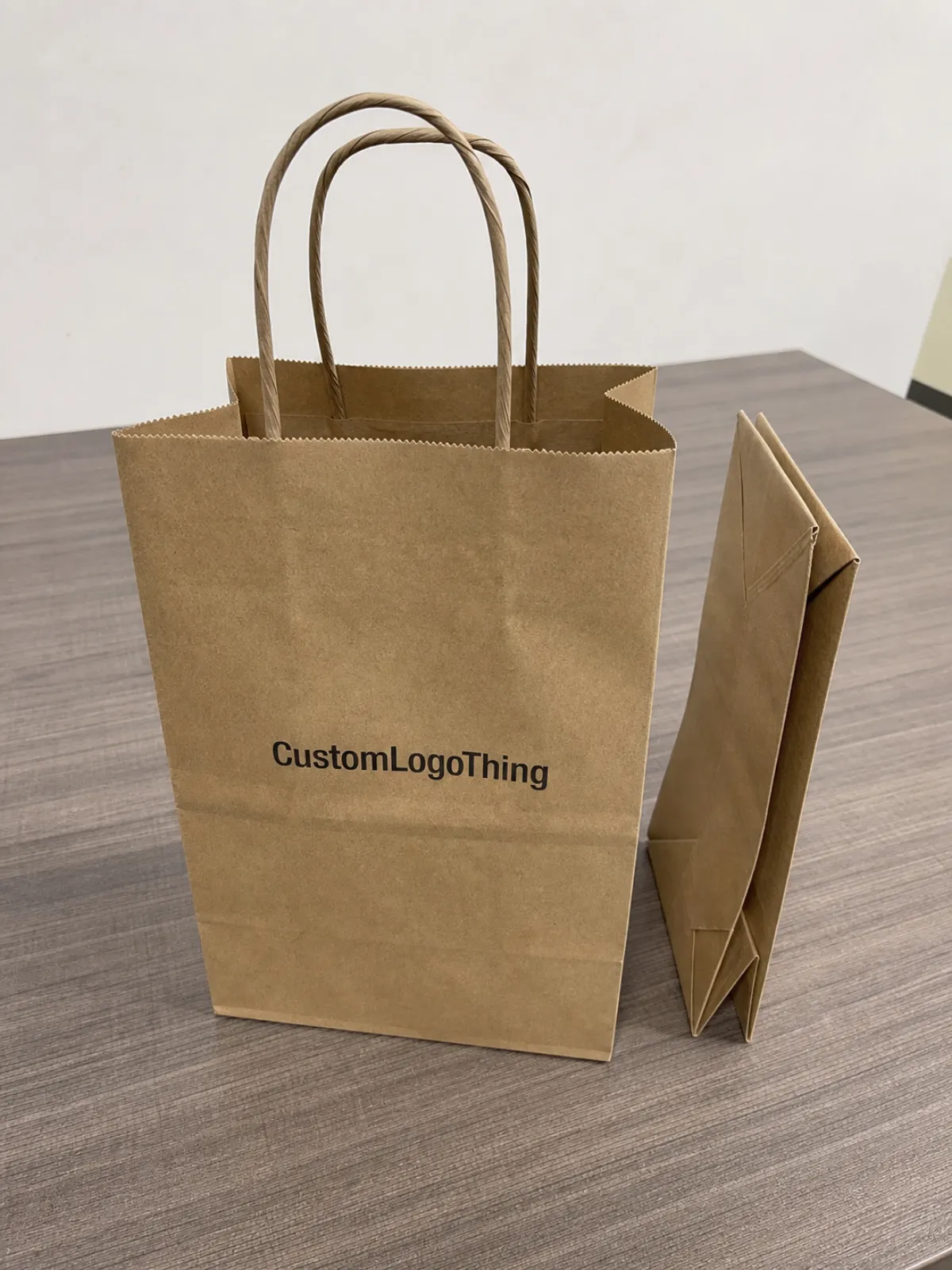
Buyers often start with a single number, usually GSM, but that number never tells the full story. GSM measures paper weight, not the whole bag's performance. Two 150gsm papers can behave very differently if one uses longer kraft fibers and the other leans heavily on recycled content. One may feel crisp and springy. The other may feel soft, slightly fuzzy, and more prone to edge wear.
For event merch, the bag usually needs three things at once: enough stiffness to stand up while it is being filled, enough strength to survive carrying, and enough surface quality to print clearly. A good bag should not collapse when merch is packed quickly at a booth. It should not split at the fold line when someone swings it by the handle. And it should still look decent after a long walk through a venue.
That combination is why paper Bags for Events are rarely specified by thickness alone. A 120gsm kraft bag can be perfectly acceptable for light brochures or a soft apparel item. The same bag becomes a poor choice for a dense kit with hard corners. On the other side, a 200gsm bag can be overbuilt for lighter giveaways and add unnecessary cost, shipping weight, and stiffness that works against a polished presentation.
What usually works best is a range, not a single point. For lighter merch, 120-130gsm may be enough. For mixed kits, 150-170gsm tends to be the practical middle ground. For heavy or premium sets, 190-220gsm gives more structure and better resistance to handle pull and side-panel distortion. Those are starting points, not laws. The right answer still depends on the contents and the construction.
| Paper range | Best fit | What buyers usually notice | Cost impact |
|---|---|---|---|
| 120-130gsm | Brochures, light samples, small apparel items | Light in hand, crisp, economical | Lowest baseline |
| 150-170gsm | Mixed merch, folded garments, compact kits | Balanced feel, better stand-up, reliable carry | Moderate increase |
| 190-220gsm | Bottle sets, dense kits, bags likely to be reused | Stiffer, more premium, more resistant to crushing | Higher increase |
| Recycled kraft blends | Eco-led programs, broad distribution, simple print layouts | Softer surface, less bright base color, natural texture | Depends on fiber mix |
The table helps, but it does not remove the need to test. A small change in structure can matter more than a big change in paper weight. If the bag has a larger gusset, a stronger base fold, or a wider reinforcement patch, it can outperform a lighter bag that looks similar on paper. That is the part many first-time buyers miss. The spec sheet is only half the story; the construction method closes the gap.
How twisted handles carry weight without failing at the mouth
Twisted handles are popular for a reason. They offer a good blend of cost, grip, and appearance. The twist gives the handle enough structure to feel more substantial than a flat strip without pushing the price into premium rope-handle territory. For event merch, that matters. Most buyers want a bag that feels clean and familiar, not fussy.
The key point is that the handle itself is not doing all the work. The load travels through the reinforcement patch, the top edge of the bag, and the side wall. If any one of those areas is weak, the handle can tear free even if the paper sheet is heavy. In practice, handle failure often starts with poor glue coverage, a patch that is too small, or a top fold that does not distribute force well.
That is why handle construction deserves as much attention as GSM. A wide and well-placed patch can improve strength more than a large jump in paper weight. Better adhesive coverage can do the same. Some buyers fixate on upgrading from 150gsm to 170gsm when the real issue is a narrow patch or a poorly aligned handle placement. The bag would carry better with better structure, not just more paper.
Twisted handles usually outperform flat handles in heavy-use event settings because they hold shape and stay comfortable in the hand. Flat handles can be fine for lightweight distribution, but they are less forgiving once the merch gets dense. Rope handles look more premium and can handle repeated use, yet they also add cost and may not make sense for large-scale runs where speed and unit price matter. Twisted Handle Paper Bags sit in the middle, which is often exactly where event programs need to be.
Bag shape changes the stress pattern too. Tall narrow bags tend to pull harder at the handle line because the contents hang lower. Wide gussets can spread the load, but they also ask more from the side panels if the stock is soft. Square bottoms help stability during packing and at handoff, though they only perform well if the base glue and fold memory are clean. Think of the bag as a load path. The handle does not carry the weight alone.
What paper thickness actually changes
Thickness changes more than strength. It changes how the bag prints, how it folds, how it sounds when handled, and how it ages during the event. Heavier stock usually gives a flatter print surface, less show-through, and better edge retention. Light stock can still work, but it tends to wrinkle more easily and may look tired after one or two carries if the merch is heavy.
There is also a visual issue. A bag that is too soft can make even good artwork look weak. The print may be fine, but the body of the bag droops and the logo loses presence. If the merch is high-value, that is a problem. The bag becomes part of the presentation, and presentation is not only about color density. It is about whether the carrier looks intentional.
Recycled content complicates the picture. It is useful for sustainability claims and can work very well, but the surface may be slightly rougher and the base tone less bright than virgin kraft. That is not a defect. It is a material tradeoff. Buyers who expect a perfectly smooth, bright white finish sometimes get caught off guard when the recycled sheet prints with a softer look. That may be acceptable, even desirable, if the brand wants a natural appearance. It may be less acceptable for glossy graphics or high-contrast branding.
Coatings also change the outcome. Matte coating can clean up print edges and reduce scuffing. Gloss can sharpen color and make the bag pop, but it can also make fingerprints and abrasion more visible. Uncoated kraft feels more tactile and earthy, which many event teams like for eco messaging. None of these finishes is inherently better. The right choice depends on the merch, the brand, and how much handling the bag will see before it is discarded or reused.
One useful way to think about thickness is this: it affects confidence. Attendees notice when a bag stands upright, holds shape, and does not bow at the sides. They also notice when the handle digs in or the base sags. A strong bag reduces the mental friction of carrying merch. That sounds minor until the bag is part of the first impression.
If you need a reference point for paper sourcing, certification should be checked carefully rather than assumed. FSC certification is useful, but ask what exactly is certified: the fiber source, the chain of custody, and whether the print supplier can document the claim. The FSC site explains the framework clearly. The point is not to collect logos. The point is to know what the claim means.
For transport-oriented thinking, it also helps to borrow a habit from package testing. Bags are not corrugated boxes, but they fail in familiar ways: corners crush, folds weaken, and handles tear under repeated load. The ISTA testing framework is useful because it pushes buyers to think about movement, vibration, and drop conditions instead of treating the package like a static object on a desk.
Specs that matter more than the GSM number alone
GSM is easy to quote, which is why it gets overused. The better buying question is which specs actually change the bag's behavior. Fiber length, basis weight, caliper, glue coverage, handle patch size, and fold consistency all matter. Sometimes they matter more than a small shift in GSM.
Caliper affects how the bag resists crushing. A sheet with good thickness but weak fiber structure can still collapse along the folds. Fiber mix affects stiffness and tear resistance. A virgin kraft sheet usually feels more confident in the hand. A recycled blend can be perfectly serviceable but may not snap back as cleanly after compression. If a supplier cannot explain the paper structure, that is a warning sign, not a nuisance.
Print coverage matters too. Heavy ink coverage on a lighter sheet can alter the way the bag dries, folds, or scuffs. Large dark solids need a stable substrate if you want them to look clean. That is why proofs should be checked on the actual paper grade, not just on a screen. A logo that looks sharp digitally can appear dull, muddy, or slightly cracked if the stock is too absorbent or too soft.
Base construction is another place where buyers under-specify. A square bottom usually improves stand-up performance, but only if the base fold is clean and the adhesive line is consistent. A weak base can distort under load even when the handle is fine. If the merch includes sharp corners or bulky packaging, the base becomes even more important.
| Spec | Why it matters | What to ask for |
|---|---|---|
| GSM | General paper weight and basic stiffness | Exact range, not a vague "heavy" or "premium" |
| Caliper | How thick and crush-resistant the sheet feels | Paper thickness data if available |
| Handle patch | Where the load enters the bag | Patch size, placement, and adhesive method |
| Gusset depth | How the bag carries bulk and keeps shape | Finished internal dimensions, not just nominal size |
| Print finish | How the brand looks and how well the surface resists scuffing | Coated, uncoated, matte, gloss, or soft-touch |
How to match bag thickness to the merch inside
The cleanest sizing process starts with the contents, not the bag. That sounds obvious, but it gets skipped constantly. Buyers approve artwork and dimensions, then realize too late that the actual merch set is heavier, bulkier, or harder-edged than expected. A bag sized around the empty item list is a bad bag.
- Weigh the full merch set. Include every piece that will go inside, not just the main item.
- Check the shape, not only the weight. A soft sweatshirt behaves differently from a boxed device or a bottle.
- Measure the largest item first. Dimensions drive gusset depth, panel height, and how much stress lands on the handle line.
- Add a real safety margin. Event teams overpack. Attendees overpack again after that. Leave room.
- Test the filled bag by hand. Lift it, swing it, and set it down a few times before approval.
For light brochure sets, thinner kraft usually does the job. For a folded tee, booklet, and insert card, 150gsm often gives enough structure without wasting money. For a hoodie, bottle, or mixed kit with hard edges, 170gsm and up becomes more sensible. Once the load gets dense enough that you would hesitate to carry it by one handle for long, the construction should step up as well. That can mean thicker paper, but it can also mean a larger patch or a different handle build.
One thing buyers rarely account for is repeated handling. A bag that only needs to survive a handoff from table to attendee is easier to spec than a bag that will be carried all day. If the event is a conference or expo, reuse is part of the brief whether anyone writes it down or not. That usually justifies a stronger bag because it has to survive more than one trip and more than one set of hands.
If the merch includes sharp-edged packaging, think twice before choosing the lightest acceptable stock. Corners create pressure points. A thin side wall can split at the fold or stretch around a rigid box. It may be fine in a sample photo. It is less fine on the show floor after the third re-pack.
Pricing, MOQ, and the details that shift quotes
Custom paper bag pricing is less mysterious than it looks. More paper costs more. Larger dimensions use more material. Higher GSM adds cost. More print colors increase setup and production time. Special finishes and reinforced handles push the price up again. The challenge is that buyers often compare quotes that are not actually the same bag.
MOQ changes the economics. Set-up work has to be spread across the run, whether that setup is for plates, dies, proofing, or production scheduling. A 1,000-piece order will nearly always look pricier per unit than a 10,000-piece order, even if the bag itself is identical. That is not because anyone is hiding a margin trick. It is because fixed prep costs do not shrink.
For most event orders, price breaks become noticeable once the run moves out of the smallest bracket. A simple bag with one or two colors and standard twisted handles may stay relatively controlled. Add heavier paper, a larger format, custom handle color, full bleed coverage, or inside print, and the quote starts moving quickly. Rush production can do the same thing because it compresses proofing and scheduling.
Use the quote to compare apples with apples. Ask for the same dimensions, same GSM, same handle style, same print coverage, same finish, and the same delivery address. If one supplier quotes a lighter sheet or a different handle patch, the lower price is not really lower. It is a different product. On paper, those differences look small. In the hand, they are obvious.
- Material grade affects strength, look, and unit cost.
- Print coverage affects setup time and finish quality.
- Handle style affects both durability and appearance.
- Freight matters because paper bags get bulky fast.
- Sampling adds time and cost, but it reduces bad approvals.
For budget planning, a rough way to think about it is simple: thin, simple, single-color bags sit at the low end; midweight bags with decent structure occupy the middle; premium, heavy, or highly finished bags sit at the top. The exact number depends on order size and location, so any quote without quantity and delivery details is only a placeholder.
Production timelines and quality control
A normal production flow starts with dieline confirmation, then artwork setup, then proof approval, then sample or first article checks, followed by printing, drying or curing, inspection, packing, and shipment. That sounds clean. Real delays come from missing dimensions, late design revisions, or a proof that looked acceptable until someone tested the bag with the actual merch load.
For straightforward runs, a common lead time is around 12-15 business days after proof approval. That does not include design changes, sampling, or freight delays. Once the bag gets larger, heavier, or more heavily printed, the schedule usually stretches. Special coatings and custom sizes can add days. A sample round adds more. If the event date is fixed, separate proof timing from manufacturing timing. If those two are blurred together, someone always ends up surprised.
Quality control should focus on the places that fail first. Check handle placement. Check whether the glue line is even. Check that the bag stands straight and the base sits flat. Check for scuffs on dark prints and for distortion around folds. Check that the paper grade matches the approved sample. These are boring checks, which is exactly why they matter.
For repeat orders, consistency matters as much as strength. A bag that is slightly different from the last approved batch can break a campaign's visual rhythm. That includes paper color, handle tone, print alignment, and overall stiffness. If a supplier can provide a spec sheet and keep the run tied to an approved reference sample, reorders are easier to manage and less likely to drift.
If the merch program is important, keep three items on file: one approved sample, one print proof, and one production spec sheet. That combination saves time on future orders and gives everyone a shared reference when someone asks for "the same bag as last time." That phrase sounds simple. It rarely is, unless the spec is documented well.
Common mistakes and practical buying rules
The biggest mistake is choosing thickness by feel alone. A bag can feel impressive empty and still be wrong for the load. Another common miss is treating handles as an afterthought. The handle system is part of the strength system. If the patch is weak or the glue is poor, extra GSM will only hide the problem for a little while.
Buyers also overestimate how much recycled or eco-labeled material tells them about performance. Recycled paper can hold up very well, but the source fiber mix matters. Not all recycled papers are equal, and not all virgin kraft papers are automatically strong. The supplier should be able to explain what is actually being used. If the explanation is vague, ask again.
The other trap is ignoring print behavior. Heavy coverage on natural kraft can look rich and grounded, but it can also make the bag less sharp if the stock is too soft. Gloss and matte finishes shift the feel of the whole piece. Uncoated paper looks honest and tactile. Coated paper looks cleaner and more controlled. Pick the surface based on the brand, not the trend.
- Test with the real merch. Empty bags tell you very little.
- Do not chase GSM alone. Construction matters just as much.
- Match the finish to the brand. A premium look is not always a glossy look.
- Confirm dimensions in finished size. Nominal specs can hide fit problems.
- Keep one approved reference. It protects reorders from drifting.
My practical rule is simple: if the merch is light and the carry is short, keep the bag efficient. If the merch is dense, sharp-edged, or likely to be carried all day, step up the paper and reinforce the handle area. If the bag is part of the brand presentation, do not let it look under-specified. The cheapest option is only cheap if it does the job.
A good event bag should feel dependable without looking overbuilt. It should stand up while loading, carry without strain, and keep the print clean enough that the brand still looks intentional by the time the attendee leaves the venue. That is the real job of a paper bag in an event program: not just to hold things, but to hold together the experience around those things.
"Spec the bag for the load you actually hand out, not the one you wish you had."
That is the part most buyers eventually learn the hard way. Once the dimensions, paper grade, handle build, and print finish are aligned, the event merch Twisted Handle Paper Bags material thickness guide stops being abstract. It becomes a practical way to choose a bag that fits the merch, the budget, and the level of abuse the event will throw at it.
What GSM should I choose for event merch twisted handle paper bags?
Start with the actual filled weight and shape of the merch, not the empty bag size. For brochures or light samples, 120-130gsm can be enough. For mixed kits and folded apparel, 150-170gsm is a practical middle ground. For dense or reusable event bags, 190gsm and up usually gives better structure. The handle patch and gusset still need to match the load.
Do twisted handles need extra reinforcement?
Not always, but reinforcement becomes more important as the load gets heavier or more awkward. A wider patch, stronger adhesive coverage, and correct handle placement can improve performance without jumping to a much heavier sheet. If the bag will be carried for long periods or reused during the event, reinforcement is worth the extra attention.
How does material thickness affect print quality?
Heavier or more stable stock usually reduces show-through and helps the print sit flatter. That often improves logo sharpness and color consistency. Coated papers can sharpen artwork and resist scuffing better, while uncoated kraft gives a more natural look. Proof the artwork on the exact stock, because the same design can change a lot from one surface to another.
What should I include in a quote request?
Include the finished dimensions, target fill weight, paper grade or GSM, handle style, print colors, quantity, and delivery location. If the merch includes bottles, boxed items, or sharp corners, mention that too. Those details affect the recommended thickness and the final price more than many buyers expect.
How long does production usually take?
For a straightforward run, around 12-15 business days after proof approval is a common reference point. Sampling, custom sizing, special finishes, and complex artwork can extend that timeline. If the event date is fixed, separate approval time from production time early so the schedule stays realistic.
Are recycled paper bags weaker than virgin kraft bags?
Not automatically. Recycled paper can perform very well, but the result depends on the fiber mix and the way the sheet is made. Some recycled bags feel softer and less bright, which may be fine for eco-led programs. The right test is still the same: load the bag with the real merch and check how it behaves.

