Why Candle Beanies Fail Before They Ever Ship
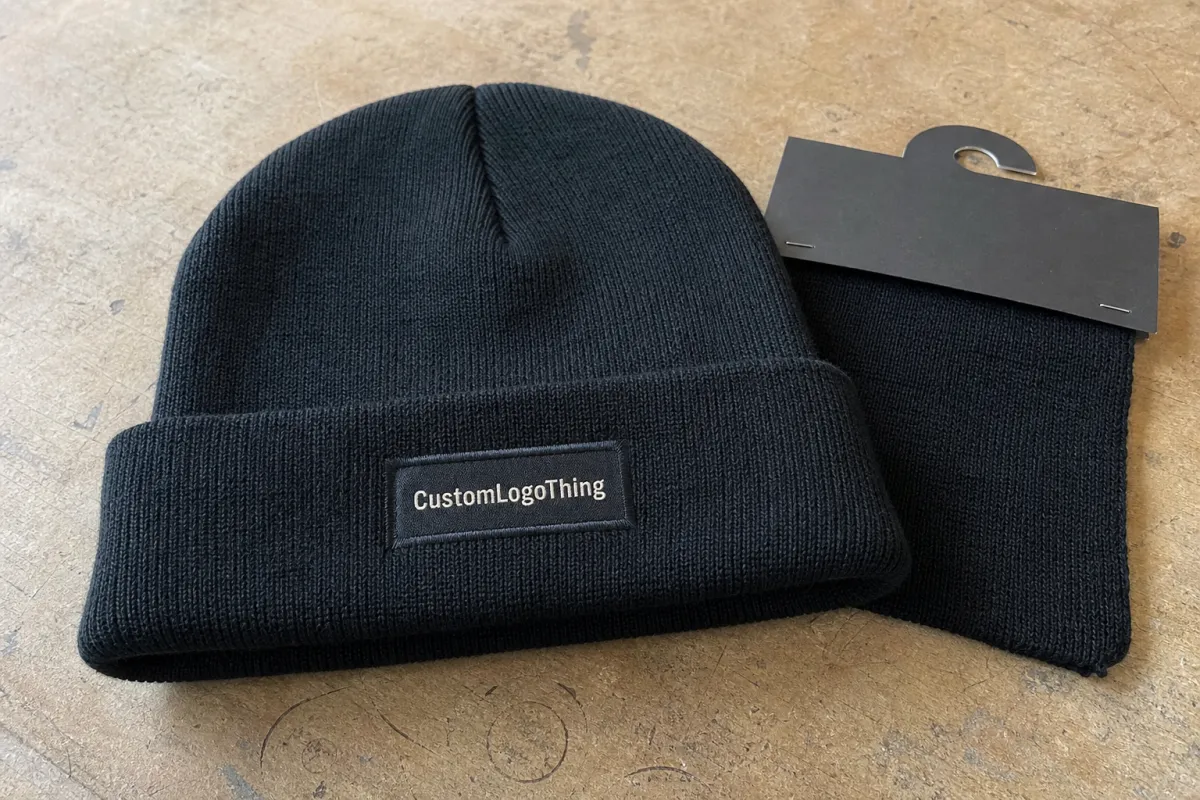
A candle Woven Label Beanies Digital Proof checklist sounds fussy until the first carton arrives and the flame icon looks muddy, the woven label sits 3/8 inch too high on the cuff, and the kraft packaging card blocks the only branded detail customers were supposed to photograph. That mistake rarely starts at the sewing table. It usually starts with a proof that looked “fine” on a screen at 9:47 p.m.
Most merch failures are not manufacturing surprises. They are proof-reading failures hiding in plain sight. A buyer approves a miniature mockup without checking actual label dimensions. Marketing signs off on a cream thread that turns beige against oatmeal knit. Someone assumes a delicate serif scent name will weave as crisply as it prints on a candle dust cover.
It will not.
Candle brands are unusually exposed to these small errors because their visual identities often depend on restraint: fine-line flames, narrow serif typography, warm neutral palettes, tiny batch numbers, metallic cues that suggest foil. A logo that feels elegant on a glass vessel can become a cramped knot of stitches on a 1 x 2 inch woven label. Thread is less forgiving than ink, and knitwear is less flat than packaging.
Think of the digital proof as a preflight check in commercial printing. It does not guarantee perfection. It does force the buyer and supplier to inspect the variables most likely to create expensive rework: artwork, thread color, label size, beanie placement, packaging coordination, approval wording, and timeline risk.
Sharp rule: if a detail affects what gets woven, sewn, packed, photographed, or shipped, it should appear clearly on the proof before approval.
That is the practical value of slowing down for 15 minutes. A careful proof review can prevent three weeks of correction, replacement labels, repacking, or awkward emails after the launch date has already passed.
What a Digital Proof Shows on Woven Label Beanies
A digital proof is the approval document that translates your artwork and product choices into a production-ready visual. For Woven Label Beanies, it should show the logo layout, label shape, approximate beanie color, cuff fold, attachment location, and sometimes the packaging presentation. Better proofs include measurements in inches or millimeters, thread or Pantone references, and notes about whether the beanie is shown flat, folded, or worn.
It can show plenty: spelling, logo orientation, general placement, label dimensions, color callouts, thread direction notes, centered versus offset placement, and whether the label wraps over the fold or sits fully on the front cuff face. Those are production instructions, not decoration.
It cannot show everything with laboratory accuracy. Thread has texture. Screens emit light; woven yarn reflects it. A charcoal thread on a black beanie may look legible in a PDF and nearly invisible under market-booth lighting. Dye lots can shift slightly, particularly with stock beanies sourced across different batches. Stitch density also behaves differently once the label is sewn onto ribbed knit that stretches on a head.
Woven labels differ sharply from printed patches. A printed patch can reproduce small gradients, soft shadows, and fine illustration lines because ink sits on a surface. A woven label must convert every mark into thread. That means a thin candle flame, botanical sprig, wax-drip icon, or small “hand poured” line may need simplification before it can be woven cleanly. The proof should make that translation visible enough for a buyer to judge.
From a packaging buyer’s point of view, evidence matters. Look for exact label size, stitch or weave notes, background color, border treatment, material description, attachment method, and the beanie color name or SKU. If packaging is included, ask whether the belly band, hang tag, or insert card appears in the same proof file. A beanie that looks right alone may fail inside a gift box if the label faces the side wall or sits under a paper wrap.
Sustainability claims need the same discipline. If a packaging card mentions recycled paper, FSC-certified stock, compostability, or plastic-free presentation, verify that the claim matches the actual material being purchased. For certified paper materials, recognized guidance from sources such as the Forest Stewardship Council can help buyers separate a real specification from a vague green phrase.
Key Proof Checks: Artwork, Thread Color, Label Size, and Placement
Break the proof into four inspection zones: woven label artwork, thread or background colors, physical label size, and placement on the beanie cuff. Basic, yes. Also where most expensive mistakes live.
Artwork Checks
Zoom in, then zoom out. Buyers often inspect a proof at 400 percent magnification, which helps catch spelling errors, but customers usually see the label from three to six feet away. If the flame icon disappears at normal viewing size, production will not rescue it. A useful test is to view the proof at actual size on a desktop monitor or print it at 100 percent scale.
Check every word. Candle merch often carries scent names, brand names, URLs, care language, trademark symbols, and short claims such as “soy wax” or “small batch.” A single missing letter on 500 beanies is not a typo. It is inventory.
Fine lines deserve extra suspicion. If the original artwork was built for a box label, website header, or vessel screen print, it may contain details too thin for a woven label. Increase negative space. Thicken strokes. Remove secondary copy that does not earn its square millimeters.
Thread Color Checks
Candle brands love warm neutrals: black, cream, amber, sage, oatmeal, charcoal, clay, and soft white. Beautiful on packaging. Risky in thread. Cream thread against a natural cuff may vanish. Amber may skew orange. Sage can turn gray under cool LED lighting. If color accuracy matters, request Pantone, thread chart, or physical sample references rather than trusting RGB artwork alone.
Metallic cues need caution. A gold line on a candle box may imply foil stamping; on a woven label, it may translate to yellow, tan, or metallic thread with a different sheen. Not worse. Different. The proof should make that difference obvious before approval.
Label Size Checks
Common woven label sizes for beanies often sit around 1 x 1.5 inches, 1 x 2 inches, or 1.25 x 2 inches, although custom sizes are possible. A 1-inch-tall mark can feel premium on a folded cuff. A 2.5-inch-wide label may dominate a minimalist candle logo and make the beanie look more like staff uniform gear than retail merch.
Size also changes cost and legibility. More surface area allows more detail, but it can increase label cost, sewing time, and visual weight. For buyers comparing options, Custom Logo Things’ Custom Labels & Tags category is a useful reference point for how label format influences the final branded product.
Placement Checks
Placement is not just “front center.” Confirm the distance from the cuff edge, the direction of the fold, and whether the label sits fully on the cuff face or wraps over the top edge. A label placed 1/4 inch too high can disappear behind a packaging card. A label placed too low may buckle when the cuff stretches.
| Proof Element | What to Check | Typical Risk | Practical Fix |
|---|---|---|---|
| Logo artwork | Line weight, spelling, icon clarity | Fine flame or serif type fills in | Simplify lines and increase negative space |
| Thread color | Pantone or thread chart reference | Warm neutrals lose contrast | Use higher-contrast thread or darker ground |
| Label size | Width, height, folded view | Label overpowers a minimalist logo | Test 1 x 1.5 inch and 1 x 2 inch layouts |
| Cuff placement | Center line and edge distance | Packaging covers the label | Show beanie with belly band or hang tag in proof |
Process and Timeline From Proof Request to Finished Beanies
The production path is predictable, though timing can wobble. A typical order moves through these steps: submit artwork and beanie specs, receive a digital proof, review and request edits, approve the final proof, produce woven labels, attach labels to beanies, inspect finished goods, pack, and ship.
The proof stage may take only a few hours of actual work. Its consequences are much larger. A one-day delay to correct label placement can prevent a multi-week correction after labels are woven and sewn. That trade is usually worth it.
Realistic lead times depend on artwork quality, proof revisions, label complexity, beanie stock, order quantity, packaging requirements, and freight method. A simple two-color label on in-stock acrylic cuff beanies may move faster than a four-color label with tiny scent descriptors, custom belly bands, and split shipping to three retail locations. Many decorated apparel runs land around 12 to 20 business days after proof approval, but supplier capacity and seasonal demand can push that window.
Candle brands often order beanies for launches, holiday bundles, market booths, subscription boxes, staff gifting, or wholesale account incentives. Those deadlines are not abstract. If the beanies miss a weekend market or subscription-box kitting date, the product may still be usable, but the commercial value drops.
Build in a revision buffer, especially if the logo includes gradients that must be converted, ultra-thin strokes, multiple label colorways, or packaging that needs to align with the beanie fold. Ask one direct question before you pay: “When does the production clock start?” Some suppliers start after quote approval. Others start after payment, final artwork, proof approval, stock confirmation, or all of those conditions.
Packaging tests can also affect shipping performance. If beanies are packed in gift boxes, mailers, or subscription kits, basic distribution testing principles from groups such as ISTA can help buyers think about compression, movement, and presentation damage during transit.
Cost, MOQ, and Quote Variables Buyers Should Check
The proof is not only a design document. It is a cost-control tool. It confirms what the manufacturer is actually quoting, and that matters because two beanie quotes can look similar until you compare label size, thread count, attachment method, packaging, and freight.
Main cost drivers include beanie style, yarn weight, label dimensions, weave complexity, number of thread colors, attachment method, order quantity, packaging components, and shipping destination. A stock cuff beanie with a two-color woven label is usually more predictable than a detailed candle illustration with five thread colors, tiny “cedar smoke” text, and a custom kraft belly band.
MOQ deserves plain language. Lower quantities, such as 50 to 100 units, may be useful for testing whether candle merch sells at markets or online. Larger runs, such as 500 or 1,000 units, usually reduce unit cost, but they also raise the cost of approving a flawed proof. A mistake at 50 pieces is annoying. A mistake at 1,000 pieces is a margin event.
Typical pricing varies widely, but buyers often see meaningful differences around decoration and packaging. A basic woven label upgrade might add roughly $0.40 to $1.25 per unit depending on size, thread count, and sewing. A packaging card or belly band can add another $0.35 to $0.90 per unit before freight. Even a $0.60 upgrade becomes $600 on a 1,000-unit run. Small numbers scale quickly.
| Option | Best Use | Typical Cost Impact | Proof Detail to Confirm |
|---|---|---|---|
| Two-color woven label | Minimal candle logos and wordmarks | Lower and more predictable | Contrast, label size, stitch clarity |
| Multi-color woven label | Illustrated flames, botanicals, scent families | Moderate to higher | Thread count, simplified artwork, color order |
| Custom belly band | Retail displays and gift bundles | Often $0.35-$0.90 per unit | Band position relative to label |
| Rush production | Event deadlines or late launches | Higher, varies by capacity | Approval cutoff time and ship date |
Compare quotes line by line. Look for setup charges, proof fees, sample fees, freight, packaging inserts, rush charges, and overage or underrun policies. If you need embroidery, woven labels, hang tags, kitting, or special packing on the same project, review Manufacturing Capabilities before narrowing the quote. The cheapest total can become expensive if it omits the detail that protects the order.
Common Digital Proof Mistakes That Lead to Rework
The highest-risk mistakes are familiar: approving a low-resolution logo, ignoring label dimensions, missing a typo, assuming screen colors equal thread colors, and failing to check placement on the folded cuff. None feels dramatic during proof review. All can become dramatic after production.
The candle-brand trap is designing the label as if it were a website header. A website can carry fine type, a delicate icon, a scent descriptor, a tagline, and a navigation-style wordmark. A woven beanie label needs fewer lines, stronger contrast, and more negative space. Thread needs breathing room.
Do not approve from a phone screen only. Mobile review is convenient, but it hides small type, slight misalignment, and scale problems. Use a desktop view if possible. Better yet, print the proof at actual size and place it against a beanie or folded fabric in a similar color. The exercise takes two minutes and catches errors that a polished mockup can disguise.
Packaging creates a second layer of risk. Hang tags may cover the woven label. Belly bands may flatten the cuff awkwardly. Gift-box inserts may rotate the product away from the logo. A beanie designed for a flat-lay product photo may not present well in a subscription box if the label faces the side wall instead of the lid opening.
Approval language matters. “Looks good” is too vague if questions remain about thread color, final label size, placement, or packaging. Use precise wording: “Approved for production using proof v3, 1 x 2 inch cream-and-black woven label, centered on front cuff, attached after fold, with kraft belly band positioned below label.” Dry? Yes. Useful? Very.
Keep one proof owner. Candle companies often involve founders, marketing, operations, retail managers, and wholesale coordinators. That can improve the product, but conflicting edits create risk. One person should gather feedback, reconcile it, and send a single approval message.
Candle Woven Label Beanies Digital Proof Checklist Before Approval
Use the candle woven label Beanies Digital Proof Checklist as a final gate, not a creative brainstorming session. By this point, the design direction should be chosen. The job is to catch production-critical errors before the supplier turns artwork into woven labels and finished beanies.
- View at actual size. Print the proof at 100 percent scale or view it on a desktop monitor with size references. A 1 x 2 inch label should look like a 1 x 2 inch label, not a poster.
- Compare against the original logo file. Check flame shape, letter spacing, icon orientation, border thickness, and any registered or trademark symbol.
- Confirm label dimensions. Verify width, height, fold type if any, border treatment, and whether measurements are listed in inches or millimeters.
- Check thread colors. Ask for Pantone, thread chart, or supplier color names. Do not rely on screen color alone for cream, black, amber, sage, or charcoal.
- Verify beanie color and style. Confirm cuff style, knit texture, yarn weight, size range, and whether the beanie is stock or custom.
- Inspect cuff placement. Confirm center alignment, distance from cuff edge, whether the label wraps over the fold, and how it appears flat and worn.
- Review every word. Check scent names, company name, URL, care language, claims, and packaging copy.
- Confirm packaging notes. Make sure hang tags, belly bands, insert cards, or gift-box placement do not cover or distort the label.
- Name the approved version. Approval should reference the exact proof file or version number production will follow.
If any production-critical detail is missing, request a revised proof. Measurements, label material, thread colors, attachment placement, and packaging notes are not minor extras. They are the instructions that prevent guesswork.
Before approval, ask three final questions: What changes after approval will trigger extra cost? When does lead time begin? What file or proof version will production follow? The answers may reveal hidden risk, especially on rush orders, split shipments, or multi-color label runs.
Document approval in one message. Include the final proof version, approved label size, approved beanie color, approved placement, approved packaging option, and any confirmed deadline. A short approval trail can settle disputes later if the finished beanies do not match the documented proof.
A proof checklist is not bureaucracy; it is the cheapest inspection point your merch order will ever get. For candle brands, that means beanies that look intentional in unboxing photos, market displays, staff gifting, and customer closets, not just acceptable in a PDF.
FAQ
What should be on a candle woven label beanies proof checklist?
Check logo accuracy, spelling, label size, woven thread colors, beanie color, cuff placement, attachment method, packaging notes, and the exact proof version being approved. The checklist should also include any deadline or packaging requirement that affects production.
Can a digital proof show the exact thread color for candle beanies?
It can show the intended color reference, but screens do not reproduce thread perfectly. Ask for Pantone, thread chart, or physical sample references when color accuracy matters, especially for cream, sage, amber, charcoal, and other candle-brand neutrals.
How many proof revisions should I expect before production?
Simple Woven Label Beanies may need one revision or none. Candle logos with fine flames, small type, narrow serif letters, gradients that must be converted, or multiple label colorways often need two or more careful proof rounds.
Does approving the digital proof mean my beanies go into production immediately?
Usually yes, but confirm when the production clock starts. Some suppliers begin lead time after payment, final artwork, proof approval, stock confirmation, or all of those steps together.
How can I reduce the unit cost of woven label beanies for a candle brand?
Simplify the label design, reduce thread colors, choose standard beanie blanks, increase order quantity, avoid rush production, and combine packaging decisions before quoting. A simpler two-color woven label is often easier to price, easier to proof, and easier to reproduce consistently.