A shopper can judge a beanie in less time than it takes to pinch-zoom the product photo. That is why woven labels Beanies for Ecommerce shops deserve more attention than they usually get. The label is often the first visible proof that a knit cap is a brand product, not a generic blank with a higher price.
Beanies are awkward ecommerce products because the base item is visually simple. A cuffed acrylic cap in black, charcoal, navy, or oatmeal can look almost identical across ten storefronts. The label does a disproportionate amount of commercial work. It carries the logo, sets a price expectation, improves thumbnails, supports repeat recognition, and gives the product a reason to sit inside a collection rather than float as a one-off accessory.
The mistake is treating the label as decoration. It is closer to packaging that stays on the product.
What Woven Labels Beanies for Ecommerce Shops Signal Before the Click
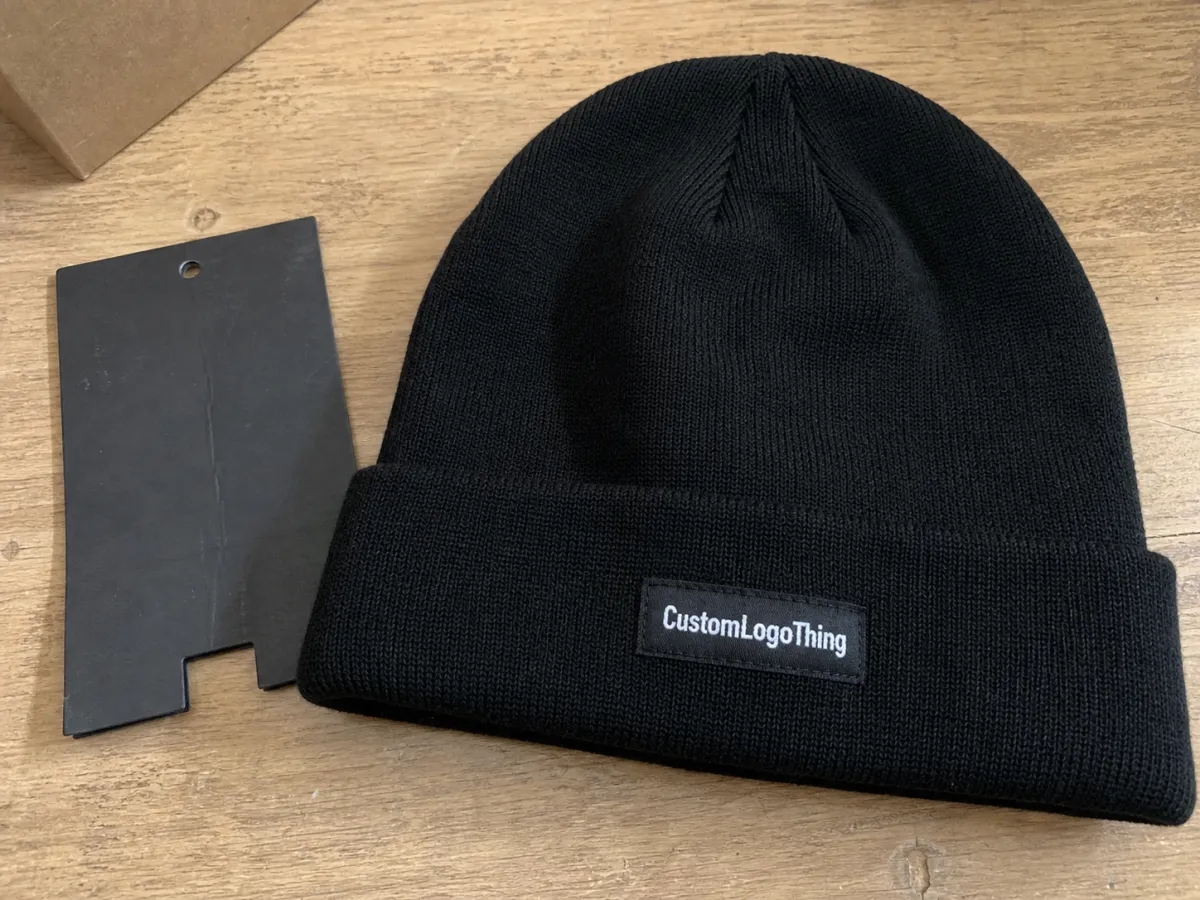
Woven labels Beanies for Ecommerce shops are knit beanies finished with custom woven brand labels, usually sewn onto the front cuff, side cuff, rear seam, hem, or inside panel. The label may be a small icon, a rectangular wordmark, a folded tag, or a compliance label with care details. Colored threads are woven into the design, then the finished label is attached to the beanie.
Online, that small piece of fabric has an outsized job. It tells the shopper the beanie belongs to a brand system. It also gives the camera something specific to catch. Without it, a plain beanie competes mainly on color, price, shipping speed, and the model photo. With it, the product can carry a drop identity, a private-label finish, or a visual cue that supports a higher perceived value.
Woven labels sit between several decoration options. Printed neck-style tags are cheap, but they do not create the same premium surface on a cuff. Leather patches can look strong, though they add thickness and may not fit every audience or care requirement. Embroidery is durable and tactile, but fine lettering can distort on stretchy rib knit. Heat transfers are smooth and lightweight, yet they can feel too flat for cold-weather merchandise.
Woven labels, by comparison, can hold crisp logos, small text, repeatable color, and consistent placement across hundreds or thousands of units. Not perfectly. Thread has limits. But for many ecommerce beanies, it is the most balanced route between branding quality, unit Cost, and Production repeatability.
Practical view: the beanie may be the garment, but the label is often the sales cue. If it disappears in a mobile thumbnail, the product loses one of its fastest trust signals.
The buying problem is rarely just “find a label.” It is label size, fold style, thread color, stitch placement, minimum order quantity, proof approval, packaging, and delivery timing. Miss one of those, and the product can still arrive on time but sell below forecast.
How Custom Woven Beanie Labels Are Made and Attached
Custom Woven Labels are not printed. Threads are selected, mapped, and woven together to create the logo, wordmark, icon, size detail, or short brand message. That manufacturing fact matters because artwork built for screens often contains gradients, hairline strokes, shadows, tiny slogans, or color blends that thread cannot reproduce cleanly.
Most ecommerce buyers will see four common label structures. Damask woven labels are popular for fine detail and a soft hand feel. Satin labels offer more sheen, useful for fashion, giftable products, or polished brand systems. Taffeta labels are usually more economical and can work well for simple marks. High-density woven labels can sharpen small artwork, although they may cost more and still need sensible minimum text sizes.
Fold style changes both the look and the sewing method. Straight cut labels lie flat and are sewn around the edge. End fold labels tuck the left and right sides under, leaving cleaner edges. Center fold labels work well on side seams or hem placements because the fold creates a small tag profile. Loop fold labels create a hanging or wrap-style effect, often used when a brand wants a more apparel-like trim.
Placement comes next. A front cuff label gives maximum marketplace visibility and works well for product cards, ad creatives, and category pages. Side cuff labels feel quieter, often used by streetwear, outdoor, or minimalist brands. Rear seam labels can look refined but may not sell as hard in the main image. Inside labels handle care information, fiber content, size, origin, or batch details.
For ecommerce beanies, front and side placements usually deserve the most testing because they influence the first product photo. A 35 mm x 20 mm label on a cuff can be readable in a thumbnail. A 20 mm square icon may look elegant in person but disappear on a phone screen unless the contrast is strong.
Artwork simplification is production discipline, not design failure. Reduce gradients to solid thread colors. Increase letter spacing. Remove tiny decorative lines. Check whether the logo still reads at actual size, not at the enlarged proof size on a laptop screen.
Label Specs That Change Fit, Feel, and Product Photos
Label size is a commercial decision. Oversized labels can dominate a small cuff and make the beanie look like promotional merch. Tiny labels can vanish once the product image is compressed into a 300-pixel card. A common ecommerce-friendly range is roughly 25-45 mm wide for icon labels and 45-70 mm wide for rectangular wordmarks, depending on cuff height and logo shape.
Height matters just as much. Many cuffed beanies have a visible cuff height of about 65-85 mm. A 25 mm tall label can feel substantial on that surface. A 40 mm tall patch-style woven label may work for a bold streetwear look, but it can look clumsy on a fisherman beanie with a shorter cuff.
Thread color matching deserves more suspicion than buyers usually give it. A cream label on an oatmeal rib knit may look tasteful on a desk and muddy in a product image. Black thread on navy can vanish under low studio contrast. If the label needs to sell the beanie in a marketplace grid, test contrast against the actual knit color, not a white proof background.
Comfort is another overlooked spec. Scratchy backing, thick edges, stiff corners, and bulky seam placement can create returns even when the beanie itself is soft. Ask whether the label has a soft backing, whether edges are heat cut or woven, and how the label is stitched onto stretch fabric. A label sewn too tightly across a ribbed cuff can pucker after the fabric stretches.
Material choice shapes perceived value. Soft damask suits premium retail. Satin adds shine but may feel less rugged. Heavier woven labels can give structured streetwear products a stronger badge effect. If sustainability is part of the brand promise, ask about recycled yarn beanies, FSC-certified paper packaging from FSC sources, and whether the supplier can document claims instead of relying on vague green language.
Photos reveal what the hand misses. Thread reflects light differently than ink or embroidery, especially under LED panels. A label may look clean in natural light and slightly washed out under studio light. For paid ads, subscription boxes, or wholesale outreach, request a physical sample or at least pre-production photos before approving bulk sewing.
Clear branding also helps customers distinguish a private-label beanie from low-cost marketplace lookalikes. That matters because ecommerce shoppers compare fast. If two ribbed beanies look similar and one has a legible woven brand mark, the branded product has more room to defend its price.
Cost, Pricing, MOQ, and Unit Cost Drivers to Check
The total cost of woven labels beanies for ecommerce shops usually combines several pieces: the blank beanie, woven label production, label sewing, setup or artwork preparation, packaging, freight, and rush fees if the schedule is tight. A quote that looks low may simply exclude sewing or retail packaging.
Unit cost drivers are predictable. Beanie yarn quality comes first: basic acrylic is usually cheaper than wool blends, recycled yarn, merino blends, or heavyweight rib knits. Label weave density affects price because finer detail can require more precise production. More thread colors can add cost. Larger labels use more material. Fold type changes finishing. Stitch complexity adds labor. Quantity affects nearly everything.
MOQ needs an honest discussion. Lower quantities are useful for testing a new ecommerce product, especially if the brand is still learning color demand. Higher quantities often reduce label and sewing cost per unit. The danger is buying 1,000 units of a trend color before neutral colors have proven demand.
| Cost Area | Typical Buyer Question | Commercial Impact |
|---|---|---|
| Blank beanie | Is it acrylic, wool blend, recycled yarn, ribbed, cuffed, slouchy, or pom? | Usually the largest base cost driver and the main comfort factor. |
| Woven label | What are the dimensions, weave type, fold style, and thread color count? | Affects detail, perceived value, and thumbnail visibility. |
| Sewing labor | Does the quote include attachment to the beanie? | Can change landed cost if labels are priced loose. |
| Packaging | Will units ship polybagged, banded, tagged, barcoded, or retail packed? | Influences fulfillment speed, unboxing, and warehouse compliance. |
| Freight | What is the destination zip or country, carton count, and delivery target? | Can erase savings from a lower unit price if shipping is high. |
As a rough budgeting habit, compare decorated unit cost only after adding marketplace fees, ad cost per order, packaging, inbound freight, returns, and fulfillment pick fees. A beanie that costs $4.80 decorated may need to retail far above $18 if paid acquisition is heavy. A few cents saved on the label can be outweighed by weaker product photos or higher return rates if the label feels rough.
Ask suppliers for tiered pricing at test, reorder, and launch quantities: 100, 300, 500, and 1,000 units, for example. Also ask whether setup, proofing, and sewing are included. If the supplier offers related finishing, review Custom Labels & Tags options early so label construction is not treated as an afterthought.
Process and Timeline: From Artwork to Ready-to-Ship Beanies
The usual sequence is simple on paper: choose the beanie style, finalize the label artwork, confirm specs, approve a digital proof, produce or sample the woven label, sew labels onto beanies, inspect, pack, and ship. The delays usually hide in approvals, not machinery.
Late logo files, unclear Pantone references, missing placement instructions, or a last-minute switch from front cuff to side cuff can push the schedule. Even a one-day delay in proof approval can matter if the beanie is tied to cold-weather demand, a creator drop, or a holiday shipping cutoff.
A useful proof should show label dimensions, fold style, thread colors, logo positioning, sewing location, and orientation. Sometimes it includes a mockup on the beanie. Do not approve by vibe. Check spelling, punctuation, registered marks, line breaks, and whether the label is right-side up after folding.
For larger ecommerce launches, samples or pre-production photos are worth the time. Not always. If the order is a small internal merch run, a digital proof may be enough. But if the beanie will appear in paid ads, influencer seeding, wholesale outreach, or a seasonal landing page, physical confirmation can prevent expensive reshoots and awkward inventory conversations.
Turnaround depends on the supply path. Stock beanies with simple labels are usually faster than custom-knit beanies. High-density labels can take longer than simple taffeta labels. Domestic sewing may shorten lead time but can raise labor cost. International production may reduce unit price at volume, while freight and customs add planning risk.
Build a buffer for photography, listing copy, warehouse receiving, barcode checks, and launch inventory counts. ISTA packaging tests, explained by the International Safe Transit Association, are more relevant for fragile goods than soft beanies, but the same discipline applies: a product is not launch-ready just because it has left production.
Timeline planning is risk control. A late beanie is not like a late evergreen sticker. Cold-weather accessories have demand curves, and missing the window can turn healthy inventory into markdown stock.
Step-by-Step Buying Guide for Ecommerce Merch Teams
Start with demand planning. Estimate launch quantity from email list size, ad budget, seasonal timing, and product role. Is the beanie a core SKU, a bundle item, a subscription add-on, or a promotional drop? Those answers change how much risk the first order should carry.
- Choose the silhouette first. Cuffed, slouchy, fisherman, pom, ribbed, and recycled yarn beanies all carry labels differently. A short cuff has less label space than a tall fold-over cuff.
- Prepare artwork correctly. Send vector files, a simplified color palette, minimum text requirements, and clear brand color references. If Pantone matching matters, say so early.
- Select construction and fold. Match damask, satin, taffeta, high-density weaving, straight cut, end fold, center fold, or loop fold to the final product image strategy.
- Request tiered pricing. Compare test order, reorder, and bulk launch economics. Ask what changes at each quantity level.
- Approve the proof carefully. Check spelling, logo proportions, thread colors, label dimensions, sewing orientation, and placement.
- Plan receiving checks. Count units, inspect label alignment, photograph defects, and confirm packaging or barcode requirements before sending inventory to a fulfillment center.
The storefront image strategy should guide many of these decisions. A minimalist brand may prefer a small side label that supports lifestyle photography. A new marketplace seller may need a clearer front label because shoppers do not recognize the brand yet.
SKU naming, listing copy, and inventory forecasts should reflect the finished branded beanie, not the blank. If the product has a recycled yarn story, say so accurately. If the label is damask, mention it only if the audience cares. Buyers often over-describe production and under-explain why the beanie belongs in the customer’s wardrobe.
If you need matching neck tags, hang tags, or brand labels across a wider apparel line, review Custom Labels & Tags before ordering the beanies. Consistency across SKUs can make a small catalog feel more mature.
Common Mistakes That Make Branded Beanies Look Cheap
The biggest mistake is treating the woven label as an afterthought after the beanie has already been chosen, photographed, or listed. By then, the label must squeeze into decisions that were made without it.
Another mistake is overloading the label. Tiny slogans, social handles, care symbols, complex mascots, and long taglines rarely improve a 50 mm woven rectangle. They usually make it harder to read. Thread rewards clarity.
Poor contrast is the conversion killer that shows up again and again in ecommerce product images. A subtle tonal label may look sophisticated in hand, but shoppers on mobile screens may see only a blank cuff. If the logo matters, it must separate from the knit background in the main product image.
Inconsistent placement can also damage the grid. Labels sewn 5 mm off-center may not bother a customer wearing the beanie, yet they look amateur in repeat product photos. Before production, define an acceptable alignment tolerance. For example, front labels must be centered within a stated range and sewn straight relative to the cuff edge.
Comfort problems create hidden return risk. Stiff corners, rough backing, thick folded edges, or seams placed where the cuff presses against the forehead can trigger complaints that sound like “itchy” or “poor quality.” The beanie may be fine. The label may be the irritant.
Do not approve proofs against a white background only. A label that pops on white may disappear on charcoal, navy, forest green, or heathered knit. Ask for mockups on each major beanie color, especially for neutrals and dark shades.
Inventory mistakes are just as costly. Ordering too many trend colors before testing demand can freeze cash. Ordering too few evergreen neutrals before peak traffic can cap revenue. For a first run, a balanced mix of black, charcoal, navy, oatmeal, and one seasonal accent is usually safer than chasing every color trend.
Next Steps Before You Approve a Beanie Label Order
Before approval, slow down for one checklist. Confirm beanie style, label size, weave type, fold, thread colors, sewing placement, packaging, MOQ, unit cost, proof approval process, and target ship date. That list sounds basic. It prevents expensive ambiguity.
If the audience is unproven, create a small test matrix. Try two label placements or two color combinations rather than betting the entire first order on one opinion. For example, compare a front cuff rectangular wordmark against a side cuff icon label. Use product photos, add-to-cart rate, and return feedback to guide the reorder.
Ask for product photos or samples before full production if the beanie will appear in ads, product bundles, subscription boxes, or wholesale pitches. A sample can reveal label glare, weak contrast, edge stiffness, or sewing tension before those flaws become inventory.
Your first message to a manufacturer should include the logo file, quantity range, beanie style references, preferred label dimensions if known, deadline, destination, and packaging needs. If you are still deciding label construction, say that. A capable supplier can usually recommend damask, satin, taffeta, fold style, and attachment method once they understand the beanie and sales channel.
Compare quotes by total landed cost and launch readiness, not just the lowest unit price. A quote that includes labels, sewing, inspection, packing, and clear proofing may be stronger than a cheaper quote with missing line items. For matching branded trims, Custom Labels & Tags can help keep the beanie aligned with the rest of the merchandise range.
Woven labels beanies for ecommerce shops work best when branding, comfort, photography, and fulfillment are decided together before production starts. The label is small. The commercial impact is not.
FAQ
What are woven label beanies for online stores?
They are knit beanies finished with custom woven brand labels, usually sewn onto the cuff, side, back, or inside seam. They help ecommerce shops make plain beanies look branded, photographable, and ready for repeat sales. The label can show a logo, icon, short slogan, size detail, care information, or private-label branding.
How much do custom woven labels on beanies cost?
Pricing depends on beanie quality, label size, weave type, thread colors, sewing labor, quantity, packaging, and shipping. Ask whether the quote includes both label production and sewing, because some suppliers price loose labels separately. Request quantity tiers so you can compare a small test order against a larger ecommerce launch order.
What is the best label size for ecommerce beanies?
The best size depends on the beanie cuff height, logo shape, and how the product will appear in mobile product photos. Small icon labels work well for minimalist brands, while wider rectangular labels suit wordmarks that need stronger visibility. Always check a scaled proof or sample because labels that look balanced on screen can feel too large on a finished beanie.
How long does it take to produce beanies with woven labels?
The timeline usually includes artwork prep, proof approval, label production, sewing, inspection, packing, and shipping. Stock beanies with simple labels are usually faster than custom-knit beanies or complex high-density woven labels. Build in extra time for samples, photography, warehouse receiving, and listing creation before your ecommerce launch date.
Are woven labels better than embroidery for beanies?
Woven labels are often better for small text, detailed logos, removable brand systems, and consistent placement across many units. Embroidery can look premium but may distort on stretchy ribbed knit and can be harder to use for very fine details. The best choice depends on the brand style, target price, artwork complexity, and whether the beanie needs a soft or structured look.


