Bulk beanie orders usually go sideways for one boring reason: the team treats decoration like a late-stage detail. It is not. A patch that is too small, a blank color that looks muddy under office lighting, or a logo file that was never set up for production can turn a clean winter merch order into avoidable rework. The beanie itself is rarely the problem. The planning around it is.
That is why vitamin logo patch Beanies Bulk Order Planning works best when the buyer thinks like a production manager for a minute. The benefit is straightforward: better unit cost, fewer freight surprises, cleaner carton counts, and less panic when the weather turns and everybody wants the same item at once. It also gives you a better shot at consistency if the order is going to multiple offices, a retail shelf, or a seasonal event kit.
The point is not to overcomplicate a simple product. It is to avoid the usual procurement chaos that shows up after the proof is approved and the calendar has already turned against you.
Why bulk beanie orders beat last-minute merch buys
Early planning gives you control over the pieces that actually affect the final result. Once a beanie order starts, the blank yarn, patch method, proofing cycle, packing method, and freight plan all need to stay in sync. If one of those shifts late, the schedule slips. A small art revision is manageable. A last-minute patch size change after samples are already approved is how buyers end up paying for a second round of work they never wanted.
Rush orders also hide costs. The quote may look fine until you add rush freight, sample shipping, setup fees, and a packing change that had to be made because the first plan was never written down. A planned order usually lands lower on total cost because the supplier can batch the run instead of treating it like a one-off exception.
There is a brand reason too, and it is not subtle. A winter kit looks better when the beanie, hang tag, carton label, and insert all feel like they belong in the same order. That consistency matters on a shelf and in a photo. It matters even more if the order is being distributed in pieces, because mismatched cartons and loose labels make a simple program look sloppy fast.
Practical buyer rule: the cheapest quote is often the most expensive order once someone has to fix artwork, split shipments, or repack cartons.
If the order is meant to repeat, ask the supplier how repeat jobs are handled before you approve anything. A reliable wholesale program should show what gets locked at proof stage, how reruns are priced, and which changes trigger new setup. That is the difference between buying hats and building a repeatable program that does not need a rescue plan every season.
It also helps to check whether the supplier can quote on the full order flow, not just the decoration. A good setup should make the cartons, labels, and delivery structure part of the conversation from day one. If those details are missing, the quote is incomplete, whether it looks cheap or not.
Vitamin logo patch beanies bulk order planning: fit, patch, and finish
Start with the blank beanie before you obsess over decoration. A cuffed acrylic beanie behaves differently from an uncuffed knit, and a blended yarn changes the feel in ways that buyers notice immediately once the sample lands. For most bulk programs, 100 percent acrylic is still the safest default because it is consistent, cost-stable, and easy to source at volume. Blends can feel softer or warmer, but they also make approval harder if the handfeel is part of the decision.
Fit matters more than the mockup suggests. One-size stretch works for a lot of adult programs, but crown depth, cuff height, and knit density all affect where the patch sits once the beanie is worn. A logo that looks centered on a flat art proof can sit too low on the head. A shallow crown can make a patch feel oversized. This is why a sample or production proof matters more than a pretty render.
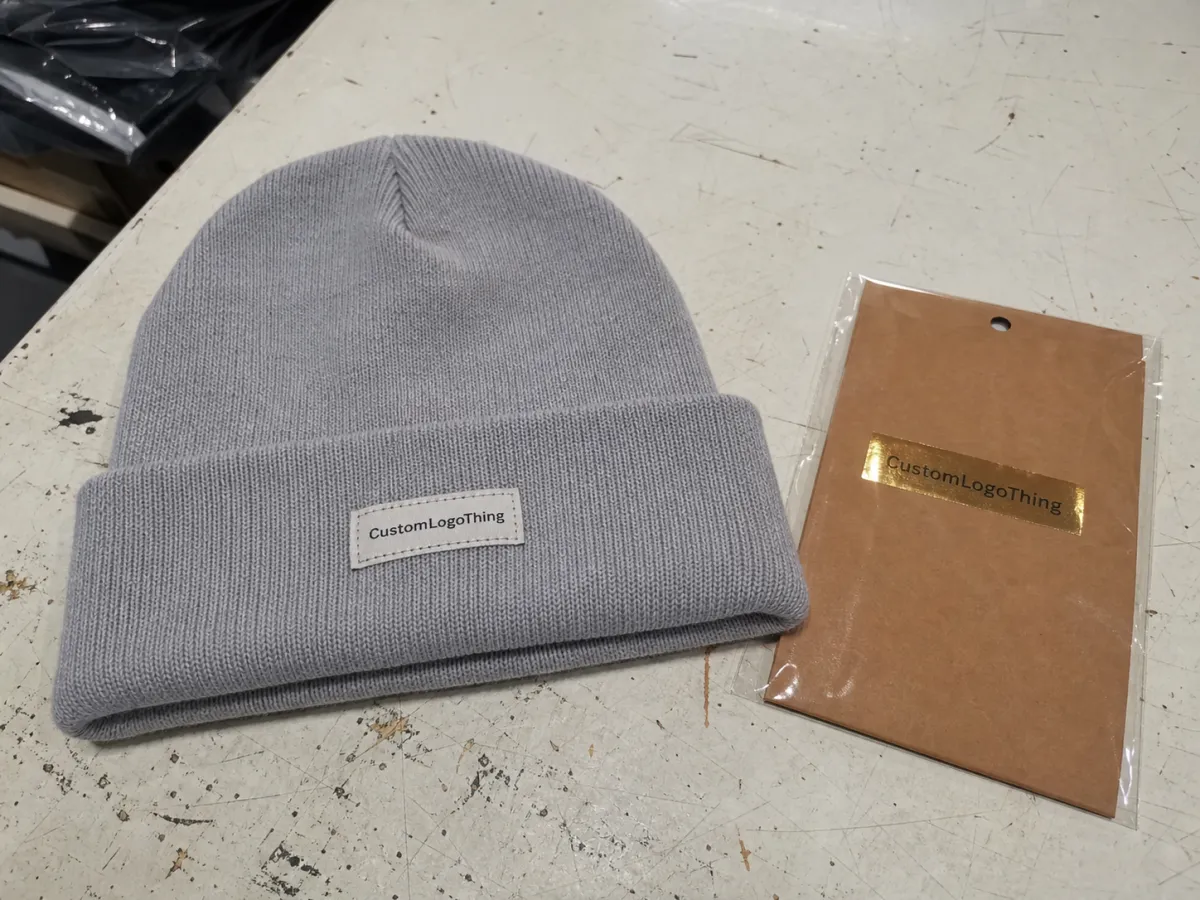
Patch choice deserves real attention. Woven patches handle small text and fine line work better than most other options. Embroidered patches add texture and give the logo more depth, though they are not the right answer for tiny lettering. Faux leather reads cleaner and more premium, especially on retail displays. PVC is useful for bold shapes and outdoor use, but it works best when the artwork is simplified and the details are not trying to do too much.
Packaging should be decided with the same discipline. Individual polybags help with retail presentation and with distribution by department or location. Size stickers reduce sorting mistakes. Hang tags can carry care instructions or basic material claims. If the order is going directly to shelf or event bags, that pack plan should be approved before production starts, not after the cartons are already sealed.
| Patch type | Best use | Look and feel | Planning note |
|---|---|---|---|
| Woven | Small text, fine logos | Flat, crisp detail | Best default for most bulk orders |
| Embroidered | Simple logos with texture | Raised stitch definition | Strong visual depth, weak on tiny copy |
| Faux leather | Retail and premium programs | Smooth, understated finish | Good for bold shapes and minimal art |
| PVC | Outdoor use, hard-edged branding | Defined edges, durable surface | Works best when the logo is simplified |
That is why vitamin Logo Patch Beanies bulk order planning should begin with the art file and the patch format, not the blank beanie color. The decoration method changes what the knit can support, how much detail survives stretching, and how the logo reads from a few feet away. A design that looks good on screen can still fail on fabric if the specs are lazy.
Decoration specs that keep patch logos crisp after wear
Patch size is a production decision, not a design flourish. On knit fabric, oversized artwork can distort, while a patch that is too small turns into noise the first time the beanie stretches. For many adult cuffed beanies, buyers often work in a patch range around 1.75 to 3 inches wide. That is a starting point, not a rule. Cuff depth, logo shape, and how much blank space the art can tolerate all matter.
Color control needs the same discipline. PMS references help, but they are not magic. A woven patch can handle clean color blocks better than a logo built around gradients. Faux leather usually looks better with bold contrast than with delicate tonal shifts. If the logo depends on shading, the safest move is to simplify the art before it goes to proof. That is not a downgrade. It is how you keep the order from becoming a color-matching argument later.
Placement should be chosen for how the beanie will be seen, not just how it looks in a file preview. Center cuff placement is common because it stays visible in photos and on retail hooks. Left cuff placement feels a little more understated. Front-panel placement works better on uncuffed styles. Whatever the location, consistency across the run matters more than style preference once the product is in cartons and moving through distribution.
Durability checks to request:
- Stitch density that keeps the patch edges from lifting or puckering the knit.
- Edge finish that resists fraying during wear, packing, and sorting.
- Seam clearance so the patch is not sitting over a thick join.
- Wash and wear notes if the beanies will be used as staff uniforms or high-frequency giveaways.
For buyers who want a firmer quality benchmark, packaging and transit can be checked against ISTA packaging test standards. That is most useful for long-distance shipping or orders that will be handled more than once after arrival. It does not replace a pre-production sample, but it gives procurement a more concrete way to ask for proof instead of promises.
Small details are where patch orders win or lose. If the patch edge is too close to a seam, the artwork can warp. If the stitch count is too high for the patch size, the design can look crowded. If the logo file still contains thin hairlines, those lines may not survive the conversion. None of that is dramatic. It is just the part of production that pretty mockups hide.
Cost, pricing, and MOQ factors that change the quote
Most quote differences come from a handful of controllable inputs: blank beanie, patch type, stitch count, labor, packaging, freight, and setup. A buyer who understands those pieces can tell whether a quote is actually competitive or just missing half the cost.
For a straightforward acrylic cuff beanie with a single logo patch, many bulk quotes land around $2.80 to $6.50 per unit before freight. That range is wide because the order mix changes the math quickly. A 500-piece run with a woven patch and simple polybagging is not the same as a 100-piece run with faux leather, hang tags, and retail folding. Same product category, very different bill.
Minimum order quantity matters more than some buyers want to admit. Moving from a small run into the next production tier often drops the per-piece cost enough to justify a larger order, especially if a second drop is likely. The catch is storage. If the extra inventory will sit in a closet for nine months, a lower unit price is not a win. It is just cheap-looking optimism.
Compare quotes on identical assumptions. If one supplier includes art cleanup, proofing, and packaging while another quotes only the blank beanie and decoration, the cheaper number is misleading. Freight deserves the same treatment. A quote with included shipping can still be worse if it forces a slow route or splits the delivery into more cartons than your team can handle.
| Order tier | Typical buyer use | Unit-cost behavior | Planning takeaway |
|---|---|---|---|
| 48-99 pieces | Testing a logo or new colorway | Highest setup pressure | Good for pilots, not always for best pricing |
| 100-249 pieces | Small retail drop or team issue | Better spread of decoration and packing cost | Often the sweet spot for first-time bulk buyers |
| 250+ pieces | Multi-location programs and repeat orders | Most favorable per-piece pricing | Worth it if the design is already approved |
Hidden costs are usually what trip people up. Art cleanup can add time if the logo file is low resolution or built in the wrong format. Sample shipping is not always included. Rush fees can turn a manageable quote into a painful one. Split shipments add carton labels, extra handling, and more room for error than anyone wants to admit.
If the order is going to multiple locations, ask for the full pack-out plan, not just the unit price. The quote should show what happens if one carton goes to a warehouse, another goes to a storefront, and a third goes to regional offices. That level of detail matters because a low product price can disappear fast once the logistics become complicated.
Process and lead time from artwork file to shipment
A clean order follows a fairly simple chain: file submission, digital proof, sample review if needed, bulk approval, production, packing, and shipment. The sequence is easy enough to write down. The delays are usually caused by slow internal approvals or by artwork that was never prepared for production in the first place.
Timing should be planned with a little realism. A proof may come back in a day, but sample changes can add several more business days. Bulk production for a standard logo patch beanie order often runs around 10 to 20 business days after proof approval. Custom packaging, split shipments, or a busy cold-weather season can push that longer. Freight should always be treated as a separate clock.
The biggest delays are usually avoidable. Missing vector artwork forces a redraw. Unclear color references trigger back-and-forth. Comments that arrive in fragments stall the queue. The most annoying delay is the one created after the first sample was already approved, when someone decides the patch should be 10 percent larger because it looked different on a head than on a screen.
Use three buffers in the plan:
- Artwork buffer for internal review and revisions.
- Production buffer for sample approval and scheduling.
- Freight buffer for carrier delays and regional distribution.
That last buffer is not optional for seasonal merch. Beanies have a sell window. If inventory lands after the window closes, the order can still be technically correct and commercially useless. Planning for the date you actually need stock in hand is more useful than planning for the date the factory says it can finish.
For repeat programs, the cleanest move is to lock the second order assumption before the first order ships. If the design works, the rerun should not require a fresh debate about artwork, placement, or carton count. If your team needs a reference point for common process questions, the FAQ page can help align expectations before the quote request goes out.
What a packaging-focused supplier should prove before production
A packaging-focused supplier reduces risk because the product is being handled as a system, not just a decorated item. Patch placement stays repeatable. Color is controlled. Cartons get labeled the same way every time. That matters just as much as the beanie itself if the order is going to retail, campus programs, or multiple offices.
Ask for a pre-production sample photo or, better, a sample with notes that show exactly what was approved. A written spec sheet should capture beanie color, patch dimensions, placement, packaging, carton count, and any special handling instructions. That file protects you on reruns. It also gives procurement something better than memory when the order is repeated six months later and everybody suddenly remembers it differently.
Multi-location programs expose weak systems quickly. If one carton is packed differently from the rest, the mistake may not show up until distribution day. That is why carton labeling, case pack accuracy, and master shipping list control are business issues, not minor production details. A supplier who treats them casually is telling you something useful, even if the sample looked fine.
Buyers also ask about sustainability more often now, and the packaging side should be able to answer cleanly. If hang tags, inserts, or cartons need to support recycled or responsibly sourced paper claims, ask for documentation tied to FSC-certified materials. That does not make the beanie sustainable by default. It only means the paper component has a credible standard behind it. Still worth asking.
Quality control should be treated as a cost item, not a slogan. Saving a few cents on the quote means very little if the order has to be repacked, reshipped, or discounted because the patches are inconsistent. On a 1,000-unit program, one preventable error can wipe out the savings from a lower base price. That is not a branding issue. That is math.
If a supplier can show photo evidence, written specs, carton control, and a rerun policy, that is more useful than a polished sales page. Buyers do not need hype here. They need repeatability, and they need it documented.
What to send before requesting a quote
The fastest quotes come from the clearest briefs. Send quantity by color, the logo file, the target patch size, the preferred blank style, the delivery ZIP, and the in-hand date. If those fields are missing, the supplier has to guess. Guessing leads to revisions. Revisions slow the order. That pattern is old and still annoyingly common.
Assign one internal approver for artwork and one deadline for feedback. It sounds bureaucratic because it is. It also prevents the order from bouncing between marketing, procurement, and operations for a week while everyone weighs in on the shade of a beanie they will never touch. The slowest part of the job is usually the inbox, not the sewing line.
Ask for tiered pricing, sample options, and freight timing in the same request. That gives you the landed cost instead of just the unit price. If the supplier can also explain split shipments, drop-ship handling, or reorder terms, you get a better read on whether they can support a program rather than just a purchase.
Use this checklist before you send the request:
- Quantity by size or color split.
- Vector logo file in AI, EPS, or PDF.
- Patch type and approximate dimensions.
- Blank beanie color and style.
- Packaging needs, including polybag or retail-ready packing.
- Delivery destination and deadline.
- Any compliance or material notes for cartons or inserts.
If the order is meant to repeat, say so. Suppliers quote differently when they know a program may reorder. That can affect how they set up artwork, how they hold specs, and how they plan the run. It is a small detail that saves real time later. The cleaner the brief, the fewer things can go wrong during production.
Vitamin logo patch beanies Bulk Order Planning works best when the brief already contains the decisions that usually stall the job. Send the specs, confirm the budget, lock the deadline, and the order starts with less noise and fewer surprises.
FAQ
How many logo patch beanies should I order for a first bulk run?
Most buyers start between 48 and 144 units because that range tests decoration quality without overcommitting inventory. Go lower if you are checking a new logo or colorway. Go higher if the program is already approved and likely to repeat.
Which patch material works best for bulk beanie orders?
Woven and embroidered patches are the safest defaults when the logo has detail that needs to stay readable on a stretchy knit surface. Faux leather fits a cleaner premium look, while PVC is better for bold shapes and better weather resistance.
Can I mix colors or sizes in one beanie order?
Usually yes, but pricing depends on whether the same blank and decoration setup can be used across every variant. More color or size splits add sorting and packing labor, so ask for a tiered quote before you finalize the mix.
What usually slows down the production timeline?
The biggest delays are missing vector artwork, unclear color references, and slow proof approvals. Patch changes add more time than blank-beanie changes, so lock the decoration details first.
How do I compare quotes for bulk beanie orders fairly?
Match the same blank, patch type, stitch count, packaging, and freight terms before comparing numbers. Ask whether setup, sampling, and reruns are included, because the lowest quote is not always the lowest landed cost.