A ceramic Unstructured Dad Hats Digital Proof checklist is useful because the mistakes are usually ordinary: the blank is the wrong tone, the logo sits too high, or the closure does not match the intended look. The proof is where those issues should surface before production. It is not a sales visual; it is the agreement between artwork, material, and factory setup.
That matters more on an unstructured hat than on a rigid cap. The crown relaxes, the front panel shifts, and the finished look depends on how the fabric holds stitch tension. A mockup that only shows a logo on a perfect flat front can miss the part that actually drives the result.
Ceramic also needs definition. It can mean a Pantone target, a sample reference, or a soft neutral direction. Under cool light it may read blue-gray; under warm warehouse light it may look more stone. The approval file should pin down the color reference, decoration method, construction, and exact version being signed off.
A proof should answer the boring questions first. If it leaves room for interpretation, production will make the decision for you.
Ceramic Unstructured Dad Hats Digital Proof Checklist: What It Catches
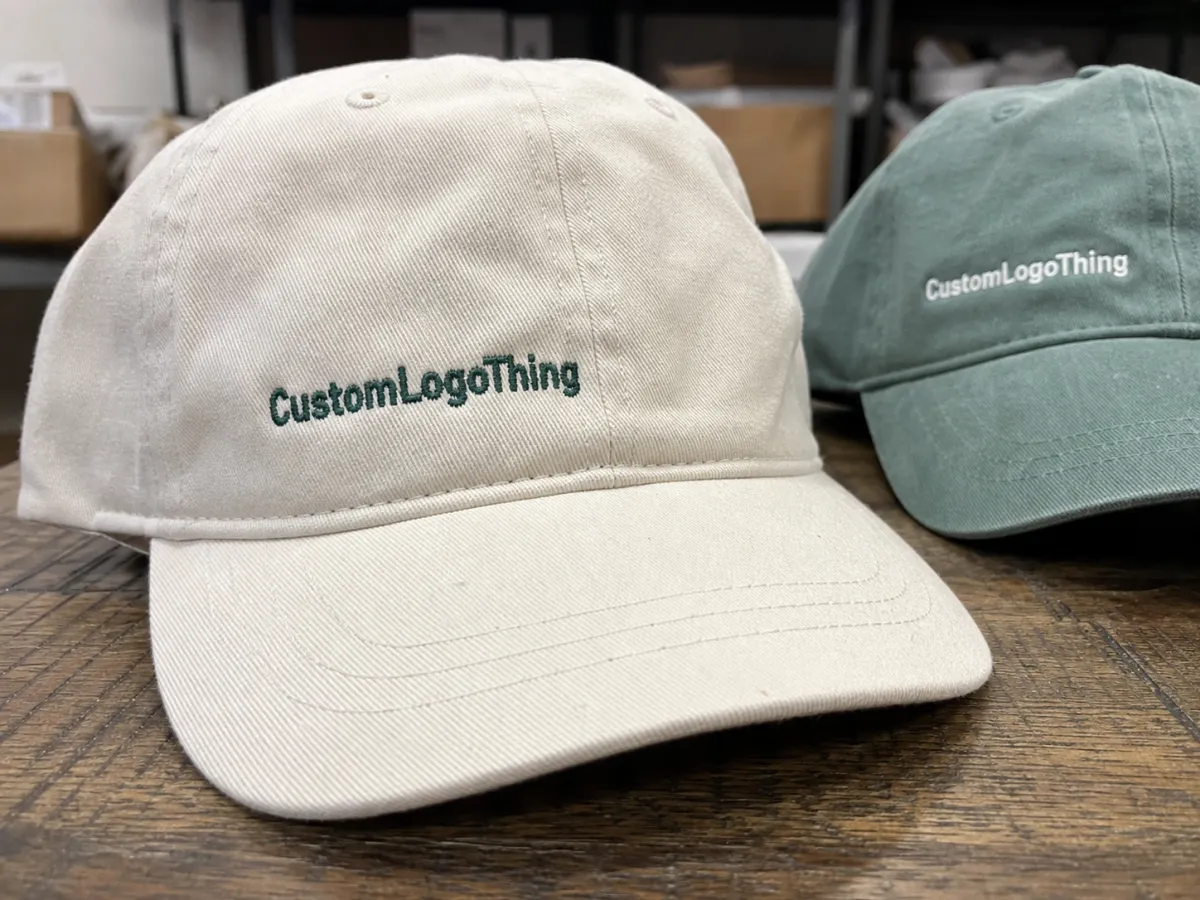
The checklist should expose the places where a simple hat order goes wrong. Buyers usually focus on the logo because it is the visible part, but the bigger risks are placement, color drift, and how the soft crown changes the final read.
Start by defining what ceramic means for the order. Is it a Pantone match, a sample hat, or a descriptive tone? If the factory has to guess, the result can drift enough to matter once the hats are in hand.
A useful proof confirms the details that affect the final hat most:
- Artwork size measured against the front panel, not the full artboard.
- Placement relative to the center seam, eyelets, and crown curve.
- Thread or patch colors with written references, not screen-only notes.
- Closure style such as strap, buckle, clip, or self-fabric back.
- Interior labeling and whether it sits under the sweatband or on tape.
- Construction notes for an unstructured crown, which behaves differently from a rigid cap.
That last point is easy to miss. An unstructured dad hat does not hold a fixed shape. The crown relaxes, folds, and rebounds based on fabric weight and packing. A design that looks centered on a flat proof can sit low or compressed once stitched and worn.
Material also matters. Cotton twill, washed cotton, and brushed cotton all change how ceramic reads. A brushed finish can mute the color slightly; a tighter twill may read cleaner and brighter. Those differences are small on paper and obvious in person.
If embroidery is the method, ask for approximate stitch count and fill density. A simple wordmark may land around 4,000 to 6,000 stitches. Dense icons, fine lettering, or layered shapes can pass 10,000 stitches, which affects price and the chance of puckering. For woven or leather patches, the main checks shift to patch size, edge finish, and how the patch sits on a soft crown.
Process and Timeline: From Art File to Approval
Hat orders move faster when the front end is controlled. The usual sequence is artwork intake, digital proof creation, revision, final approval, pre-production setup, decoration, quality check, packing, and freight. Delays usually come from missing vector files or vague color direction.
A realistic timeline helps buyers plan. A clean vector file can produce a first proof in 1-3 business days. A consolidated revision usually takes 24-48 hours. After approval, standard production for embroidered hats is often 12-15 business days, though quantity, complexity, and factory load can move that range. Woven patches and multi-step decoration can add more time.
Every clarification costs time. A logo sent as a low-resolution JPG needs tracing. A note that says “match the website” creates back-and-forth. If ceramic is described one way in the proof and another way in email, the schedule stalls while instructions get reconciled.
Some add-ons extend lead time more than buyers expect:
- Custom labels need separate artwork and a separate production step.
- Patch applications can require material confirmation before scheduling.
- Extra colorways split inventory and complicate matching.
- Rush shipping speeds transit, not production, so it rarely rescues a late approval.
That distinction matters. Freight can be expedited; approval cannot. Most missed launch dates happen upstream, not in transit. For teams managing several SKUs, one owner should consolidate feedback so revisions do not conflict and the proof count stays low.
If the order is tied to a launch date, the useful question is not “Can you make it fast?” It is “What must be locked before production starts?” Usually the answer is artwork, color reference, quantity, and closure or label choice.
Cost, Pricing, and MOQ: What Changes the Quote
Hat pricing is driven by six variables: quantity, stitch count, digitizing, thread color count, decoration method, and whether the back closure or interior label is customized. Remove one variable and the quote simplifies. Add several and the unit price rises quickly.
MOQ matters because setup time has to be spread across the order. A 100-piece run can cost much more per unit than a 500-piece run because the same proofing, digitizing, machine prep, and inspection effort is divided across fewer hats. The headline number matters less than the line items.
A simple tier comparison shows the pattern:
| Order Tier | Typical Unit Range | Best For | Main Watch-Out |
|---|---|---|---|
| 100-149 units | $9.50-$15.00 | Small launches, internal events, test merch | Setup costs weigh heavily on the unit price |
| 250-499 units | $7.25-$10.25 | Brand drops, local retail trials, team programs | Revisions can erase savings if art keeps changing |
| 500-999 units | $6.25-$8.75 | Steady replenishment and margin control | Color consistency becomes more visible across the lot |
| 1,000+ units | $5.25-$7.25 | National promotions, retail assortments, resale programs | Approval mistakes scale quickly |
The cheapest quote is not automatically the weakest, and the highest quote is not automatically the safest. The important question is whether the pricing matches the build. A woven patch run should not be priced like flat embroidery. A leather patch order should not be compared to a one-color stitched wordmark.
To reduce cost without hurting the final hat, simplify the artwork, trim thread colors, and avoid unnecessary secondary decoration. A one-color embroidered logo is usually cheaper than a six-color patch with small type. Standard strapback hardware usually costs less than a custom closure plus a printed or woven interior label package.
Ask for a line-by-line breakdown: blank hat cost, decoration setup, digitizing, proof fee, revision allowance, and freight. That keeps hidden charges from showing up late in the process.
Spec Checks That Decide Fit, Color, and Decoration
The soft front panel is the whole story on an unstructured dad hat. It does not behave like a structured cap. The fabric folds, breathes, and relaxes, so the logo has to be checked on a real hat shape, not just on a flat artboard.
Check the artwork against the actual hat dimensions:
- Front panel width so the logo does not look squeezed or oversized.
- Crown depth so placement sits where the fabric naturally carries the design.
- Seam distance because embroidery too close to a seam can distort.
- Bill curve since a more curved brim changes the visual balance.
- Eyelet placement when the design sits high on the crown.
Color is the second major check. Screen color is weak because it depends on brightness, calibration, and the device being used. For ceramic, ask for a Pantone reference, a physical swatch, or a written note that defines warm versus cool. If the hat has to match a broader brand system, a physical sample is better than a visual approximation.
Decoration method should match the design. Embroidery suits bold lettering, simple logos, and a textured premium feel. Woven patches keep fine lines cleaner. Leather patches create a heavier, more tactile look and simplify color control. Printed labels work when interior branding needs more information without adding bulk.
Quality control should check thread tension, skipped stitches, puckering, and symmetry between left and right placement. On patch orders, inspect edge fray, adhesive bleed, and whether the patch sits flat after pressing or sewing. On an unstructured crown, small flaws are easier to see because the fabric does not hide them behind heavy reinforcement.
Step-by-Step Review for a Clean Proof Sign-Off
A clean sign-off is usually a process issue, not a design issue. The best review uses one source of truth and keeps corrections in one place. That prevents people from rebuilding decisions from screenshots and old emails.
- Gather the source file: spec sheet, artwork, quantity, color reference, and deadline.
- Review line by line: spelling, logo proportions, placement, closure style, and any secondary decoration.
- Annotate once: send all corrections in one response so revisions do not conflict.
- Check at real size: compare against a ruler or sample hat if one is available.
- Record approval: note who approved it and on what date so the decision is traceable.
That final step matters because the approved proof becomes the reference if a production question comes up later. Without it, teams debate intent instead of fixing the issue. The same logic applies to packaging proofs or label releases: the approved file defines the limit of acceptable change.
Read the notes before studying the artwork, because the notes often contain the actual constraints. Check the proof in daylight if ceramic tone matters. A backlit laptop can flatten subtle shifts that become obvious near a window or under warmer indoor light. Compare the proof file name with the approval email so version control stays clear.
Brands that reorder often should standardize the format. Use the same fields every time: logo name, color reference, hat style, decoration method, quantity, proof version, approver, and timestamp. That turns the checklist into a repeatable control point instead of a one-off scramble.
Common Mistakes That Derail Hat Orders
Some errors show up so often they become predictable. The first is approving from a phone screen. A small display hides spacing issues, line-weight problems, and placement shifts that are easy to spot on a larger screen.
The second mistake is assuming the digital proof guarantees exact color. It does not. A proof confirms intent, but thread batch variation, screen calibration, and lighting all affect the final read. If ceramic color is critical, ask for a swatch reference or sample approval.
The third issue is forgetting the back of the hat. Buyers focus on the front logo, then realize the closure style clashes with the design or the interior label sits where it rubs the neck. A proof should include the back closure, the label placement, and any marks on the side or underside of the brim.
Another avoidable problem is skipping MOQ and revision rules. Some factories charge for extra proof rounds once the artwork changes beyond a threshold. Others reset the minimum if the decoration method changes late in the process. If you do not ask, the revised invoice becomes the first place you learn the real cost.
Missed approval deadlines are the final trap. A late sign-off can push the order into the next production window, which is usually more disruptive than a small artwork tweak. The factory can handle clarity; it cannot manufacture time that was not approved.
For larger runs, a first-piece check can catch a shifted placement, thread tension issue, or patch that sits slightly crooked. If the order size and timeline justify it, that check is worth asking for.
Expert Tips and Next Steps Before You Approve
Ask for a second proof whenever the logo size, thread color, or decoration method changes. One extra review is cheaper than a correction on a completed run, especially once the order reaches 500 units or more.
Request a production note that restates the approved dimensions, ceramic color reference, and placement offsets. That note should travel with the order so the team building the hats does not rely on memory or a scattered email thread. If the proof and production note disagree, stop and resolve it before the run starts.
Compare the final proof against daylight and, if possible, against a physical swatch or sample hat. Ceramic can move from crisp neutral to warm gray depending on the surface and the room. That is a viewing-condition issue, and the fix is to look again under better light.
Use a narrow approval group:
- One internal decision maker owns the approval.
- One brand or merch contact confirms the design intent.
- One end-use reviewer checks whether the hat fits the audience and use case.
Three voices are usually enough. More people often slow the process and blur accountability. If you Order Custom Hats regularly, build the review around the same template each time so the checklist becomes part of the buying system.
Save the approved proof, the quote, and the notes in one folder under the same naming system every time. That makes reorders, seasonal drops, and vendor comparisons much easier. For ceramic Unstructured Dad Hats, the goal is not a prettier mockup. It is a proof that leaves no ambiguity about what gets made, how it will fit, and what color it will actually be under normal light.
FAQ
What should a ceramic unstructured dad hats digital proof checklist include?
It should list artwork size, placement, stitch or patch method, thread colors, closure type, and label position in one place. Add the approval version number and any color reference so production is not working from an outdated file.
How long does digital proof approval usually take for custom dad hats?
A clean order often gets the first proof in 1-3 business days, but missing files or unclear specs can stretch that window. Each revision round adds time, so consolidated feedback is the fastest way to keep the schedule moving.
What changes the price of unstructured dad hats the most?
Quantity, stitch count, decoration complexity, color changes, and custom labels are the biggest cost drivers. Rush handling, extra proof rounds, and sample fees can also move the final price more than buyers expect.
Can a digital proof show the exact ceramic color on the hat?
Not perfectly, because screens, lighting, and thread batches all affect how the color reads. Use a Pantone reference, swatch, or physical sample if the ceramic tone has to match a brand standard closely.
What should I do before I approve the proof for production?
Compare the proof against the spec sheet, confirm measurements, and make sure every stakeholder has signed off. Save the final version with the quote and notes so the approved file can be traced during production.

