Cheap Custom Plastic Bags for Bulk Orders and Fast Quotes
Cheap Custom Plastic Bags can cut total packaging cost long before a logo reaches the press. They ship flat, stack efficiently, and take far less warehouse space than cartons, clamshells, or rigid containers. That storage advantage is not a side benefit. For many buyers, it is the main reason flexible packaging wins the bid.
The format works because it solves several problems at once. It lowers freight volume, reduces handling time, and gives brands a printable surface without paying for unnecessary structure. A bag can look polished on shelf or in transit if the film, closure, and print method are matched to the product. If they are not, the order only looks cheap on paper.
That distinction matters. The lowest unit price is not the same as the best buy. A bag that tears at the seal, wrinkles badly under product weight, or forces repacking can cost more than a sturdier option with a slightly higher quote. The real target is value: enough protection, enough presentation, and no wasted material.
Why Flexible Bags Beat Rigid Packaging on Cost and Storage
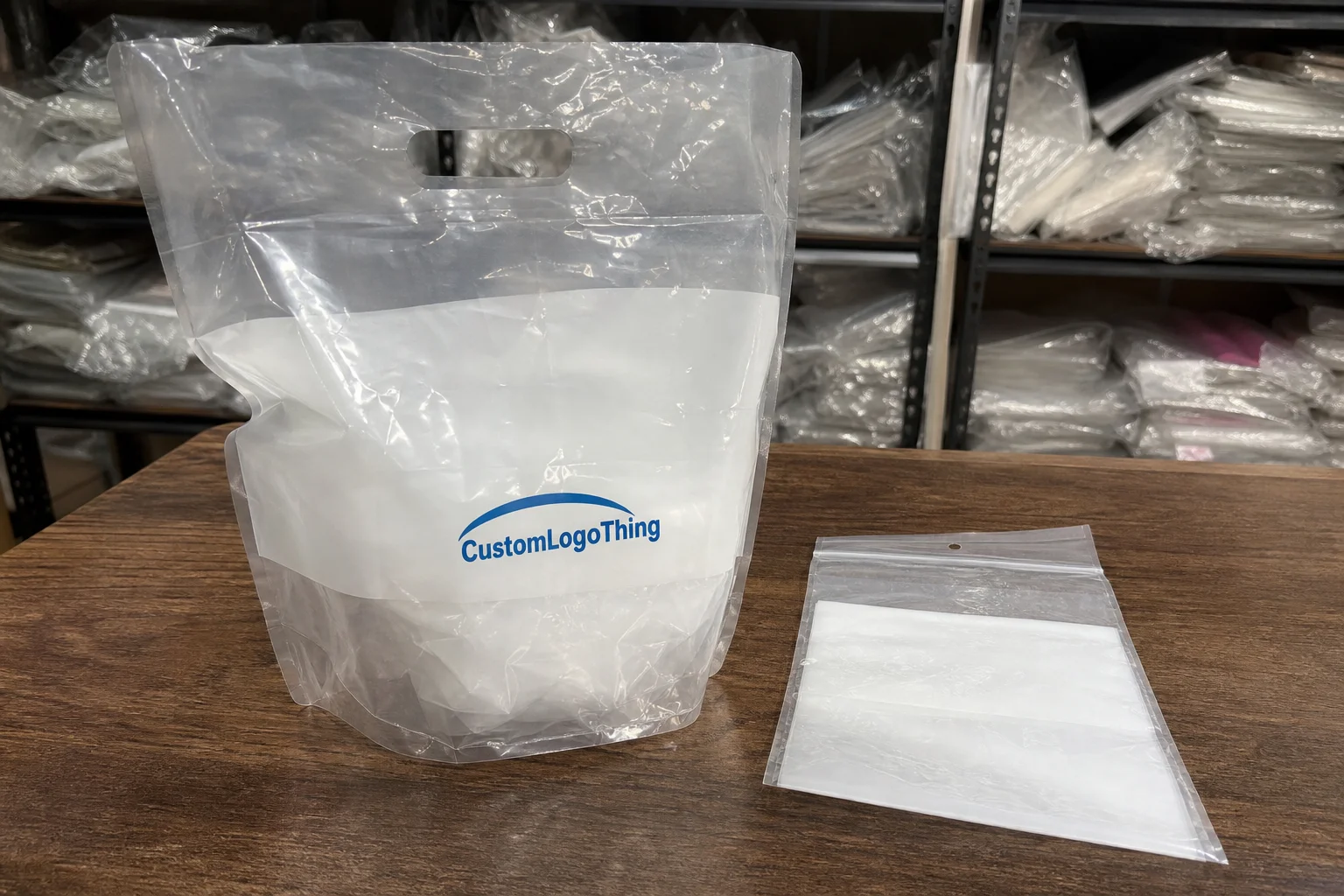
Rigid packaging has a place, but it usually carries more resin, more freight volume, and more storage drag than a flexible bag. Cheap Custom Plastic Bags avoid much of that overhead because they arrive flat and are easy to store on pallets, in cartons, or directly on packing lines. That matters most for high-turn items, where space inside the warehouse is a recurring cost instead of a one-time purchase.
There are three common cases where flexible bags make the most sense. Distributors use them for parts, samples, and bundled kits. E-commerce sellers use them to keep shipping weight down. Retail brands use them for branded presentation without paying for a box or molded shell when a film structure will do the job.
The product still drives the decision. A dry snack, a garment, and a set of fasteners do not ask the same thing from packaging. Each one needs different seal strength, different puncture resistance, and a different level of clarity or barrier protection. A bag that is too thin can fail under load; a bag that is too heavy can erase the savings that justified the switch in the first place.
That is the practical test: what is the least expensive structure that still protects the item, supports the branding, and moves cleanly through storage, packing, and delivery? If flexible packaging passes that test, the savings can be substantial without making the package look improvised.
Bag Materials, Styles, and Print Options That Fit the Job
Material choice shapes most of the final result. LDPE is often selected for its softer hand feel, better clarity, and flexible drape. HDPE is typically lighter and crisper, which can make sense for economy-focused applications. Co-extruded film adds another layer of control, often improving puncture resistance, printability, or moisture behavior depending on the construction.
Style matters just as much as resin. Flat poly bags are the simplest and usually the most economical format for bulk orders. Gusseted bags add depth for boxed goods, apparel, or wider products. Wicketed bags are built for faster packing lines. Resealable bags make sense when the end user will open and close the package several times. Printed retail bags prioritize presentation; shipping bags prioritize speed and protection.
Print method has a direct effect on both price and appearance. A one-color flexographic print is often enough for a logo, product name, or web address. Multi-color flexographic printing improves visual separation, but each color adds setup work, proofing time, and waste during make-ready. Full-coverage print can look strong on shelf, though it only pays off when the branding justifies the added ink and press time. For many orders, a clean one- or two-color design is the best balance of cost and impact.
A low-cost bag is not the same as a low-value bag. The right film, the right gauge, and the right print setup usually save more money than pushing the material spec down to the cheapest possible number.
Before choosing a style, look at how the bag will be opened, filled, stacked, and handled after packing. If it will move through a warehouse, sit in transit, or be reopened by the customer, those details matter. Packaging evaluated for shipping is not the same as packaging evaluated only on a tabletop sample. Resources from ISTA help explain transport testing, and packaging.org offers useful terminology and industry context.
| Bag Type | Typical Use | Common Price Effect | Best Fit |
|---|---|---|---|
| Flat LDPE bag | Light retail, inserts, garments | Lowest setup and material cost | High volume, simple branding |
| Gusseted bag | Thicker items, boxed goods | Moderate increase for extra film | Better fit and cleaner presentation |
| Resealable bag | Reopenable consumer packaging | Higher cost because of zipper feature | Repeat use, retail packaging |
| Wicketed bag | Fast pack lines, food service, bulk fulfillment | May add assembly complexity | Speed and consistency |
Thickness, Dimensions, Closures, and Performance Specs
Thickness is one of the easiest places to under-spec or overspec a bag. Buyers usually talk in mils or microns, and the difference matters. A thin retail bag may only need to look clean and seal well, while a heavier product may need a thicker gauge to resist puncture, seam stress, and abrasion during handling. Cheap custom plastic bags stay cheap only if the thickness matches the load instead of compensating for a weak design elsewhere.
Dimensions should be written clearly: width, length, gusset depth if needed, and the exact closure style. A bag that is too narrow at the opening slows packing and can snag the product. A bag that is too loose looks sloppy and can shift inside transit packaging. If the design needs a zipper, punch hole, vent, or tear notch, include it early. Those features affect tooling, lead time, and the final quote.
Performance specs are where practical buyers separate marketing language from real use. Ask about tear resistance, seal strength, clarity, moisture behavior, and whether the bag needs anti-static properties or venting. Some products need a stronger seal, not a thicker film. Others need puncture resistance more than a glossy finish. Packaging design should start with the product and the handling route, not with a guess at what sounds premium.
Common mistakes appear quickly in production. A buyer may assume one size fits all and then find the opening is too tight. Another may request a thin gauge because the sample looked fine, only to see failures under weight or during pallet movement. A third may approve artwork without defining the seal area, which creates rework. Those problems are avoidable with a complete spec sheet.
Storage conditions also matter. Heat, pressure, and humidity can change how film behaves over time. Bags stored in a warm warehouse may curl differently than bags kept in a climate-controlled room. Products that are sharp, oily, cold, or moisture-sensitive need that context called out before production starts. A careful supplier will ask those questions before quoting.
Cost, Pricing, MOQ, and What Changes Your Quote
Pricing for cheap custom plastic bags usually comes down to six variables: material type, thickness, bag size, print colors, quantity, and extra features such as zippers or handles. Each one affects raw material use, setup work, and machine time. Even a small change in size can alter yield across the sheet or roll, which is why price shifts can feel larger than the specification change itself.
MOQ is usually the first number buyers notice after unit price. Lower quantities carry a higher per-unit cost because setup, proofing, and production preparation are spread across fewer bags. Larger runs reduce unit cost, but they also require storage space and more cash tied up in inventory. The right order size depends on turnover. A company with steady monthly demand may do better with a bigger run; a seasonal brand may accept a higher unit price to avoid holding too much stock.
For directional budgeting, a simple one-color flat bag in volume can often land in the low cents to a few tens of cents per piece, depending on size and film choice. Add a zipper, heavier gauge, multi-color print, or low quantity, and the figure can move quickly. Those are not exact promises. They are the normal effect of setup cost and material usage. Buyers who want accuracy should compare several spec levels instead of treating one price as universal.
The landed cost matters more than the factory price. Freight, carton count, pallet pattern, and shipping destination all influence the final number. A low unit price can become a poor deal if the packing format ships inefficiently or if the bags arrive damaged because the carton spec was too light. Quotes that include delivery assumptions are far more useful than quotes that list only the bag price.
To get a quote that can actually be compared, send the exact dimensions, preferred material, thickness target, number of print colors, quantity, and application. If the bag will hold food, chemicals, apparel, or electronics, say so. If you want a standard and upgraded option side by side, ask for both. That makes it easier to compare cheap custom plastic bags against a more durable alternative without guessing where the price difference comes from.
| Choice | Typical Effect on Price | Typical Effect on Performance | Buyer Takeaway |
|---|---|---|---|
| LDPE | Often moderate for flexible applications | Softer feel, good clarity | Strong all-purpose option for branded packaging |
| HDPE | Often lower material cost | Lighter structure, more crisp feel | Useful where economy matters most |
| Co-extruded film | Usually higher than single-layer film | Better balance of strength and appearance | Good for demanding product packaging |
| One-color print | Lower setup and ink cost | Clean, simple branding | Best value for many bulk orders |
| Multi-color print | Higher setup and press time | Stronger visual impact | Worth it only if the design needs it |
Production Steps, Proofing, and Lead Time Expectations
A clean order usually moves through the same sequence: spec review, material selection, artwork confirmation, proof approval, production, inspection, packing, and shipment. Cheap custom plastic bags are faster to produce when the buyer gives complete information early, because the shop does not have to chase down missing dimensions or guess at print placement. Fewer corrections before release usually mean a smoother run.
Proofing is where many problems get caught before they become expensive. The proof should show print position, copy accuracy, barcode legibility if needed, and the relationship between the design and the seal or edge area. Color on screen is not the same as color on film, so a serious buyer should expect some variation and confirm what level of matching is acceptable. If the bag will carry product names, lot codes, or regulatory text, that material deserves a careful check before approval.
Lead time depends on several inputs, but clear specs and fast proof approval usually shorten the schedule more than anything else. Revisions slow things down. Missing artwork slows things down. A quantity change after approval can also reset the schedule because it may alter material allocation or machine planning. For many standard custom printed bags, a realistic timeline is often 12 to 15 business days from proof approval. More complex constructions, heavy print coverage, or tightly controlled color work can take longer.
Buyers can avoid delays by confirming the delivery address, packaging requirements, and any compliance or labeling needs before the order is released. If the bags are meant for food contact, retail display, or export, those details should be included up front. A supplier can work much faster when the job is defined clearly than when it has to be reconstructed from scattered emails.
One useful habit is to ask for a written summary of the final spec before production starts. That summary should include size, gauge, material, print count, closure, carton configuration, inspection point, and ship date estimate. It is basic, but it prevents confusion later, especially on larger orders where several people touch the job.
Quality control should also be visible in the workflow. Good production teams check film thickness, seal integrity, print registration, and carton counts before shipment. If the order has barcodes or serialized information, that needs a separate verification step. For high-volume buyers, those checks matter because a small defect rate becomes expensive fast once thousands of bags are in circulation.
How to Judge Supplier Quality When Price Is the Priority
Price matters, but supplier quality shows up in the details. Strong suppliers document film specs, print method, tolerance ranges, proof process, and final inspection standards up front. That is not paperwork for its own sake. It is the difference between repeatable output and a one-off order that looks fine on the quote but fails in use.
Communication quality is often the clearest warning sign. A responsive team asks practical questions: What is the product weight? How will the bag be packed? Does the design need a zipper or tear notch? Are the bags going to retail shelves, warehouse fulfillment, or direct shipment? Those questions save money because they reduce the chance of ordering cheap custom plastic bags that are cheap only until the first mistake.
Watch for vague quotations. If the quote does not define material, thickness, print count, included setup, or inspection method, the low number can hide later charges. That creates friction during approval and usually leads to surprise costs at the end. A good supplier is transparent about what the price includes and what would change it.
There is also a practical difference between a supplier that can print and a supplier that can deliver consistently. Clean edges, even seals, readable graphics, and on-time shipment matter more than promotional language. If the vendor can explain how they handle tolerance control or how they check print registration, you are likely dealing with someone who understands real production rather than just order entry.
For buyers comparing Custom Packaging Products, the useful test is simple: which option protects the product, presents the brand well, and keeps reorders predictable? That is the kind of value that matters in retail packaging and bulk fulfillment, because an inexpensive bag that causes rework is not actually inexpensive.
The lowest quote only matters if the bags survive production, packing, and transit without creating scrap or complaints.
Next Steps: Send the Right Specs and Get a Usable Quote
If you want fast pricing on cheap custom plastic bags, send a complete order summary the first time. Include the bag style, dimensions, thickness, material preference, print colors, quantity, closure type, and intended use case. Add artwork files, shipping destination, and any compliance requirements so the quote is specific enough to compare.
A clean request should also say whether the bag is for retail packaging, shipping, or internal handling. That single detail can change the recommendation more than many buyers expect. A display bag for apparel and a shipping bag for components may both be flexible formats, but they are not built the same way and should not be priced as if they are.
Review the offer by checking unit price, setup charges, MOQ, proof timing, production lead time, and freight. If those items are clear, suppliers can be compared on substance instead of guesswork. If they are vague, the quote is not ready for approval. In practice, the buyers who save the most time are the ones who ask one more round of questions before signing off.
Clear specs also reduce tradeoffs later. If the order is low-cost but the film is too thin, the savings disappear into damage or repacking. If the print looks good but the quantity is too small to absorb setup cost, the unit price rises. If the lead time is short but the artwork is incomplete, the schedule slips. Cheap custom plastic bags stay economical only when the request removes ambiguity from the start.
Are cheap custom plastic bags durable enough for shipping?
Yes, if the thickness, seal type, and material match the product weight and handling conditions. For shipping, buyers should prioritize puncture resistance, seam strength, and the right gauge rather than the lowest possible film spec.
What information do I need for a cheap custom plastic bags quote?
Provide bag dimensions, material preference, thickness target, print colors, quantity, closure type, and intended use. Artwork files, shipping destination, and any compliance requirements help narrow pricing and lead time quickly.
How does MOQ affect the price of custom plastic bags?
Lower quantities usually carry a higher unit cost because setup, proofing, and production preparation are spread across fewer bags. Larger runs reduce per-unit pricing, but the best order size depends on storage space, turnover, and cash flow.
Which material is best for low-cost custom plastic bags?
LDPE is commonly used when buyers want flexibility, clarity, and a smooth finish. HDPE can be a practical choice when the priority is lighter weight and a more economical structure for certain applications.
How long does production usually take for custom printed plastic bags?
Lead time depends on artwork approval, material availability, print complexity, and order size. Clear specs and fast proof approval usually shorten the schedule more than any other single factor.


