For buyers comparing custom plastic Bags with Logo wholesale, the real question is whether the bag performs at scale, protects the contents, and stays economical for repeat use. A plain carryout bag moves the product out the door; a printed bag keeps carrying the brand afterward, in transit, at the office, or across a crowded event floor.
That combination of low unit cost, useful branding space, and repeatability is why this category remains common in retail packaging, events, and fulfillment. A bag is not trying to be premium packaging. It is trying to move efficiently, hold up under normal use, and deliver enough visual value to justify the print.
There is also a procurement advantage. Packaging teams buy what can be reordered without friction, and wholesale plastic bags fit that brief because the materials are familiar, the production steps are standardized, and the finished product stores easily. For recurring programs, predictability often matters more than novelty.
Why branded plastic bags still outperform plain carryouts
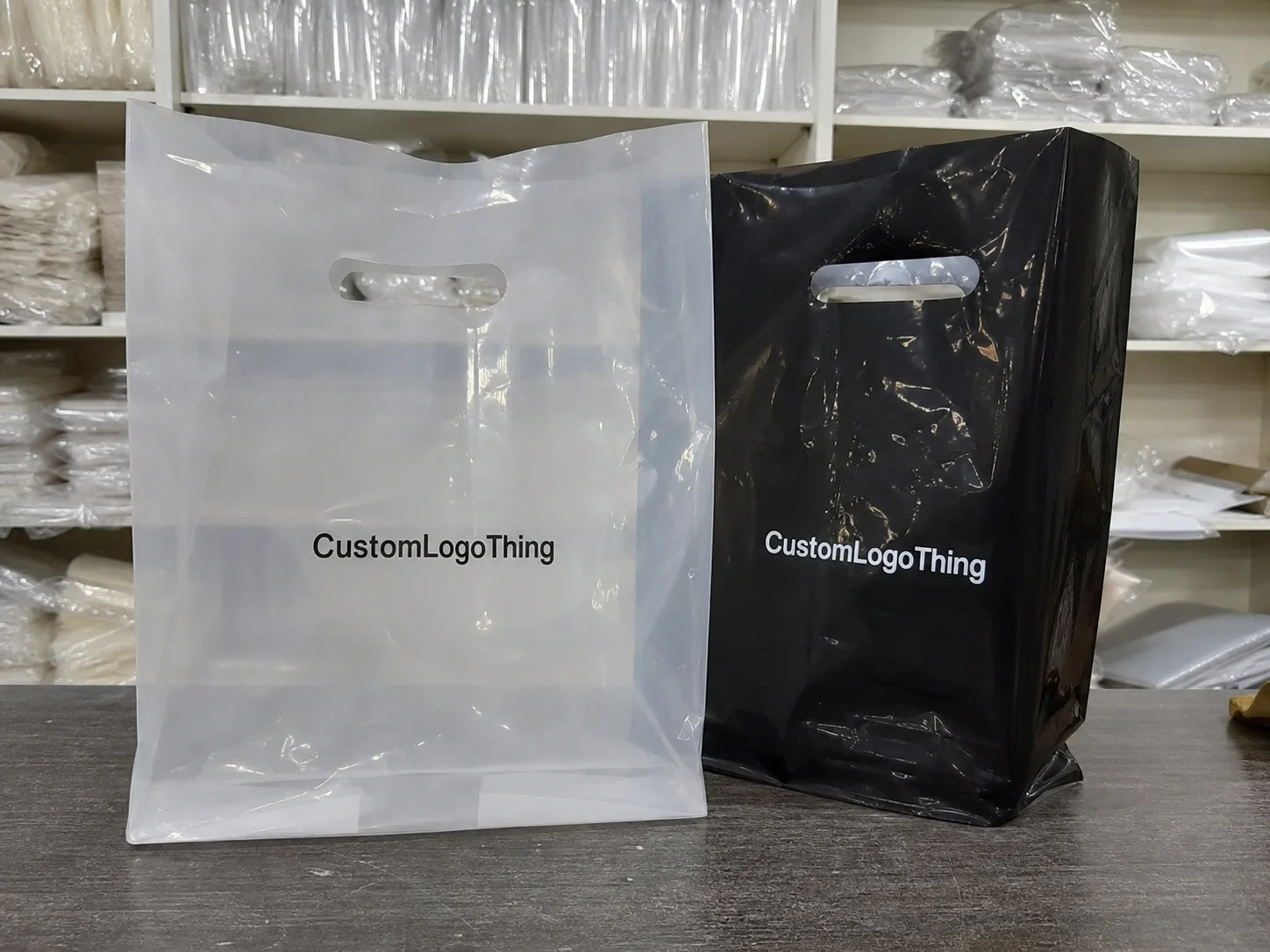
A plain bag is functional. A printed one is functional plus distribution. Every customer who leaves with a logo on the handle is carrying a small moving ad, and unlike shelf signage, the ad continues into real-world use. That reach is one reason branded bags stay practical for apparel stores, convenience retail, beauty counters, trade shows, and fulfillment operations.
Custom Plastic Bags with logo wholesale also tend to outperform more expensive packaging on cost per impression. Rigid boxes can create a stronger unboxing moment, but they are heavier, more storage-intensive, and more expensive to print at volume. The bag is less theatrical, but it is often more useful for high-volume programs where margins matter.
Consistency is another reason buyers keep returning to this format. Stores and distributors need bags that print the same way every time, arrive on schedule, and match the agreed thickness. Small variations become expensive when they ripple through shipping, merchandising, and customer service, so production discipline matters as much as design.
“A good branded bag is not the loudest packaging in the room. It is the one that prints cleanly, arrives on schedule, and holds up without complaints.”
That is the real bar for this category. The logo matters, but the production outcome matters more.
Bag styles, materials, and print options that affect performance
Bag style should come first, because the format determines how the customer will carry and reuse it. T-shirt bags remain common for quick-service retail and grocery-style carryouts because they dispense quickly and pack flat. Die-cut handle bags present better for apparel, cosmetics, and promotions because the shape feels cleaner in hand. Gusseted merchandise bags work better for boxed items or products with more bulk, while resealable bags suit kits, samples, or parts where closure matters.
There is no universal winner. A bag that works for a folded T-shirt can fail with bottled goods, and a bag that feels polished for a boutique may be overbuilt for an event insert. The right format follows the load, not the logo.
Material choice changes both durability and appearance. HDPE is typically thinner-looking at comparable strength, which helps keep costs down for high-volume carryout. LDPE feels softer and more flexible, so it is often preferred when the bag needs stretch or a smoother hand. PP is firmer and clearer, which can help when presentation matters and the contents need to be visible.
Thickness, usually discussed as mil or gauge, matters just as much as the polymer itself. A lightweight apparel bag may only need around 0.9 to 1.5 mil. Heavier applications, or bags expected to hold multiple items, often move to 2 mil and above. More material increases durability, but it also raises cost and can make a bag feel stiff or overbuilt.
Print method is where many orders become more expensive than expected. Flexographic printing is common for higher runs because it is efficient once setup is complete. Digital printing can be useful for shorter runs or artwork that changes more often. Screen printing can work for simpler graphics on specific substrates. The more colors, gradients, or tight registration the design requires, the more likely the production cost rises. Tiny type on tinted or translucent film is especially risky.
| Bag type | Typical use | Strength/appearance | Best fit for |
|---|---|---|---|
| T-shirt bag | Retail carryout, quick-service | Light, efficient, economical | High-volume basic retail packaging |
| Die-cut handle bag | Apparel, promotions, events | Cleaner presentation, better branding surface | Branded packaging with stronger visual impact |
| Gusseted merchandise bag | Bulky goods, boxed items | More capacity, improved fit | Product packaging that needs volume |
| Resealable bag | Kits, samples, parts | Closure support, controlled access | Fulfillment, bundling, and shipping inserts |
Surface finish affects the final impression too. Gloss tends to make colors feel brighter. Matte reads more restrained and can hide small scuffs. Frosted film sits between the two, with a softer premium feel. Clear bags maximize visibility, but they also expose the contents and the folds inside. Ink does not behave the same way on white, clear, and tinted film, so color accuracy shifts accordingly.
Specifications buyers should confirm before ordering
Most costly mistakes start with vague specs. Before requesting Custom Plastic Bags, the buyer should lock down dimensions, construction, thickness, handle style, print area, number of colors, and artwork format. Leaving any of those open can make a quote look attractive until the actual production assumptions appear.
Use case should drive the spec sheet. A carryout bag for a light apparel order is not the same as an event bag loaded with brochures and samples. Shipping inserts create a different set of requirements again, especially if the bag is secondary packaging inside a mailer. If the bag is too small, it tears or looks cramped. If it is too large, the material cost rises and the finished package feels sloppy.
Material compliance deserves attention, especially for food-related programs. Buyers should ask whether the bag is suitable for food contact, whether it meets local packaging rules, and whether any special documentation is available. Sustainability claims also need to be handled carefully. If the packaging plan includes references to recycling, use the correct local guidance rather than assuming all films are treated the same way.
Artwork prep is another area where projects lose time. Vector files are preferred because they scale cleanly. Pantone references help maintain consistent brand color from run to run. Logo placement should be measured, not estimated. Bleed and safe area matter near handles, seams, and gussets, where the available print field is often smaller than a marketing team expects.
Production teams work best with complete information. A request that says “make the logo bigger” is not enough. A request that gives exact placement, exact dimensions, and a clear color target is far more useful.
- Dimensions: width, height, and gusset depth
- Material: LDPE, HDPE, PP, or specialty film
- Thickness: gauge or mil target tied to load weight
- Print: one color, two color, or full custom artwork
- Artwork: vector file, Pantone callouts, and placement notes
- Compliance: food contact, recycling, or local packaging rules
Cost, pricing, and MOQ factors that change your quote
Price is a stack of variables, not a single line item. Quantity is usually the largest driver. Bag size, material, thickness, and the number of print colors follow close behind. Special finishes, heavier gauges, and custom dimensions add cost quickly. Buyers sometimes focus on artwork first, but the physical spec usually matters more to the final number.
MOQ, or minimum order quantity, works in a predictable way. Smaller runs have higher unit pricing because setup costs are spread over fewer pieces. Larger runs reduce the per-bag cost, but they also require storage space, cash flow, and a forecast that holds up under scrutiny.
For buyers comparing custom plastic Bags with Logo wholesale, typical price bands are easiest to understand as market-style ranges. They move with resin prices, freight, artwork complexity, and lead time.
| Order profile | Typical unit cost range | What drives the price | Best for |
|---|---|---|---|
| Simple one-color print on standard bag | $0.08–$0.16 | High quantity, basic film, limited setup | Retail packaging and recurring programs |
| Two- to three-color print | $0.12–$0.24 | More plates, tighter registration, additional proofing | Brand-heavy retail and events |
| Specialty film or heavier gauge | $0.18–$0.35 | Material cost, feel, and performance requirements | Premium product packaging |
| Lower MOQ test run | $0.22–$0.45 | Setup spread over fewer units | Pilot orders and new packaging design tests |
One-color prints on standard sizes almost always cost less than multi-color artwork on specialty films. Heavier gauges cost more because there is simply more resin in each bag. Dense ink coverage also raises the number. If a quote comes in far below the field, the likely explanation is that something is missing: proofing, plate setup, freight, or color correction.
That is why itemized quotes matter. They let buyers compare total landed cost instead of chasing the lowest headline price. A low unit price can evaporate once freight, setup, and revisions are included.
Process, timeline, and turnaround from proof to shipment
The production path is usually straightforward: inquiry, specification review, artwork submission, digital proof, approval, production, quality check, packing, and freight booking. The sequence is simple enough. Delays happen when one step is under-specified or approved too late.
Artwork issues are among the most common causes of delay. Missing dielines, low-resolution files, and incomplete color references all slow the proof stage. Seasonal congestion can also stretch timelines, especially around retail peaks and event calendars. Stock-based customization usually moves faster than fully custom sizes or unusual print combinations.
Many standard orders take roughly 12 to 15 business days from proof approval, though actual timing depends on workload, material availability, and shipping method. Specialized orders can take longer. Rush work is sometimes possible, but the margin for revision shrinks quickly. If the deadline is fixed, the best way to protect it is to submit complete specs at the start.
Final signoff is not a formality. It is the point where the production team starts working to the approved file, not to the original conversation. After approval, even a small change can affect cost, schedule, and delivery.
- Send dimensions, material, thickness, and quantity.
- Submit vector artwork and color references.
- Review the digital proof carefully.
- Approve only after confirming print placement and copy.
- Build in freight time before launch or receiving deadlines.
For buyers who need packaging that will be handled repeatedly during distribution, it can also help to ask whether the supplier uses inspection or transport checks aligned with common freight-testing practices such as those described by ISTA.
What sets a reliable wholesale supplier apart
Good suppliers do not hide behind broad promises. They explain the spec, tell you what affects the price, and give a direct answer about lead time. Clear quoting is the first sign of competence. So is a willingness to flag problems early. If a supplier can say, before production starts, that a certain artwork detail is too small for the chosen film, that is a useful partner.
In-house coordination matters too. Fewer handoffs usually mean fewer mistakes. When design, production, and logistics are aligned, buyers get fewer surprises at proof stage and fewer errors at shipment. That may sound basic, but in wholesale packaging it separates dependable suppliers from vendors that require constant follow-up.
Quality control should be visible rather than implied. Ask about sample availability, seam-strength tolerances, print consistency checks, and how the supplier handles acceptable variation across a run. No real production line produces perfect clones. A good vendor can talk about variance honestly instead of pretending it does not exist.
Repeat-order support matters more than many first-time buyers expect. Saved specs, reorder tracking, and a clean production history reduce procurement friction later. If a supplier remembers dimensions, artwork settings, and prior changes without asking you to rebuild the whole order, the second run is usually faster and more error-prone than the first.
How to place the right order and avoid costly revisions
Start with a proper specification sheet. Include bag size, material, thickness, handle style, print count, logo placement, quantity, deadline, and receiving address. That single document removes a surprising amount of back-and-forth. It also makes it easier to compare suppliers, because everyone is quoting against the same baseline.
Artwork should be vector-based whenever possible. Confirm brand colors before proofing. If the logo has thin strokes or small text, ask whether it will remain readable on the selected film and ink color. That concern is not cosmetic. On frosted, tinted, or clear bags, contrast can collapse faster than expected.
A sample or digital proof is worth requesting before full production. New packaging programs benefit from that extra check because it catches sizing errors, placement issues, and color problems while they are still inexpensive to fix.
Do not forget freight. Many buyers focus on unit price and overlook receiving time. If the bags need to land before a launch, event, or seasonal peak, build in enough buffer for shipping, unloading, and any internal inspection. A great quote is of little value if the cartons miss the window.
The cleanest order process is usually the simplest one: request a quote, compare unit cost at two or three quantities, review the proof carefully, and approve only after the spec matches the real need.
Frequently asked questions
What is the minimum order for custom plastic bags with logo wholesale?
MOQ varies by bag style, size, and print method. Simpler stock-based options usually allow lower minimums, while more custom builds often require larger runs. Larger orders reduce unit cost, but smaller test quantities are often available when a buyer wants to confirm size, color, or print quality first.
Which material is best for printed wholesale plastic bags?
HDPE is common for lightweight strength and lower cost, while LDPE is often chosen for flexibility and a softer feel. PP or specialty films make more sense when clarity, rigidity, or a more premium look matters more than a soft hand feel.
How long does production usually take for custom logo bags?
Lead time depends on artwork approval, order complexity, and production workload. Standard orders often move faster than fully custom builds. Fast approvals and complete specs are the best way to protect turnaround and avoid avoidable delays.
What artwork do I need to order custom plastic bags with logo wholesale?
Vector files are preferred because they scale cleanly and help maintain logo sharpness on the final bag. Provide Pantone or approved brand colors, logo placement preferences, and any text limitations before proofing so the quote reflects real production requirements.
How do I compare quotes from different suppliers?
Compare size, thickness, material, print colors, setup charges, freight, and MOQ—not just the headline unit price. An itemized quote makes hidden differences visible and helps buyers choose the lowest total landed cost.


