A bag that saves three cents can become the most expensive item in the order if the handles tear at checkout, the ink rubs onto a jacket, or the size forces staff to double-bag every third purchase. Buyers who order Custom Plastic Bags are not just buying a printed carrier; they are buying load capacity, brand visibility, and predictable fulfillment.
That distinction matters. Plastic bags are light, moisture resistant, compact to warehouse, and often cheaper per impression than rigid packaging or custom printed boxes. A carton of folded plastic retail bags can sit behind a counter without eating a stockroom. A printed shopping bag also travels. Parking lot, train platform, hotel lobby, trade show aisle. The brand keeps moving after the transaction.
Custom Plastic Bags make the strongest commercial sense for retail checkout, trade shows, delivery packaging, boutiques, salons, dispensaries, event merchandise, and promotional kits. Blank stock bags solve an immediate need. Custom-printed bags make the handoff look intentional.
Here is the practical buyer’s angle: define the material, size, print method, minimum order quantity, cost drivers, proofing steps, and production timing before requesting a quote. Fewer assumptions. Fewer revisions. Better pricing conversations with Custom Logo Things.
Order Custom Plastic Bags Only After Checking the Real Use Case
The first question is not “What is the cheapest bag?” It is “What job must this bag survive?” A boutique selling a 6-ounce silk scarf has a different risk profile than a bookstore packing two hardcovers, a candle, and a boxed mug into one carrier.
In practice, bag failures usually come from three predictable gaps: underestimated weight, weak handle selection, and poor size planning. A 12-inch by 15-inch bag may look generous on a quote sheet, but once a 3-inch side gusset opens, the usable front panel changes. Add a rigid box with sharp corners and the film now needs puncture resistance, not just a nice logo.
Plastic remains popular because the economics are blunt. A simple printed merchandise bag might cost a fraction of a rigid box, depending on quantity, film gauge, and print coverage. It also packs flat. That can reduce inbound freight, storage space, and staff handling time. For high-volume retail packaging, those small operational savings compound fast.
Buyer reality: the bag is often the last branded object a customer touches. If it feels flimsy, the product inside starts to feel cheaper too.
There are cases where paper, fabric, or a box is the better answer. Heavy glass. Luxury gifting. Sharp hardware. High-end unboxing campaigns. But for many apparel, beauty, wellness, promo, and event programs, buyers order Custom Plastic Bags because they need a practical balance of cost, print area, moisture protection, and repeatable packing speed.
Custom Logo Things can help compare bag formats across Custom Packaging Products, but the strongest quotes start with use case discipline. What goes inside? How heavy is it? Will the customer carry it for five minutes or fifty? Will it rub against other goods in a shipping carton? Those answers shape the specification more than logo size does.
Plastic Bag Types That Match Retail, Event, and Shipping Jobs
Not all plastic bags are built for the same commercial task. The right format depends on the product, the customer handoff, and the handling path after packing.
| Bag type | Best fit | Practical buying note |
|---|---|---|
| Die-cut handle bags | Light retail goods, brochures, event handouts | Clean look and cost-efficient, but handle comfort drops with heavier loads. |
| Patch handle bags | Apparel, catalogs, boutique checkout | Reinforced handle area improves strength without changing the whole bag style. |
| Soft loop handle bags | Premium retail, gift programs, cosmetics | More comfortable to carry and more polished, usually at a higher unit cost. |
| Poly mailers | Ecommerce apparel, soft goods, subscriptions | Protects shipments without box weight; opacity and seal strength matter. |
| Zipper or resealable bags | Kits, samples, accessories, reusable storage | Useful when the customer needs repeated opening and closing. |
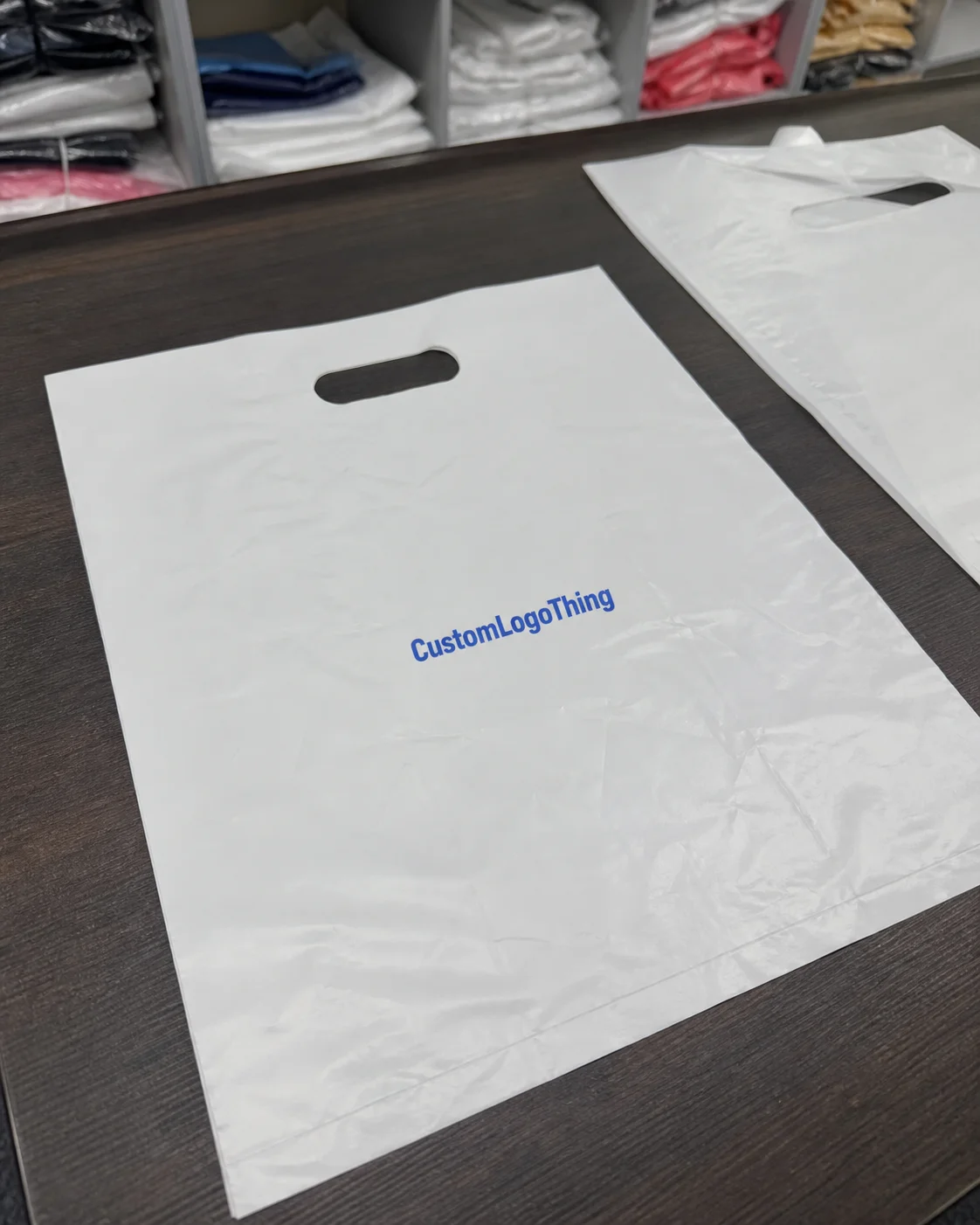
Die-Cut Handle Bags are simple, flat, and sharp enough for many retail counters. Patch handle bags add reinforcement around the hand hole. Soft loop handle bags feel more comfortable and often suit cosmetics, boutique apparel, and premium event merchandise. Drawstring bags work well for kits or reusable promo packaging. Poly mailers protect ecommerce shipments without the dimensional weight penalty of many boxes.
Material changes the feel. HDPE is crisper and often used at thinner gauges. LDPE feels softer and more flexible. Frosted film gives a more upscale, semi-private appearance. Clear film shows the product, which can help for organized kits but hurt privacy. Co-extruded mailer film improves opacity, so a black shirt or invoice does not show through the package.
Recycled-content poly and compostable options may be available, but the decision should be tested against strength, print quality, local disposal rules, and cost. Environmental claims need care. The U.S. Environmental Protection Agency provides guidance on sustainable materials management at epa.gov/smm, and buyers should match any claim to the actual material stream in their sales region.
Common mismatches are easy to spot after the damage is done. A boutique-style soft loop bag used for heavy catalog packs. A thin clear bag chosen for angular boxed products. A transparent mailer selected for products that require privacy. Better to catch those conflicts during specification review than after 5,000 units arrive.
Specifications Buyers Should Lock Before Requesting a Quote
A useful quote needs more than “medium bag with logo.” The core inputs are bag width, height, gusset, material, thickness, handle type, print colors, print coverage, finish, quantity, packing method, and delivery destination. Miss one, and the quote becomes a guess dressed as a number.
Size is the first trap. A folded T-shirt may sit nicely in a 10-inch by 13-inch merchandise bag. A shoebox may need a wider base, a side gusset, and enough headroom for staff to pack without fighting the opening. A bag that looks roomy while flat can lose usable space once the gusset expands around a rectangular product.
Thickness is usually discussed in mils or microns. Light merchandise may work in thinner film, especially for short carry distances. Heavier goods need higher gauge, stronger seals, reinforced handles, or a different bag style. For reference, a 2.0 mil LDPE bag feels substantially different from a 3.0 mil LDPE bag in hand, even before load testing.
Print placement also deserves scrutiny. Handle cutouts, side gussets, bottom folds, seams, and edge clearances all affect how artwork lands on the finished piece. A logo that looks centered on a flat dieline can appear too low once the bag is filled. Large ink fields can change flexibility and may reveal scuffing faster than a smaller one-color mark.
Color matching is controllable, not magical. Pantone references help align package branding, but exact appearance can shift based on film color, opacity, ink laydown, and whether the bag is viewed under store LEDs or outdoor light. White ink underbases may be needed for strong color on clear or dark film.
One practical data point improves the whole conversation: expected load weight. Give it in pounds or kilograms. “Two hoodies and a receipt” is less precise than “up to 6 lb with bulky fabric.” Buyers who Order Custom Plastic bags with load expectations help production recommend a structure before problems appear at checkout.
- Dimensions: width, height, bottom gusset, side gusset, or lip size for mailers.
- Material: LDPE, HDPE, frosted film, recycled-content poly, clear film, or co-extruded mailer film.
- Thickness: mil or micron target tied to weight, product shape, and carry distance.
- Print: number of colors, Pantone references, coverage area, logo position, and finish expectations.
- Logistics: quantity tiers, carton labeling, delivery ZIP code, deadline, and split-ship needs.
Pricing, MOQ, and Unit Cost: What Changes the Number
Custom plastic bag pricing is driven by quantity, material, film thickness, bag dimensions, print method, ink colors, print coverage, handle style, packing, and freight. A buyer may see two bags that look nearly identical online, yet one carries a higher unit cost because it uses thicker film, a reinforced handle, two-sided print, or a lower production quantity.
Minimum order quantities exist for a reason. Film setup, plate or screen preparation, press changeover, ink mixing, proofing, converting, and packing labor all have to be spread across enough units to make production efficient. The first few thousand bags carry the heaviest setup burden. Larger runs usually lower the per-bag price, but they increase total cash outlay and storage requirements.
For a simple one-color retail bag, a buyer might see a meaningful unit cost drop between 2,500, 5,000, and 10,000 pieces. A more complex soft loop handle bag with two-sided print, thicker film, and carton labeling may need a higher starting quantity before the economics make sense. This depends on the exact specification, not a universal price chart.
Cost adders are often hiding in plain sight. Metallic inks. Full-bleed coverage. Special finishes. Recycled-content material. Rush production. Split shipments. Custom carton marks. Inner bundling. Tight color tolerances. None of these are automatically wrong, but each should earn its place.
| Cost driver | Why it changes price | Buyer control point |
|---|---|---|
| Film thickness | More resin per bag and often slower converting for heavier structures. | Match gauge to load weight instead of guessing high or low. |
| Print colors | Additional screens, plates, setup time, and registration checks. | Ask if one strong brand color can do the job. |
| Print coverage | More ink, more drying control, and greater risk of scuff visibility. | Compare full coverage against a centered logo or repeat pattern. |
| Handle style | Patch and soft loop handles add material and converting steps. | Use reinforcement only where load or customer experience justifies it. |
| Freight | Carton count, destination, shipping speed, and split delivery affect landed cost. | Quote delivered pricing, not only ex-works or product-only pricing. |
The best purchasing move is to request two or three quantity tiers. Ask for 2,500, 5,000, and 10,000 pieces if those volumes fit your storage and usage rate. That shows the cost curve. It also prevents the common mistake of treating the first unit price as the only possible number.
Custom Logo Things should help buyers avoid over-specifying where it adds cost without improving strength, shelf appeal, or customer experience. Sometimes a thicker film is smart. Sometimes a better handle is smarter. Sometimes the cheapest improvement is a corrected size.
Artwork, Proofing, and Production Timeline From File to Delivery
The production path has a sequence: quote request, specification review, artwork check, digital proof, approval, material preparation, printing, converting, quality control, packing, and shipping. Skip clarity early and the schedule pays for it later.
Before production starts, artwork may need vector conversion, color separation, bleed adjustment, logo cleanup, or confirmation that fine lines will print cleanly on film. A 0.25-point line that looks elegant on a PDF may break up on flexible plastic. Tiny reversed text can fill in. Large gradients may not reproduce the way they do on a screen.
Standard lead time depends on product type, quantity, print complexity, material availability, proof approval speed, and freight distance. Many custom packaging projects are planned in business days from proof approval, not from the first inquiry. That difference catches buyers. An inquiry on Monday does not protect a Friday event if artwork remains unresolved until Wednesday afternoon.
Buyers control more speed than they think. Complete vector artwork, Pantone references, final dimensions, a clean shipping address, and fast proof feedback can remove days from the process. Changing the bag size after the proof, by contrast, may trigger a new layout and revised pricing.
Trade shows, seasonal retail pushes, product launches, and multi-location rollouts need extra planning. One late carton can disrupt an entire campaign if stores are scheduled to open kits on the same morning. For larger rollouts, ask whether carton labeling, pallet configuration, or split shipments should be built into the quote from the beginning.
If shipping performance matters, testing standards can be relevant. The International Safe Transit Association publishes package testing protocols at ista.org. Not every plastic bag order needs formal ISTA testing, but the principle is useful: packaging should be judged by the handling conditions it will actually face.
Quality Checks That Prevent Weak Handles, Bad Ink, and Waste
Quality control matters because a bag failure happens in public. The customer is not inspecting resin grades. They are standing near a checkout counter with your logo visible while the handle stretches, the seal splits, or the print smears onto another item.
Inspection points should include film thickness, seal strength, handle reinforcement, print registration, ink adhesion, color consistency, carton count, and random load testing where appropriate. For heavier retail loads, a simple hang or carry test can reveal weaknesses before the full order is used in stores.
Ink adhesion is a real performance issue on plastic film. The ink must bond well enough to survive rubbing against clothing, countertops, car seats, and other packaged goods. High-contact environments need more caution than a bag used once for a lightweight event brochure.
Sustainability belongs in the same practical conversation, not in a separate slogan box. Recycled-content or recyclable plastic bags may support brand goals, but availability, strength, appearance, cost, and local disposal realities vary. Some jurisdictions restrict plastic bag thickness, fees, recycled content, or use cases. Buyers should confirm rules in every sales region before placing a large order.
Standards help create a shared language. ASTM methods are often used across plastics and packaging tests, while FSC applies to fiber-based packaging rather than plastic; it may matter if the same campaign also uses paper inserts, sleeves, or cartons. For mixed product packaging programs, keep claims separate and accurate.
Honestly, I think this is where many bag projects go wrong: the buyer treats the bag like a logo surface instead of a small load-bearing package. Custom Logo Things can ask the investigative questions before printing. What is the heaviest order? How far will customers carry it? Does the product have corners? Will bags sit in a hot vehicle? Catching a weak specification on paper is cheaper than discovering it in a store aisle.
Next Steps: Build a Quote-Ready Bag Brief
A quote-ready brief does not need to be complicated. It needs to be specific. Choose the bag style, estimate load weight, measure the product, select a material preference, choose quantity tiers, define print colors, and set the required delivery date.
- Choose a target bag format: die-cut, patch handle, soft loop, mailer, drawstring, frosted, clear, or resealable.
- Measure the product or current bag: width, height, depth, gusset, and any bulky corners.
- Estimate the maximum packed weight, not just the average order.
- Prepare logo files in vector format if available, plus Pantone colors and placement notes.
- Request quantity tiers that match realistic usage, storage space, and campaign timing.
- Provide the shipping ZIP code, event date, launch date, or required delivery window.
Photos help. Physical samples help more. A photo can show the shape of a competitor bag, but it cannot prove film feel, seal strength, handle comfort, or how the bag behaves with a boxed product inside. If performance matters, send a sample or describe the current failure point: tearing at the die-cut, weak bottom seal, poor opacity, or ink rub.
Buyers should also ask for recommendations, not only a price match. A cheaper bag with the wrong gauge or handle may raise replacement costs, customer complaints, or reprint risk. A slightly better structure can be the lower-cost decision once labor, waste, and brand perception are counted.
Custom Logo Things can connect bag specifications with broader branded packaging needs, including related programs through Wholesale Programs and common purchasing questions in the FAQ. That matters for brands buying plastic bags alongside labels, inserts, mailers, or other packaging design elements.
When buyers Order Custom Plastic Bags with exact specs, realistic quantities, and approved artwork, the quote is faster and the finished product is more predictable. Contact Custom Logo Things with a quote-ready brief to compare materials, MOQ options, production timing, and delivered pricing before placing the order.
FAQ
What information do I need to order custom plastic bags?
Provide bag size, style, material preference, thickness, quantity, print colors, artwork files, delivery location, and deadline. If you are unsure on specs, share product dimensions, expected weight, and use case so the team can recommend a suitable bag.
What is the typical MOQ for custom printed plastic bags?
MOQ depends on bag type, material, print method, and factory setup requirements. Higher quantities usually reduce unit cost, so ask for multiple price breaks before choosing the order size.
How much do custom plastic bags cost per unit?
Unit cost is affected by size, thickness, material, handle style, print colors, coverage, order quantity, and freight. The best comparison is the same specification priced at several quantity tiers.
How long does production take for custom plastic shopping bags?
Lead time varies by product, quantity, artwork readiness, proof approval, material availability, and shipping distance. Production usually begins after final proof approval, so quick artwork feedback helps protect the schedule.
Can I order custom plastic bags with recycled or eco-friendly materials?
Recycled-content, recyclable, or alternative-film options may be available depending on bag style and performance needs. Buyers should confirm strength, appearance, cost, MOQ, and local packaging rules before selecting an environmental claim.