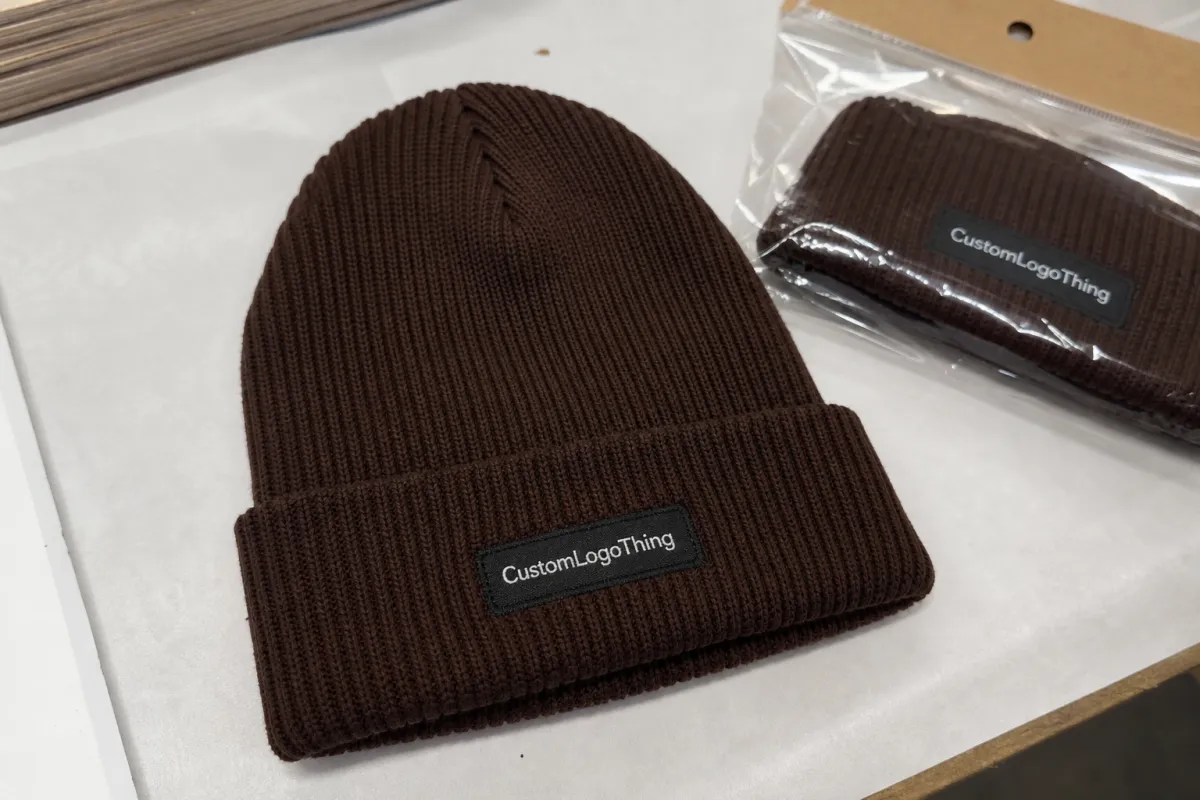
Chocolate ribbed winter beanies Bulk Order Planning looks easy until the spec has to survive real use. The color has to read cleanly in winter light, the rib knit has to stretch without bagging out, and the decoration has to stay legible on a moving surface. If one of those pieces is vague, the order can still ship but miss the buyer's actual goal.
Chocolate works well in bulk because it sits between utility and polish. It feels more elevated than black in some programs, warmer than charcoal in gift sets, and less trend-sensitive than seasonal fashion colors. It also hides handling marks better than lighter shades, which matters once cartons move through warehouses, offices, and retail stock rooms.
That makes the style useful for staff uniforms, campus drops, holiday kits, and retail basics. One color can serve several audiences without forcing separate inventory paths, which helps reduce dead stock and keeps reorders simpler.
Chocolate Ribbed Winter Beanies Bulk Order Planning
The first planning question is not whether a ribbed beanie works. It does. The real question is whether the version you are buying matches the use case. A 250-piece employee order, a giveaway run, and a retail assortment all tolerate different trade-offs.
Start with three filters: who will wear it, how visible the branding must be, and how much quality the budget can support. Many orders begin with the logo file, but the end use should come first because it drives fit, decoration, and pricing.
For team wear, prioritize broad fit, shape retention, and warmth. For giveaways, unit cost and a simple decoration method usually matter most. For resale, hand feel, stitch consistency, and packaging become more important because the product is being compared against other retail goods, not just a blank promo item.
Useful buyer lens: if the hat is for outdoor work, prioritize cuff stability and low-friction decoration. If it is for a gift or shelf program, prioritize appearance under display lighting and repeatable color matching.
- Best uses: staff uniforms, school and campus programs, winter events, retail basics, and holiday gifting.
- Main risks: overpaying for decoration, under-specifying yarn, or approving a logo that is too small for ribbed knit.
- Best planning habit: lock the core spec before asking for final pricing.
Most weak beanie orders do not fail because of the hat itself. They fail when the buyer trims the one detail that gives the product its value.
Fit, Yarn, and Rib Structure Buyers Should Compare
Ribbed knit is popular because it stretches naturally and recovers better than flat knit. That makes it forgiving across mixed head sizes, which is exactly what bulk buyers need when they are not collecting individual measurements. Fit still matters, but the usual problems are crown depth, cuff height, and yarn choice.
Acrylic is the standard budget material. It is predictable, easy to source, and usually the fastest route to a stable quote. Wool blends cost more and usually feel better in colder markets, but they raise the price and may require clearer care instructions. Recycled yarns are useful when sustainability claims matter, but they should be judged on finish and consistency, not the label alone.
Rib structure changes the visual result. Tight ribs look cleaner and more retail-ready. Wider ribs feel looser and more casual, but they can distort embroidery and make small logos less crisp. A mockup can look fine while the finished hat looks different once the knit starts moving under the needle.
Cuff height deserves more attention than it usually gets. A deeper cuff creates a stronger branding area and more warmth over the ears. A shorter cuff looks cleaner and slightly more modern, but it gives less room for decoration. Crown depth and overall slouch matter too. Too much height can look trendy in a sample photo and awkward in actual wear. Too little can look unfinished.
A useful spec sheet should answer the practical questions before pricing starts:
- What is the yarn content, and is it single-layer or double-layer construction?
- What gauge or stitch density is being used?
- How tall is the cuff, and how much branding space does it create?
- Does the rib stay tight enough to keep embroidery clean?
- Is the fit intended for retail, staff use, or giveaway distribution?
If those answers are vague, the quote is only a rough estimate, not a final spec.
Decoration Specs That Change the Final Proof
Decoration is where the order becomes specific. Rib knit is not a flat canvas, and that changes what works well. Thin lines, tiny text, and tightly packed symbols often lose clarity once they are transferred from screen to stitch.
Embroidery is still the most common choice because it is durable and familiar. It works well on the cuff when the logo has solid shapes and moderate detail. Woven patches are better when the design is too intricate for direct stitch work or when sharper edges are needed. Woven labels fit understated branding, while silicone badges make the product feel closer to a fashion accessory than a standard promotional item.
Placement affects both look and cost. Front cuff placement gives the strongest visibility and usually the simplest approval path. Side placement softens the promotional feel, which can help retail or lifestyle programs. Fold-over edge branding is tidy, but it reduces usable area if the logo is wide. A good supplier should flag those trade-offs before proof approval.
Color matching matters more on chocolate than many buyers expect. Brown yarn can shift how adjacent brand colors read. Reds may look warmer, some blues deepen, and blacks can disappear faster than they do on lighter bases. That is normal, but it is best checked with thread cards, swatches, or a pre-production sample rather than discovered after the bulk run.
Practical rule: choose the decoration that stays readable after the fabric stretches, the hat is worn, and the garment is folded into shipping cartons. Fancy is optional. Legibility is not.
Small text and fine-line logos are where knit orders often fail. If the artwork needs perfect stillness to look good, it is not a good beanie design.
Cost, MOQ, and Quote Variables That Matter
Unit price is shaped by more than the base material. Yarn type, stitch complexity, decoration method, packaging, labeling, and order quantity all affect the final number. Buyers often focus on the hat body first and then get surprised when a custom hangtag, insert, or polybag adds more cost than expected.
MOQ works the same way. Lower minimums usually carry higher per-piece prices because setup costs are spread across fewer units. Larger runs often lower unit cost, but only if the inventory can actually be used. Ordering 1,000 hats because the price looks better than 250 can create storage and cash-flow problems that erase the savings.
| Option | Typical Unit Price | Best For | Watch-Out |
|---|---|---|---|
| Blank acrylic ribbed beanie | $2.60-$4.20 at 250 units | Fast giveaways and simple staff use | Least branding impact |
| Embroidered cuff beanie | $3.80-$6.50 at 250 units | Team orders and basic resale programs | Fine text can distort on rib knit |
| Wool-blend beanie with patch | $5.90-$8.90 at 250 units | Premium retail and gift sets | Higher cost and longer approval cycle |
| Recycled yarn with custom packaging | $4.80-$7.60 at 250 units | Sustainability-led programs | Packaging add-ons can move the quote quickly |
Those ranges are planning numbers, not fixed rules. They help a buyer decide whether 100, 250, 500, or 1,000 pieces makes sense. The real question is which tier fits the demand, the timeline, and the margin the program actually needs.
Late changes cost more. If the supplier priced a standard hat and the buyer later adds custom labels, upgraded packaging, or a second decoration location, the revised quote will rise. That is not a trick. It is production math.
For retail or resale programs, it is usually smarter to spend more on the part people touch than on packaging that never survives the first use. Better knit, cleaner embroidery, and steadier cuff structure do more for sell-through than a box that gets thrown away.
Ask for tiered pricing at realistic quantity breaks. If the quote gives one flat number for every volume, the supplier has not really helped you plan.
Production Timeline and Lead Time Milestones
A workable timeline is one of the most important parts of the order, and it should be written down before approval. The chain is simple: artwork review, proof approval, sample signoff if needed, production, quality check, and shipping. The risk is drift. Once the steps get fuzzy, the deadline usually does too.
Simple orders can move quickly if the base material is in stock and the decoration is standard. More custom builds take longer. Multiple logo locations, mixed packaging, recycled yarn requests, and special labeling all add time before the main production run starts.
For planning, a realistic range is often 10-15 business days after final proof approval for simpler runs and 15-25 business days for more involved orders. That is only the production window. Shipping comes on top of that. Domestic transit may be quick, while international freight can extend the total timeline and customs delays can stretch it further if paperwork is incomplete.
Approval speed is a hidden variable. A factory can only move as quickly as the slowest sign-off in the chain. If a proof sits for four days, the schedule shifts. During peak winter buying, that can be the difference between launching on time and missing the season entirely.
If the beanies will be distributed through warehouses or multiple stops, packaging performance matters too. Cartons that look fine on a pallet may fail once they are transferred, stacked, or re-handled several times. For reference, ISTA guidance is useful when judging how much shipping abuse a packed order should survive.
Clean timeline planning beats urgent recovery every time. The most expensive order is often the one that is technically correct and still too late to matter.
What Reliable Suppliers Do Better on Reorders
A decent supplier can fill an order. A reliable supplier can repeat it without turning it into a new project. That difference shows up in color stability, fit consistency, proof accuracy, and the ability to carry forward the same spec without rewriting everything.
Communication is the first test. Buyers need clear answers on stock, yarn availability, sample timing, and any production limits before the order is locked. A good response does not need to be long. It needs to be specific.
Quality control is the second test. Ribbed beanies should be checked for stitch tension, seam neatness, cuff symmetry, and logo placement before packing. A crooked patch or uneven embroidery may pass in a rushed promotional run, but it becomes obvious on repeat orders.
Reorder value is often quiet but important. If the first run was well spec'd, the second run should not require re-deciding the yarn, fit, or decoration method. The supplier should know what was approved and what tolerances are acceptable. That saves time and protects the program from drifting over the season.
For brands using paper inserts or hangtags, a simple sourcing check can matter. If environmental claims are part of the story, confirming FSC-certified paper through FSC is a straightforward way to keep the paper component consistent with the rest of the program.
- Consistent sizing: the stretch and cuff depth should remain close across runs.
- Repeatable color: the chocolate tone should come back close to the approved sample.
- Fast proofing: the supplier should mark changes clearly and reduce revision loops.
- Better QC: thread ends, patch placement, and seam lines should be checked before cartons close.
That is what separates a one-time vendor from a supplier that can support a recurring program.
Next Steps to Lock Sizes, Samples, and Ship Dates
Begin with three things: quantity, decoration, and deadline. Those inputs shape the first usable quote and show whether the order is straightforward or likely to need more setup. If the answer is vague at that stage, the final production run probably will be too.
Request a physical sample or at least a clear pre-production proof before approving the full run, especially when the logo includes small type, thin outlines, or more than one stitch color. A screen proof cannot show how the cuff sits, how the yarn feels, or how the chocolate shade changes under indoor light.
Packaging should be settled early as well. Ask whether the beanies will ship folded, bagged, labeled, or packed in sets. Presentation changes carton count and can affect unit cost. It also changes how much handling your team will need after the shipment lands.
If the order has multiple destinations, build in tolerance for small variations in packaging or tone. Decide what matters most before production starts. Exact logo placement, exact shade, exact fold, and exact carton presentation are not always equally important, and trying to make them all perfect can push the order into unnecessary cost.
For buyers comparing blanket programs, team kits, and merchandise drops, the Wholesale Programs page is a practical starting point for volume planning and product fit. The FAQ page covers common ordering bottlenecks without requiring a long back-and-forth.
Chocolate ribbed winter Beanies Bulk Order Planning works best when the spec is locked early, the sample is approved without drama, and shipping is booked before the winter rush starts compressing every lead time in sight.
Questions Buyers Ask
How do I plan chocolate ribbed winter beanies bulk order quantities without overbuying?
Start with actual distribution numbers: staff count, event headcount, store demand, or a confirmed giveaway list. Add a small reserve for replacements and size preferences, not a large cushion that assumes every unit will move. Tiered pricing helps only when the extra quantity matches a real need.
What decoration works best for chocolate ribbed winter beanies in bulk?
Embroidery is the standard choice for simple logos with solid shapes because it is durable and familiar. Woven patches or woven labels work better when the rib texture would crowd the design or when the artwork has too much detail for direct stitch work. Thin text should be avoided unless the supplier confirms it will read clearly on knit.
What is a realistic MOQ for bulk chocolate ribbed beanie orders?
MOQ depends on the factory, the yarn, and the decoration method. Blank or standard-decor orders are usually more flexible, while fully custom builds often start higher. The safest approach is to compare MOQ with your actual sell-through or distribution plan before you commit.
How long does production usually take after artwork approval?
Simple orders often take about 10-15 business days after final proof approval. More custom programs can run 15-25 business days or longer, especially if sample approval, special packaging, or material sourcing adds steps. Shipping time should always be added on top.
Can I split colors, sizes, or packaging in one bulk beanie order?
Sometimes, but every split can affect setup, MOQ, and unit cost. Mixed packaging or multiple presentation styles should be confirmed in the first quote, not after approval. If flexibility matters, ask for the split structure up front so the pricing is accurate.
If the spec stays tight and the timeline stays honest, the order stays predictable, repeatable, and much easier to move through production without avoidable surprises.