Buyer Fit Snapshot
| Best fit | CMYK Printed Eco Stickers Cost projects where brand print, material claims, artwork control, MOQ, and repeat-order consistency need to be specified before quoting. |
|---|---|
| Quote inputs | Share finished size, material target, print colors, finish, packing count, annual reorder estimate, ship-to region, and any compliance wording. |
| Proofing check | Approve dieline scale, logo placement, barcode or warning zones, color tolerance, closure strength, and carton packing before bulk production. |
| Main risk | Vague material claims, crowded artwork, missing packing details, or unclear freight terms can make a low unit price expensive after revisions. |
Fast answer: CMYK Printed Eco Stickers Cost: Pricing, MOQ, and Specs should be specified like a repeatable production item. The safest quote records material, print method, finish, artwork proof, packing count, and reorder notes in one written spec.
Production checks before approval
Compare the actual filled-product size with the drawing, then confirm tolerance on folds, seals, hang holes, label areas, and retail display edges. Reserve space for logos, QR codes, warning copy, and material claims before decorative graphics fill the panel.
Quote comparison points
Review material grade, print process, finish, sampling route, tooling charges, carton quantity, and freight assumptions side by side. A quote is only useful when the supplier can repeat the same color, closure quality, and packing count on the next order.
CMYK Printed Eco Stickers Cost: Pricing, MOQ, and Specs
If you are pricing cmyk printed eco stickers cost for a launch, the first surprise is usually this: the eco label itself is rarely the big-ticket item. Size, quantity, adhesive, shape, and finish tend to move the number more than the word "eco" on the spec sheet. That is why buyers at Custom Logo Things usually get better budget control by starting with the use case, not the artwork file.
CMYK is often the most practical print route for branded stickers with gradients, full-color illustrations, product photos, or mixed brand palettes. It keeps setup sane, especially for digital printing on shorter runs. Offset printing or flexographic printing can make sense later if the order gets bigger and the format stays locked. The point is simple: match the build to the job, and the cmyk printed eco stickers cost question turns into planning instead of guesswork.
Recycled facestocks, kraft papers, FSC-oriented papers, and other sustainability-minded options can still land at competitive prices when the order is built well. The quote usually reflects labor, finishing, and waste more than whether the stock carries an eco label. If you want a clean comparison, keep the discussion anchored to quantity, size, and application. That is where the real money lives, and where the cmyk printed eco stickers cost conversation gets useful.
Why cmyk printed eco stickers cost less than they seem
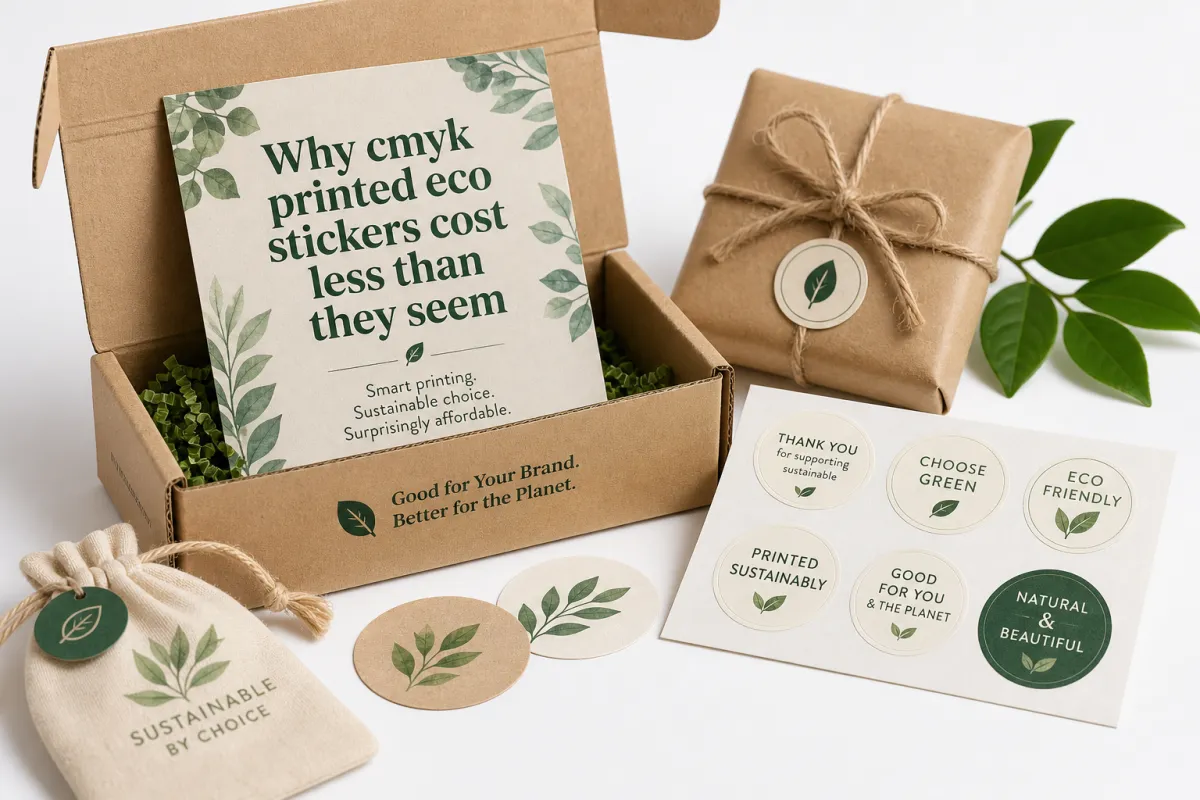
A lot of buyers hear "eco stickers" and assume the price automatically climbs. Sometimes it does. Not always. The honest answer is that cmyk printed eco stickers cost less than people expect when the order uses a standard shape, a sensible quantity, and a print method that fits the art. A clean 2 x 2 inch sticker on a paper-based facestock can be much cheaper than a complicated die line with heavy ink coverage and a specialty finish. Fancy does not always mean smart.
CMYK helps because it handles multiple colors in one pass. If the design includes gradients, shadows, tiny type, or photo-like detail, CMYK usually avoids the extra setup that spot color work can bring. Spot color still matters for strict brand matches on simple logos, but many buyers do not need that level of control. For a mixed-color logo or a graphic with a soft fade, CMYK usually gives the best balance between look and unit cost. That is one reason cmyk printed eco stickers cost can stay reasonable even when the art looks rich and detailed.
From a packaging buyer's angle, the sticker should do one job well, not five jobs badly. A recycled paper sticker for hand application on a retail jar does not need the same structure as a freezer label on a cold-chain carton. Neither one needs the same finish as a shipping seal. When the material and adhesive match the surface, the cmyk printed eco stickers cost line usually improves because there is less risk of rework, rejection, or over-specifying the build.
Pricing can also feel lighter than expected because sustainable facestocks are not rare unicorns. Kraft paper, recycled white paper, and FSC-certified stocks are common in roll, sheet, and kiss-cut formats. There is enough volume in the market that they do not automatically push the quote into premium territory. The trick is choosing a production format that respects the material. Ask for a tiny quantity with a custom cut and special packing, and the quote jumps. Order in a cleaner production tier, and cmyk printed eco stickers cost can land in a very usable range.
The cheapest sticker is not the one with the lowest printed price alone. It is the one that sticks properly, looks right, and does not trigger a reprint two weeks later.
That is the real buying lens. A quote should be judged by value, not by the first number on the page. The best cmyk printed eco stickers cost is the one that fits the run, the surface, and the timeline without extra drama.
CMYK printed eco stickers cost: choosing the right build
The build choice is where the numbers start moving. A buyer may ask for "eco stickers," but that phrase covers several constructions, and each one changes cmyk printed eco stickers cost in a different way. Paper-based labels, recycled stocks, FSC-certified facestocks, removable adhesives, and stronger permanent adhesives all behave differently once they move from a proof to a production run.
For most branded work, CMYK is the right print method when the artwork has more than one or two solid colors. If the logo is simple and the brand book allows it, spot color can sometimes reduce ink complexity, especially on large repeat jobs. For a design with gradients, a full-color illustration, or multiple product variants, CMYK is usually the cleaner route. It keeps the quote easier to read and often lowers the practical barrier to ordering, which is why cmyk printed eco stickers cost often compares well against more specialized methods.
Digital printing is usually the natural fit for small to medium quantities because it cuts setup time and handles short runs well. Offset printing can become efficient once the order grows and the artwork stays stable across larger sheets. Flexographic printing is often used on roll labels and higher-volume repeat orders where throughput matters. None of these methods is "better" in every case. They solve different production problems. The right one depends on quantity, format, and the finish needed, and that decision feeds directly into cmyk printed eco stickers cost.
Shape and format matter just as much. Kiss-cut singles are easy to hand out and work well for inserts, but they bring different labor than sheeted stickers or roll labels. Sheet format can reduce packing time for smaller orders, while rolls usually make machine application or high-volume hand application more efficient. Custom die shapes are useful for brand recognition, yet they bring setup considerations that can raise the quote. If the sticker will live on a pouch, candle jar, mailer, or bottle, the best build is not the flashiest one; it is the one that matches the use and keeps cmyk printed eco stickers cost under control.
Application is the first question I would ask. A shipping seal needs different handling than a retail product label, and a label for a cool, humid warehouse is not the same as a label for dry shelf display. The adhesive needs to match the surface, the storage condition, and whether the labels are hand-applied or machine-applied. That is why the most accurate estimate for cmyk printed eco stickers cost starts with what the sticker has to do once it leaves the press.
Specifications that affect cmyk printed eco stickers cost
Specs are where a small tweak can move the quote more than expected. Width, height, die complexity, number of designs, ink coverage, and the quantity tier all influence cmyk printed eco stickers cost. A standard square or circle usually prints more efficiently than a silhouette with tight corners and tiny cut-ins. One design across 5,000 pieces tends to be cheaper per unit than three versions split across the same total count, because every extra version creates another setup path.
Ink coverage matters too. A light logo on a natural kraft stock is usually less demanding than a full-bleed background with rich blacks and layered detail. That does not mean CMYK is too expensive for bold graphics. It just means coverage affects ink usage and press time. Buyers comparing cmyk printed eco stickers cost should ask whether the artwork can keep its look with a slightly lighter background or a smaller print area. Those changes often preserve the design while improving the unit price.
Finish is another major variable. Uncoated paper gives a soft, matte feel and fits a natural look. A matte varnish or protective coating can improve scuff resistance. A soft-touch-style lamination creates a distinct tactile effect, though it may not be the best choice if the buyer wants the simplest eco story. The same goes for high-gloss finishes: they can make color pop, but they add cost and may change recyclability expectations. Each finish shifts cmyk printed eco stickers cost a little differently, so the best choice is the one that serves the product instead of dressing up the quote.
Adhesive selection deserves equal attention. Permanent adhesive is common for product branding and shipping seals. Removable adhesive suits temporary promotions, event packs, or surface-sensitive applications. Freezer-safe adhesive can be important for chilled logistics. High-tack adhesive helps on textured cartons or curved containers where grip matters. The wrong adhesive can create the most expensive outcome of all: a reprint. That is why a careful review of the surface, temperature range, and dwell time belongs in any serious cmyk printed eco stickers cost discussion.
Proofing and setup also enter the picture. Digital proofs usually confirm the layout, size, and cut line. For brand-critical work, especially if the print is color sensitive, an extra check may be needed before production starts. Some builds may also involve die charges or setup fees, especially when the shape is custom. Those are not hidden costs. They are part of the production path. The clearer the files are prepared, the more predictable cmyk printed eco stickers cost becomes.
If the order uses FSC-certified paper, that can help with sustainability claims and purchasing records. For buyers who need a more formal sustainability reference, FSC has a clear certification framework at fsc.org. That does not make every sticker automatically recyclable or compostable, but it gives procurement teams a better paper trail when they are comparing facestocks.
Table: common build choices and planning ranges
| Build | Best use | Typical MOQ | Planning unit cost | Notes |
|---|---|---|---|---|
| FSC paper, standard shape, CMYK, sheeted | Hand-applied retail stickers, inserts, small promotions | 250-500 pcs | $0.18-$0.45 each | Good for low-to-mid runs; simple shapes keep cmyk printed eco stickers cost under control. |
| Recycled facestock, custom die, matte finish | Product seals, jars, pouches, brand packs | 500-1,000 pcs | $0.10-$0.28 each | Better value at moderate volumes; a custom shape adds setup but can lift shelf appeal. |
| Roll labels, permanent adhesive, CMYK | Faster hand application, repeat SKUs, packaging lines | 1,000-2,500 pcs | $0.06-$0.18 each | Often the best path if you need efficiency and stable artwork across batches. |
| Specialty eco stock, protective coating, multiple artwork versions | Launch kits, multi-language packs, premium kits | 1,000+ pcs | $0.14-$0.40 each | More setup and more handling; useful, but not the leanest way to manage cmyk printed eco stickers cost. |
Those are planning ranges, not a final quote. A 1.5 inch circle and a 4 x 6 inch label live in different cost worlds even if they are both "eco stickers." Still, the table shows a useful pattern: once the format gets more production-friendly, cmyk printed eco stickers cost improves quickly, especially in roll or sheeted formats with stable artwork.
How cmyk printed eco stickers cost is calculated
The quote formula is straightforward, even if the inputs change. Material cost, print setup, finishing, quantity tier, packaging, and shipping all sit in the final number. That is why two orders with the same artwork can still land at very different prices. A simple recycled-paper circle at 5,000 pieces will not cost the same as a short run of custom-die seals with multiple versions and specialty packing. The math behind cmyk printed eco stickers cost is really the math of production efficiency.
Unit cost usually drops as quantity rises because the fixed work gets spread across more pieces. The first price break is often the one that matters most. Going from 250 pieces to 1,000 can move the per-unit figure more than going from 5,000 to 10,000, especially if the job keeps the same size and finish. Buyers sometimes focus on the absolute lowest unit price, but the better question is where the next break point sits. That is how experienced buyers manage cmyk printed eco stickers cost without overordering inventory they may never use.
Minimum order quantity, or MOQ, depends on the construction. Small digital jobs can often run low, but setup and finishing make very tiny quantities less efficient. If the order includes multiple designs, the effective MOQ for each version can rise, because each version behaves like its own mini job. A single SKU at 500 pieces is very different from five SKUs at 100 pieces each. The second version can still be done, but the per-piece result will usually be higher, and that shows up in cmyk printed eco stickers cost.
To make the pricing clearer, here is a practical way to think about it: standard shape plus standard size plus one design plus a common finish is the easiest route. Add a custom die, add a second artwork version, add a stronger finish, and add special packing, and the quote climbs in predictable steps. The trick is knowing which step actually matters to the buyer. If the sticker is going on a premium jar label, a better finish may be worth a few cents more. If it is only sealing an inner carton, those extra cents may not make sense. That judgment call sits at the center of cmyk printed eco stickers cost.
The same logic applies to packing format. Sheets can be efficient for small hand-applied orders. Rolls can lower handling time for larger volume or machine-assisted work. Stacked singles may be useful for inserts or event giveaways, but they can increase labor. Freight also matters. A lightweight sheeted order may ship cheaply, while a dense roll order can add transit weight. Good buyers ask for the quote to include the packing style up front, because it changes the real cmyk printed eco stickers cost, not just the manufacturing line.
Packaging standards can matter here too. If the labels will travel in secondary cartons, some teams like to reference handling confidence with resources from the ISTA community, especially when transit damage or moisture exposure is a concern. That does not replace common sense, but it does help when the sticker order is part of a larger packaging system. A label that arrives intact and usable is part of the cost story.
One more practical point: if your quote seems unusually low, check what is not included. Sometimes the number excludes freight, setup, or proof revisions. Sometimes it assumes a standard adhesive instead of a specialty one. A clean quote should tell you exactly what is in the total, because transparency keeps cmyk printed eco stickers cost from turning into a moving target.
Process, proofs, and timeline for eco sticker orders
The order path should stay simple, and the best suppliers keep it that way. First comes the spec review: size, shape, quantity, substrate, adhesive, finish, and delivery format. Then comes file checking, proof creation, approval, production, quality control, and shipment. Each step protects cmyk printed eco stickers cost from drifting because of avoidable rework. A clear file on day one is usually cheaper than a rushed fix on day three.
Most delays start with the same handful of issues. The dieline is missing or unclear. The artwork is low resolution. The final dimensions are still under discussion. Color expectations are not defined. The adhesive requirement is assumed rather than stated. None of those problems are unusual, and none are fatal, but they all add time. If the buyer wants the quote to stay on schedule, the easiest move is to send a finished size, a proper art file, and the intended use together. That improves turnaround and cmyk printed eco stickers cost because the proof cycle gets shorter.
Digital proofs are the normal first checkpoint. They confirm placement, cut line, and copy. If the job is color-sensitive, a second round of review may be worth it, especially on brand-critical packaging where the sticker sits beside cartons, jars, or pouches produced elsewhere. A proof cannot show every nuance of press behavior, but it can catch the expensive mistakes before production starts. That is one of the least glamorous ways to protect cmyk printed eco stickers cost, and one of the most effective.
Lead time depends on how custom the job is. A repeat order with the same stock, same size, and same artwork usually moves faster than a first-time order with a new die shape and several artwork variants. Simple runs may fit into a shorter production window, while more involved jobs need more time for setup and finishing. Shipping time should be planned separately from production time, especially if the stickers are tied to a launch date, trade show, store opening, or fulfillment deadline. A quote is only useful if the timeline matches the launch window, not just the production line.
There is a practical side to proofing that people skip because it feels tedious. Check the tiny stuff. Barcode quiet zones. Pantone expectations if you are matching surrounding packaging. Die cut clearance around thin lines. Copy that may become unreadable once scaled down. It is boring work, but boring is good here. Boring is cheaper. And yes, that sounds like a sentence I would print on a sticky note and keep on my desk.
For buyers juggling multiple SKUs, I usually recommend building the proof workflow around the most complicated variant first. If that version passes, the simpler ones are far less likely to cause trouble. It is a small planning step, but it can save a round of revisions and keep cmyk printed eco stickers cost from creeping up due to avoidable changes.
Why choose us for cmyk printed eco stickers cost planning
The best supplier is not the one that says yes to everything. It is the one that tells you where the quote can be trimmed without wrecking the product. That matters a lot with cmyk printed eco stickers cost, because buyers often start with a design wish list and only later discover which details are actually worth paying for. A good production partner should help sort the nice-to-haves from the must-haves.
At Custom Logo Things, the planning conversation starts with the end use. Retail packaging, inserts, mailers, event giveaways, and machine-applied labels do not need the same build. That sounds obvious. It still gets missed all the time. Our job is to connect the material, adhesive, format, and print method to the real application so the quote reflects what the sticker has to survive, not just what it looks like in a mockup.
We also keep an eye on honest tradeoffs. A kraft paper sticker may fit the brand story beautifully, but a coated stock may be the better choice if the labels will be handled a lot. A removable adhesive can save a display table, but it is a bad idea if the label has to stay put through shipping and refrigeration. The right answer is not always the prettiest one. It is the one that works. That approach keeps cmyk printed eco stickers cost tied to actual performance instead of wishful thinking.
And because no quote exists in a vacuum, we call out the parts that can surprise buyers: die charges, proof revisions, special packing, and freight. Nobody likes surprise math. We do not either. A clean estimate makes it easier to compare options, and it lowers the chance that a "cheap" order turns expensive later.
That is the kind of experience buyers usually want and rarely get in one pass. Not magic. Just fewer headaches.
Next steps for a fast, accurate quote
If you want the most reliable cmyk printed eco stickers cost estimate, send the basics together: finished size, quantity, shape, artwork version count, stock preference, adhesive type, finish preference, and whether the labels will be sheeted, rolled, or kiss-cut. If you already know the application surface, include that too. Paperboard, glass, coated cartons, textured kraft, chilled packaging, and plastic all behave differently. That one detail can save a round of back-and-forth.
If the design is still in progress, send the current version anyway. A rough starting point is better than a blank request and usually gives the printer enough context to flag problems early. I have seen too many quotes stall because the buyer waited for perfection before asking for pricing. That is kind of backwards. The quote often helps shape the final spec.
For teams comparing options, the most useful internal question is not "What is the cheapest sticker?" It is "What sticker does the job cleanly with the least waste?" That frames the order around function, not ego. And that is usually where the best cmyk printed eco stickers cost lands.
Actionable takeaway: pick one finished size, one adhesive, one finish, and one production format before requesting pricing, then compare that against any version-change or finish-upgrade options. If you tighten those four variables first, the quote gets clearer fast and the budget stops wobbling around like a shopping cart with one bad wheel.
Decision checklist before ordering
- Measure the real product and confirm how it will be packed, displayed, stored, and shipped.
- Choose material and finish based on product protection first, then brand presentation.
- Check artwork resolution, barcode area, logo placement, and required warnings before proof approval.
- Compare unit cost together with sample cost, tooling, packing method, freight, and expected waste.
- Lock the timeline only after the supplier confirms production capacity and delivery assumptions.
FAQ
Are eco stickers always more expensive?
No. Recycled paper, kraft facestocks, and FSC-certified options can be very competitive. The larger cost drivers are usually size, quantity, shape complexity, finish, adhesive, and packing format. A smart build often keeps cmyk printed eco stickers cost in a normal range.
Is CMYK the right choice for all eco stickers?
Not all of them, but it works well for most full-color artwork. If the design is a simple logo with one or two solid colors, spot color may be a better fit. If the art includes gradients, photos, or multiple tones, CMYK is usually the cleaner route for cmyk printed eco stickers cost and color flexibility.
What makes a quote jump the most?
Custom die shapes, multiple artwork versions, specialty finishes, small quantities, and unusual packing requests. Those are the usual suspects. If a quote feels high, ask which one of those is driving it. Usually there is a boring answer, and boring answers save money.
Are FSC paper stickers recyclable or compostable?
FSC certification only speaks to responsible forestry and supply-chain oversight. It does not automatically make a sticker recyclable or compostable. The adhesive, coating, and local recycling rules all matter. If sustainability claims are part of the brief, get specific instead of guessing.
What information should I send for a quote?
Finished size, quantity, shape, artwork file, substrate preference, adhesive, finish, packing format, and application surface. If there is a deadline, include that too. The more complete the brief, the tighter the cmyk printed eco stickers cost estimate.
Do rolls cost less than sheets?
Sometimes, but not always. Rolls can be more efficient for larger runs or machine-assisted application, while sheets can be the better call for smaller hand-applied orders. The cheaper format is the one that matches your workflow instead of fighting it.
Can I get a very small quantity?
Yes, especially with digital printing, but extremely low quantities often carry a higher per-piece price because setup work gets spread over fewer stickers. If you only need a sample batch, that may still be the right move. Just do not expect wholesale pricing on a dozen pieces. Printers are good, not psychic.
What is the safest way to keep costs down without wrecking the design?
Use a standard shape, keep the artwork to one design version, avoid unnecessary finishes, and Choose the Right adhesive for the surface. That usually gives the best balance of appearance and cmyk printed eco stickers cost. Small changes add up fast, so trim the extras before the quote trims your patience.

