Buyer Fit Snapshot
| Best fit | CMYK Printed Mailing Bags projects where brand print, material claims, artwork control, MOQ, and repeat-order consistency need to be specified before quoting. |
|---|---|
| Quote inputs | Share finished size, material target, print colors, finish, packing count, annual reorder estimate, ship-to region, and any compliance wording. |
| Proofing check | Approve dieline scale, logo placement, barcode or warning zones, color tolerance, closure strength, and carton packing before bulk production. |
| Main risk | Vague material claims, crowded artwork, missing packing details, or unclear freight terms can make a low unit price expensive after revisions. |
Fast answer: CMYK Printed Mailing Bags: Design, Cost, and Lead Time should be specified like a repeatable production item. The safest quote records material, print method, finish, artwork proof, packing count, and reorder notes in one written spec.
Production checks before approval
Compare the actual filled-product size with the drawing, then confirm tolerance on folds, seals, hang holes, label areas, and retail display edges. Reserve space for logos, QR codes, warning copy, and material claims before decorative graphics fill the panel.
Quote comparison points
Review material grade, print process, finish, sampling route, tooling charges, carton quantity, and freight assumptions side by side. A quote is only useful when the supplier can repeat the same color, closure quality, and packing count on the next order.
CMYK Printed Mailing Bags: Design, Cost, and Lead Time cmyk printed mailing bags are a smart move when a parcel needs to do more than just arrive. They protect the product, stay light in transit, and carry a branded surface that feels intentional rather than thrown together. For ecommerce teams that want a stronger presentation without moving up to a rigid box, cmyk printed mailing bags tend to land in a very practical middle ground.
They also solve a subtle branding problem. A customer often sees the mailing bag before they touch the product, so the outer pack becomes part of the first impression, not just the shipping layer. I have seen brands underestimate that moment and then end up reworking their packaging after launch because the plain mailer did nothing for the unboxing experience. A good printed bag can carry more brand signal than people expect, and it does it without adding much weight or storage hassle.
What cmyk printed mailing bags are and why they stand out
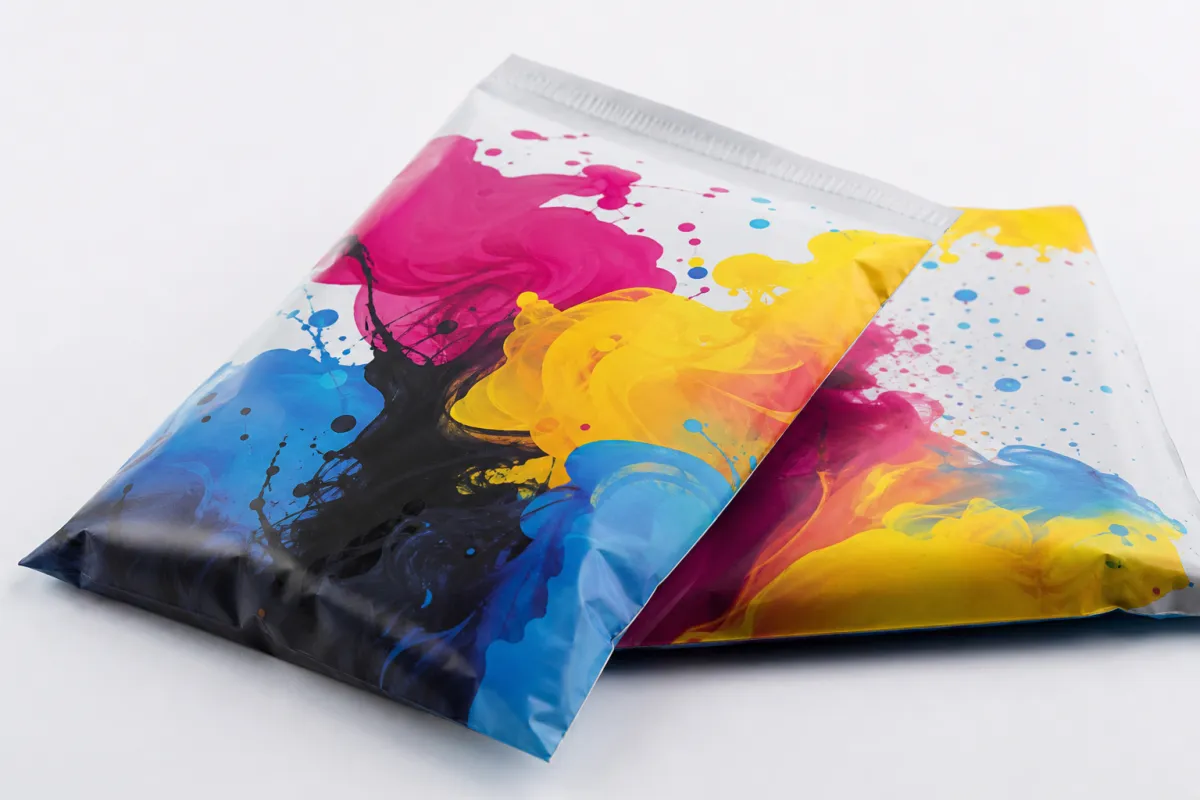
cmyk Printed Mailing Bags are poly mailers printed with four-color process artwork. Cyan, magenta, yellow, and black are layered to build logos, gradients, illustrations, promotional graphics, and image-heavy brand artwork. They are not the same thing as a plain shipping bag with a tiny logo in one corner. Think of them as a branded outer layer that still keeps the parcel efficient and lightweight.
For packaging buyers, that combination is the appeal. cmyk printed mailing bags let a brand create a visual moment without paying for box weight, box storage, or box assembly time. They suit apparel, beauty products, subscription kits, accessories, and seasonal campaigns where the outer pack plays a real role in the customer experience. If you already use Custom Poly Mailers, this is the more design-led version of that same idea.
They also work well for brands that care about the reveal before the product is even opened. A plain gray mailer says the order shipped. A carefully printed mailer says the brand thought through the whole journey. That difference lands faster than many teams expect, and it can change how polished the order feels right out of the gate. cmyk printed mailing bags can deliver that extra bit of attention without forcing every order into a heavier carton.
CMYK still needs respect. It reproduces a lot, though not everything with equal ease. Neon shades, deep dark backgrounds, and fine gradients take planning. Transparent artwork can disappear on tinted film. Skin tones and subtle brand colors can shift if the substrate, ink system, or proofing step is handled loosely. cmyk printed mailing bags can look crisp and rich, but they can also go dull fast if someone assumes screen color and print color are interchangeable. They are not, and the mismatch shows up quickly once production starts.
Different print methods solve different problems. Spot color is cleaner for simple marks and flat brand graphics. Flexographic printing is common for high-volume packaging with straightforward artwork. Digital printing is useful for smaller runs and artwork changes. Offset printing suits paperboard far better than plastic mailers. cmyk printed mailing bags belong in the lane where detail, color depth, and image quality matter more than a single ink hit.
For that reason, cmyk printed mailing bags make sense when the outer pack is part of the brand story. If the goal is only to place a logo on a shipping sleeve and move on, a simpler setup may be enough. The best option is the one that matches the product, the route, and the budget, not the one with the flashiest mockup.
There is a practical side too. A bag that looks a little more considered can reduce the feeling of “cheap shipping” even when the product itself is small or low profile. That matters in categories where repeat purchase depends on trust and presentation, because customers are reading the packaging as a signal of how the rest of the order was handled.
How cmyk printed mailing bags work in production
The process sounds simple until the artwork hits film. cmyk printed mailing bags are produced by separating the design into process colors and laying those inks down so the eye reads a full-color image. Done well, that method gives you gradients, shadows, and detailed branding that would be awkward or costly in a single spot-color setup.
The substrate has a larger effect than many buyers expect. cmyk printed mailing bags printed on a bright white outer film will hold color differently from the same artwork printed on gray recycled film or a glossy opaque black bag. Finish matters too. Gloss tends to make color feel brighter and exposes registration issues faster. Matte reduces glare and can feel more premium in hand, though it can soften the look of the artwork a bit. That comes from surface behavior, not mystery.
White ink or an underbase becomes important very quickly. Dark or tinted film can swallow the CMYK layers and leave the design looking weak. A white underlayer gives the print something clean to sit on. Without it, the common complaint is simple: the logo looks tired. cmyk printed mailing bags are especially sensitive to this because the artwork usually covers a large visible area instead of a tiny label.
Artwork prep shapes the result more than most teams realize. A printer usually wants vector logos, high-resolution images for photography, exact bleed, and a clear understanding of where seams, folds, and seals will land. A design that crosses a side gusset or sits too close to the closure can be chopped, stretched, or hidden once the bag is filled and sealed. That is not a print defect. It is a layout problem that should have been caught earlier.
cmyk printed mailing bags reward careful setup and punish guesswork. A proof that looks fine on a laptop can still fail under warehouse lights or when viewed on a phone camera. Real samples matter because they show what the bag will actually do in the physical world, not what it promises on a screen.
A print file is not the same thing as a finished bag. The file can be accurate and the bag can still disappoint if the film, ink, and artwork placement are not matched with care.
Packaging should be judged like a transit system, not just a design surface. The ISTA approach to package testing is helpful because it keeps the focus on handling, vibration, stacking, and drop events before the customer ever sees the artwork.
Key factors that affect cmyk printed mailing bags quality
The film is the first quality driver. cmyk printed mailing bags are usually made from LDPE or co-extruded film structures, sometimes with recycled content blended in. Standard ecommerce bags often sit around 60 to 100 microns, while heavier loads may call for thicker film. Thinner bags reduce weight and cost, though they scuff more easily and usually feel less substantial in hand.
Surface finish Shapes the Final appearance just as much. A smooth, bright film usually holds color better than a recycled-looking surface with more visible variation. Opaque film helps. Tinted film can demand a white base or a redesign. cmyk printed mailing bags are unforgiving when the substrate is wrong because the print area is large enough that weak choices show up right away. A tiny issue on a label can be ignored. The same flaw across a full mailer looks like a design decision nobody wanted.
Artwork scale matters too. Small text, thin rules, and crowded details may look clever in a PDF and fall apart on a shipped parcel. Once the bag is folded, sealed, and handled by a carrier, the image loses some precision. cmyk printed mailing bags look best when the layout has breathing room: a strong logo, clear contrast, and a pattern that can survive a few millimeters of movement without losing its shape.
The shipping job matters just as much as the brand layer. Soft apparel can often travel in a standard mailer. Items with edges, hardware, or sharper corners call for more puncture resistance and better seal performance. Buyers sometimes focus on color and forget the product can tear through the seam on the way to the customer. That kind of failure is hard to recover from, and the bag gets blamed even when the real problem was the spec.
For fragile or rough-route shipments, ask about transit testing and abuse testing. The aim is not to make a mailer indestructible; that would miss the point entirely. The aim is to match material strength, adhesive performance, and closure design to the actual journey. A reference like EPA recycling basics is also useful if you are discussing recycled content, material claims, or how the packaging will be described to customers.
cmyk printed mailing bags also sit inside a wider packaging system. If cartons, inserts, or swing tags are part of the order, those pieces may be the better place for heavier branding or paper-based sustainability claims. The mailer can stay simple while the rest of the pack carries more of the story. That usually puts budget in the right place and keeps the shipping component focused on doing its job.
- Material: LDPE or co-ex film, often 60-100 microns for standard use.
- Surface: Matte for softer glare, gloss for stronger pop.
- Artwork: Clear hierarchy, no tiny type, no seam conflicts.
- Performance: Check puncture resistance, seal strength, and moisture protection.
- Brand fit: Make sure the visual style matches the product price point.
Production steps, timeline, and lead time for cmyk printed mailing bags
Production usually starts with artwork review. Someone checks dimensions, bleed, safe area, seam positions, color setup, and whether the file can actually be printed without a cleanup cycle. A sloppy file slows the schedule before the machine even starts. That is why approval steps matter far more than many teams want to believe.
Once the artwork is clean, the supplier prepares the print setup. Depending on the line, that may mean digital printing for shorter runs or flexographic printing for larger orders. Digital printing gives more flexibility for revisions and lower minimums. Flexographic printing can be stronger for volume and repeat orders. cmyk printed mailing bags can be made through either path, but the setup changes the timing and the cost structure.
The real delay often happens before production begins. Buyers tend to blame the factory, yet the slowest part is usually the back-and-forth over artwork and approvals. Missing dielines, fuzzy logo files, unclear Pantone references, and last-minute design changes all eat time. One more tweak at the wrong moment can push the whole order back.
A realistic schedule for cmyk printed mailing bags often looks like 2 to 4 business days for artwork review and proofing, 5 to 10 business days for production on a straightforward run, and another 3 to 7 business days for packing and freight depending on the route. Add extra time for custom sizing, unusual finishes, recycled-material documentation, or a second proof. If a supplier promises a miracle timeline, the missing detail is usually in the fine print.
Simple stock-size bags with standard artwork move the fastest. Fully custom dimensions, complex gradients, and special finishing slow things down. cmyk printed mailing bags with heavy ink coverage may also need extra drying or inspection time, especially when the film and ink system are particular about handling. Planning backward from the launch date is safer than hoping the schedule behaves itself.
For launch planning, a buffer is usually smarter than optimism. If the campaign date is fixed, allow 10 to 15 business days after proof approval for production and inland shipping, then add more if the bags need to cross borders. That cushion is what keeps a team from paying emergency freight because someone approved artwork from a phone late at night. I have watched that happen, and it is never fun for the budget.
Cost, pricing, MOQ, and quote basics for cmyk printed mailing bags
Pricing for cmyk printed mailing bags comes down to a few plain variables that have a habit of mattering a lot: size, thickness, print coverage, order quantity, and whether the bag is stock or fully custom. The logo itself is rarely the main cost driver. Coverage is. A small one-color mark on a blank bag costs less than a full-wrap, image-heavy design with dense ink coverage and color adjustment.
Minimum order quantity changes the math very quickly. Lower MOQs usually cost more per unit because setup, waste, and machine time are spread across fewer bags. That is normal, not a trick. Small runs can land around $0.35-$0.75 per unit, while larger runs may move closer to $0.14-$0.32 depending on spec, coverage, and material choice. cmyk printed mailing bags with heavy coverage or recycled-content requirements often sit higher than plain stock bags, even before freight is added.
| Order type | Typical MOQ | Unit price signal | Lead time signal | Best fit |
|---|---|---|---|---|
| Stock-size mailer, light CMYK coverage | 1,000-3,000 pcs | $0.22-$0.38 | 10-15 business days after approval | Fast-moving ecommerce launches |
| Custom size, full-wrap artwork | 3,000-5,000 pcs | $0.28-$0.55 | 12-18 business days after approval | Brand-led campaigns and premium packaging |
| Heavier film or recycled-content spec | 5,000 pcs+ | $0.18-$0.40 | 12-20 business days after approval | Shipping performance and material-story focus |
| Small test run with extra proofing | 500-1,000 pcs | $0.35-$0.75 | 7-14 business days if stock is available | Artwork validation before a larger buy |
Quote comparison only works when the quotes describe the same thing. Unit price alone can hide shipping, sample fees, plate charges, or proofing costs in the fine print. Other quotes look expensive because they include freight up front. cmyk printed mailing bags are easy to quote once the specification is clear, but vague requirements create fake comparisons that waste time.
A solid quote request should list bag dimensions, film thickness, print coverage, number of colors in the artwork, MOQ, sampling cost, lead time, and freight terms. If the bag needs a matte finish, extra opacity, or a stronger seal, say so early. A slightly higher unit price can still be the better value if it lowers damage rates or cuts reprints. Cheap bags that fail in transit end up costing far more than they saved.
Budgeting for testing is part of the job. cmyk printed mailing bags with gradients, photographic imagery, or dark backgrounds often need more proofing than a simple logo bag. That is normal. Fixing color problems after production starts is not a design task; it is a costly correction, and nobody wants to explain that after thousands of units are already packed.
Common mistakes with cmyk printed mailing bags
Overdesign is the mistake that shows up first. cmyk printed mailing bags are not a flat poster, and they are not viewed in ideal conditions. They fold, crease, seal, and get handled by people who are not studying the artwork. Tiny text, thin rules, and crowded compositions often disappear once the bag is closed and shipped. A layout needs room to breathe if it is going to survive the trip.
Color assumptions are next. A screen mockup is a direction, not a guarantee. cmyk printed mailing bags almost always shift a little from what the designer sees on a monitor. That shift may be mild or embarrassing depending on the film color, print method, and proof quality. If the brand depends on a specific blue, ask for a printed sample or a controlled production proof before the main run begins.
Size errors are another common problem. A bag that is too small crushes the product and interrupts the artwork. A bag that is too large can feel loose, waste material, and look less refined than it should. The right dimension fits the item with enough margin for loading and sealing. cmyk printed mailing bags should support the shipment, not fight it.
Finish mismatch creates a different kind of disappointment. A premium-looking design printed on weak film usually looks worse than a simpler design printed on a stronger structure. Many buyers spend on graphics and cut corners on material. That is backwards. The bag is a shipping tool first, and a pretty print on a flimsy bag is just a prettier failure.
Deadline blindness may be the most expensive mistake of all. If the launch date is fixed, leave time for proof review, revisions, production, and freight. Rushing cmyk printed mailing bags often leads to air freight, overtime charges, or reprints. The budget gets hit in more than one place, and all of it is avoidable. A team can kinda talk itself into “just this once” until the invoice arrives.
- Avoid tiny text and thin strokes.
- Check the bag size against the actual packed item.
- Approve a printed proof, not just a PDF.
- Match the film quality to the shipping load.
- Leave time for one revision cycle.
Expert tips and next steps for cmyk printed mailing bags
Start with a strict artwork checklist. cmyk printed mailing bags need logo files in the right format, exact color references, bleed, safe zones, and a layout that avoids seams and seals. If the design team sends a screenshot and hopes for the best, the printer will spend time cleaning up problems that could have been caught in the first pass. That is not efficiency.
Ask for a real proof instead of relying on a polished PDF. A real proof shows how cmyk printed mailing bags look in daylight, under warehouse lighting, and in a phone photo. Those are the conditions that matter because they are the conditions the customer and fulfillment team will actually see. If the proof feels even a little off, fix it before production. Small issues at proof stage turn into loud problems at scale.
Choose the bag specification around the product first. The shipment has to survive the route before the branding gets any attention. Light apparel may only need standard film and a strong print. Heavier items or products with edges call for better material before anyone starts chasing fancy graphics. cmyk printed mailing bags should make the shipment stronger, not just prettier.
Use sampling strategically. A small test run can show whether gradients reproduce cleanly, whether dark backgrounds need a white underbase, and whether the size feels right in hand. That is a cheap lesson compared with 5,000 units of regret. Comparing a printed mailer with a simpler option like Custom Poly Mailers can also make the value of CMYK detail easier to judge.
My practical next step is simple: compare two quotes, confirm MOQ and lead time, approve one proof, and lock the artwork before production starts. If a supplier cannot explain unit price, setup cost, and the estimated transit window in plain language, keep asking until the answer is clear. cmyk printed mailing bags are a straightforward buy once the specification is nailed down. They only become expensive when the buyer improvises.
For brands making claims around recycled content, paper inserts, or broader sustainability messaging, keep the paperwork tidy and support every claim with documentation. cmyk printed mailing bags work best when the design, material, and logistics all point in the same direction. That is where the package starts to feel honest.
If you are building a launch pack, the strongest version is usually the one that keeps the artwork clean, the film honest, and the shipping setup boring. That is the point. cmyk printed mailing bags do not need theatrics. They need correct specs, a sensible timeline, and artwork that still makes sense after the bag has been folded, sealed, handled, and delivered.
The takeaway is simple: choose the film and print method first, then pressure-test the artwork against the real bag size before you place the order. If those three pieces line up, cmyk printed mailing bags can look polished, ship well, and avoid the kind of headaches that show up only after production has already started.
Are cmyk printed mailing bags good for small brands with limited budgets?
Yes, if you keep the artwork clean and the bag size standard. They are usually more affordable than custom boxes for lightweight ecommerce shipping, especially when the product already fits a poly mailer. The budget risk comes from low quantities, complex artwork, and too many revision rounds on cmyk printed mailing bags.
How accurate are colors on cmyk printed mailing bags?
Close, not perfect. That is the honest answer. Accuracy depends on film color, surface finish, artwork setup, and proofing quality, so a good printed sample matters more than a polished screen mockup. For brand-critical colors, ask for a controlled proof before ordering cmyk printed mailing bags in volume.
What artwork files work best for cmyk printed mailing bags?
Use vector files for logos and clean line art whenever possible. High-resolution raster images can work for photos, but they need proper bleed and enough resolution to stay sharp after print and handling. Always send the supplier exact color references, not just a screenshot, because cmyk printed mailing bags will show that difference fast.
How long does production usually take for cmyk printed mailing bags?
Standard runs are faster than fully custom sizes or special finishes. The biggest timing variable is usually artwork approval, not the actual print run, which surprises people who expect the machine to be the bottleneck. Build in extra time for sampling, revisions, and shipping so the launch date does not drift.
What should I ask for in a quote for cmyk printed mailing bags?
Ask for bag size, thickness, material, print coverage, MOQ, unit Price, and Lead Time. Confirm whether shipping, setup, and proofing are included so the quote is actually comparable. If the quote is vague, assume the final cost will be higher than it looks, because cmyk printed mailing bags always reward clarity and punish guessing.