Buyer Fit Snapshot
| Best fit | Coffee Packaging Bags Custom projects where brand print, material claims, artwork control, MOQ, and repeat-order consistency need to be specified before quoting. |
|---|---|
| Quote inputs | Share finished size, material target, print colors, finish, packing count, annual reorder estimate, ship-to region, and any compliance wording. |
| Proofing check | Approve dieline scale, logo placement, barcode or warning zones, color tolerance, closure strength, and carton packing before bulk production. |
| Main risk | Vague material claims, crowded artwork, missing packing details, or unclear freight terms can make a low unit price expensive after revisions. |
Fast answer: Coffee Packaging Bags Custom: Materials, Costs, and Fit should be specified like a repeatable production item. The safest quote records material, print method, finish, artwork proof, packing count, and reorder notes in one written spec.
Production checks before approval
Compare the actual filled-product size with the drawing, then confirm tolerance on folds, seals, hang holes, label areas, and retail display edges. Reserve space for logos, QR codes, warning copy, and material claims before decorative graphics fill the panel.
Quote comparison points
Review material grade, print process, finish, sampling route, tooling charges, carton quantity, and freight assumptions side by side. A quote is only useful when the supplier can repeat the same color, closure quality, and packing count on the next order.
Coffee Packaging Bags Custom are not decoration with a zipper attached. They are part of the preservation system. Roasted coffee keeps changing after it leaves the roaster. Oxygen gets in. Moisture sneaks around. Light does its own damage. Aroma fades faster than people think, and a bag that looks pretty but performs badly is just expensive theater.
I have seen roasters blame the bean when the real problem was the package. That happens a lot. A bag with weak barrier, a bad seal, or no degassing plan can turn a great roast into a flat one before it ever reaches a customer. From a packaging buyer's point of view, coffee packaging bags custom sit right where freshness, machine fit, shelf presentation, and unit economics all collide.
That is why roasters move past stock pouches once they want tighter control over shelf life, better package branding, or a format built for a specific fill weight and roast profile. A good bag does more than hold beans. It supports the product story, survives filling and shipping, and gives the customer a clean opening and reseal experience. If you are comparing formats for a launch, you can also review Custom Packaging Products alongside your coffee line so the structure, print method, and finish work as one system.
For roasters, importers, and private label brands, the real question is not whether packaging matters. It is how much protection and presentation the product needs, and what that means in materials, structure, and lead time. That is the practical lens here, and it is the one worth using when you evaluate coffee packaging bags custom.
Coffee Packaging Bags Custom: What They Are and Why They Matter
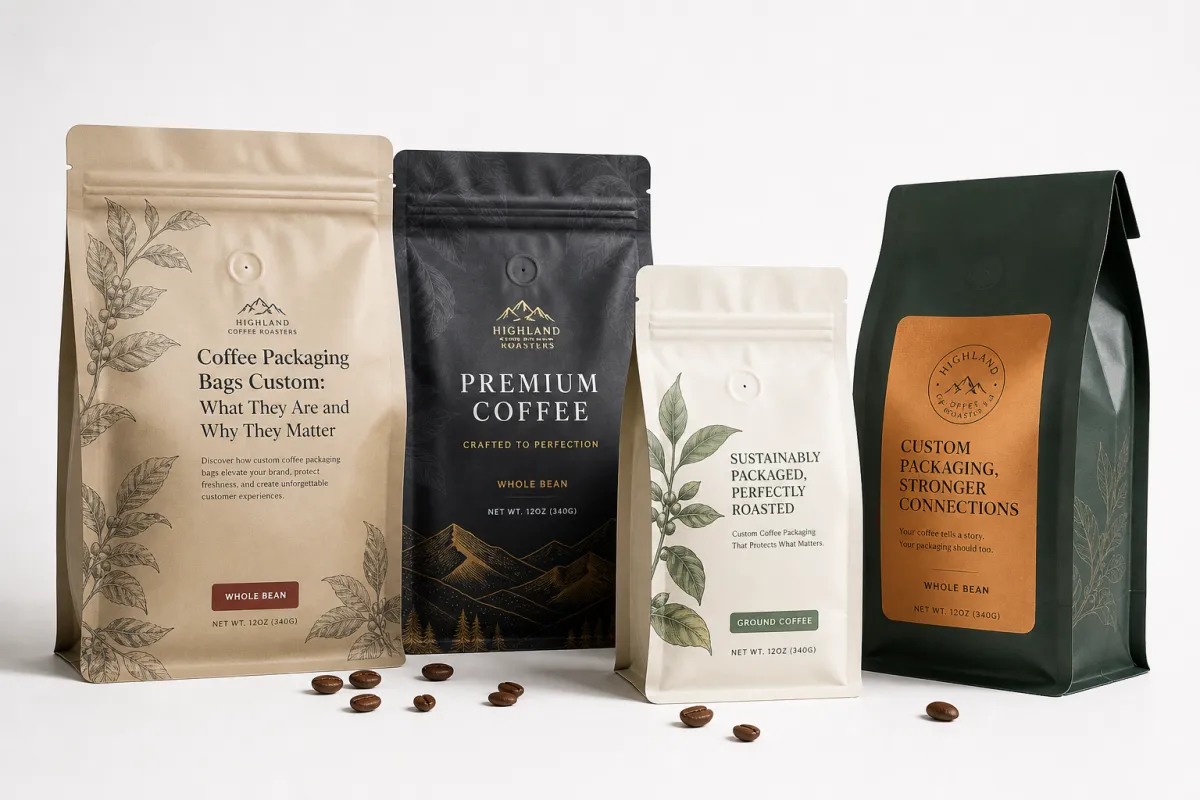
Roasted coffee starts changing as soon as it leaves the roaster. The beans release carbon dioxide, absorb odors, and lose aromatic compounds if the pack allows too much oxygen exchange. Simple enough. The bag is part of the product. That is why coffee packaging bags custom are built around the bean, the fill weight, the sales channel, and the shelf-life target instead of forcing everything into a generic pouch that only half fits.
Custom packaging earns its place when a brand needs a specific look or a specific performance target. A small-batch roaster selling 12 oz whole bean bags through retail may need a high-barrier structure, a one-way valve, and a matte finish that reads premium without trying too hard. A subscription brand moving coffee quickly may care more about packing speed and print impact. In both cases, coffee packaging bags custom let you tune the packaging design instead of making the product adapt to whatever stock size happened to be in the catalog.
The most common formats are familiar, but each one solves a different problem:
- Stand-up pouches give solid shelf presence and work well for hand filling or semi-automated lines.
- Flat bottom bags create a premium retail footprint and stay upright with less fuss when packed correctly.
- Side gusset bags suit classic coffee presentation and often work well for higher-volume runs.
- Retail-ready bags often combine resealable zippers, tear notches, and valves for practical customer use.
Plenty of buyers start with the look and only later notice the structure has to cooperate with the filling line, the bean volume, and the way the bag sits in a carton or on a shelf. A pouch that photographs beautifully but leaks aroma, swells, or seals badly is not a win. The best coffee packaging bags custom balance barrier performance, machine compatibility, and visual identity without letting any single piece do all the work.
Custom usually makes sense in one of three ways: fresher coffee, stronger retail presence, or less wasted labor during packing. For brands selling premium coffee, that difference can be the line between a pack that looks ordinary and a pack that makes the product feel legitimate at first glance. That is why many serious roasters treat coffee packaging bags custom as a product decision, not a print order.
There is also a quiet truth here. Once a brand starts selling more than a few hundred bags, the package stops being a side detail and becomes an operating decision. The wrong pouch slows the line. The wrong valve placement messes with graphics. The wrong barrier spec makes the best roast taste tired. None of that is dramatic. It is just expensive.
How Coffee Packaging Bags Custom Work: Layers, Valves, and Seals
Most coffee pouches are not one sheet of film. They are laminated structures, and each layer has a job. One layer supports print quality. One or more layers provide barrier protection. The inner sealant layer creates the heat seal that closes the pack. That layered build is one reason coffee packaging bags custom can be adjusted for different roast styles, shipping routes, and shelf-life goals.
A typical high-barrier coffee structure might include a printed outer layer, a metalized or barrier film layer, and a sealant layer designed to weld cleanly under heat. The exact stack changes from supplier to supplier, but the logic stays the same: keep oxygen out, keep moisture exchange low, and give the bag enough strength to survive filling and handling. For brands comparing structures, the real question is not only what looks good. It is what barrier level the coffee actually needs. That is where coffee packaging bags custom earn their keep.
The one-way degassing valve is the part people underestimate most. Freshly roasted coffee keeps releasing carbon dioxide for days, sometimes longer depending on the roast and bean density. The valve lets gas escape while limiting outside air from coming back in. Without it, the bag can puff up, stress the seals, or sit badly on shelf. With it, the pack looks cleaner and behaves better in retail. If you are building coffee packaging bags custom for whole beans that ship soon after roasting, the valve belongs in the discussion from the start.
Zippers, tin ties, tear notches, and rounded corners are not just convenience features. They change repeat opening, reseal quality, and the way the consumer handles the product after purchase. A zipper helps freshness after the first open. A tear notch helps the bag open cleanly without fighting the seal. Tin ties still have a place on certain formats, though they show up less often in premium retail. Each add-on changes the construction and the cost a bit, but in coffee packaging bags custom the usability gain can be worth it.
Seals deserve more attention than they usually get. Seal width, temperature, dwell time, and the condition of the sealing jaws all affect leak resistance. A narrow or uneven seal can fail during transit or create a pack that looks fine but loses protection over time. Bottom construction matters too. A flat bottom bag spreads weight well, while a side gusset bag can be more efficient for volume but demand tighter control over fill level and headspace. The packaging line should guide the bag choice, not the other way around.
Different filling methods change the best format as well. Manual filling may favor a forgiving pouch with a wide mouth and a simple closure. Automated or semi-automated lines may need tighter tolerances on dimensions, valve placement, and seal performance. If the bag fights the machine, labor costs rise and output drops. That is one reason experienced buyers ask for sample runs early when they order coffee packaging bags custom.
For technical reference, many packaging teams look at standards and testing methods that help validate performance. Industry resources such as the Flexible Packaging Association and transit testing guidance from ISTA are useful starting points when a buyer wants to understand barrier, handling, and shipment expectations in a more formal way. I have had more than one conversation end with, "Yeah, the mockup looked fine, but the test bag told a different story." That is normal. The bag is supposed to reveal the weak spot before the shipment does.
Practical rule: if the bag carries the freshness promise, treat it like product engineering, not a print file with a fancy finish. That mindset usually leads to better coffee packaging bags custom decisions and fewer ugly surprises after launch.
Key Factors in Coffee Packaging Bags Custom: Freshness, Branding, and Compliance
Freshness is usually the first reason brands upgrade to coffee packaging bags custom, and for good reason. The big barrier variables are oxygen transmission rate, moisture protection, and light resistance. Oxygen is the main enemy for most roasted coffee because it dulls aroma and speeds up staling. Moisture brings its own problems in humid storage or long transit lanes. Light, especially on clear or lightly printed structures, can also chip away at product quality. A bag that controls those three exposures will do more for the coffee than a shiny finish ever will.
Bag size matters more than many buyers expect. If the bag is too large for the fill weight, extra headspace leaves too much air inside and makes the pack look underfilled. If the bag is too small, the coffee can stress the seams, distort the shape, or make sealing inconsistent. Good coffee packaging bags custom should match bean density, fill weight, and the visual target on shelf. A 12 oz bag of dense medium roast can behave very differently from 12 oz of a lighter roast, and a 1 lb pack may need a different layup than a 5 lb wholesale bag.
Finish choices carry real weight on the branding side. Matte film often reads as premium and modern, while gloss can make color pop and sharpen contrast in certain artwork systems. Soft-touch coatings feel elevated in hand, though they can add cost and need scuff testing. Metallic accents, spot varnish, and high-coverage graphics can create strong shelf impact when handled well. Clear windows still show up on some coffee packaging, but buyers should think hard before choosing them, because windows trade away barrier and can make the freshness story harder to defend. Done right, the visual side of coffee packaging bags custom becomes part of the product instead of a sticker slapped onto it.
Material choice is where sustainability and performance usually meet head-on. Traditional multilayer laminations remain common because they deliver strong barrier properties and reliable sealing. Recyclable mono-material structures are getting more attention, especially for brands that want a cleaner sustainability message, but those structures do not automatically match the same barrier level as some older multi-material formats. That tradeoff matters. Not every recyclable claim is equal, and not every recycling stream accepts the same pouch format. If a brand uses recycled-content or recyclable messaging, the claim should be accurate, supportable, and aligned with real local recovery options. That is especially true for coffee packaging bags custom that need to carry a premium or eco-conscious identity.
Compliance and traceability matter just as much as design. Coffee bags often need space for lot codes, best-by information, net weight, ingredient or origin data, allergen statements if applicable, and sometimes country-of-origin copy. Barcodes must scan cleanly. Regulatory panels need room to breathe. If a pack gets crowded, the brand can end up with unreadable information or a design that looks polished in a render and fails in print. The artwork should leave real estate for the things that have to be there, not squeeze them in at the last minute. The best coffee packaging bags custom make compliance look deliberate instead of awkward.
For sustainability language, many buyers also consult resources from FSC when paperboard or certified fibers are part of the broader packaging system. That matters when coffee brands extend their identity beyond the bag into cartons, displays, or shipping components.
If you are comparing bag formats against other product packaging options such as sleeves or custom printed boxes, do not compare only on appearance. Compare shelf life, line speed, shipping protection, and disposal expectations as well. Sometimes a box and inner pouch work better together than one format trying to carry the whole load alone.
One more practical note: sustainability messaging needs to survive contact with reality. If the film is technically recyclable but no curbside system accepts it, say that carefully. If a paper-forward structure still needs a barrier layer, say that too. Buyers trust plain language more than polished nonsense. That trust is part of the package.
Coffee Packaging Bags Custom Process and Timeline: From Brief to Delivery
The cleanest projects start with a tight brief. Before requesting quotes for coffee packaging bags custom, it helps to list the coffee type, roast level, grind or whole bean, fill weight, target shelf life, bag style, print needs, and whether a one-way valve or zipper is required. A supplier can only recommend the right structure if the input is specific. "Need coffee bags" is too vague. "Need 12 oz whole bean stand-up pouches with matte finish, valve, zipper, and a six-month shelf-life target" gives the conversation a real backbone.
Next comes the dieline and artwork stage. The dieline maps the exact panel sizes, seal areas, barcode zones, hanging holes if needed, and margins for legal copy. This is where many projects get delayed, because artwork that looks fine on a screen may fail once it hits the actual bag layout. Good suppliers should check panel orientation, finish limits, and any special registration requirements before print files are locked. That step matters even more for coffee packaging bags custom with full-bleed graphics or metallic accents.
Proofing and sampling are where the bag stops being theoretical. A flat proof can confirm copy, spacing, and layout, but a physical sample tells you much more. You want to check how the pouch fills, how the zipper behaves, whether the seal holds, how the valve is positioned, and whether the pack stands the way it should. If possible, test the bag with real coffee instead of a substitute. Bean size, dust level, and roast profile all change the way a bag behaves. A sample that looks fine empty may act very differently once filled. That is why coffee packaging bags custom should always be validated with product, not just on paper.
Production usually follows a sequence that looks something like this:
- Artwork approval and file prepress review.
- Printing of the outer structure or print web.
- Lamination or film combination, depending on the structure.
- Slitting into the required roll or sheet width.
- Bag conversion, including gusseting, shaping, and sealing.
- Valve insertion, zipper application, or other hardware steps.
- Inspection, packing, and shipment.
The timeline usually breaks into three buckets: approval, manufacturing, and freight. Simple jobs can move quickly if the art is ready and the structure is already known, but new tooling, special finishes, or multiple proof rounds can stretch the schedule. For many projects, a realistic expectation is often 12-15 business days from proof approval for production after all details are settled, with freight added on top. That does not fit every order, but it is a useful planning benchmark for coffee packaging bags custom so inventory does not get squeezed by a last-minute launch.
Buyer communication matters here. A supplier that answers dieline questions clearly, handles sample comments without drama, and gives straight timeline updates can save real time later. That is one reason roasters often judge a supplier by responsiveness as much as by unit price. When you are coordinating a launch, our custom packaging products should be easy to discuss, easy to proof, and easy to revise before production starts.
My advice on timeline planning is pretty plain: work backward from the ship date, not forward from the quote. That means leaving room for artwork corrections, sample approvals, and freight hiccups. The schedule will thank you. So will your launch team.
Coffee Packaging Bags Custom Pricing: What Drives Cost
Pricing for coffee packaging bags custom rarely comes down to one number. It is a stack of variables, and the unit price shifts as those variables change. Quantity is usually the biggest one. Setup costs, print preparation, and conversion labor get spread across more units as volume rises, so the per-bag price usually drops at higher quantities. A 5,000-piece order can carry a very different unit cost than a 25,000-piece run, even with the same artwork.
Material structure is another major driver. A plain laminated pouch with standard barrier may cost less than a recyclable mono-material pouch engineered for the same use case. Metalized film, high-barrier layers, and specialty coatings add cost too. If the coffee needs better protection from oxygen and light, the structure becomes more technical, and technical usually means more expensive. That is not a flaw. It is the real cost of making coffee packaging bags custom that protect the product properly.
Print complexity can move the number fast. More colors mean more press work. Full coverage graphics need careful registration. Matte over-varnish, spot gloss, hot stamping, and textured finishes each add steps. If the design uses large solid areas, the supplier may need tighter color control to avoid banding or mismatch between runs. Strong branding is valuable, but Buyers Should Know polished visuals carry production costs. Good coffee packaging bags custom are priced around both the structure and the art, not just one or the other.
Functional add-ons matter too. Valves, zippers, tear notches, hang holes, and rounded corners all add measurable cost. None of them is shocking on its own, but several together can change the quote materially. The same goes for special packing requirements, custom carton counts, or individual polybagging. A clean spec sheet prevents a lot of confusion here.
| Option | Typical Cost Impact | Best Use Case |
|---|---|---|
| Standard stand-up pouch | Lowest base cost | Shorter runs, simpler retail presentation |
| Flat bottom bag with valve and zipper | Moderate to higher | Premium shelf presence and repeat-open convenience |
| High-barrier laminated structure | Higher material cost | Longer shelf life or broader distribution |
| Recyclable mono-material pouch | Varies, often higher than standard film | Brands prioritizing sustainability messaging |
| Special finish with hot stamping | Higher print and finishing cost | Luxury positioning and standout branding |
There is also the landed-cost question, which buyers sometimes miss until the quote is already in hand. Freight, duties, inland delivery, packing method, and local handling can change the real number quickly. A cheap unit price from a distant supplier may not stay cheap once shipping and receiving costs are added. If you are comparing coffee packaging bags custom, ask for a full delivered estimate whenever possible so the quote reflects reality, not just the factory price.
For many brands, a rough planning range on a mid-volume job might land somewhere around $0.18-$0.28 per unit for a well-specified pouch at 5,000 pieces, depending on print coverage, barrier level, and hardware. Larger runs can move lower, while specialty finishes, thick barrier films, or low quantities can move higher. That is a broad range, not a promise, but it is the kind of practical number that helps a buyer sanity-check a proposal for coffee packaging bags custom.
One more thing gets overlooked: labor on the filling side. A more expensive bag that runs cleanly may cost less overall than a cheaper bag that jams the line, wrinkles during sealing, or needs extra handwork. The true cost of coffee packaging bags custom includes labor, waste, and risk, not only the invoice line for the pouch itself. Cheap can get weird in a hurry.
When I review quotes, I look for what is missing as much as what is included. Is the valve spec clear? Is the finish named properly? Does the supplier define carton count and shipping terms? If those details are fuzzy, the final bill is probably gonna be uglier than the first estimate.
Common Mistakes When Ordering Coffee Packaging Bags Custom
The first mistake is sizing the bag before checking the bean volume. Coffee density changes with origin, roast degree, and whether the product is whole bean or ground. Two 12 oz coffees can fill the same pouch very differently, and a bag that fits one roast well may look loose or overstuffed with another. Before committing to coffee packaging bags custom, test the actual product, not a guess.
The second mistake is treating graphics as the whole job. Great branding matters, but if the barrier is weak, the coffee will stale faster and the customer experience will fall apart. The most attractive retail packaging in the store is not much help if aroma fades early or seals fail in transit. It is easy to get hooked on color and finish, but coffee packaging bags custom have to perform before they impress.
Ignoring degassing is another common issue. Fresh coffee keeps releasing gas after roasting, and if the structure has no valve or no room for gas management, the bag can swell hard enough to distort the shape or strain the seal. Some buyers also forget to match the valve position to the final artwork, then discover the feature blocks an important design element. That can be avoided with a better dieline review and a sample in hand.
Overcrowded artwork creates its own mess. If the layout tries to do too much, the bag becomes hard to read from a few feet away. The product name should be obvious. The origin story should be easy to find. Regulatory text should stay legible without shrinking the whole design into a postage stamp. In strong coffee packaging bags custom, hierarchy matters as much as style. The eye needs a path.
Lead time mistakes are probably the most painful. Buyers sometimes assume artwork approval, sampling, and production can all happen in a short window, then discover they have no buffer for revisions or freight delays. That gets ugly fast for seasonal launches and retail resets. If the launch date is fixed, the packaging schedule should be built backward from that date with honest time allowances for proofing and shipping. In other words, plan your coffee packaging bags custom order like it belongs on the launch calendar, because it does.
Another classic error: choosing a supplier because the sample looks good and then skipping the line-test. The empty bag may stand beautifully on a table and still fail when it meets an actual filler. I have seen zippers catch, seals wrinkle, and corners split under normal use. The sample is the starting point, not the finish line.
- Test bag volume with the actual roast and grind.
- Confirm barrier needs before approving artwork.
- Check valve, zipper, and seal placement on the proof.
- Keep legal copy readable and spaced correctly.
- Build lead time into the calendar early.
The best packaging teams avoid these errors by treating the pouch like a production component, not a last-minute design accessory. That mindset usually leads to cleaner coffee packaging bags custom and fewer write-offs after launch.
Expert Tips and Next Steps for Coffee Packaging Bags Custom
If you want the project to move smoothly, build a one-page packaging spec before you request quotes. Include the bag format, target dimensions, fill weight, closure type, barrier needs, finish, artwork approach, and any compliance language that must appear. The clearer the brief, the fewer revisions you will need later. That matters even more for coffee packaging bags custom, because the bag has both a technical role and a brand role.
Order samples early and fill them with real coffee. A sample pouch on a desk tells you very little. A filled pouch tells you whether the headspace is right, whether the seal feels secure, whether the zipper is easy to use, and whether the bag stands the way you expected. Drop tests and transit checks help too. For anything shipping into retail or ecommerce, a little physical testing can prevent embarrassing failures. If the pack has to survive rough handling, talk to your supplier about methods aligned with packaging transit expectations and product handling standards.
Compare suppliers on communication quality, not just price. Fast answers, clean proofs, and realistic timelines are part of the service. A supplier who flags a problem before production is worth more than one who agrees to everything and fixes nothing until the run is already underway. With coffee packaging bags custom, clarity is part of the product.
Plan the order around sales velocity. If a new roast is experimental, do not overbuy packaging that may not fit the long-term line. If a flagship SKU sells fast, make sure the reorder window is wide enough to absorb production and freight. Coffee businesses often lose money by holding the wrong format or by running out of the right one. Good coffee packaging bags custom planning prevents both problems.
Here is a practical next-step checklist that works in the real world:
- Confirm the exact product type, fill weight, and roast style.
- Choose the bag format and closure features.
- Define the barrier target and finish.
- Review a dieline with real panel dimensions.
- Approve samples filled with actual coffee.
- Lock artwork after checking legibility and compliance copy.
- Build in shipping time and reorder safety stock.
That process is not flashy, but it works. It gives the buyer control over the details that actually matter and keeps the project grounded in production reality. If your team wants a broader packaging conversation, Custom Packaging Products can help frame the coffee bag alongside other branded packaging pieces in the same program.
My advice is simple: choose coffee packaging bags custom for function first, then refine for presentation. When the structure, barrier, finish, and timeline all fit the coffee and the sales channel, the result feels easy to use and easy to buy. That is what good packaging is supposed to do.
One last check before you place the order: ask whether the bag will still make sense after three months of sales, not just on launch day. If the answer is yes, you are probably on the right track. If it is no, fix the spec now instead of paying for it later.
FAQ
What size should coffee packaging bags custom be for 12 oz beans?
Start with the actual bean density and the target fill weight, because roasted beans can occupy very different volumes depending on origin, roast level, and whether the coffee is whole bean or ground. For coffee packaging bags custom, the usable internal volume matters as much as the label size. You also want enough headspace for sealing and any valve or zipper hardware so the pack looks full without stressing the top seal. Ask the supplier for a sample dieline or a test bag before you lock production, because the right bag size is always a product-specific decision.
Do coffee packaging bags custom always need a one-way valve?
Freshly roasted whole beans usually benefit from a valve because they release carbon dioxide after roasting. That gas needs somewhere to go, especially if the coffee ships soon after roasting. Pre-ground coffee or short-life promotional packs may not need a valve, depending on fill volume and how fast the product moves through the channel. With coffee packaging bags custom, the better rule is to match the structure to product behavior instead of adding a valve just because it feels standard.
What affects coffee packaging bags custom pricing the most?
Order quantity, material structure, and print complexity usually drive the biggest pricing swings. Special features such as valves, zippers, rounded corners, and premium finishes add cost, but they can also improve usability and shelf appeal. Freight and duties can change the final landed cost, so compare quotes on delivered pricing whenever possible. For coffee packaging bags custom, unit price alone rarely tells the whole story.
How long does it take to produce coffee packaging bags custom?
The schedule usually includes artwork setup, proof approval, sampling, production, and shipping. Simple projects move faster when the artwork is ready and the bag structure is already defined. Build in extra time if you need new tooling, special finishes, or multiple approval rounds. A realistic planning window for coffee packaging bags custom often runs longer than people expect once freight is included, so it helps to work backward from the launch date.
Can coffee packaging bags custom be recyclable?
Yes, some custom bags use recyclable mono-material structures, but barrier performance and local recycling access still matter. Not every recyclable claim works in every market, and not every structure delivers the same product protection. The right choice depends on both your coffee's freshness needs and the recycling options where the bag will be used. If you are evaluating coffee packaging bags custom for sustainability messaging, ask for documentation that supports the claim so the story stays accurate and defensible.
Done well, coffee packaging bags custom protect freshness, support brand identity, and keep the packing line moving without unnecessary friction. The most practical next step is simple: lock the spec, test the filled sample, and confirm the timeline before you print anything. That is the boring part. It is also the part that keeps good coffee from ending up in a bad bag.


