A coffee roaster Ribbed Winter Beanies unit cost review only works if it gets past the headline. The actual decision is not whether a beanie looks nice in a mockup; it is whether the knit, cuff, decoration, and order size add up to a product that can sit on a retail shelf, go into staff rotation, and still leave room for margin.
Ribbed knit changes the whole read of the hat. It adds structure, softens minor fit differences, and gives the logo a more finished backdrop than a flat promo cap does. For roasters, that matters because the same beanie often has to do several jobs: winter merch, staff uniform, bundle add-on, and wholesale item. The design needs to hold up across all of them.
Why ribbed winter beanies outperform generic roastery swag
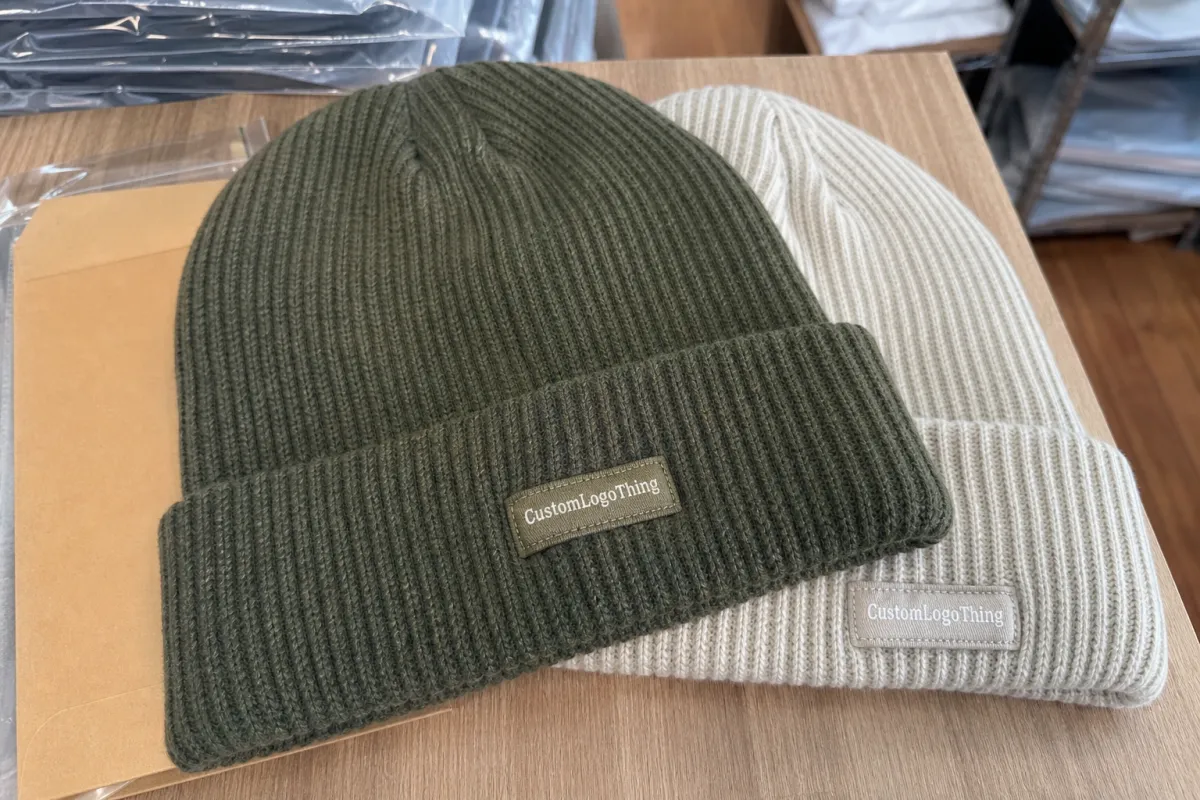
Ribbed knit gives the hat shape and visual depth. The vertical texture catches light, makes the beanie feel denser, and hides small inconsistencies better than smooth knit does. In a cafe or retail setting, that helps the product read as intentional instead of generic.
Recovery is the other advantage. Rib knit stretches and returns to form better than cheaper flat styles, so the hat keeps its silhouette after being tried on, stuffed into a pocket, or worn through a shift. That matters for staff use and for retail handling, where the product has to survive constant touch without looking worn out.
Cuff depth affects value more than most buyers expect. A deeper cuff creates more room for branding and usually gives the hat a heavier, more premium feel. A shallow cuff can look cleaner in fashion apparel, but for roastery merch it often leaves too little space for the logo and makes the product feel underbuilt.
Color choice also shapes sell-through. Black, charcoal, oatmeal, and forest green usually perform well because they support contrast and fit most coffee brand palettes. Heathered yarn can look rich, but it can blur small artwork. Bright colors can work if they match the brand system, but muted bases generally photograph better and age better.
Fabric, cuff, and fit details that change sell-through
Yarn choice sets the floor for cost and feel. Standard acrylic is still the most common option because it is affordable, consistent, and easy to source in volume. Acrylic-wool blends feel warmer and more premium, but they raise cost and can introduce more variation. Recycled fiber blends support a sustainability story, though the final handfeel depends on the mill and finishing process.
For most buyers, the practical material lanes are simple:
- Acrylic: lowest entry cost, wide color range, reliable for volume merch.
- Acrylic-wool blend: warmer and more premium, with a higher unit price.
- Recycled fiber blend: useful when the brand already emphasizes low-waste or refill products.
Cuff size should be treated as a spec, not a guess. A cuff around 2.5 to 3.5 inches usually leaves enough room for embroidery or a woven patch without overwhelming the hat. Smaller cuffs can feel cramped, while larger cuffs can make the beanie look heavy, especially on smaller heads. Most adult unisex styles land around 8.5 to 9.5 inches from cuff to crown, though knit tension and stretch change the actual fit.
“One size” is convenient language, not a production spec. Fit depends on crown depth, yarn weight, and how much the cuff is meant to fold. A hat for staff wear needs to stay put during service. A hat for retail needs to feel comfortable on first try and still hold shape in the mirror. If the spec is vague, the product usually looks vague too.
Texture and color should work together. A dense ribbed knit in charcoal with a crisp white patch often looks more premium than a brighter hat with busy art. The beanie is part of a broader coffee brand environment that already includes packaging, cups, labels, and signage. The hat should support that system, not compete with it.
Decoration specs that survive wash, wear, and retail handling
Decoration has to respect the stretch of rib knit. Direct embroidery works well when the logo is simple and the stitch count stays under control. Woven patches are better for small text or fine detail because they keep edges sharper than thread alone. Leatherette patches create a more fashion-forward feel, while sewn labels suit understated branding and lower-key merch programs.
The logo should stay simple. One or two colors usually beat a crowded thread palette on textured knit. Thin strokes, tiny type, and complicated icons can get lost once the beanie stretches and the ribbing starts creating shadow. A clear mark is safer than an elaborate design that only looks good on a flat proof.
Placement matters as much as artwork. The cuff is usually the best location because it offers a flatter field, keeps the crown cleaner, and avoids distortion. Crown placement can work, but rib knit can make it less stable and less comfortable. For most roastery programs, cuff placement gives the best balance of visibility, wearability, and production simplicity.
Here is the comparison buyers usually need before they choose:
| Decoration method | Typical fit on rib knit | Retail look | Cost impact |
|---|---|---|---|
| Direct embroidery | Best on cuff, simple art only | Clean and familiar | Low to medium |
| Woven patch | Very good on cuff | Sharper for small details | Medium |
| Leatherette patch | Good if size is controlled | Premium, more style-driven | Medium to high |
| Sewn label | Best for minimalist branding | Subtle and clean | Low |
Setup costs are manageable until the order gets very small. Digitizing or file prep often lands in the $25 to $85 range, though complexity can push that higher. Custom knit artwork, jacquard patterning, or unusual trim details raise the price because the factory has to program the machine rather than just decorate a stocked cap. That is fine on a strong seasonal run, but it is harder to justify on a tiny test order.
Packaging changes the perceived value quickly. A beanie folded into a thin polybag will still sell, but branded swing tags, belly bands, or a simple insert card usually improve shelf presentation without adding much cost. If the hats are shipping in cartons, ask how they are packed so cuffs do not get crushed and labels do not arrive bent. Lightweight headwear can still look damaged if packing is careless.
Coffee roaster ribbed winter beanies unit cost review
This is where the buying decision becomes concrete. A coffee roaster Ribbed Winter Beanies unit cost review has to include quantity, yarn, decoration, packaging, and freight. A supplier who gives only one flat number is leaving out the parts that control margin. The same beanie can look cheap at 1,000 units and expensive at 50 units for ordinary reasons.
For a stock ribbed beanie with one decoration location, these are realistic starting bands. Freight, sampling, and packaging can move the final number, but the ranges help anchor the conversation before quotes get noisy.
| Quantity | Typical cost per piece | MOQ reality | Notes |
|---|---|---|---|
| 50 units | $6.50-$9.00 | Usually stock color only | Setup charges carry a heavy share |
| 100 units | $4.80-$7.20 | Common minimum for simple decoration | Works for small pilot drops |
| 250 units | $3.40-$5.20 | Better bulk pricing starts here | Often the cleanest balance of risk and cost |
| 500 units | $2.60-$4.20 | Healthy reorder volume | More room for packaging upgrades |
| 1,000 units | $2.10-$3.60 | Best pricing if storage is manageable | Useful for wholesale and multi-location retail |
Small runs cost more because setup, proofing, sampling, and freight are divided across fewer pieces. That is why a 50-unit order often looks disproportionately high. It is not necessarily overpriced; it just has not reached the volume where overhead gets diluted. If the project is seasonal or experimental, that may be acceptable.
Custom dyeing, multiple decoration locations, and special packaging all raise the total. A cuff patch plus a woven label plus individual gift boxing sounds polished, but each add-on adds time and handling. For roastery merch, one strong decoration often gives better value than several weak custom touches. The final hat looks cleaner, the quote is easier to read, and the storage load stays reasonable.
Samples are another line item buyers should expect. A physical sample or strike-off often lands around $35 to $95, with custom knit tests sitting above that range. It is worth it because it catches cuff depth problems, contrast issues, logo distortion, and finishing flaws before the bulk run starts. Saving a little at sampling can cost much more if finished hats need rework.
A good quote should separate garment cost, decoration cost, setup, sampling, freight, and any special packout. Bundled quotes make comparison harder and hide where the margin pressure sits. The useful question is not “What is the cheapest number?” It is “What does the piece actually cost after all the real steps are counted?”
Process, sample approval, and turnaround from art to delivery
The strongest production process is the least dramatic one. Start with a tight brief, send the artwork in the right format, approve the proof once the details are right, and avoid late revisions. Vector art is usually the safest starting point for embroidery and patch work, while knit development may need more file clarity for the factory’s program. If the file is fuzzy at the start, the final hat tends to be fuzzy too.
A practical sequence looks like this:
- Brief and quantity confirmation
- Artwork review and placement check
- Digital proof or mockup
- Sample or strike-off, if needed
- Production knit or decoration
- Quality control and packing
- Shipment
Turnaround depends on how custom the order is. A stock ribbed beanie with a simple cuff decoration may need 2 to 5 business days for proofing. A sample can add another 5 to 10 business days if it has to be produced from scratch. Production after approval often lands in the 10 to 18 business day range for moderate quantities. Add freight on top, and the full timeline usually lands around 15 to 25 business days after approval for a typical order, sometimes longer during seasonal congestion.
Change requests are the main schedule risk. A different yarn, a new logo size, or a packaging swap after approval reopens a closed step. That is normal manufacturing behavior, not a service problem. The safest orders are the ones where the spec is locked before the proof is signed. Any launch date with no room for freight, inspection, or one correction is a gamble with a retail deadline attached.
Why roasters keep reordering the same beanie program
Repeatability turns a decent hat into a useful product line. Once the yarn, cuff depth, logo size, and packing method are fixed, the reorder process gets much easier. The factory knows the build, the buyer knows the cost, and the retail team gets a product that looks consistent across seasons.
That consistency matters more than novelty for most roasters. Merch works best when it feels like part of the brand system rather than a one-off experiment. Reordering the same style also protects margin because the team can compare true unit cost from one run to the next instead of rebuilding the spec each time.
Good reorder documentation is simple but important. Thread codes, patch dimensions, placement distance from the cuff edge, approved yarn color, packing format, and ship-to details should be stored with the final approval. If the first run looked right, capture the exact version instead of trusting memory.
Quality control should stay disciplined. Check stitch tension, logo placement, color match, trim finish, and pack consistency before cartons leave the floor. If the sample passed but the bulk run starts to drift, catch it early. A few imperfect cartons can make an entire retail display look inconsistent.
What to send for a fast quote and a cleaner first proof
A useful quote starts with enough detail to price the actual job. Quantity, in-store date, logo file, decoration method, color preference, and shipping destination all change the number. If those details are missing, the first answer will usually be a placeholder rather than a real quote.
- Quantity: give one target and one fallback number, such as 100, 250, or 500.
- Timing: include the needed delivery date, not just an urgent note.
- Artwork: send vector files if possible and note the desired logo size.
- Decoration: specify embroidery, woven patch, leatherette patch, or sewn branding.
- Packaging: say whether the hats need bagging, boxing, belly bands, or bundle-ready packing.
- Ship-to: provide the ZIP or postal code so freight is not estimated blindly.
Ask for tiered pricing if the order may grow. Seeing costs at 50, 100, 250, 500, and 1,000 units makes the economics easier to read and helps compare real volume breaks against expected sell-through. The quote should also separate setup charges and sample cost instead of folding them into one line. That separation matters, especially when the first order is small and setup is carrying most of the cost.
Packaging decisions should be made early because they affect labor, shipping weight, and carton count. A beanie sold in a cafe display is not packed the same way as a beanie shipped for ecommerce fulfillment or included in a gift bundle. Waiting until the end to choose the format usually creates avoidable cost.
What drives coffee roaster ribbed winter beanies unit cost the most?
Quantity has the biggest impact, followed by yarn choice, decoration method, and packaging. Lower quantities carry a heavier share of setup, proofing, and freight, so the per-piece price rises even when the hat itself is simple.
What MOQ should I expect for custom ribbed winter beanies?
For stock colors and a simple cuff decoration, 50 to 100 pieces is common. Custom dyeing, multi-color knit patterns, or specialty trims usually push the minimum higher.
Which decoration method works best for a coffee roaster beanie?
Simple embroidery or a woven patch on the cuff usually gives the best retail read. Both hold up better than overly detailed art, which can lose clarity on textured rib knit.
How long does production usually take after proof approval?
A realistic window is 15 to 25 business days after approval for many orders, plus sample time if a sample is required and plus freight time. Custom knit development or holiday demand can add more time.
Can I reorder the same coffee roaster beanie without starting over?
Yes, if the final spec, artwork, and color references were saved from the first run. Reorders move faster when thread codes, placement notes, packing format, and approved files are already on record.

