Coffee Rope Handle Gift Bags Supplier Buyer's Guide
A coffee Rope Handle Gift Bags supplier is not just filling a packaging order. They are shaping the first value cue a shopper sees. Before the coffee tin is opened or the roast notes are read, the bag has already suggested whether the gift feels modest, practical, or premium. That judgment happens quickly, and it is usually made from structure, not graphics alone.
For coffee brands, roasters, subscription boxes, and seasonal retail programs, rope-handle bags sit in a useful middle ground. They cost more than plain paper carriers, but they usually deliver better shelf presence, better hand feel, and a more finished gift look. That can support a higher retail price without pushing the package into rigid-box territory.
The buying question is less about style and more about fit. Should the bag carry a single pouch, a tin and a card, or a mixed bundle with jars and samples? Will it sit on a counter, ride in a courier carton, or be handed over at checkout? A bag that performs well in one setting can look underbuilt in another. The best supplier will ask those questions before quoting.
A good bag does not try to impress with noise. It tells the customer the product was planned.
Why rope-handle gift bags feel more premium than they cost
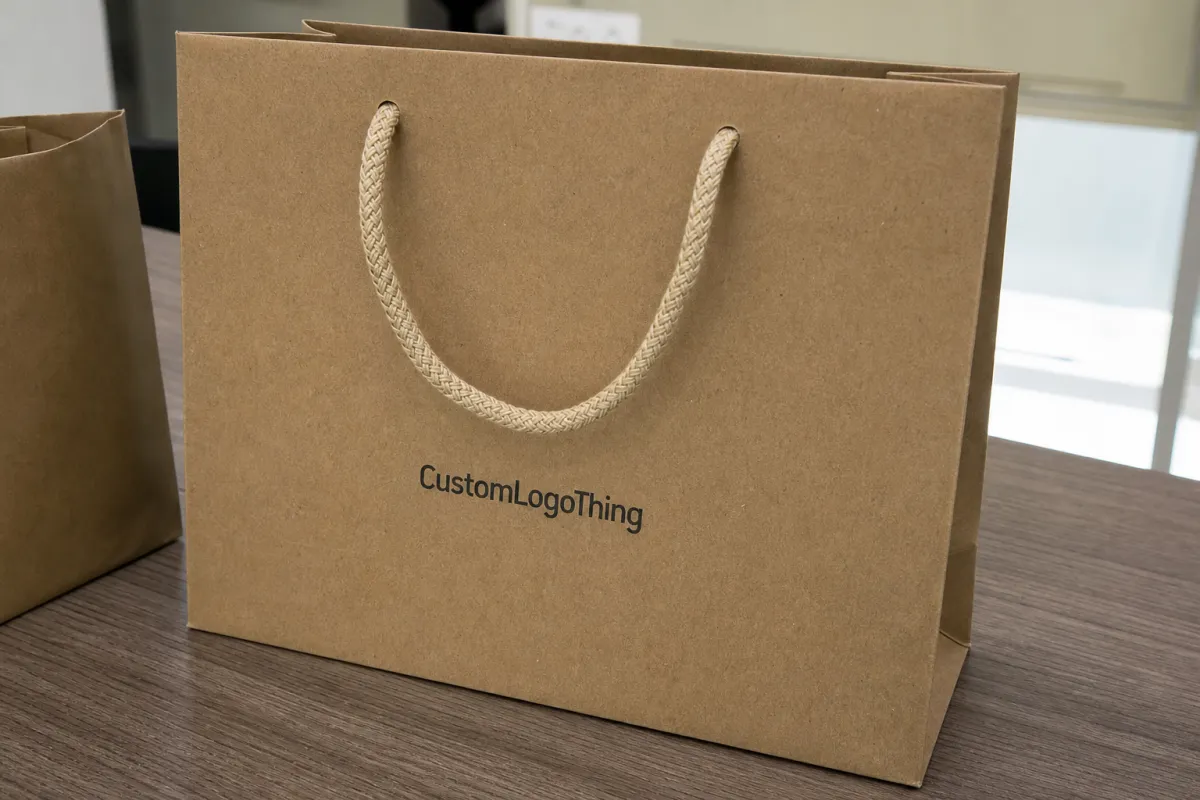
Rope handles change the experience immediately. They spread load better than a thin die-cut opening, and they feel more deliberate in hand. The shopper notices the handle first, then the top fold, then whether the side panels stay upright when the bag is lifted. That order matters because the eye reads structure as value.
Compared with standard paper bags, rope-handle versions usually include a reinforced top edge, a more rigid body, and a base that stands better on shelves or counters. Those three details do most of the work. The print carries the brand, but the structure carries the impression. For coffee gifts, that makes the bag behave like part of the product rather than disposable wrapping.
This format works especially well for holiday bundles, tasting sets, subscription renewal gifts, and retail add-ons at checkout. A customer buying two bags of coffee and a syrup bottle is usually not looking for theater. They want something ready to hand over. Rope handles answer that need without moving into expensive rigid-box construction.
The tradeoff is real: rope-handle bags cost more than twisted-handle or flat paper carriers. The extra cost comes from reinforcement, handle attachment, finishing, and sometimes more manual assembly. A useful supplier explains that split clearly. If a quote looks cheap but hides the structural steps, the bag often shows it later.
In practice, the premium feel is not about luxury for its own sake. It is about reducing the gap between what the product costs and what the packaging signals. A coffee set that sells for $18 to $35 can support a better bag far more easily than a low-margin pouch sold at checkout. Packaging should match the pricing tier, not exceed it.
How rope handles, paper weight, and inserts work together
The bag only feels premium if the structure is doing real work. Rope handles transfer load through reinforced attachment points, while the paper stock and any internal board control stiffness. A nice print on flimsy stock still feels flimsy. A restrained print on well-built stock can feel more expensive than expected.
Paper weight is the first variable most buyers should understand. Many custom gift bags sit around 157gsm to 250gsm for the outer paper. Heavier builds may add board, laminate, or reinforcement at the top and base. If the bag carries a single coffee pouch, a moderate stock may be enough. If it carries a tin, a sampler box, and a card, the supplier may need a top insert or doubled fold around the handle area.
Gusset width and bottom construction matter just as much as paper weight. A narrow gusset can hold a slim pouch well, then fail once the bundle shifts sideways. A wider base gives the bag more room to settle, which helps with jars, tins, and mixed gift sets. If the contents weigh more than about 1.5 to 2 kg, ask how the supplier handles pull-through, handle tear, and bottom deformation.
Laminate and internal board can change behavior quickly. A matte laminate can reduce scuffing and soften the look. A board insert can keep the front and back panels from collapsing when the bag is set down half-full. The same artwork can perform very differently depending on reinforcement. That is why sample testing matters.
There is also a practical limit to how much structure can be hidden inside a gift bag. A very soft, folded bag may still be acceptable for light pouches, but once the product starts leaning or the handle holes stretch, the customer notices. For coffee gifts, the bag should feel calm under load. If it flexes too much before the product is even carried a few meters, the finish will not save it.
If the bags will travel with product inside, ask about carton testing against an ISTA profile or a comparable drop and vibration method. A supplier who can talk through transit risk is usually thinking beyond the artwork file. That tends to save surprises later, especially on e-commerce or mixed retail shipments.
Pricing, MOQ, and unit cost basics
The price of a custom rope-handle bag is driven by a small set of variables that stack quickly: paper stock, rope type, print coverage, special finishes, inserts, and the amount of manual assembly required. If you want to understand where the money goes, start there. The artwork is rarely the expensive part. The construction is.
Minimum order quantity changes the math as much as the design does. A smaller run may look cheaper until setup, tooling, and labor are spread across fewer units. That is why MOQ 500 can produce a very different unit cost from MOQ 5,000, even when the bag looks nearly identical. For a brand testing a new roast or a short holiday run, that spread can decide whether the packaging is viable.
Below is a practical comparison. These are indicative ranges before freight, and they move with size, coverage, and finish choices. A $0.20 difference per bag is easy to ignore until you order 5,000 pieces. Then it becomes a material line item.
| Option | Typical MOQ | Indicative unit price at 1,000 pcs | Best for | Notes |
|---|---|---|---|---|
| Stock size with custom print | 500-1,000 | $0.75-$1.35 | Launch tests, small seasonal runs | Lower setup cost, fewer structural choices |
| Semi-custom size with rope handle | 1,000-3,000 | $0.58-$1.10 | Core retail, coffee gift bundles | Good balance of cost and presentation |
| Fully custom with lamination, foil, or inserts | 3,000+ | $0.95-$2.30 | Holiday programs, premium gift sets | Higher finish cost, stronger shelf impact |
Ask about hidden line items before comparing quotes. Plate or die charges, sample fees, packing method, color matching, and freight can change landed cost more than the base unit price. A supplier who lists those items clearly is easier to trust than one who leaves them buried in the fine print. If one quote looks unusually low, check whether it excludes handle assembly, packaging cartons, or export-ready packing.
There is also a material reality behind the numbers. Kraft paper can lower cost and support a natural brand look, but it may limit ink brightness and foil sharpness. Coated art paper prints better and feels smoother, but the finish can raise cost and may show scuffing more quickly if lamination is skipped. A coffee rope handle gift bags supplier should be able to explain those tradeoffs without talking only in marketing language.
Production steps and lead times for custom orders
Most custom bag orders follow the same path: RFQ, spec review, artwork proofing, sampling, pre-production approval, mass production, inspection, and shipment. The order sounds simple until a missing dimension or unclear print file slows the chain. That is why the best buyers send a complete spec sheet the first time.
Lead time depends on how much the bag is changing. A stock-style bag with custom logo placement can move faster than a fully bespoke construction with unique handle color, foil, and inserts. As a working benchmark, simple orders often need 12 to 18 business days after proof approval before shipment, while more complex jobs can run longer. Transit time sits on top of that.
Most delays happen in three places. The first is artwork, especially when the supplier has to redraw a dieline or clean up low-resolution files. The second is color matching, because paper stock and coating affect how ink lands. The third is sampling, since a bag that looks right in a PDF can still feel too narrow, too soft, or too tall once it is built.
For products tied to a fixed launch date, plan backward instead of forward. Leave room for at least one round of revisions, sample approval, production, inspection, and shipping. If the bags will arrive packed with coffee, add a buffer for overages and carton damage. A good supplier should help you work from the in-hand date rather than pretending the calendar is flexible.
Some buyers skip a physical sample because the mockup looks close enough. That decision often costs more later. A sample reveals the true handle angle, whether the top fold springs open, and whether the base can stand without wavering. It also exposes print issues that are invisible on screen: a logo too close to the fold, a metallic ink that reads dull, or a kraft stock that absorbs color more than expected.
For transit risk, ask whether the supplier understands carton drop logic, stack pressure, and pallet patterns. The bag may be perfect out of the press and still arrive damaged if the outer cartons are overfilled or the inner count is too loose. Good production teams think in layers, not just in print passes.
Specs that matter most before you order
A clean quotation starts with clear specs. If you do not define the bag size, handle style, finish, and packing count, you will get comparisons that look similar but behave differently. That is a common source of confusion when multiple vendors are involved.
Use a simple checklist:
- Bag dimensions: width, gusset depth, and height.
- Paper weight: outer stock, plus any backing board.
- Finish: matte, gloss, soft-touch, spot UV, foil, embossing, or none.
- Handle details: rope material, length, color, and attachment style.
- Print method: offset, flexo, screen, or digital for short runs.
- Packing count: bags per carton and carton dimensions.
Match the bag to the actual product mix. A single pouch needs different geometry than a tin plus two sample packs. A sampler box needs enough clearance to slide in and out without bending the panels. A gift set with a bottle or ceramic cup needs a wider base so the load does not lean against one side.
Finish choices change perception quickly. Matte lamination can make a branded bag feel calmer and more controlled. Foil can add seasonal detail without covering the whole surface. Embossing adds tactile interest but should be used with restraint; too much texture can make the bag look busy rather than premium. Kraft paper, by contrast, sends a more natural signal and works well for roasters that want a less polished, more artisanal look.
Sustainability questions should be specific. If you need recycled paper or FSC-related claims, ask for documentation rather than a verbal promise. The FSC chain-of-custody framework is the kind of evidence serious buyers ask for. For broader material recovery and waste reduction context, the EPA's guidance on sustainable materials management is also useful. Claims should be supported, not guessed.
If the bag sits near food, ask about inks, adhesives, and whether any food-contact concerns apply to your exact use case. Most coffee gift bags are not direct food-contact packaging, but the distinction should still be confirmed. A careful supplier will tell you where the line is. That clarity matters more than a broad sustainability statement on a quote sheet.
One more detail is often overlooked: color consistency across repeat orders. If a seasonal bag sells well, the reorder should match the first run closely enough that a customer would not notice a shift on shelf. That means keeping the same paper base, finish, and handle specification whenever possible. Changing any one of them can alter how the brand color reads.
Common mistakes that undercut bag strength and print quality
The most expensive mistake is buying by outside dimensions alone. A bag can look perfect on a spec sheet and still fail in hand if the base footprint is too narrow or the gusset does not match the actual load. That happens often with bundled sets, because the contents are not evenly distributed.
Another common error is approving digital color too quickly. Screen color is not final color. Stock shade, coating, ink density, and print method all affect the result. A black logo can look crisp on coated art paper and softer on kraft. A metallic tone can read richer under gloss than matte. If the brand color is critical, insist on a proof process that reflects the final substrate.
Handle reinforcement is where many returns begin. A weak attachment point can survive one carry and fail on the second. That matters because gift bags are often reused. Customers do not treat them like shipping cartons; they reuse them for another purchase, a trip, or a household carry. A bag that tears after one short walk damages the brand faster than a slightly cheaper quote helps it.
There is also a production mistake that shows up only after the order lands: ignoring the difference between a nominal paper weight and actual finished stiffness. Two bags can both be described as 200gsm, yet feel different if one uses a denser board or a tighter fold. Buyers who compare only a single specification tend to miss that.
The pretty bag is not the hard part. The hard part is making sure the bag still feels premium after it has been lifted, set down, and carried across a parking lot.
Shipping carton planning gets overlooked too. If the quantity per carton is too tight, crushing increases. If overrun is ignored, the buyer may have no margin for inspection rejects or late-stage replacements. Ask how many extra units are built into the run, and whether cartons are optimized for pallet loading. That small question can prevent a budget surprise later.
One last risk is overdesign. Too many finishes can make the bag expensive without improving the sell-through. A foil logo, a strong paper color, and a well-chosen rope handle usually do more than stacked effects that compete with each other. Premium does not always mean elaborate. In packaging, restraint often photographs better and costs less.
Expert tips for better shelf appeal and better margins
Standardize where you can. Two or three core sizes usually beat a long list of one-off dimensions. Fewer sizes mean simpler inventory, less confusion during reorders, and better setup efficiency. A seasonal brand can still feel varied by changing print or handle color instead of rebuilding the structure every time.
Use one strong cue rather than decorating every inch of the surface. A foil logo, a deep brand color, or a contrast rope handle often does more than a crowded print layout. Buyers tend to remember contrast. They forget clutter. That principle is especially useful for coffee packaging, where the bag often sits beside strong brand imagery on cartons, tins, and shelf talkers.
Ask the supplier for samples that show the bag filled, not just flat. A flat mockup can hide weak corners, soft board, or handle pull angle. A filled sample tells the truth. It also helps with merchandising decisions, because the bag may look taller, stiffer, or more balanced on shelf than the drawing suggests.
Carton efficiency matters more than many marketing teams expect. Nesting-friendly die lines, sensible packing counts, and stackable cartons can reduce freight pain. On a larger run, that can protect margin without touching the brand face. The same is true for material choice. A slightly lighter board with better finishing sometimes looks stronger than a heavier stock with poor print clarity.
Keep the customer’s actual use in view. If the bag will be reused, choose a handle attachment and paper stock that survive at least a second carry. If it will be handed out during a promotion, a lighter build may be acceptable. If it sits on a boutique shelf, structure and print registration matter more than the last cent of unit price.
A coffee rope handle gift bags supplier should help you balance structure, finish, and quantity at the same time. If they only talk about decoration, they are missing the point. The best result is the bag that looks expensive enough to support the product, but not so overbuilt that it swallows the margin.
Next steps before you request a quote
Before you request pricing, gather the facts that change the quote. You will move faster, and the supplier will answer more accurately. Send the product dimensions, target quantity, artwork files, preferred finish, handle style, packing count, delivery location, and the real in-hand deadline. That is the minimum package.
If you can, request at least one sample or a detailed spec sheet. The sample shows handle feel, print clarity, stiffness, and how the bag closes at the top. The spec sheet shows whether the supplier understands the build well enough to repeat it without hand-holding. Both matter.
A simple quote-comparison table helps a lot. Include unit cost, setup fees, sample cost, lead time, freight estimate, and MOQ. If one supplier is cheaper but cannot deliver before launch, that quote is not cheaper. It is simply incomplete.
For a careful comparison, keep the same specification pack in front of every bidder and compare their replies line by line. Look at structure, timeline, and landed cost together. The right supplier is the one that can prove the bag will carry the product, print cleanly, arrive on time, and support the retail price you need. That is the job. The rest is decoration.
FAQ
How do I choose a coffee rope handle gift bags supplier for a small launch?
Prioritize suppliers that offer a realistic MOQ for your test run, not just the lowest quoted unit price. Ask for a sample or pre-production proof so you can check handle comfort, print quality, and bag stiffness. Compare total landed cost, including setup fees and freight, because small launches are often won or lost there.
What affects the price of custom rope-handle coffee gift bags most?
Paper stock, handle type, and finish usually move price more than the artwork itself. Large print coverage, foil, embossing, and custom colors add cost quickly. Order quantity has a major effect because setup costs are spread across more or fewer bags.
How long do production and delivery usually take?
Lead time depends on whether the bag is stock-based or fully custom, and whether artwork is approved on the first round. Sampling, production, quality checks, and shipping all need separate time in the schedule. If you have a fixed launch date, build in buffer time for revisions and transit delays.
What size works best for coffee tins, pouches, or bundles?
Start with the actual product footprint and height, then add room for inserts or tissue if the gift presentation needs it. Bundles need more gusset depth than a single pouch because the weight can shift during carrying. Test with real samples before ordering in bulk, since a bag that looks right on paper may be too tight in hand.
What should I send for an accurate quote from a supplier?
Send dimensions, quantity, preferred material, finish, handle style, and print requirements in one spec sheet. Include your delivery location and target in-hand date so freight and timing are priced correctly. If possible, attach artwork and a reference photo so the supplier can quote against the exact look you want.

