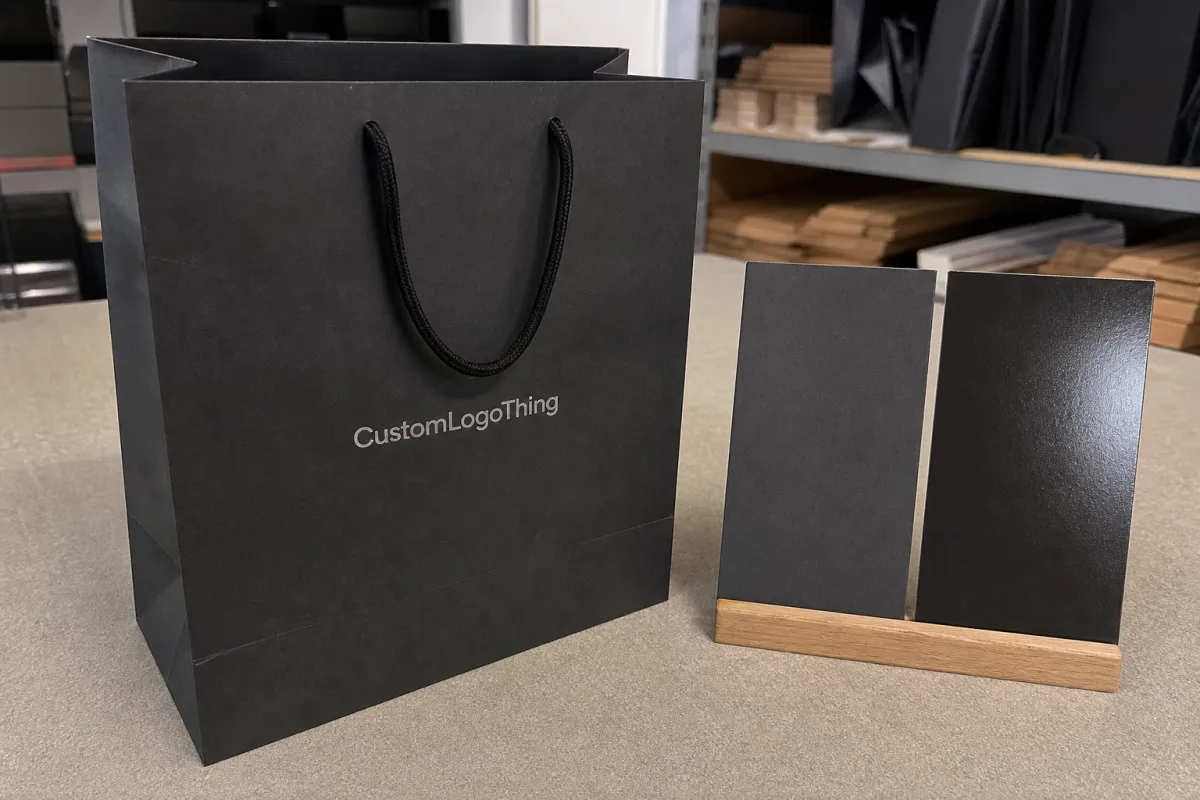
Buyers usually want one number first. They send a logo, maybe a rough size, and wait for a quote. The problem is that rope handle bags are priced less by artwork than by structure: board weight, handle type, finish, and how much reinforcement the bag needs to carry real product. Send only the dimensions and you get a placeholder price, not a number you can plan against.
These bags do earn their place in retail launches, cosmetics, apparel, corporate gifting, and premium event kits because the package is part of the presentation. That makes the specification matter more than many buyers expect. A clean quote starts with the right inputs; a messy one starts with a vague request and a follow-up chain that eats a week.
If the spec is still moving, the price is still moving too. That is not a supplier problem. It is a scope problem.
Rope Handle Gift Bags MOQ Guide: What Changes the First Quote
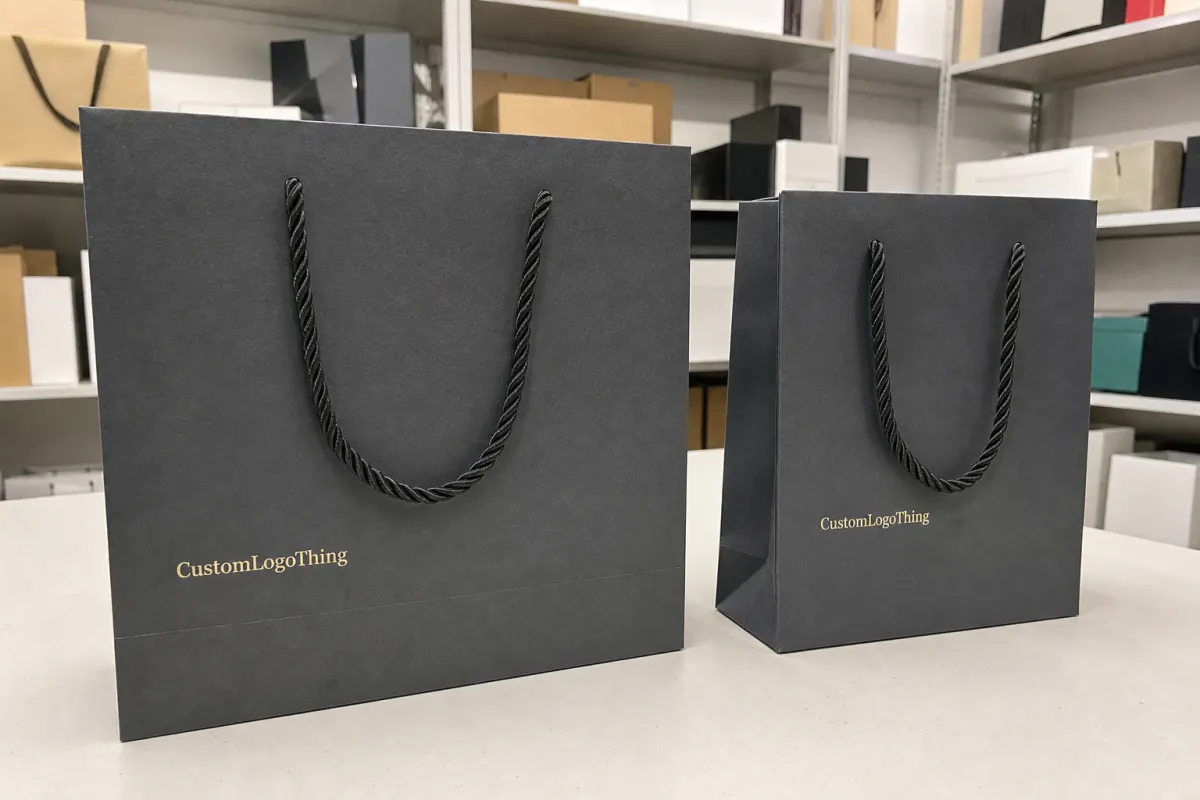
The first Quote for Custom rope handle bags usually shifts because of the board weight, handle style, and surface finish. The logo matters, but it is rarely the main cost driver. A simple one-color print on standard art paper is a different job from a bag built with thick board, cotton rope, matte lamination, foil, and a reinforced top edge. The second version takes more material, more labor, and more room for error.
Buyers who send only width, height, and depth often receive slow pricing or a wide range that is not very useful. A usable quote needs the finished size, paper stock, number of print colors, handle preference, finish, and target quantity. If the supplier also knows the product weight, they can tell you whether the bag needs a stronger bottom insert or extra reinforcement near the handle holes. That keeps you from approving a beautiful bag that sags the first time someone lifts it.
These bags make the most sense when packaging adds value: boutique retail, fragrance sets, wine, apparel, holiday gifts, and VIP kits. In those applications, the bag is carrying brand perception as much as product. A bag that looks premium but fails under load is a bad trade. A bag that is slightly simpler but reliable under real use is usually the better buy.
MOQ works the same way. A higher order quantity can lower the unit cost, but only if the build stays stable. Change the size, switch the rope, or add a different finish and the savings can vanish quickly. Buyers often focus on the lowest starting number and miss the more useful question: what spec can stay fixed across the run without creating re-quote after re-quote?
That question matters because the first quote is really a test of discipline. When the inputs are clean, pricing is faster, the schedule is clearer, and production has fewer surprises.
Paper Weight, Rope Handles, and Finish Options
Paper stock controls stiffness, print feel, and how premium the bag looks in hand. Art paper and coated paper are common because they print sharply and fold cleanly. Kraft paper gives a natural look that works well for earthy or minimal brands. Specialty stocks can look impressive, but they often increase cost faster than buyers expect and may require a higher MOQ to justify setup.
For paper weight, buyers usually compare ranges rather than one exact number. Smaller gift bags often sit around 157gsm to 210gsm. Retail bags that need to carry bottles, boxed sets, or heavier apparel commonly move into 230gsm to 350gsm. More board is not always better. Too much weight without proper construction can make the bag stiff but not stronger, which is a subtle but expensive mistake. Too little board, on the other hand, gives you soft walls and a bag that looks tired before it leaves the counter.
Rope handles affect both appearance and hand feel. Cotton rope feels softer and usually reads as more premium. PP rope is economical and durable, which is useful when the order has to stay lean. Satin rope fits fashion, gifting, and event applications where the handle is part of the design language. Color-matched rope can strengthen the visual identity, but stock rope often makes more financial sense if the budget is tight. In many cases, a better board and a clean print do more for the bag than a custom-dyed rope nobody notices after the sale.
Finish options can raise or ruin the budget. Matte lamination gives a softer, calmer look. Gloss lamination is brighter and shows color more aggressively. Soft-touch adds a tactile premium feel, but it also pushes up the cost per piece. Foil stamping, embossing, and spot UV should be used when they support the artwork, not because they sound premium in a quote sheet. On busy designs, too many effects can make the bag look expensive without looking better.
Practical construction details matter as much as the visible finish:
- Reinforced tops improve handle anchoring on heavier bags.
- Bottom inserts help the bag stand square and spread the load.
- Eyelets protect the handle holes and reduce tear risk.
For weighty goods or fragile packaging, simple load testing is cheap insurance. ISTA publishes package testing methods that are useful for evaluating handling and shipping stress: ISTA package testing standards. A paper gift bag does not need laboratory treatment, but if it is carrying glass or boxed products, a pull test and a bottom-strength check are worth the time.
Size Specs That Affect Carry Strength and Shelf Impact
Width, gusset, and height work together. Ignore one and the bag starts behaving strangely. A tall, narrow bag can look elegant but tip awkwardly once a heavy item is inside. A wide bag with a shallow gusset may show the logo well yet fold badly under load. The mockup can look correct while the filled bag behaves like a weak carton with handles.
Bag size should follow the product first and the shelf second. Jewelry and small cosmetics usually need compact formats. Apparel tends to need a broader base. Bottle sets and premium gift boxes require enough gusset depth to keep the weight centered and the side walls from bowing. Mixed-item gift kits are trickier because one heavy piece can shift the load toward the handle area and stress the fold line. That is where buyers learn that appearance and carrying performance are not the same thing.
Oversized bags waste paper, freight space, and storage. Undersized bags crush presentation and strain the handle anchoring. A supplier should be able to recommend a finished size from the actual product dimensions, not from the logo alone. If the bag must sit neatly on a shelf, say so. If it needs to hold a rigid box without crushing the corners, that detail changes the proportion more than most people expect.
Pack method matters too. A 10-piece retail pack is not the same as loose bulk cartons for events or distribution. Ask how many bags fit into each master carton, because carton count affects freight density, warehouse space, and how quickly the order can be counted at receiving. If the bags need to ship flat, the supplier should confirm the folding method and carton size before production starts. Small omission, large headache.
Some buyers also ask for FSC-certified paper because it supports sustainability requirements and retail documentation. The certification is not a design feature, but it can matter in compliance review. You can read more at FSC certification information.
Cost, Pricing, and MOQ Breakpoints That Matter
The main price drivers are the least glamorous ones: bag size, paper weight, rope style, print colors, lamination, special finishes, and reinforcement. Once those are fixed, quantity becomes the next major lever. MOQ breakpoints matter because tooling, setup, and press preparation get spread across more pieces as the run gets larger. That is why bigger orders usually lower the unit number.
For planning, use directional ranges rather than pretending one exact price applies to every build. A quote without the full spec is only a starting point.
| Run Size | Typical MOQ | Cost Per Piece | Best Fit | Common Adders |
|---|---|---|---|---|
| 300-500 pcs | 300-500 | $0.95-$1.80 | Launches, press kits, VIP events | Sampling, setup charges, simple print only |
| 1,000 pcs | 500-1,000 | $0.55-$1.10 | Retail tests, seasonal drops | Matte lamination, standard rope, basic reinforcement |
| 3,000-5,000 pcs | 1,000-3,000 | $0.28-$0.65 | Established SKUs, multi-store rollouts | Foil, embossing, specialty print effects |
| 10,000+ pcs | 5,000+ | $0.18-$0.42 | National programs, recurring replenishment | Lowest cost per piece if spec stays fixed |
One common mistake is focusing on the base quote and ignoring the extras. Sampling may be free, or it may not. Printing plates, die-cut tooling, and special finishing dies can appear as one-time charges. Freight can also swing the landed cost more than the bag itself on smaller orders. If those items are missing from the proposal, the quote is incomplete rather than competitive.
Ask for at least three pricing tiers. A 500-piece option, a 1,000-piece option, and a 3,000-piece option show where the real savings begin. That is the simplest way to understand bulk pricing without guessing. It also reveals whether a premium finish adds a little or a lot. Buyers need that spread before they can judge whether a higher MOQ is actually worth the lower unit cost.
Compare quotes only after every supplier has matched the same paper stock, same rope, same finish, same pack method, and same artwork coverage. Otherwise you are comparing a stripped-down quote against a fully built one. That is not a fair procurement process. It is a false economy dressed up as diligence.
Process, Lead Time, and Sample-to-Ship Timeline
The production path is straightforward, but buyers often blur the steps. It usually runs like this: inquiry, spec confirmation, dieline review, artwork setup, proofing, sampling, mass production, inspection, and packing. A mockup is not a production sample. A sample is not a packed bulk order. Each stage has its own purpose and its own clock.
Sampling often takes about 5 to 10 business days, depending on the design and how complete the artwork files are. Mass production commonly takes 12 to 20 business days after proof approval for standard builds. Add more time if the order uses foil, embossing, custom rope colors, or heavier reinforcement. Seasonal demand can stretch the schedule too. The calendar does not care about launch pressure.
Most delays are caused by ordinary problems: missing dimensions, blurry files, color changes after proofing, or slow answers to production questions. The fastest jobs are the ones where the spec is locked before files are exchanged. If the launch date is fixed, tell the supplier the real deadline and separate production time from freight time. A bag can finish on schedule and still arrive late if shipping was not planned.
If the order needs sustainability paperwork, ask early. Some buyers need FSC documentation. Others need a simple material declaration or packing list detail. The supplier should know which file supports which requirement and provide it without making the buyer chase attachments through email threads. That matters even more for retail programs where compliance review happens before release.
Clear approvals save time. Written revision notes, one point of contact, and explicit sign-off on every spec change reduce the chance of rework. A supplier that keeps changing the quote after each message is not being cautious; they are still learning the job. Good communication is part of quality control.
What a Reliable Supplier Should Confirm Before Production
A serious supplier does not jump straight to printing. They check the file, confirm the dieline, verify the material, and review print readiness before anyone talks about production start. That may feel slower at first. It is much faster than remaking thousands of bags because a handle position or artwork margin was wrong.
Size tolerance matters. Handle placement matters. Glue-line alignment matters even more on premium paper bags because flaws show immediately. A good factory or vendor should be able to explain expected variance in plain language. If they cannot tell you how much size variation is normal, they probably do not control it well.
Quality control should include visual checks, load testing, carton packing checks, and final approval against the signed sample. If the bag is intended for bottles, ceramics, or boxed sets, ask whether the build has been checked under realistic weight. A simple pull test on the rope and a bottom-strength check can prevent a failure that would be obvious in the field but invisible in a quote.
Finish consistency is another place where problems hide. Matte lamination that varies across cartons, foil that scuffs easily, or an emboss that is too shallow can all make an otherwise good run look uneven. Ask for a production standard, not just a pretty sample image. Samples are helpful, but they can also flatter a construction that is hard to repeat at scale.
For buyers who want a deeper checklist, our ordering FAQ is a practical reference before production is released. It covers the file details and sampling questions that usually slow orders down.
Next Steps to Lock Your Order Spec
Before requesting a quote, gather five basics: finished bag size, paper stock, rope style, print count, finish details, and target quantity. If you already have the product that will go inside the bag, send that too. Product dimensions beat estimates, and product weight tells the supplier whether the structure needs reinforcement. That one detail alone can prevent a lot of bad assumptions.
Ask for two or three quantity breakpoints so you can see where the unit cost drops in a meaningful way. That lets you compare a small test run against a more efficient production run instead of staring at one number and hoping it is fair. If the supplier can only offer one price, ask again. A real quote should make the buying decision easier.
Decide early whether a sample is needed. If the bag uses a new finish, a new structure, or a tight launch schedule, sampling is cheap compared with rework. If the order repeats an existing spec, production may be able to move forward after proof approval. The right choice depends on risk, not habit.
Keep the scope fixed once the quote is confirmed. Changing the board, rope, finish, or artwork coverage after pricing usually moves the cost and the schedule. That is normal. It is also why disciplined buyers lock the spec first and negotiate second. The cleanest Rope Handle Gift Bags moq guide decision path is simple: define the build, compare like for like, check the hidden charges, and approve only after the numbers match the actual bag.
What is the usual MOQ for rope handle gift bags?
Most custom orders start in the low hundreds to low thousands, depending on size, print complexity, and finish. Simple one-color builds usually allow a lower MOQ than bags with foil, embossing, or specialty lamination. If you need mixed sizes or mixed artwork versions, expect the MOQ to rise because each version needs its own setup.
Which materials work best for rope handle gift bags with a lower unit cost?
Coated paper or standard art paper usually gives the best balance of presentation and price. Kraft can be efficient for a natural look, but premium finishes can erase the savings quickly. The lowest-cost choice is not always the best value if it needs extra reinforcement to hold the product safely.
How long does production usually take after artwork approval?
Simple orders can move faster, but custom rope handle bags usually need time for proofing, printing, finishing, and packing. Sampling and mass production are separate steps, so approval speed matters more than many buyers expect. Add shipping time on top of production time if the bags are needed for a launch or event.
What should I send to get an accurate quote?
Send finished dimensions, paper type, print colors, finish details, rope preference, and order quantity. Include the product weight or the item that will go inside the bag so the supplier can check carry strength. If you already have artwork, send the editable file and note any brand color requirements.
Can I mix sizes or artwork versions in one order?
Sometimes, but mixing sizes or versions usually raises MOQ and unit cost because each version needs its own setup. Ask whether the supplier can combine items under one run or whether each version must be priced separately. If budget is tight, one standardized size and one artwork version is usually the cleanest path.