Gift Set Rope Handle Gift Bags Material Guide for Buyers
The quickest way to weaken a strong gift set is to treat the bag as a finishing touch. In practice, the gift set Rope Handle Gift Bags Material guide starts with failure points: the fold lines, the top edge, the base, and the handle anchors. Those are the parts that show stress first, long before a logo starts to fade or a foil stamp loses its shine.
That matters because gift sets are rarely neat, evenly distributed loads. One side holds a bottle, another side carries a candle or jar, and the center may include tissue, inserts, and a card. The weight shifts in transit. The top edge twists in the hand. If the board, rope, and reinforcement are not built to work together, the bag feels tired before it has even reached the customer.
Buyers usually want three things at once: a bag that looks premium, carries properly, and stays within a sensible budget. Those goals are not in conflict, but they do depend on making the right choices early. A bag can look expensive on a render and still fail at the crease line, which is why samples matter more than spec sheets.
A sample tells you more than a drawing ever will. If the handle pulls the top edge into a V, the base bows under a real load, or the side gusset wrinkles badly, the design is already telling you what it can and cannot do.
Think of the bag as a system. Paper stock, board thickness, handle type, reinforcement, finish, and pack-out all change the result. Two bags can look nearly identical on screen and behave very differently once they hold glass, apparel, or mixed retail pieces.
Gift set rope handle gift bags material guide: what buyers miss first
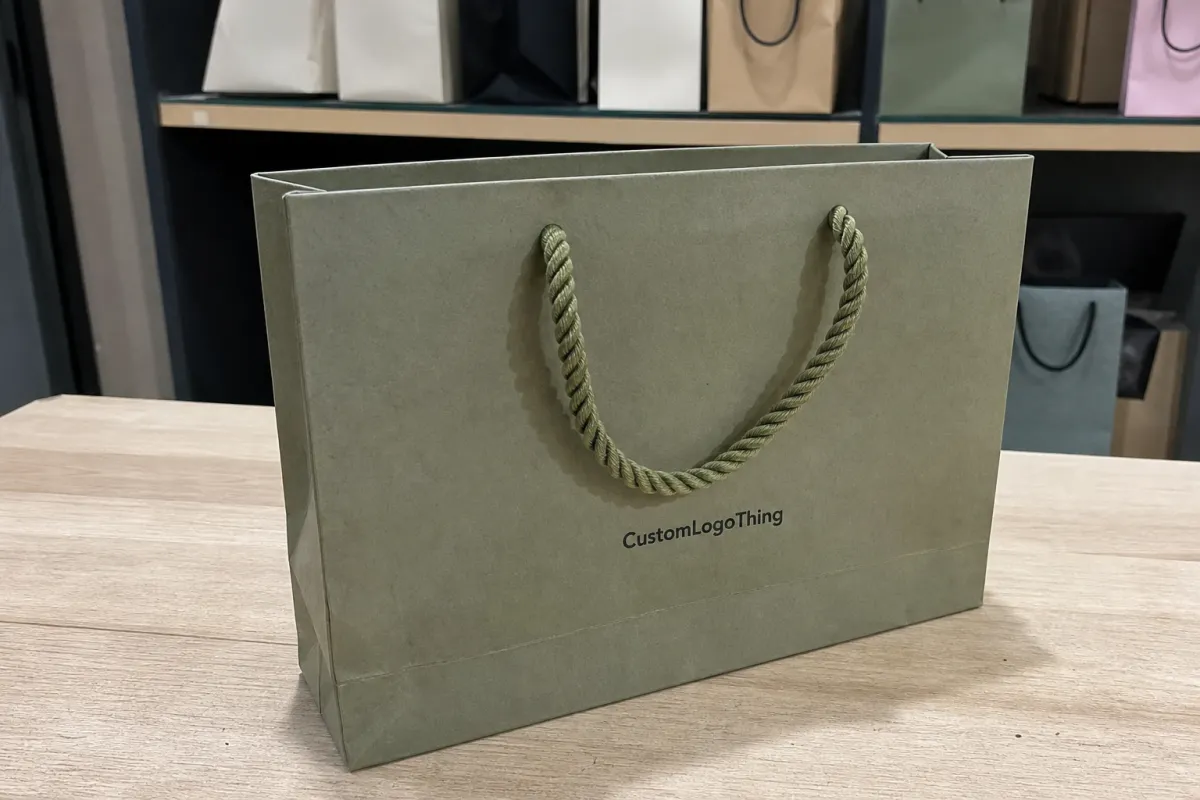
Most buyers start with print. I usually tell them to start with structure. A beautiful graphic on a weak bag still reads as a weak bag, because customers notice the first crease, the dipped top line, or the way the bag leans when it is lifted from one side.
Gift sets put uneven pressure on packaging. A fragrance bottle pushes differently than a stack of apparel. A candle is dense and vertical. A mug creates a point load. One item shifts sideways while another drives down into the base. That is why material choice matters more than artwork in many programs.
The brief should answer three questions before design starts: how heavy is the set, how much movement can happen during carry, and what kind of presentation does the brand need at handoff? If the answer is “premium retail,” the bag has to act like a premium object, not just resemble one in a PDF.
There is also a habit worth correcting: buyers often judge rope handle bags by the handle alone. In reality, a strong cord attached to a weak wall still fails. The handle is the visible part of the system, not the whole system. The wall, top fold, glue area, and base insert do just as much work.
For eco-led projects, claims need to be matched to construction. FSC certified paper, recycled content, and water-based inks are common requests, but they do not automatically make a bag recyclable or compostable in every market. A paper bag with a plastic cord and film lamination tells a different story from a kraft build with a paper rope handle and water-based ink.
That nuance matters when the bag carries branded language about sustainability. Buyers who skip it often end up with a packaging story that is technically true and practically muddy.
Paper stocks that hold shape without overbuilding cost
For rope-handle gift bags, the paper stock does a lot of the visual work before it does any physical work. Smooth coated board, natural kraft paper, and recycled sheets all communicate something different, and they also behave differently in folding, gluing, and print registration.
SBS and coated art board are usually the cleanest choice for sharp logos, saturated colors, and fine typography. They print well, laminate well, and give the bag a retail finish that suits cosmetics, premium confectionery, and branded gift sets. The main tradeoff is fold stress. If the crease rule is too tight or the board is too aggressively laminated, the coating can crack along the fold.
Kraft paper gives a warmer, more tactile result. It suits artisan food, wellness kits, and brands that want the package to feel natural rather than polished. Kraft is not automatically strong or cheap, though. Some stocks are softer than buyers expect, and heavy ink coverage can flatten the texture that made the material attractive in the first place.
Recycled board and post-consumer waste content are useful when the claim matters, but the sheet quality needs to be checked carefully. A recycled sheet can print acceptably and still fold poorly if the formation is uneven. Scuffing, curling, and cracking are not cosmetic issues only; they affect assembly speed and the bag’s life in use.
I often see buyers jump straight to corrugated board because they want strength. That can make sense for transport packaging, but it changes the feel completely. Corrugated is bulky, more structural than elegant, and usually belongs in shipper cartons rather than the gift bag itself. If the contents are heavy, the better answer is often a mid-weight board with proper reinforcement, not a thicker sheet for its own sake.
For a realistic starting point, many custom rope-handle gift bags use:
- 157-200 gsm coated board for smaller premium bags, usually laminated for durability.
- 170-230 gsm kraft or specialty paper for natural-looking builds.
- 1.5-2.0 mm gray board or chipboard for rigid structures or gift boxes paired with bags.
- Paper or film lamination chosen according to scuff resistance, not just appearance.
The stock choice should match the product weight, the brand message, and the folding geometry. If any one of those is ignored, the bag starts giving away the budget in the form of rework, damage, or a look that is less polished than the mockup promised.
For brands that need a third-party reference point, FSC certification speaks to responsible sourcing, while the bag’s overall material mix determines what can honestly be claimed about recyclability or compostability. That distinction is easy to miss and hard to fix after print approval.
| Stock option | Best use | Typical feel | Indicative unit price at 5,000 pcs | Notes |
|---|---|---|---|---|
| Coated art paper / SBS | Premium retail gift sets | Smooth, crisp, color-accurate | $0.32-$0.58 | Strong for print; needs careful creasing and lamination choice |
| Kraft paper | Natural, eco-led presentations | Tactile, warm, understated | $0.28-$0.50 | Works well for simple graphics; watch ink density and scuffing |
| Recycled board | Brands emphasizing recycled materials | Earthy, slightly less uniform | $0.30-$0.55 | Check surface consistency and folding behavior before approval |
Those prices move with size, coverage, and finish, but they give a practical starting point. A sheet that looks premium on a mood board can still fold badly, crack on the line, or hold glue poorly. The buyer feels that immediately, even if the spec sheet looks fine.
Size, structure, and load path: how to spec the bag before artwork starts
The biggest structural mistake is sizing the bag from the artwork, not from the contents. A bottle with a box, tissue, and a card needs different geometry than a flat clothing set. The bag should be built around the real load path: where the weight sits, where the pressure moves, and where the handle pulls.
Width, gusset depth, and height matter in different ways. Width affects how the contents stand. Gusset depth controls whether the bag can take a bulky item without buckling. Height influences whether the top edge closes cleanly once the set is packed. If the bag is too tall for the contents, it can look empty and unstable. If it is too short, the top edge deforms and the carry experience gets awkward.
For dense gift sets, the base deserves as much attention as the walls. A bottom insert made from chipboard, duplex board, or a matched paperboard layer helps the bag sit flat and resist bowing. That little layer is often the difference between a bag that stands upright on a retail table and one that leans after the first fill.
There is a useful rule of thumb: the heavier the contents, the more the bag should be designed around centered mass. If one item is much denser than the rest, use an insert, divider, or tray to keep the center of gravity from drifting. A bag that carries weight evenly always feels more expensive than one that looks impressive but twists in the hand.
Common practical specs buyers ask for include a gusset that gives enough side room for the main product plus tissue, and a top edge that can take repeated lifts without fraying or opening at the fold. For a medium gift set, the handle opening, base reinforcement, and bag height should be tested together, not treated as separate choices.
Dimension changes are expensive after the artwork has been approved. Move the panel by a few millimeters and the logo may cross a fold, a pattern may land off-center, or a foil stamp may require a new plate. Lock the structure first. The visuals should follow the bag, not fight it.
How rope handles and reinforcements actually carry the load
The rope is only one part of the load path. The real question is how stress moves from the handle into the top edge and down into the side walls. That is where low-cost bags often fail. The cord does not break first; the paper around the opening elongates, crushes, or tears after repeated lifts.
Cotton rope feels soft in the hand and usually reads as more premium. It is a good fit for gift-led packaging, especially when the bag needs a natural appearance. Polypropylene rope is more economical and often more consistent in diameter and color, which helps at higher quantities. Blended cords sit between those two. The right pick depends on comfort, cost, and the tone the brand wants to project.
Handle diameter also changes the experience. A thinner cord can look neat but may bite into the hand with a heavy load. A thicker cord spreads pressure more comfortably, though it can look casual if the bag is supposed to feel refined. Most buyers are surprised by how noticeable that difference becomes once the bag is full.
The attachment method matters just as much. Punched holes are the cheapest option, but they concentrate stress in the board around the opening. Eyelets and grommets spread that stress and usually make the bag feel more finished. A glued anchor patch, folded top edge, or reinforcement strip can make a large difference to tear resistance, especially on heavier gift sets.
For practical testing, I prefer to see the bag loaded with the real contents and then handled the way a customer would actually use it:
- Lift it by one handle and then both handles.
- Hold it for several minutes, not a few seconds.
- Tilt it slightly and watch the gussets and top edge.
- Set it down and check for base bowing or corner crushing.
- Repeat the lift after the bag has been carried once, because first-lift behavior can hide weak glue or brittle folds.
That is not a lab protocol, but it exposes the usual problems quickly. If a bag shifts too much under load, the handle zone needs more reinforcement or the contents need internal support. A simple tray or divider can stabilize the set and reduce twist, which is often more effective than just making the rope thicker.
For shipping and transit checks, the logic behind ISTA methods is useful because it forces the buyer to think about vibration, handling, and stress instead of assuming the bag will always be carried upright by one person for ten seconds. Real use is messier than that.
Finish, print, and insert choices that make the set feel premium
Finish is where the bag starts to tell the brand story, but finish should never be asked to carry structure. Matte lamination gives a quieter, modern read. Gloss pushes saturation and makes dark art feel sharper. Soft-touch adds a velvety hand-feel that buyers often associate with cosmetics, fashion gifting, or premium seasonal sets. Foil, embossing, and spot UV can each strengthen the impression, provided they are used with restraint.
The biggest print difference is usually between coated stock and kraft paper. On coated board, black stays black, fine type stays clean, and metallic accents can look crisp. On kraft paper, the same colors shift warmer and less exact. That is not a flaw. It is what the material does. Still, if a brand needs strict color control, kraft should be approved with physical samples, not only digital proofs.
Heavy ink coverage changes the build as well. A full-bleed dark design can look excellent, but it often reveals fold stress sooner and can show scuffing faster at the corners. Thin reversed type and delicate rules should always be checked at actual size, particularly on textured or recycled surfaces.
For curated gift sets, inserts and dividers often matter more than buyers expect. If the contents can slide around, the bag loses its shape the moment it is picked up. A base support, die-cut tray, or paper divider keeps items centered and visible, which improves both presentation and carry stability.
One caution: more decoration does not equal more value. A clean logo, a good board, and one strong finish choice usually feel richer than a bag packed with foil, gloss, emboss, and spot UV all at once. The better bag is often the one that stops one step earlier.
Cost, pricing, MOQ, and quote factors buyers should model first
Most quote confusion comes from looking at a single line item. A rope handle gift bag is priced by the whole build, not by the paper alone. Stock, thickness, handle material, reinforcement, finish, insert work, and packing format all move the number.
For many custom programs, MOQ often sits around 1,000 to 3,000 units, though retail runs commonly move higher. The issue is not only the minimum order. It is how the MOQ changes the unit cost. A 1,000-piece order can look expensive per bag, while a 5,000-piece order often drops the price noticeably. That helps if the size and artwork are stable, but it creates inventory risk if the design may change soon.
At 5,000 pieces, a clean medium-size bag might land around $0.28-$0.42 per unit with one-color print and standard PP rope. Add soft-touch lamination, foil, embossing, a reinforced top edge, or custom inserts, and the number can move into the $0.70-$1.20 range quickly. That spread is normal. Buyers who ask for a single “best price” without defining the build usually get a number that is cheap for the wrong product.
Quotes should spell out tooling, sampling, color matching, finish plates, and shipping packaging. If the quote is vague, ask what is included and what is not. A low number that excludes proofing or assumes lighter board can cost more later once rework, damage, or presentation issues show up.
A better way to compare suppliers is to compare the bag as a finished object:
- What board or paper is used, and at what weight or caliper.
- How the handle is attached and reinforced.
- Whether the finish adds scuff resistance or only appearance.
- Whether the pack-out protects the bag shape during freight.
- Whether the quote includes a real sample and not just a flat proof.
Sustainability-driven programs should ask for specific material declarations. FSC certified board, recycled content, and water-based inks can all be part of the build, but the handle and lamination still matter. A paper bag with a plastic cord and film layer is not the same claim as a fully paper-forward structure. That distinction affects both marketing and compliance.
The buyer mistake I see most often is choosing the cheapest bag and paying later in broken handles, repacking, or disappointing shelf presence. Saving a few cents on paper is rarely a win if the bag has to be replaced or the set has to be reworked at the warehouse.
Production steps and lead time from sample to shipment
A clean project usually follows the same path: spec review, artwork confirmation, sample production, sample approval, mass production, inspection, and shipment. Buyers often compress those steps in their heads, but each one takes time, especially when the bag uses custom dimensions or specialty finishing.
Sample approval is the point that saves most projects from expensive mistakes. On screen, handle placement may look centered. On the physical sample, the pull can lean slightly, the crease can land too close to the print, or the base may show a weak point once loaded. Physical samples are worth the time whenever the set carries real weight or the branding is high-visibility.
Lead time depends on more than factory speed. Custom dies, hot foil, special lamination, imported paper, and seasonal congestion all stretch the schedule. A simple production run may move in 12-15 business days after proof approval, while a more involved build can need 20-25 business days before packing and export. Sampling often adds another 5-8 business days, and freight can add more depending on route and season.
Work backward from the launch date or event date. If the bags are for a trade show, holiday program, or retailer activation, leave time for one round of revisions. Rushed orders nearly always push buyers into compromises on board weight or finish, and those compromises tend to show up in handling.
One small but important check: confirm carton pack-out and shipping dimensions early. A bag that seems efficient in production can take more freight space than expected if it is bulky, heavily reinforced, or packed with inserts. That affects landed cost just as much as the unit price does.
Also ask for a pre-production sample or photo proof of the assembled bag, not just loose components. Handle length, knot placement, and top-edge folding can shift during assembly. If those details are wrong, the rest of the build is harder to trust.
Common mistakes and the next checks before you place the order
The most common mistake is treating the bag as an afterthought. Buyers finalize the set, then try to squeeze the bag around it. That order of operations causes trouble. The bag should be sized to the actual contents, including tissue, protective packing, dividers, and any small accessories that sit beside the main item.
Another mistake is choosing a handle for style alone. A soft cotton rope can feel great, but if the bag is heavy and the top edge is weak, comfort does not save the pack. A shiny cord may look neat but feel awkward in the hand. The handle should match the load, the brand tone, and the carry experience.
Before you place the order, confirm these points:
- Final bag dimensions and gusset depth.
- Contents weight and any shifting risk.
- Paper stock, finish, and print coverage.
- Handle material, attachment method, and reinforcement.
- Quantity target, MOQ, and replenishment plan.
- Delivery window, sample deadline, and freight method.
Do not approve artwork until the size is locked. A beautiful layout can fail if the logo crosses a fold or if the artwork has to move after the structure changes. That sounds basic, but it is one of the most expensive mistakes in custom packaging.
If sustainability messaging matters, keep the claim language precise. FSC certified board is not the same as a fully biodegradable packaging system. Recycled materials do not automatically make a bag recyclable in every market. The right claim depends on the actual build, local regulations, and the materials used in the handle and finish.
One useful final check is to compare the sample against the intended use, not against a general expectation of quality. A good bag for jewelry can be the wrong bag for a bottle set. A good bag for a holiday kit can be wrong for a luxury skincare launch. The right choice is the one that supports the set it actually carries.
That is the useful version of a gift set Rope Handle Gift Bags material guide: not a list of trendy materials, but a way to match structure, load, finish, and budget without letting one weak detail drag down the whole presentation.
FAQ
What paper stock is best for gift set rope handle gift bags?
Choose the stock that balances stiffness, print quality, and fold durability. SBS or coated board usually suits premium printed sets, while kraft paper works well when a natural tactile look matters more than high-gloss color. If the set is heavy, prioritize how the board folds and how the handle is anchored, not just the visual finish.
How thick should the bag be for a heavier gift set?
Match thickness to the real load, not only the visual style. A well-reinforced mid-weight board often performs better than an oversized sheet with weak folds or poor handle anchoring. For dense sets, a stable base insert and a reinforced top edge usually matter more than sheer thickness.
Are rope handle gift bags strong enough for glass items?
Yes, if the bag includes proper reinforcement, a stable base insert, and a handle attachment method that spreads the load cleanly. Glass items should not shift inside the bag, because movement can stress the bottom and top edges during carry. A divider or snug tray can make the difference between acceptable and fragile.
What drives the price of custom rope handle gift bags most?
Paper grade, board thickness, print coverage, handle material, reinforcement, and specialty finishes usually drive the biggest price changes. MOQ also affects unit cost, so the same design can look much cheaper at higher volume even when setup cost stays similar. Freight dimensions matter too if the bag is bulky or packed with inserts.
How long does production usually take after approval?
Timing depends on sample approval, material availability, and whether the bag uses special finishes or custom structural parts. A realistic plan should include artwork confirmation, sample review, production, and shipping. Simple runs can be relatively quick, while custom builds with foil, lamination, or complex inserts need more buffer.

