Fleece Lined Beanies Artwork Proof Checklist for Coffee Shops
Most custom beanie problems do not begin with careless stitching. They begin a few steps earlier, inside the proof: a logo line too thin for thread, a warm beige thread that nearly disappears against oatmeal knit, a cuff fold that hides the lower half of a badge once the beanie is actually worn. A fleece lined beanies Artwork Proof Checklist for coffee shops gives owners, managers, roasters, and merch buyers a practical way to review the visible and functional details before production starts.
An artwork proof is more than a pretty mockup. It should show the decoration size, logo placement, beanie color, thread or patch colors, cuff position, label or patch layout, and any notes about fleece lining or construction. A mockup helps the team picture the item; a proof tells production what to make.
Coffee shops use fleece lined beanies in several different ways. Some sell them beside retail coffee bags and mugs during colder months. Some issue them to baristas working outdoor kiosks, delivery runs, market booths, or patio service. Others use them in gift boxes with beans, drink cards, candles, or brewing accessories. The beanie needs to feel warm and wearable, but it also has to sit naturally inside the shop’s brand system.
Soft knit fabric is not a cup sleeve, kraft bag, menu board, or sticker. It stretches. It casts shadows through the ribs. Embroidery pulls against the surface, while patches and labels add their own edges, thickness, and texture. Fleece lining adds warmth and structure, but it can also change the way the cuff folds and where the artwork lands on the forehead.
The proof is the point where brand standards meet real material limits. If the review is rushed, small issues become expensive. If the proof is checked carefully, the finished beanies tend to look cleaner, feel more intentional, and reorder with fewer surprises.
How Artwork Proofs Work on Fleece Lined Beanies
The usual path is simple. The buyer sends logo files, brand colors, preferred beanie style, decoration method, and order quantity. The supplier reviews whether the design can be produced cleanly, prepares a proof, and waits for written approval before moving into sampling or bulk production. That approval matters; it is the moment a discussion becomes a production instruction.
A digital mockup and a production proof are not the same document. A mockup may show a logo sitting on the front of a beanie at a general size. A production proof should specify decoration width and height, thread or patch colors, attachment method, material notes, and sometimes stitch count or label construction. “Front embroidery, 2.75 inches wide, centered on 3-inch cuff, cream thread” gives useful direction. A logo floating on a stock beanie image does not give enough control.
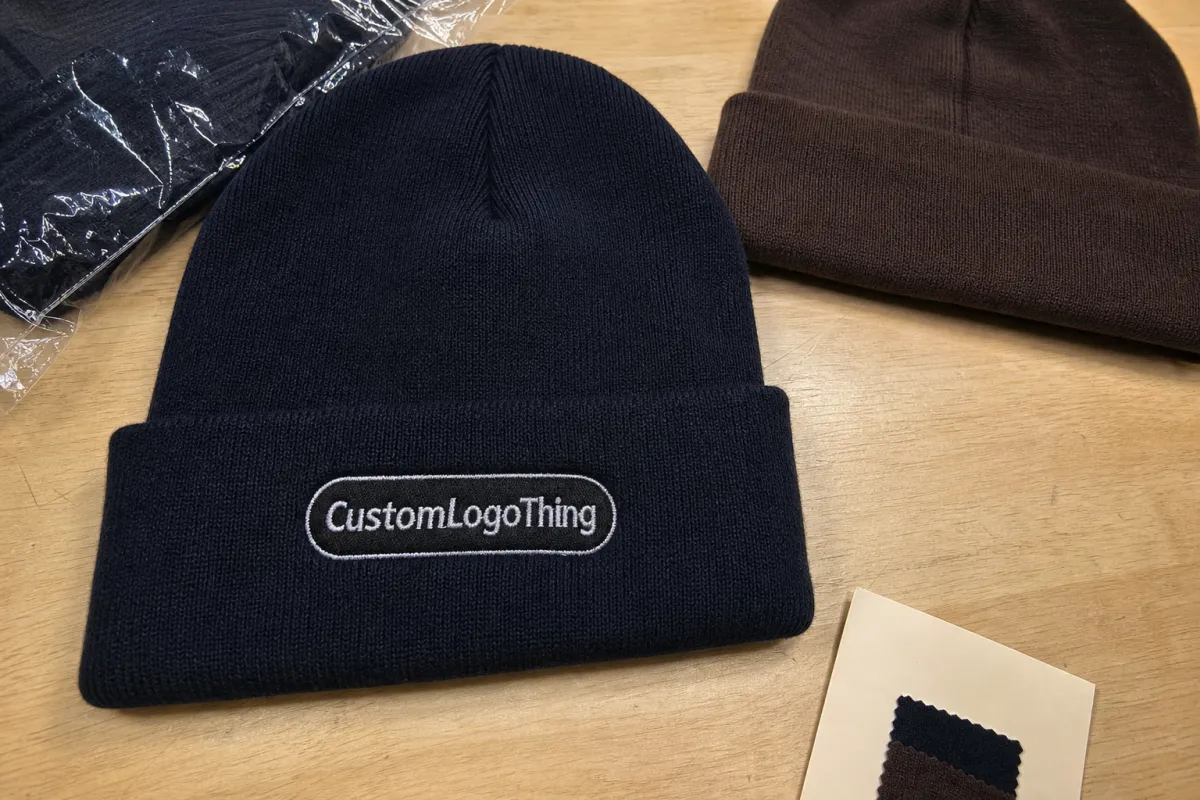
Common decoration methods for coffee shop beanies include direct embroidery, woven labels, faux leather patches, rubber or silicone patches, and folded tags. Embroidery has a familiar stitched look and works best with bold marks, clean initials, simple icons, and limited small type. Woven labels hold finer detail and can suit badge-style logos or multi-color artwork. Faux leather patches often fit roaster branding, lodge-style retail displays, and warm heritage color palettes. Rubber patches feel more modern and durable, especially for outdoor carts, winter markets, and brands with bold graphic systems.
Fleece lining changes the review because the interior layer adds loft and firmness. A lined beanie may not fold exactly like an unlined acrylic knit. The cuff can feel thicker, the front panel may stand slightly differently, and the decoration can shift visually once the beanie is pulled onto a head. Many cuffed beanies are shown with a fold around 2.5 to 3.5 inches deep, but staff and customers do not all wear them the same way.
For embroidery, artwork usually needs digitizing. That means converting the logo into a stitch file with defined stitch types, stitch direction, density, underlay, trims, and thread changes. Tiny type, distressed textures, gradients, hairline steam marks, and delicate bean illustrations often need simplification. The cleanest beanies usually come from restraint, not from forcing every printed detail into thread.
Proofing rule: review the beanie as a worn product, not only as flat artwork. Confirm where the logo lands after the cuff is folded, whether the mark is centered, whether colors are named or matched, and whether the fleece lining style is clearly specified.
Logo, Stitch, Color, and Placement Details to Check
Start with legibility. Coffee shop logos often include beans, steam lines, founding dates, neighborhood names, circular badge type, or hand-drawn illustrations. Those details may be beautiful on a 12-ounce bag label, then collapse when reduced to a two- or three-inch embroidery area. If a tagline falls below roughly 0.12 inch in letter height, it may need to be removed, enlarged, or moved to a woven label.
Size needs a practical eye. A front cuff logo should read from a few feet away without turning the beanie into a billboard. Many direct embroidery marks land around 2.25 to 3.25 inches wide on a front cuff, while a small side tag may be closer to 0.75 to 1.25 inches. Larger decoration is not automatically better. Dense stitching over a soft rib knit can pull, pucker, or feel stiff if the artwork area carries too much thread.
Color deserves more care than it often gets. Screen colors are only a guide. Thread has sheen. Knit has depth. Faux leather absorbs light differently from rubber. A warm cream thread on a tan beanie may look refined in a PDF, then lose contrast under amber cafe lighting. Black thread on espresso-brown knit can disappear from three steps away. For beanies that need to photograph well online, contrast usually matters more than a perfect digital color match.
Placement checks should be exact. Confirm whether the proof shows the beanie flat or worn, whether the logo is centered on the front panel, whether the cuff height is specified, and whether the decoration remains visible after folding. If the proof shows a 3-inch cuff but the team tends to fold the beanie closer to 2 inches, the logo may sit too high or run into the fold.
Line weight and negative space need the same review. Thin outlines, tight counters inside letters, fine script, and narrow steam lines can close up in embroidery. Woven labels and printed patches may hold finer detail, but they still have minimum line weights, edge tolerances, color limits, and texture constraints. A useful checklist asks one plain question before approval: will this logo still read clearly at actual size?
Compare the proof against the shop’s most visible brand pieces. Put it beside a cup sleeve, retail coffee bag, apron, loyalty card, takeout sticker, menu board, or gift box label. The beanie does not need to match every item perfectly, but it should look like it belongs to the same family. If the shop’s brand is quiet and tonal, a high-contrast rubber patch may feel too aggressive. If the brand is graphic and modern, a rustic faux leather patch may soften the identity more than intended.
Process, Timeline, and Approval Flow Before Production
A clean approval flow usually looks like this: Request a Quote, submit artwork, select the fleece lined beanie style, choose the decoration method, receive the digital proof, review or request revisions, approve the final proof, then move into sampling or bulk production. Higher-value retail runs, first-time patch programs, and complex embroidery may include a pre-production sample before the full order is released.
The proofing stage is one of the most controllable parts of the timeline. Organized feedback can keep an order moving. Scattered comments from five people can add several business days before production even starts. If the beanies are tied to holiday gift boxes, winter patio service, a new location opening, or a limited roast launch, that delay can matter more than the team expects.
One decision-maker helps. The owner may care about brand tone. The marketing lead may focus on logo accuracy and color. The operations manager may care about comfort, staff uniformity, and delivery timing. All of that input is useful, but it should be consolidated before replying to the supplier. Mixed notes create avoidable revisions: make the logo larger, make it smaller, move it down, change the beanie color, return to the first version.
Sample timing depends on risk. A pre-production sample can add several business days, and sometimes longer if a custom patch, mold, or label must be made first. For a new retail beanie expected to sell around $22 to $34, that sample can be worth the time because shelf appeal, comfort, and perceived quality directly affect sell-through. For a repeat order using the same logo, same beanie, and same decoration method, a detailed proof with confirmed specs may be enough.
Typical production varies by quantity, decoration type, stock availability, and shipping method, but many decorated beanie orders fall around 12 to 20 business days after proof approval. Rush production may be possible, though it can narrow decoration options, reduce time for sampling, and raise cost. If the beanies need to be packed into gift boxes, sorted by location, labeled for retail, or photographed before launch, build that work into the schedule instead of treating delivery date as the only deadline.
Cost, MOQ, and Pricing Factors Hidden in the Proof
Proof choices can change the quote. A simple one-color embroidered logo prices differently from a multi-color woven label, an oversized faux leather patch, or a dense stitched badge with five thread colors. The proof is not only a visual checkpoint; it is also a cost checkpoint.
Main pricing variables include the base beanie style, fleece lining type, order quantity, decoration method, logo size, number of colors, setup or digitizing needs, sample requirements, packaging preferences, and shipping schedule. MOQ, or minimum order quantity, is tied to blank inventory, decoration setup, custom label or patch production, and the efficiency needed to keep unit cost reasonable. For many basic decorated beanie programs, buyers often see order breaks around 48, 72, 144, or more pieces, while custom patches or labels may carry higher minimums.
| Decoration Option | Best Fit | Typical Cost Behavior | Proof Detail to Check |
|---|---|---|---|
| Direct embroidery | Simple logos, bold initials, clean icons | Often economical at 48 to 144+ pieces; stitch count affects price | Digitized size, stitch density, thread colors, small text removal |
| Woven label | Badge logos, small type, multi-color designs | May require higher MOQ, but detail can be cleaner than embroidery | Label dimensions, edge finish, sew-down position, color palette |
| Faux leather patch | Rustic coffee merch, roaster branding, retail displays | Patch setup and size affect unit cost; larger patches add material cost | Deboss or print style, patch color, corner radius, stitch line |
| Rubber or silicone patch | Modern outdoor feel, durable merch, bold logos | Custom mold or setup can raise initial cost | Patch thickness, raised areas, color count, attachment method |
Reducing detail can save money without weakening the brand. Removing tiny founding dates, using two thread colors instead of four, or switching a crowded circular logo to a woven label can produce a sharper beanie and a more predictable unit cost. A dense embroidery file with high stitch count may also feel stiff on the cuff, which is not ideal for a soft fleece lined style meant to be worn for hours.
If the beanies will be sold near the register or online, review landed cost against the planned retail price. Decoration is only one part of the math. Freight, polybags, hang tags, barcode labels, custom packing, and split shipments all affect margin. A beanie that lands at $8.50 and sells for $24 has a different margin profile than one that lands at $13.75 and sells for the same price.
Watch for proof details that may signal extra cost: oversized decoration areas, metallic thread, specialty patches, custom PMS matching, retail labeling, rush production, and shipments to multiple cafe locations. Ask pricing questions while reviewing the proof, not after approval. Late changes can require reproofing, and in some cases they can restart setup work.
Step-by-Step Proof Review for Coffee Shop Teams
A simple desk workflow prevents most mistakes. Open the proof beside the original logo file, brand guide, or the most accurate printed reference you have. If your retail coffee bag is the best color reference, use it. Digital brand colors do not always translate neatly to thread, woven yarn, rubber, or faux leather.
- Confirm the logo version. Check that the correct mark is being used: horizontal, stacked, icon-only, badge, or simplified merch version.
- Review the beanie style. Confirm fleece lining, cuffed or uncuffed shape, knit texture, beanie color, and any sizing notes.
- Check the decoration method. Verify whether the design is direct embroidery, woven label, leatherette patch, rubber patch, or folded tag.
- Confirm dimensions. Review the width and height in inches or millimeters, not just how the proof looks on a page.
- Inspect color callouts. Ask whether thread, patch, or label colors come from an available palette, are approximated to brand colors, or can be specifically matched.
- Review legibility at real size. Print the proof at actual scale if possible, or view it on screen at approximate beanie size.
- Check cuff placement. Confirm cuff height, center point, and whether the logo remains visible after the fold is set.
- Consolidate feedback once. Reply with specific changes such as “increase logo width to 2.75 inches,” “change thread to cream,” “center on cuff,” or “remove small tagline.”
- Save the final proof. Keep it with the quote, purchase order, invoice, and artwork files for easier reorders.
The checklist works best as a shared internal tool, not as a long email chain. One person can check art, one can check operations details, and one can confirm budget, but the final response should read like a single clear instruction set. Manufacturers can work with specific notes; they struggle with unresolved preferences.
For packaging and shipping expectations, especially if the beanies are part of gift kits or mailer boxes, standards from groups like ISTA can help teams think about distribution testing and transit risk. If your brand cares about certified paper hang tags or FSC-labeled retail packaging, review options through the Forest Stewardship Council before final packaging is specified.
Common Proofing Mistakes That Make Beanies Look Off
The most common mistake is approving artwork that is too detailed for the decoration method. Coffee shop marks often carry a lot of personality: vintage seals, tiny roaster names, illustrated mugs, hand-lettered script, or rough ink texture. Those details may need editing before embroidery can hold them cleanly.
Ignoring cuff height causes trouble too. If the decoration is placed too low, it can sit on the curve of the fold or disappear into it. If it is placed too high, it can look like it is floating above the front zone. A quarter inch can make a visible difference on a cuff that is only 3 inches tall.
Color assumptions lead to real disappointment. A brown patch on a brown knit may look tonal and premium in a rendered proof, then read flat under cafe lighting. Cream thread on oatmeal knit may feel soft and tasteful, but it may not photograph well for online merch. Tonal branding can work beautifully, but it should be chosen deliberately rather than discovered after the cartons arrive.
Another mistake is treating the proof like a lifestyle image. A proof should be reviewed for measurements, production notes, decoration method, color callouts, and construction details. If the image looks attractive but lacks specs, the team still needs answers before approval.
Too many reviewers can also create problems. Brand feedback is useful, but late changes from owners, baristas, marketers, and event teams can conflict. One person asks for a larger logo. Another asks for a smaller logo. Someone else changes the beanie color. That is how the wrong version gets approved, even when everyone had good intentions.
File problems show up often. Screenshots, low-resolution JPEGs, flattened artwork, and logos pulled from social media can lead to redraw time or inaccurate edges, especially on patches and labels. Vector files such as AI, EPS, or editable PDF are usually best because they keep curves clean and allow accurate resizing. If only a PNG or JPG exists, send the highest-resolution version available and expect the supplier to review whether simplification or redrawing is needed.
Finally, do not approve only the art and forget the order details. Quantity, shipping address, required delivery date, packaging needs, and split shipments should be checked alongside the final proof. The cleanest logo proof cannot fix a beanie order that ships to the wrong location or arrives after the winter merch table is already set.
Next Steps Before You Approve the Final Beanie Proof
Before requesting the final proof, gather the final logo file, preferred beanie color, desired decoration method, target quantity, budget range, delivery date, and brand color references. If the beanies are going into gift boxes or retail displays, gather hang tag, folding, barcode, and packing requirements too. Those details may feel separate from artwork, but they often affect timeline and landed cost.
Build a short internal checklist that includes logo version, decoration size, cuff placement, color contrast, fleece lining confirmation, MOQ, unit cost, production timeline, shipping plan, and final approval authority. It does not need to be elaborate. A one-page checklist can prevent a $2,000 merch order from being approved with the wrong mark, the wrong cuff placement, or a thread color that looked fine only on screen.
Decide the main purpose of the beanie before judging the proof. Staff gear needs comfort, warmth, and durability through repeated wear. Customer merch needs retail finish, clean branding, and a price point that makes sense near the register. Gift box items need presentation and packability. Event giveaways may prioritize budget and lead time. The right proof decision depends on that use.
Ask direct questions before approval: Is this logo suitable for embroidery at this size? Would a woven label hold the detail better? Are the thread colors high-contrast enough? Does the fleece lining affect cuff placement? What happens to the schedule if one more revision is requested? A good supplier should be able to answer plainly, even when the answer depends on stock, artwork, quantity, or decoration method.
Save the approved specs for future reorders, especially if the shop plans seasonal colors, new location merchandise, or recurring winter drops. Consistent files reduce proofing time and help the brand look steady across repeat production runs. A fleece lined beanies Artwork Proof Checklist for coffee shops is not paperwork for its own sake; it is the practical bridge between a warm merch idea and a finished beanie that looks clean, feels comfortable, and represents the cafe well every time it is worn.
FAQ
What should coffee shops check first on a fleece beanie artwork proof?
Start with the logo version, decoration size, and placement on the cuff because those details determine whether the beanie reads clearly when worn. Then confirm beanie color, fleece lining, decoration method, thread or patch colors, quantity, and delivery timeline before approving production.
Is embroidery or a patch better for fleece lined beanies for coffee shops?
Embroidery works well for clean, simple logos with strong shapes and limited fine detail. Woven, faux leather, or rubber patches are often better for small type, badge-style logos, or designs that need a stronger retail merchandise finish.
How does fleece lining affect the artwork proof for custom beanies?
Fleece lining can add thickness and structure, which may influence how the cuff folds and where the logo sits when the beanie is worn. The proof should confirm the lining, cuff height, decoration position, and whether the chosen decoration method works with the added interior layer.
What artwork files are best for a coffee shop beanie proof checklist?
Vector files such as AI, EPS, or editable PDF are usually best because they keep edges clean and allow accurate resizing. If only raster files are available, provide the highest-resolution PNG or JPG possible, but expect the manufacturer to review whether redrawing or simplification is needed.
Can a fleece lined beanies artwork proof checklist help control cost?
Yes. Checking logo complexity, color count, decoration size, MOQ, packaging, and shipping requirements before approval helps avoid surprise changes later. A clear checklist can also show when simplifying the artwork or changing from embroidery to a label or patch will improve both appearance and unit cost.