A rainstorm will expose a weak mailer in minutes. A bad QR code can take weeks to notice, which is why a waterproof apparel mailers Artwork Proof Checklist for coffee shops matters before a single bag prints.
Think about a typical merch order: one limited-edition hoodie, a sticker, a loyalty card, and perhaps a bag of beans packed separately so the apparel does not pick up aroma or oil. The Waterproof Apparel Mailer may survive the porch delivery without tearing or soaking through. That is only half the job. If the QR code points to last month’s seasonal menu instead of the new merch page, every bag in the run now carries the same quiet error.
Waterproof Apparel Mailers Artwork Proof Checklist for Coffee Shops: What It Catches
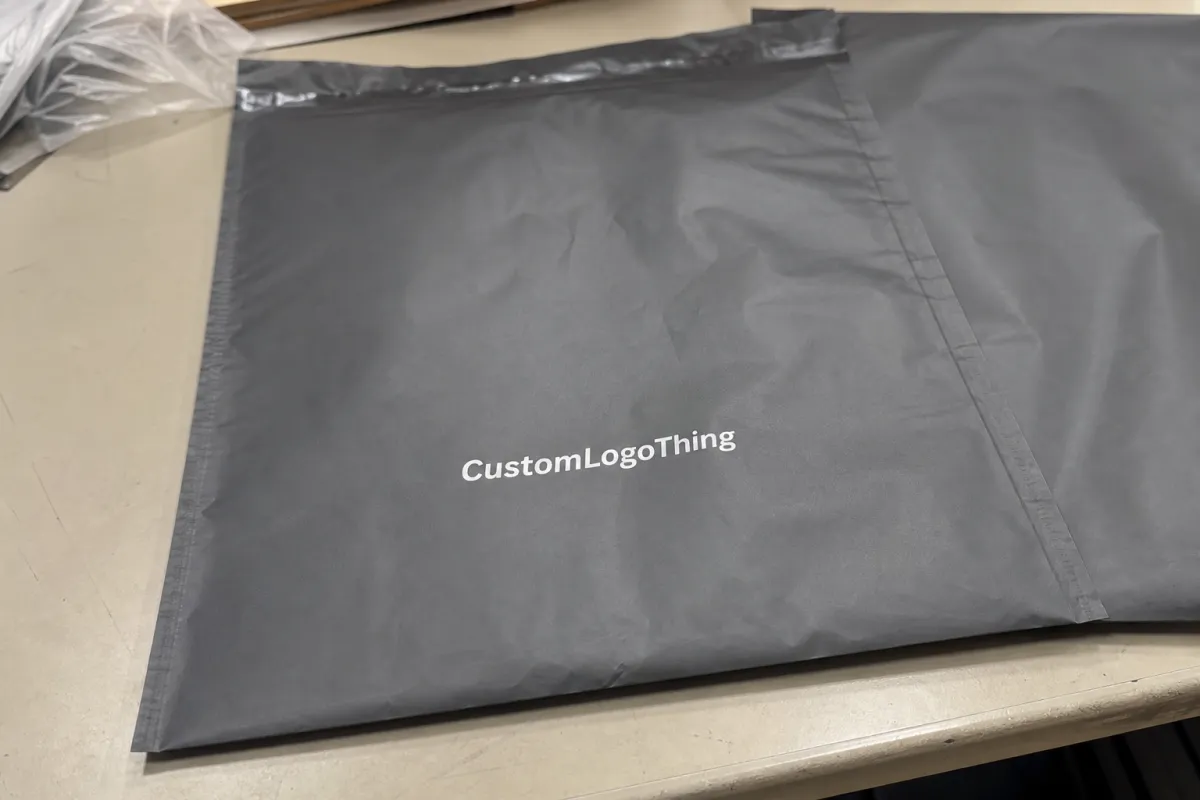
Waterproof apparel mailers are usually polyethylene mailing bags designed for soft goods: T-shirts, aprons, sweatshirts, caps, staff uniforms, and branded cafe merchandise. Coffee shops use them because they are lightweight, moisture-resistant, printable, and far easier to store behind the counter than stacks of corrugated boxes. A 10-by-13-inch or 12-by-15.5-inch poly mailer can often hold a tee, apron, or lightweight hoodie without adding much dimensional weight.
The artwork proof is the last practical checkpoint before production. It confirms finished size, print placement, logo scale, copy, color references, barcode readability, seal zones, and brand consistency before the supplier treats the file as approved.
Small coffee teams are especially exposed to proofing mistakes because packaging approval rarely belongs to one full-time packaging manager. The same person may approve mailers, post the merch drop, order cups, update a catering form, and handle a vendor call before lunch. Add rain exposure, courier delivery, mixed orders, and seasonal campaigns, and the mailer has to perform physically and visually.
A good checklist protects two things at once: the bag’s shipping function and the first branded moment the customer sees before touching the product. A wet cardboard mailer fails visibly. A bad proof fails quietly across every printed unit.
Proofing rule: if the error would annoy you on one bag, it becomes expensive on 1,000 bags. Packaging multiplies small decisions.
How Waterproof Apparel Mailers Work for Coffee Shop Merch
Most waterproof apparel mailers are made from polyethylene film with a pressure-sensitive adhesive strip and a fold-over flap. Typical film thickness for apparel shipping often ranges from about 2.0 to 3.0 mil, with heavier or more puncture-prone contents pushing buyers toward thicker film or co-extruded material. The goal is straightforward: keep flexible goods protected from normal handling, light abrasion, and moisture during transit.
These bags are not coffee bags. Coffee packaging is built around aroma barrier, degassing valves, food-contact requirements, and shelf presentation. Apparel mailers are built around low shipping weight, exterior branding, tamper resistance, moisture resistance, and fast packing. That distinction matters if an order includes beans, paper inserts, enamel pins, fragile retail items, or anything that needs rigid protection.
Before reviewing artwork, buyers should understand the functional specs behind the proof:
- Film thickness: standard apparel mailers may sit around 2.5 mil, while bulky hoodies or mixed bundles may need more strength.
- Opacity: white or colored film can hide contents; thin or light film may show shadows from dark garments.
- Tear and puncture resistance: important for caps, zippers, embroidered patches, folded sweatshirts, and staff uniform bundles.
- Adhesive strength: the seal should close cleanly and stay closed during normal handling.
- Print surface treatment: ink adhesion depends on the film surface and print method, not only on the quality of the art file.
Waterproofing comes from the film repelling moisture and the sealed flap protecting the opening. Still, overstuffing, wrinkles near the adhesive, dust on the seal area, and crooked closing can create weak points. Waterproof does not mean crush-proof, insulated, food-safe for loose beans, or suitable for hot drink products.
Artwork interacts with performance near folds, seams, perforations, adhesive strips, and scanner zones. A logo placed too close to the flap may look balanced on a flat template, then distort once the bag is filled and sealed. A barcode near a crease can fail in a packing station. For coffee shop merch, the art and the bag construction need to be reviewed together, not as separate tasks.
Artwork Proof Factors That Decide Whether the Bag Prints Cleanly
A strong proof review has three layers: what customers see, what printers need, and what fulfillment teams must scan or handle. Skip one layer and the risk does not disappear; it simply moves to production, packing, or delivery.
Logo, Type, and Brand Assets
Start with the logo. Confirm the correct version, clean edges, no accidental stretching, and enough contrast against the mailer color. A cream logo on a tan, kraft-inspired film may feel warm and cafe-friendly on screen, then lose definition under warehouse lighting or in a delivery photo. Vector files such as AI, EPS, or production-ready PDF are preferred because they scale without pixelation.
Typography deserves its own pass. Check spelling, line breaks, small-type legibility, URL accuracy, social handle accuracy, and final printed size. A 7-point tagline may look tidy on a laptop proof and become nearly unreadable on flexible, slightly glossy film. View the art at 100 percent scale whenever possible, then step back and judge it like a customer would.
Color, Layout, and Print Reality
Color is where expectations often wobble. Pantone references help when brand color matters. CMYK values may be used for process printing. White ink underbase can affect brightness on colored or transparent film. Screen color is not a printed color guarantee; substrate, ink system, curing, film color, and print method all influence the result.
Layout checks should include bleed, trim, live area, seam clearance, adhesive-strip clearance, and front-versus-back orientation. Ask for no-print zones in writing. A placement tolerance of plus or minus 1/8 inch may be acceptable for many Custom Poly Mailers, but tight borders, centered badges, or thin rules can make normal production movement look like a mistake.
QR Codes, Barcodes, and Coffee-Specific Copy
QR codes and barcodes need quiet zones, high contrast, and printed-size testing. Scan from a phone. Scan from a printed proof at final size. Type the backup URL manually. If the campaign uses UTM parameters, confirm the landing page is live before approval and that the destination will not be retired after a short promotion.
Coffee shops carry content risks that general apparel brands may not have: seasonal drink names, limited roast labels, event dates, neighborhood references, loyalty offers, and claims such as recyclable, compostable, or waterproof. Be careful with sustainability language. The U.S. Environmental Protection Agency offers useful context on recycling systems and claims at epa.gov/recycle, but local acceptance still varies by material, ink coverage, store drop-off access, and municipality.
Process and Timeline: From Art File to Approved Production Proof
The usual path starts with the buyer sending bag size, quantity, film color, print colors, logo files, final copy, and deadline. The packaging supplier checks feasibility, flags missing assets, and prepares a digital proof. If you are comparing formats, Custom Logo Things lists related Custom Packaging Products that can help buyers separate apparel mailers from other branded packaging styles.
File review is often the first delay point. Vector logos are preferred. Raster artwork generally needs to meet resolution requirements, often 300 dpi at final print size for detailed graphics, though the supplier’s print method controls the exact requirement. Screenshots, compressed social media graphics, low-resolution website logos, and artwork copied from a menu PDF usually trigger rework.
The first digital proof should show finished dimensions, print location, front and back views if relevant, color callouts, and production notes. Good proofs make risk visible. Bad proofs make buyers guess. If a proof does not show the adhesive strip, flap direction, seams, or no-print zones, ask for a clearer version before anyone approves it.
Inside a coffee shop, approval should not depend on one tired person at closing time. The owner checks brand. Marketing checks campaign copy. Operations checks the shipping use case. E-commerce checks QR codes, barcodes, URLs, and landing pages. One round of revision may solve a simple logo move; size changes, color changes, missing assets, or switching to a different bag format can restart the clock.
Custom Printed Poly mailer timelines vary, but a practical planning range is often 10 to 20 business days after proof approval for standard jobs. Sampling, complex print, higher quantities, holiday volume, and freight distance can add time. For cafe anniversaries, holiday merch, collaborations, and pop-up events, build in at least two extra weeks if the packaging is tied to a launch date.
Approval language matters. Once the proof is approved, the supplier treats it as authorization to print. That is exactly why the waterproof apparel mailers Artwork Proof Checklist for coffee shops should be completed before anyone replies, “Approved.”
Cost, MOQ, and Quote Details Coffee Shops Should Verify
Pricing is rarely just the bag price. It can include material, size, film thickness, print coverage, number of ink colors, plate or setup charges, proofing, freight, and taxes. MOQ means minimum order quantity: the lowest production run a manufacturer can efficiently print. Unit cost usually drops as quantity rises, but inventory risk rises with it.
A one-color logo on a standard white mailer is usually less expensive than full-coverage artwork on custom-colored film with front-and-back printing. For a basic Custom Poly Mailer order, small to mid-volume pricing might land around $0.18 to $0.45 per unit depending on quantity, size, gauge, print method, and coverage. Short runs, special colors, thicker film, and heavy ink coverage can push costs higher.
| Mailer Option | Typical Use | Common Cost Drivers | Buyer Watchout |
|---|---|---|---|
| One-color logo mailer | T-shirts, aprons, staff uniforms | Bag size, film gauge, quantity, one setup charge | Low contrast can make simple artwork look weaker than expected |
| Two-color branded mailer | Merch drops, local delivery campaigns | Ink colors, registration tolerance, proof revisions | Small misregistration may show around thin lines, badges, or outlined type |
| Full-coverage printed mailer | Launch kits, premium drops, collaboration packages | Print coverage, film color, setup, longer production time | Seasonal artwork can become dead inventory quickly |
| Heavy-duty apparel mailer | Hoodies, bulky bundles, embroidered caps | Thicker film, larger size, freight weight | A tight bag slows packing and creates weak seals |
Ask whether the quote includes artwork proofing, revision rounds, production setup, sample options, and shipping to one or multiple locations. Compare quotes with identical specifications, not just identical quantities. A 2.0 mil mailer and a 3.0 mil mailer are not the same purchasing decision, even if both are described as waterproof poly mailers.
False savings are common. A lower unit cost can become expensive if the bag is too thin, too small, or printed with artwork that needs correction. Inventory math helps: estimate monthly merch shipments, event volume, storage space, and whether seasonal artwork will expire before the bags are used. A cafe shipping 80 merch orders per month may not need 10,000 bags with a limited drink campaign printed across the front.
Step-by-Step Proof Review Before You Approve the Mailers
A practical checklist starts with the use case, not the logo. Confirm whether the mailer will ship T-shirts, hoodies, aprons, caps, gift bundles, or employee uniforms. Then match the size and strength to that item. A folded hoodie can turn a clean template into an overstuffed pouch with a stressed seal.
- Confirm the bag template: verify finished dimensions, flap direction, adhesive strip, seam location, print panels, and no-print zones.
- Review the brand assets: check the logo, Pantone or CMYK references, typography, tagline, website, social handle, and campaign message.
- Inspect at final scale: print the proof or view it at 100 percent, then judge readability from arm’s length and close range.
- Test digital elements: scan QR codes, type URLs manually, confirm redirects, and verify campaign tracking links.
- Verify claims: avoid unsupported recycling icons, food-contact implications, compostability claims, or waterproof promises beyond the material spec.
- Document approval: save the final proof, quote, revision notes, and approval email for reorders or dispute resolution.
Ask direct questions about anything ambiguous: expected color variation, print placement tolerance, opacity, ink coverage, and whether the final film color may shift the artwork. For shipping performance, the International Safe Transit Association offers packaging test resources at ista.org, though most small coffee shop merch programs will rely on supplier guidance and practical pack tests rather than formal lab testing.
If you are sourcing mailers specifically, review options such as Custom Poly Mailers and compare size, film thickness, print capability, and closure style before approving art. The proof should reflect the actual bag being produced, not a generic rectangle with a logo dropped onto it.
Common Mistakes That Turn a Good Mailer Into a Bad Brand Moment
The most common error is approving a proof on a phone screen. Scale disappears. Color looks flattering. Small type seems sharper than it will print. Five minutes on a laptop at full size can catch what a thumb-sized preview hides.
Artwork too close to the adhesive strip, fold, seam, or edge creates another avoidable failure. Flexible packaging moves. Filled bags bulge. Flaps cover more visual space than a flat dieline suggests. Keep key marks, QR codes, and slogans inside the safe area.
Contrast is a coffee-brand trap. Brown, black, cream, and kraft-inspired palettes feel natural for cafes, but they can lose legibility on dark, smoky, or translucent film. A black logo on a dark brown mailer may look elegant in a mockup and muddy in a sorting bin.
Campaign timing mistakes are just as costly. Printing seasonal copy, event dates, retired roast names, or limited collaboration language on too large a run can create dead inventory. Larger orders can reduce unit cost, but they also lock the brand message in plastic. That tradeoff deserves more scrutiny than it usually gets.
QR and barcode failures break the customer journey. Glossy glare, insufficient quiet zone, low contrast, tiny codes, and redirected landing pages all cause trouble. Test scans from printed-size artwork. If the QR code supports loyalty signups, reorder pages, or event registration, treat it as working infrastructure, not decoration.
Do not assume waterproof mailers protect everything inside. Apparel may be fine, but paper inserts, stickers, thank-you cards, or unprotected coupons can still curl or smudge if moisture enters through a poorly sealed flap or if condensation forms inside a mixed package. A beautiful bag that is too tight, slippery, or hard to seal consistently can also slow packing and frustrate staff during a busy shipping day.
Next Steps: Build a Proof Packet Your Supplier Can Actually Use
Build the proof packet before requesting production. Include final logo files, bag size, quantity, preferred film color, print colors, shipping use case, and deadline. Add the exact product mix if you know it: “one folded crewneck sweatshirt plus one sticker sheet” gives a supplier more useful context than “merch.”
Name one decision-maker for final approval. Coffee shops often stall because the owner, designer, merch manager, and operations lead each assume someone else is checking the proof. A two-column checklist helps: customer-facing checks on one side and production checks on the other. Brand risks and technical risks belong in the same review.
Ask the supplier three blunt questions: where are the no-print zones, what color variation should be expected, and what changes after proof approval trigger new costs or delays? Then test the mailer with a real product before committing to a large run, especially for hoodies, bulky apparel, event kits, or mixed merch bundles.
Keep a reorder file with the approved proof, specifications, quantity, invoice, and notes from fulfillment. Did the adhesive seal cleanly? Did the film hide the product? Did staff overstuff the bags? Did customers scan the QR code? Those notes make the second order smarter than the first.
A waterproof apparel mailers Artwork Proof Checklist for coffee shops is not paperwork for its own sake. It is a control system for avoiding expensive, visible mistakes before they reach customers.
FAQ
What should a coffee shop include in a waterproof mailer artwork proof checklist?
Include bag size, logo version, print placement, brand colors, seal and seam clearance, QR or barcode tests, spelling, URL accuracy, material specs, and written final approval. Review the proof at final size, not only on a small screen, because scale changes how readable and balanced the artwork feels.
Are waterproof apparel mailers suitable for shipping coffee shop merchandise?
Yes. They work well for soft merchandise such as T-shirts, aprons, hoodies, caps, and staff uniforms when the bag size and film thickness match the product. They are not a substitute for coffee bean packaging, hot drink packaging, insulation, or rigid protection for fragile items.
How long does the artwork proof process take for custom waterproof apparel mailers?
Timing depends on file quality, revision rounds, order complexity, print method, and supplier workload. Coffee shops can speed up the process by sending vector artwork, final copy, correct dimensions, color references, and one clear approval contact.
What affects the cost of custom waterproof apparel mailers for coffee shops?
Major cost factors include mailer size, film thickness, order quantity, print colors, print coverage, setup charges, proofing, freight, and custom material requirements. A higher MOQ can lower unit cost, but seasonal or campaign-specific artwork may become outdated before all bags are used.
Can a coffee shop approve a digital proof without ordering a sample?
A digital proof may be enough for simple one-color logo mailers if the buyer understands size, placement, and color tolerance. A sample is smarter for new bag sizes, tight color standards, large merch launches, high-value orders, or designs with QR codes and detailed artwork.


