Woven Label Beanies Artwork Proof Checklist for Coffee Shops
Why Coffee Shop Beanies Fail Before Anyone Wears Them
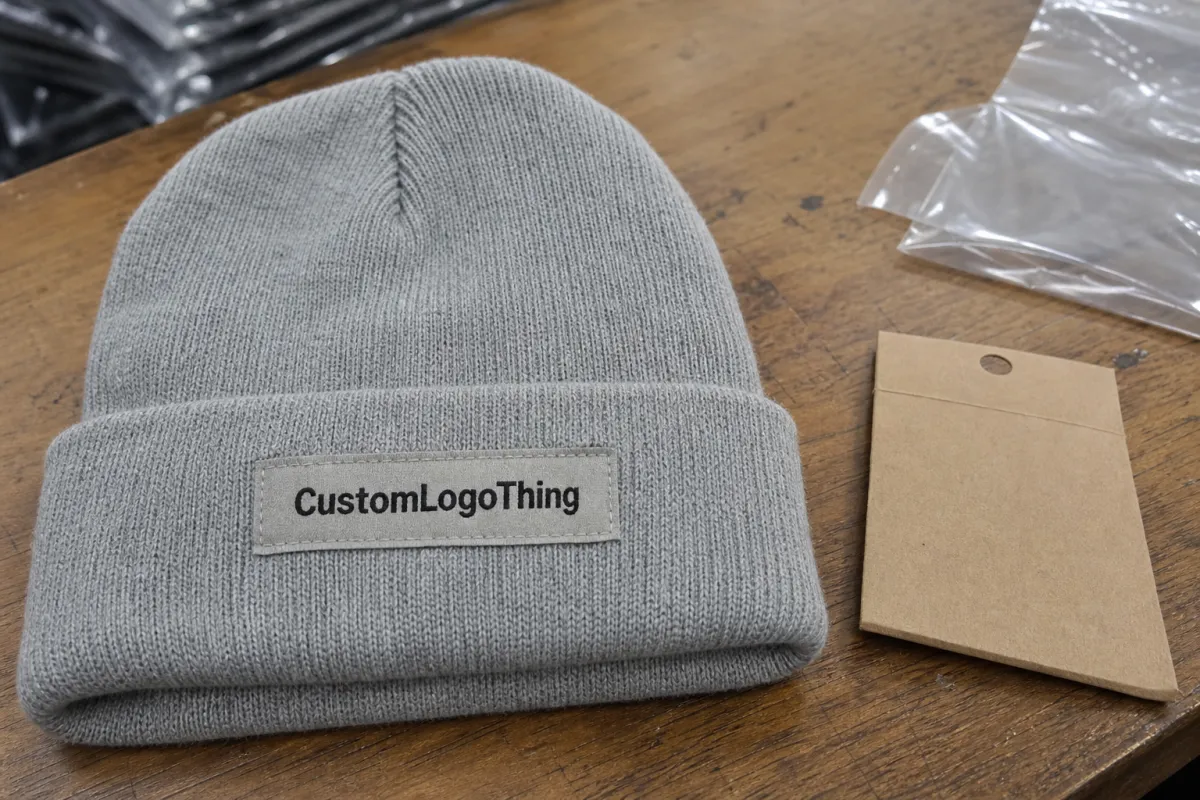
Most disappointing custom beanies are not ruined at the sewing table. They are usually ruined earlier, during proof approval, when the logo looks acceptable on a screen and nobody checks what that little woven label will actually become on a ribbed cuff.
Cute logo. Wrong scale. Muddy thread. Label placed like an afterthought. Congratulations, now there are 300 beanies in the back room that feel slightly off every time someone unfolds one.
An artwork proof is not a decorative mockup for a launch post. It is the visual and technical confirmation of the order: beanie style, yarn color, cuff height, label type, logo artwork, label dimensions, fold, placement, thread colors, backing, stitch notes, quantity, and production instructions. Treat it like a contract with pictures, because once approved, that is often how production treats it too.
Coffee Shops and Roasters have different merch problems than a generic event order. A cafe mark may rely on soft browns, cream, olive, charcoal, rust, or a fine serif wordmark. A roaster badge might include steam lines, a tiny coffee plant, a founding date, or a neighborhood name that looks beautiful on a menu and questionable on a 1.25-inch woven label. Thread does not forgive overly delicate artwork.
Customers notice cheap labels. Staff notice scratchy ones. Owners notice slow-moving inventory sitting beside bags of coffee like a quiet accounting lesson. A proper woven label beanies Artwork Proof Checklist for coffee shops catches scale, contrast, placement, comfort, pricing, and timing issues while the fix is still a revision, not a write-off.
Blunt rule: approve the proof only after you can explain the label size, fold, thread colors, placement, quantity, and deadline without guessing.
The payoff is practical: fewer revisions, cleaner labels, better shelf presentation, fewer surprise costs, and less time explaining why the oat-milk leaf icon became a beige smudge.
How a Woven Label Proof Works on Custom Beanies
The production path is usually simple on paper. You send the logo, preferred beanie colors, quantity, budget target, and in-hand date. The supplier reviews the artwork, builds a digital proof, sends it back, and waits for approval or revision notes. After final approval, the order moves into label weaving, beanie production or decoration, quality check, packing, and shipping.
A useful proof should show the beanie color, knit style, cuff height, label location, label dimensions, fold type, thread colors, logo layout, and any text or icon detail. If you are ordering through Custom Logo Things, the related Custom Labels & Tags options matter because construction changes the final look as much as the artwork does.
A digital mockup sells the idea. A production proof confirms what will be made. Those two documents can look similar, but they do not carry the same weight. The proof should answer manufacturing questions, not just make the beanie look nice in an email.
Woven labels have limits because thread has thickness. Tiny type fills in. Gradients do not weave cleanly. Thin coffee bean lines, steam curls, and delicate leaf veins often need simplification. A damask woven label can hold finer detail than a basic weave, but it is still thread crossing thread. It is not ink, and it does not care how polished the brand deck looks.
Common label formats to review
- Flat woven patch: a front-facing label, often stitched on all sides for a clean retail look.
- Center-fold label: folds over an edge, so artwork must stay clear of the fold line.
- End-fold label: folded ends tuck under the label for a neat stitched finish.
- Manhattan fold: a structured apparel-style fold with a more finished edge.
- Loop fold: wraps over the cuff edge and can show branding on both sides.
- Damask woven label: smoother and better for small detail, though still limited by thread and scale.
Ask for the actual label size in inches, thread color names or codes, fold direction, stitch placement, and confirmation that the proof is shown to scale. For premium retail drops, larger runs, staff uniform programs, or new logo artwork, a physical sample may be worth the added cost and time. Hand feel, label stiffness, and shelf presence are hard to judge from a flat screen.
Artwork Details to Check Before You Approve the Label
Start with the logo file. Vector artwork is best: AI, EPS, SVG, or a clean PDF. A PNG may help as a visual reference, but a low-resolution image is not production-friendly artwork. If the mark is blurry at four inches wide, it will not become crisp when woven at 1.5 inches.
Check simplification before arguing about thread colors. Fine lines, small dates, city names, coordinates, taglines, tiny stars, cup icons, and steam curls may need to be thickened, removed, or separated into a simpler version for labels. Coffee brands often want “small batch roasted daily” on a label the size of a postage stamp. Ambitious, yes. Readable, rarely.
Minimum text size depends on the weave, letterform, color contrast, and label size, but secondary text should be used carefully. On many woven labels, anything under roughly a 5-6 pt equivalent becomes risky, especially with thin serif type or low-contrast thread. That is not a universal law, but it is close enough to make a buyer pause before approving microcopy.
Confirm the label size against the beanie cuff. A 1.5-inch wide label can look restrained and premium. A 3-inch patch on a narrow cuff can start to look like a municipal warning sign. If the cuff is only 2.5 inches tall, a tall label may crowd the top and bottom stitch areas, especially after normal sewing tolerance is considered.
Thread colors need a reality check. Thread is not ink, so exact Pantone matching may be approximate. Ask for the closest available thread match and approve with that limitation in mind. Cream on beige can look tasteful in a design file and nearly invisible in real life. Coffee palettes built around tan, walnut, oat, clay, olive, rust, and charcoal need extra contrast review because the difference between tasteful and unreadable can be small.
Do a spelling pass slowly. Confirm punctuation, accents, neighborhood names, URLs, social handles, founding dates, and any roasting or sourcing language. The manufacturer will usually weave what is approved. Typos do not become charming just because they are stitched into inventory.
Artwork proof checks before approval
- Logo supplied as AI, EPS, SVG, or clean PDF where possible.
- Small text simplified, enlarged, or removed before production.
- Label dimensions shown in inches, not only as a screen mockup.
- Thread colors listed by available thread code or supplier color name.
- Fold direction and label orientation shown clearly.
- Placement shown on the actual beanie style, not a generic flat graphic.
If sustainability claims appear on a label, hangtag, or retail package, keep the language accurate. For paper hangtags or packaging, programs such as FSC can help buyers understand responsible paper sourcing, but certification wording should be verified before printing. Guessing at compliance language is a poor use of thread, paper, and money.
Beanie Specs That Change the Final Look
The label is only half the job. The beanie body changes how the label reads, sits, stretches, and sells. A patch that looks sharp on a flat digital proof can distort on a chunky rib knit if placement, backing, or stitch tension is not considered.
Acrylic is common for cafe merch because it is warm, widely available, color-friendly, and usually cost-effective. Cotton gives a softer natural feel, though it may not carry the same cold-weather personality. Wool blends feel more premium and can support a higher retail price, but they often cost more and may require more care-label attention. Recycled yarns can be a good fit for sustainability-minded shops, with the caveat that colors and availability may be narrower.
Knit style matters. Rib knit gives stretch and the familiar coffee-shop winter look. Fisherman knit has a chunkier, more textured feel. Fine knit presents cleaner on shelves and works well with minimalist branding. Waffle and cable styles can make a seasonal drop feel more distinctive, but they may fight with small labels if the cuff surface is uneven.
Cuff height deserves more attention than it usually gets. A taller cuff gives more label space and stronger visibility. A shallow cuff can make even a modest woven patch feel squeezed. For many coffee shop beanies, a cuff around 2.5-3.25 inches tall gives enough room for a 1.25-1.75 inch label without making the branding feel forced.
Fit should match how customers and staff will actually wear the beanie. Snug watch caps, slouchy beanies, skull caps, pom beanies, and fisherman styles all send different signals. Cafe merch usually performs best when it looks like something a customer would choose on a cold walk, not something they accepted from a folding table and forgot in the car.
Placement options include centered front cuff, side cuff, near seam, or slightly off-center for a boutique feel. Off-center can look intentional. Random does not. A half-inch shift can change the attitude of the whole beanie, so placement belongs in the proof review, not in a vague production note.
| Beanie Option | Typical Use | Tradeoff | Proof Detail to Confirm |
|---|---|---|---|
| Acrylic rib knit | Budget-friendly cafe merch and staff wear | Good color range, less premium hand feel | Cuff height and label stretch |
| Fine knit | Minimal retail presentation | Cleaner surface, less chunky winter texture | Label scale and stitch tension |
| Fisherman knit | Chunky seasonal drop | Strong texture, harder label seating | Patch backing and placement |
| Wool blend | Premium cafe or roaster merchandise | Higher cost, care details matter | Comfort, care labeling, and retail price |
Also check backing comfort. A scratchy label near the forehead is a fast way to make a customer stop wearing the product, no matter how good the logo looks. Review the planned display too: folded on a shelf, hung near mugs, bundled with coffee bags, or worn by baristas during a morning rush. If the label disappears when the beanie is folded for retail, the proof has not answered the real merchandising question.
Pricing, MOQ, and Unit Cost Traps for Cafe Merch
Custom beanie pricing depends on the blank or knit quality, yarn material, knit complexity, woven label size, number of thread colors, label fold type, stitch method, quantity, packaging, shipping, and whether the order needs rush handling. That is why two quotes can look wildly different even when both say “custom woven label beanie.”
Small runs usually live in the higher unit-cost zone because setup, label weaving, handling, and decoration are spread across fewer pieces. A 24-piece run may be possible in some cases, but it will not price like a 300-piece order. That is not a supplier being mysterious. It is basic production math.
As a rough planning range, simple custom Woven Label Beanies may land around $9-$16 per unit at lower quantities, $6-$11 per unit at mid-size quantities, and $4.50-$8.50 per unit at larger quantities, depending on material, label detail, packaging, and freight. Premium wool blends, special knits, custom bags, hangtags, or rush shipping can push those numbers up quickly.
Setup and artwork fees need attention. Some suppliers build them into the unit cost. Others list them separately. Compare total landed cost, not the prettiest per-piece number. Landed cost should include the beanie, label, setup, proofing, packaging, shipping, duties if applicable, and any sample charge.
Color splits can quietly wreck a clean plan. Ordering 50 black, 50 cream, 50 forest, and 50 rust sounds thoughtful, but split colorways can affect MOQ, production efficiency, and inventory risk. A smarter first order often starts with two proven beanie colors that match the brand and one label design that works clearly on both.
Retail pricing needs sober math. If landed cost is $8.25, a $22-$28 retail price may make sense for a standard acrylic beanie in a cafe setting. If landed cost is $14.50 for a premium knit, the shop may need $32-$42 retail pricing or a holiday bundle with coffee bags, mugs, or gift cards. Perceived value matters. So does margin.
Ask for a quote that separates beanie specs, label specs, quantity breaks, packaging, shipping, and sample costs. If the merch program also uses woven patches, hangtags, or branded trims, review the Custom Labels & Tags category so label decisions stay consistent across products instead of drifting one order at a time.
Process and Timeline From Artwork Upload to Finished Beanies
The typical process runs in this order: quote request, artwork review, digital proof, revision window, approval, label weaving, beanie production or decoration, quality check, packing, and shipping. Simple. Not instant.
The proof stage should not be treated as a speed bump. It is the point where buyers catch expensive mistakes before production starts. One clear revision is normal. Five rounds because the team cannot decide between oatmeal and bone thread will slow the order. Oatmeal and bone are different, sure. They are also not a personality test.
Timeline depends on artwork readiness, revision speed, label complexity, beanie availability, quantity, seasonality, shipping method, and whether a physical sample is requested. A common production window for many standard runs is roughly 10-20 business days after proof approval, with more time needed for larger quantities, custom knits, imported production, or peak winter schedules. Shipping can add another 2-10 business days depending on method and distance.
Fall and winter beanie orders get crowded fast. If a shop wants beanies for holiday retail, staff uniforms, market pop-ups, a seasonal drink launch, or a roaster anniversary, waiting until the last minute is not a strategy. It is a stress hobby.
Assign one decision-maker to approve proofs. Group feedback is useful until eight people comment on a 1.25-inch label like it is a mural. Keep one approval thread or shared document. Scattered notes across texts, emails, and chat apps are how version control goes to die.
After approval, do not casually swap logos, add taglines, or move placement unless the supplier confirms production has not started. “Quick changes” are rarely quick once labels are being woven or beanies are already in decoration.
Ask for four dates in writing: estimated proof time, production lead time, shipping time, and the final date artwork must be approved to hit the launch. For shipping performance and transit testing on packaged goods, groups such as ISTA publish useful packaging test standards, especially for brands shipping retail kits or bundled merchandise.
Common Proof Mistakes Coffee Shops Should Catch Early
Mistake one: approving a label that is too small for the logo. Minimalist does not mean microscopic. If the logo needs two inches to stay legible, forcing it into 0.9 inches because the mockup looked “clean” will not improve it.
Mistake two: using low-contrast thread and label colors. Warm neutral palettes can be beautiful, but taupe on tan can vanish faster than a croissant at 8 a.m. If the palette is cream, clay, oat, walnut, and fog, ask for a contrast view before approval.
Mistake three: keeping too much text. Roastery name, city, founding date, slogan, coordinates, and tiny coffee cup icon rarely fit cleanly on one woven label. Choose the main brand mark first. Add secondary detail only if it stays readable at actual size.
Mistake four: ignoring the fold. A center-fold or loop-fold label needs artwork positioned so nothing important disappears into the fold, seam allowance, or stitch area. Ask for a fold diagram if the proof does not show one.
Mistake five: approving based on screen color only. Monitors lie. Thread reflects light differently, and woven texture changes color perception. A dark olive thread may look nearly black under cafe lighting. A pale tan may disappear on oatmeal yarn.
Mistake six: not checking placement on the actual beanie style. A label that looks balanced on a flat mockup may sit too high, too low, or too close to a seam on the real cuff. Ask what normal placement tolerance is, whether that is around 0.125-0.25 inch or another range your supplier uses.
Mistake seven: forgetting retail presentation. If the label is hidden when the beanie is folded or stacked, it will not sell as well in the shop. Put a sample or paper stand-in on a shelf beside coffee bags, mugs, and cards before deciding placement.
Mistake eight: assuming the manufacturer will fix unclear instructions. Good suppliers flag obvious problems. They are not mind readers with sewing equipment.
Next Steps Before You Send the Beanie Proof Approval
Before approving, run one final check. Confirm the logo file, label size, thread colors, contrast, fold type, placement, beanie color, cuff height, quantity, packaging, pricing, shipping address, and deadline. Boring list. Very useful list.
Print the proof at actual size if possible. Looking at a 1.5-inch label on a large monitor is how bad decisions dress themselves up as confidence. If printing is not practical, zoom the proof to real dimensions on screen and hold a ruler against it. Low-tech. Works.
View the proof on both light and dark backgrounds if the label uses neutral threads or relies on negative space. Ask three direct supplier questions before approving:
- Is this proof shown to scale?
- Are these thread colors the closest available match?
- Will the label placement match this mockup within normal production tolerance?
For larger orders, premium retail drops, new logo artwork, unusual label colors, or staff uniforms, request a physical sample or at least a pre-production photo. For a smaller budget run with a simple logo, a detailed digital proof may be enough if scale, thread colors, and placement are confirmed. The right choice depends on artwork complexity, deadline, budget, and how painful a mistake would be.
Keep one approval thread or document. Attach the final logo file, final proof, quantity, color breakdown, ship-to address, and in-hand date. If labels need to match across beanies, bags, aprons, or other merch, use the same approved specs from the Custom Labels & Tags order so the brand does not shift product by product.
Use this checklist before final approval, not after the cartons arrive and everyone suddenly develops opinions. Gather the final artwork, choose the beanie colors, settle the label size, confirm the deadline, and send those specs together. A careful proof review will not make the order glamorous, but it will make the finished beanies easier to sell, easier to wear, and much less likely to become a stack of expensive lessons.
FAQ
What should a woven label beanie proof checklist for coffee shops include?
A woven label beanies Artwork Proof Checklist for coffee shops should include logo file type, label size, thread colors, contrast, fold type, beanie color, cuff height, label placement, quantity, packaging, shipping address, and deadline. It should also confirm whether the proof is shown at actual scale, since that one detail prevents a surprising number of expensive mistakes.
Can tiny coffee shop logos work on woven labels for beanies?
Yes, but small details may need to be simplified. Thin lines, tiny text, dates, and detailed coffee icons often lose clarity when woven. A damask woven label usually handles finer detail better than a basic weave, but it still has limits because thread is not ink.
How much do custom woven label beanies cost for a coffee shop?
Pricing depends on beanie quality, material, label size, thread colors, quantity, setup, packaging, and shipping. As a practical range, many custom woven label beanies fall around $4.50-$16 per unit depending on quantity and specs, with premium options costing more. Compare total landed cost, not only the unit price.
How long does the custom beanie proof and production process take?
The timeline depends on artwork readiness, proof revisions, label complexity, quantity, seasonality, and shipping method. Many standard runs take roughly 10-20 business days after proof approval, plus shipping, but busy seasonal schedules and physical samples can add time.
Should coffee shops order a physical sample before approving woven label beanies?
A physical sample is smart for larger orders, premium retail drops, new logo artwork, unusual label colors, or beanies meant for staff uniforms. For smaller budget runs, a detailed digital proof may be enough if the artwork is simple and the supplier confirms scale, thread colors, and placement.