Buyer Fit Snapshot
| Best fit | Custom Leather Corner Box Packaging Luxury projects where brand print, material claims, artwork control, MOQ, and repeat-order consistency need to be specified before quoting. |
|---|---|
| Quote inputs | Share finished size, material target, print colors, finish, packing count, annual reorder estimate, ship-to region, and any compliance wording. |
| Proofing check | Approve dieline scale, logo placement, barcode or warning zones, color tolerance, closure strength, and carton packing before bulk production. |
| Main risk | Vague material claims, crowded artwork, missing packing details, or unclear freight terms can make a low unit price expensive after revisions. |
Fast answer: Custom Leather Corner Box Packaging Luxury: Material, Print, Proofing, and Reorder Risk should be specified like a repeatable production item. The safest quote records material, print method, finish, artwork proof, packing count, and reorder notes in one written spec.
Production checks before approval
Compare the actual filled-product size with the drawing, then confirm tolerance on folds, seals, hang holes, label areas, and retail display edges. Reserve space for logos, QR codes, warning copy, and material claims before decorative graphics fill the panel.
Quote comparison points
Review material grade, print process, finish, sampling route, tooling charges, carton quantity, and freight assumptions side by side. A quote is only useful when the supplier can repeat the same color, closure quality, and packing count on the next order.
Custom Leather Corner Box Packaging luxury can change the sale before the product is even in a customer’s hands. That sounds dramatic until you watch how quickly people judge a box. In packaging reviews and retail testing, first impressions happen in seconds, and sometimes the decision is made before anyone reads a single line of copy. A rigid box with leather corner accents does not merely hold an item. It frames the item as something worth pausing for. That is why this format shows up in premium retail packaging, branded packaging, premium gift packaging, and limited-run presentation cases for watches, cosmetics, spirits, and collector sets. If you are evaluating custom leather corner box packaging luxury, the structure matters as much as the surface. A polished wrap over a weak shell still feels weak. If you want a baseline for other rigid formats, the options on Custom Packaging Products make a useful comparison point.
The appeal is not cosmetic first and functional second. The structure does the heavy lifting. Corners are visible. Edges are visible. Any drift in alignment shows immediately, which is exactly why this format reads as premium when it is executed well. A soft mailer can hide a little sloppiness. A rigid box cannot. That makes Custom Leather Corner Box Packaging luxury sit in a different tier from simple sleeves or standard Luxury Rigid Boxes. It is more exacting. It also signals something specific: the brand paid attention to the parts of the box that usually get ignored. That tends to land as restraint, not excess, which is a rare combination in luxury packaging.
I have watched buyers in sampling rooms run a thumb across a corner seam and make a call in under five seconds. Not because they were being fussy, but because corners tell the truth. A box can have a beautiful print file and still feel ordinary if the edges are sloppy. That is the practical side of custom leather corner box packaging luxury: it makes quality visible in places that are hard to fake. And, honestly, that is kinda the point.
There is a sharp line between “premium” and “trying too hard.” Most packaging decisions happen on that line. The rest of this piece breaks down how custom leather corner box packaging luxury is built, what drives cost, what sampling should reveal, and how to brief a supplier so the answer you get back is useful rather than polished noise.
Why does custom leather corner box packaging luxury feel so premium?
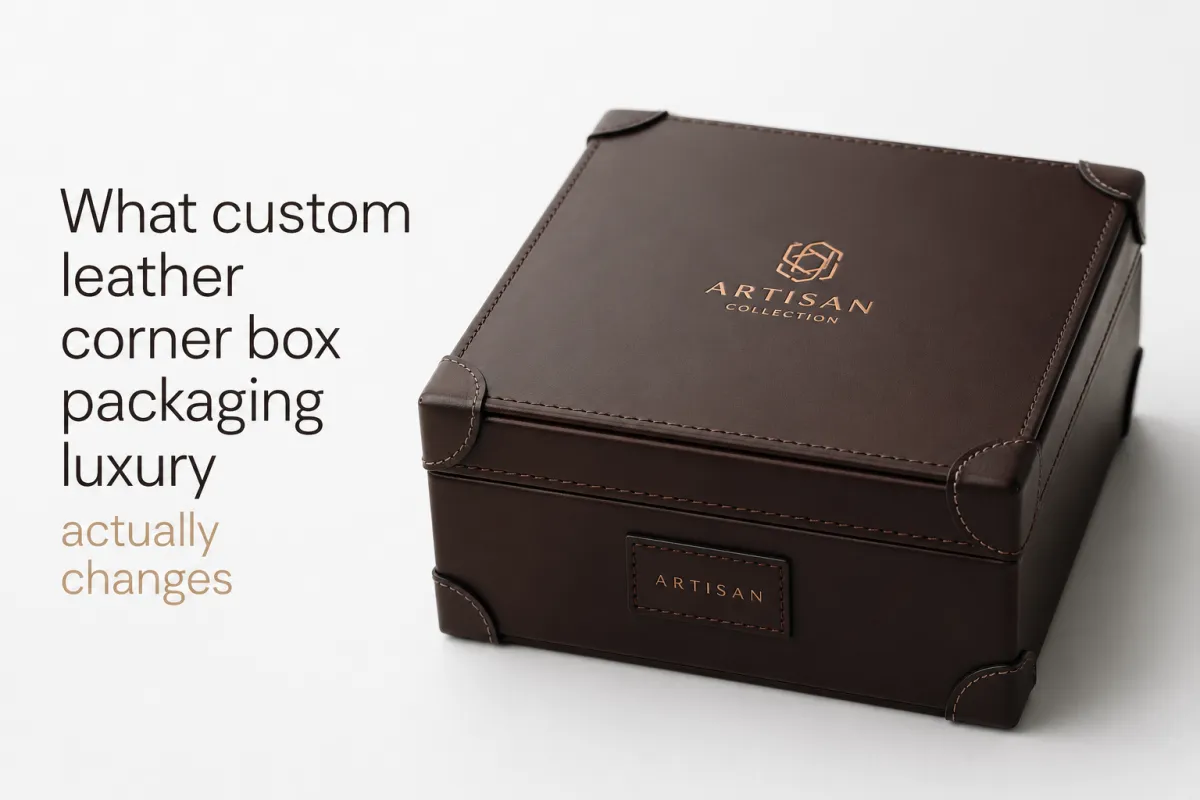
The short answer is that it combines visual control with tactile weight. Buyers do not study a spec sheet before they touch the box. They see weight, color, edge quality, and closure behavior, then decide whether the product feels special, giftable, or forgettable. Industry studies on packaging perception consistently point to the same thing: the box shapes value faster than most marketing copy ever will. Custom leather corner box packaging luxury takes advantage of that fact because the corners become a visual anchor. A clean corner tells the eye that the rest of the box was built with care. A crooked one does the opposite in a fraction of a second.
The second change is tactile. Leather or leather-look corner details create contrast against the main wrap, and that contrast matters because the hand reads texture faster than the eye reads copy. Opening becomes a sequence: lift, feel, open, reveal. That sequence is the point. Customers remember packaging that makes the product arrive like an event, not a transaction. Good package branding does not shout. It uses texture, weight, and rhythm to slow the moment down. Custom leather corner box packaging luxury does that well because the corner treatment introduces a small pause before the product appears.
The third change is structural. A rigid box with reinforced corners usually keeps its shape better during stacking, retail handling, and freight than a lighter carton. That does not make it invincible. It does mean the box resists the kind of flexing that turns premium packaging into a slightly bent disappointment. For watches, cosmetics, bottles, and small gifts, that stability matters because the box often becomes part of the product itself. Buyers store it, reuse it, or display it. That is one reason custom leather corner box packaging luxury sits naturally alongside premium product packaging and high-end Custom Printed Boxes instead of mass-market mailers.
There is also a brand signal that gets underestimated. Leather corners suggest patience, material intent, and a willingness to spend money where it counts. They feel closer to a collector case or a bound book than to a commodity carton. Minimal brands use that cue to keep the surface quiet while still feeling expensive. Heritage brands use it to echo leather goods, archival boxes, or presentation cases. Either way, custom leather corner box packaging luxury gives a brand a way to look serious without turning the box into an advertisement.
A luxury box should feel designed from the inside out. If the corners are doing all the persuasion, the structure is probably too weak. If the structure is sound and the corners are clean, the box earns attention instead of demanding it.
That leads to the part many teams rush past: alignment between the box and the product. A heavy fragrance set needs different internal support than a slim watch tray. A bottle needs transport stability. A cosmetics set needs a calmer reveal. Custom leather corner box packaging luxury works best when the structure serves the product rather than competing with it. The box has a job. It should not be auditioning for one.
It can raise perceived value quickly. Sometimes strikingly. The catch is that the rest of the design has to agree with the signal. A box that looks expensive on the lid and slightly unconvincing on the sides creates distrust faster than a simpler design would. People notice mismatch. Premium buyers notice it first.
How custom leather corner box packaging luxury is built
Custom leather corner box packaging luxury usually begins with a rigid core. Greyboard or chipboard often sits in the 1.5-2.5 mm range for smaller premium boxes, and thicker board appears in larger or more load-bearing formats. The outer wrap can be coated paper, specialty paper, textured stock, or a leather-look surface. Corner treatment then becomes the signature move, either as a true leather piece, a PU leather panel, or a corner wrap that imitates leather without the sourcing complexity of actual hide. Inside, the insert may be EVA foam, molded pulp, paperboard partitions, flocked trays, or a custom-cut structure built around the product.
The build sequence matters because problems tend to hide at the handoff points. A typical flow starts with dieline approval, then material selection, then structural sampling, fit checks, artwork setup, finishing approval, and full production. None of that sounds glamorous. It is still where the budget is won or lost. If the dieline is off, the rest becomes expensive correction work. If the sample does not fit the product properly, the prettiest finish in the room cannot save it. Custom leather corner box packaging luxury is one of those formats where a 1 mm error can show up as a crooked edge, a lid that drifts, or a corner that feels wrong the moment the hand touches it.
The corners themselves can serve two roles. Decorative, yes. Protective as well. They can shield the edges from scuffs during handling and transport while also adding visual depth. The problem is that corner detailing leaves very little room for sloppy assembly. Edges need to meet cleanly. Corner placement needs to be even. Color matching between the leather-look corner and the main wrap needs to stay controlled. If any of that slips, the box starts to read as patched together rather than deliberate. That is why custom leather corner box packaging luxury rewards factories that are precise about wrapping, folding, and edge finishing.
Material choice changes the result more than many buyers expect. Genuine leather has the strongest tactile signal and a natural variation that some brands want because it feels expensive in a deep, quiet way. It also brings sourcing and consistency challenges. PU leather is more predictable, usually easier to source at scale, and generally lower in cost. Leatherette can be even more controlled while still delivering the visual cue. For custom leather corner box packaging luxury, the right choice depends on use. A keepsake box destined for a private collection can justify different material decisions than Retail Packaging Designed for shelf turnover.
Closures and inserts matter more than people assume. A magnetic flap feels excellent, but only if the magnets are aligned and the lid meets the base without wobble. A ribbon pull can work, yet it needs the right weight and proportion or it ends up looking ornamental in the wrong way. Inserts should keep the product from shifting when the box moves. If the outside says luxury and the inside rattles, the whole effect drops. Custom leather corner box packaging luxury only lands when the interior experience matches the exterior finish.
Labor also deserves attention. Some suppliers quote the structure well and underestimate the corner work. Hand application, alignment checks, and edge finishing can add real time to the run. That is why buyers should ask how the corners are applied, whether the wrap is full coverage or partial, and what tolerances the factory holds on edge alignment. These are not glamorous questions. They are the questions that keep a premium project from becoming a repair job with a luxury label attached.
Key factors that make custom leather corner box packaging luxury work
The material mix is the first lever to control. Real leather, PU leather, and textured paper do not behave the same way, and custom leather corner box packaging luxury depends on understanding that difference before artwork gets approved. Real leather gives a deeper premium signal, especially for gift sets or collector-style packaging. PU leather can look cleaner and more consistent across a run. Textured paper with leather-style corners may be the right compromise if the budget is tighter or the brand needs a more recyclable structure. There is no universal winner. There is only a better fit for the brand position and the product’s life cycle.
Board thickness is the next big variable. Luxury packaging needs enough rigidity to survive shipping, stacking, and repeated opening without bowing. Many rigid structures use board in the 1200-1500 gsm range for smaller boxes, with thicker options for larger formats or heavier contents. Too thin, and the box feels cheap no matter how refined the surface looks. Too heavy, and freight climbs while the package becomes cumbersome. Custom leather corner box packaging luxury only feels premium when stiffness, weight, and proportion stay in balance.
Finish choices often change the impression more than procurement teams expect. Debossing creates a quieter, architectural look. Foil raises the signal, though it can turn loud if the layout gets crowded. Stitching details add a handcrafted note, yet they also create more labor and more room for inconsistency. Soft-touch lamination feels good in hand but can mark more easily if the supply chain is rough. Matte and satin surfaces tell different stories. The lesson is simple: custom leather corner box packaging luxury is not about piling on finishes. It is about choosing the finish that supports the brand and leaving the rest alone.
Brand fit makes the difference between elegant and awkward. Minimal brands usually need cleaner surfaces and fewer interruptions. The leather corners should add structure, not decorate every inch like the box got nervous. Heritage brands, fine fragrance lines, and certain spirits labels can carry richer texture because their packaging already speaks that language. Custom leather corner box packaging luxury should reinforce the story the product is already telling. If the product is calm, the box should be calm. If the product feels ceremonial, the box can carry more presence.
Sustainability belongs in the brief even when the project is clearly premium. Buyers increasingly ask whether rigid cores are recyclable, whether the leather-look material contains recycled content, and whether the adhesive choice supports material recovery. For shipping performance, many teams reference ISTA protocols or similar distribution testing methods. For paper sourcing, FSC-certified materials are a familiar benchmark. That sounds procedural because it is. Packaging has two jobs here: survive shipping and still look luxurious on arrival. Both matter. For sourcing references, the FSC site is useful, and ISTA outlines widely used testing methods.
There is a simpler truth underneath all of this. The strongest custom leather corner box packaging luxury designs do not try to impress in every direction. They pick one or two details worth the spotlight. Maybe it is the corner treatment. Maybe it is a restrained foil mark on the lid. Maybe it is a deep insert that cradles the product like a presentation case. Too many signals and the whole package starts arguing with itself.
Custom leather corner box packaging luxury pricing and cost drivers
Pricing for custom leather corner box packaging luxury is driven by the familiar packaging variables: materials, labor, tooling, quantity, and freight. Corner detailing adds extra steps, and extra steps cost money. That part never changes. What changes is how sharply the price rises when the order volume is small or the finish is hand-applied. Smaller runs with more labor can land in the mid-single digits per unit and climb well above $10 depending on the spec. Larger runs with simpler details can come down substantially. Genuine leather, custom inserts, and complex closures can push the number much higher.
MOQ affects the picture immediately. A 300-unit run has to absorb sampling, setup, and finishing across fewer pieces than a 5,000-unit run. That alone can double or triple the per-unit price. This is why a sample can seem affordable while the production order arrives as a surprise. It is not a surprise. It is math. Custom leather corner box packaging luxury scales best when the spec is stable, the build is repeatable, and the factory does not need to reconfigure its workflow for every small change.
A good way to think about the cost stack is to break it apart. The core structure provides the base. The wrap material sets the visual level. The corner material adds labor and alignment control. The insert adds complexity. The print method adds setup. Freight then shows up and quietly reminds everyone that luxury boxes are bulky. With custom leather corner box packaging luxury, shipping is not a footnote. Rigid boxes take space, and space costs money. A design that looks refined on screen can become a freight headache in real life.
| Option | Typical Use | Pros | Tradeoffs | Relative Cost |
|---|---|---|---|---|
| PU leather corners | Premium retail packaging, cosmetics, gifts | Consistent look, easier sourcing, strong visual impact | Less authentic tactility than real leather | Medium |
| Real leather corners | Collector boxes, ultra-premium gifting | Rich tactile feel, strong luxury signal | Higher cost, sourcing variation, more handling sensitivity | High |
| Leather-look wrap with corner detail | Brand-led packaging with tighter budgets | Cleaner procurement, controlled consistency, scalable | Less depth than genuine leather | Lower to medium |
| Mixed rigid structure with premium insert | Products that need display and protection | Better spend allocation, strong unboxing experience | Insert engineering can add time and setup cost | Medium to high |
The smartest cost control is usually not “cut the luxury.” It is “spend where the customer notices.” For custom leather corner box packaging luxury, that often means the corners, the lid reveal, the insert fit, and one clean finish. Hidden surfaces can stay simpler. The inside face of a lid does not need three different finishing methods just because a mood board got ambitious. If the box is for retail packaging, the shelf-facing surfaces deserve more attention than the parts nobody sees.
A practical move is to request a line-item quote. Ask the supplier to separate board, wrap, corner material, insert, print, finishing, and assembly. If the quote arrives as one neat number with no breakdown, treat it carefully. You do not need a novel. You need enough visibility to see which upgrade is costing what. That is how you decide whether a particular version of custom leather corner box packaging luxury is worth the spend or simply an expensive shape with a good attitude.
If you are comparing formats before locking the spec, the Custom Packaging Products page helps because it makes rigid box styles easier to compare against target price, run size, and use case. That comparison often saves money before the first sample is ever cut.
Step-by-step process and timeline for custom leather corner box packaging luxury
A good custom leather corner box packaging luxury project starts with a proper brief. Not a mood. A brief. Product dimensions, target quantity, product weight, brand tone, shipping destination, retail or gift use, and budget range all belong in the first conversation. If the box needs to fit a bottle, a watch, or a skincare kit, the supplier needs exact measurements and clear tolerance expectations. “Make it premium” is not a brief. It is a request for guesswork.
After the brief comes structural development. The supplier builds a dieline or working spec, then checks product fit and opening behavior. A structural sample should confirm that the product sits securely, the lid closes correctly, and the corner treatment lands where the design intended. For custom leather corner box packaging luxury, this step matters because the eye goes straight to edges and corners. If anything is off, even slightly, the box looks less engineered and more improvised.
Once the structure works, artwork and finishing are locked in. Embossing depth, foil placement, color matching, lining texture, and corner material all need approval. Good suppliers will show swatches or material references before production. Good buyers will actually review them instead of waving them through because the render looked expensive. With custom leather corner box packaging luxury, the sample stage is the time to ask the questions that feel too basic. Those questions are what stop a costly misread later.
The timeline depends on complexity, but a realistic flow often looks like this:
- Brief and quote: 1-3 business days if the information is complete.
- Structural sample: 5-10 business days, sometimes longer if the insert is custom.
- Revisions and approval: 2-7 business days depending on internal feedback speed.
- Production: often 12-20 business days for straightforward builds, longer for hand-finished leather corner work.
- Packing and freight: varies by destination, carton count, and transport method.
That is the tidy version. Real projects slow down because of indecision, late artwork changes, or a sample that exposes a fit issue nobody caught in the original product spec. Custom leather corner box packaging luxury can move quickly when the team is aligned, but it is not magic. If the supplier is doing hand application on the corners or custom insert fabrication, the schedule should reflect that. Otherwise the timeline is fantasy dressed as planning.
Packaging testing deserves real attention. If the box is traveling through a rough distribution chain, ask about drop and compression testing. Many teams use ISTA-style distribution thinking or similar internal checks to see whether the box survives the journey without opening early, crushing, or scuffing its corners. Luxury packaging is not only about display. It still has to move from the facility to the customer in one piece. The best custom leather corner box packaging luxury projects account for that from the beginning instead of treating it as a last-minute problem.
Before final approval, ask how the cartons will be packed for shipment. Will the boxes nest? Will they be polywrapped? Will corner pressure marks appear under stacked cartons? These details sound minor until a full run arrives with slight rubbing on the leather-look corners. Good packing protects the unboxing experience before the customer ever sees it. Poor packing turns a premium box into a damaged one with excellent intentions.
I once reviewed a sample batch for a fragrance launch where the outer box looked perfect, but the lid had a tiny sideways drift that only showed up after the third open-and-close cycle. Nobody caught it in the render. Everybody caught it in hand. That kind of miss is why custom leather corner box packaging luxury has to be tested in real conditions, not just admired on a screen.
Common mistakes when ordering custom leather corner box packaging luxury
The most common mistake is choosing expensive materials before the structure is settled. That is how brands end up with custom leather corner box packaging luxury that looks impressive in a render and awkward in production. If the board is wrong, the lid fit is wrong, or the insert leaves too much play, the finish cannot rescue the project. Start with the build. Then choose the surface. Not the reverse.
The second mistake is ignoring edge quality. Leather corners expose alignment issues immediately. A tiny inconsistency in wrap fold, corner application, or board cut can stand out more than a large printed area would. That is why premium packaging teams obsess over tolerances. Not because they enjoy friction. Because corners tell the truth. Custom leather corner box packaging luxury leaves less room for visual forgiveness than a simple wrap box, so quality control has to be tighter.
The third mistake is treating the insert like an afterthought. A product that shifts inside the box instantly makes the packaging feel cheaper. It rattles. It tilts. It signals that nobody measured the interior properly. For cosmetics, watches, spirits, and gift sets, the insert is half the unboxing experience. In some projects, it matters more than the exterior print. That is especially true for custom leather corner box packaging luxury, because the outside already carries a premium signal. The inside has to match it.
The fourth mistake is overloading the design with finishes. Debossing, foil, stitching, a velvet lining, magnetic closure, leather corners, and a foil-stamped insert can all exist in the same world. They just do not always belong in the same box. At a certain point, the package stops feeling refined and starts feeling like a list of features. Better to choose two strong signals than six weak ones. Strong custom leather corner box packaging luxury usually feels edited, not crowded.
The fifth mistake is ignoring quantity reality until the sample is already loved. That one hurts because the sample is the exciting part. The trouble starts when the sample includes more handwork than the final budget can support. A design may look perfect at 50 pieces and annoying at 2,000. That is not a failure of creativity. It is a failure to connect design with production economics. If the MOQ is not confirmed early, the project can turn into an expensive compromise or a full restart.
One more mistake deserves attention: not aligning the box with the product story. A technical product may need a cooler, more precise presentation. A gift product may need warmth and display value. A heritage-inspired brand may need texture and restraint. Custom leather corner box packaging luxury works best when the design choices support the story already in the product, not when they try to invent a new identity from scratch. Boxes frame value well. They are poor at inventing it.
Expert tips and next steps for custom leather corner box packaging luxury
Start by defining the job of the box. Protection, display, gifting, or storage. Pick one primary role, then let the rest follow. That one choice shapes board thickness, insert style, closure choice, and finish level. Custom leather corner box packaging luxury gets easier to specify when the box is not being asked to do everything at once. A storage box can be more substantial. A display box can be more visual. A shipping-sensitive box needs stronger internal restraint. One structure should not be forced into all three jobs just because the team likes the prototype.
Ask for three things before you approve a supplier: material swatches, a structural sample, and a line-item quote. Swatches show whether the leather look actually feels right. The structural sample shows whether the product fits and the corners behave. The line-item quote shows where the money is going. If a supplier cannot explain the build in practical terms, that is a bad sign. Good partners can talk about greyboard, wrap, finish, insert tolerance, and assembly time without sounding like they are reading from a brochure. That matters in custom leather corner box packaging luxury, where the details are the whole point.
Compare two versions of the same design before locking the spec. Version A can put premium detail everywhere. Version B can concentrate upgrades on the corners, the lid reveal, and the insert. Version B often looks just as good to the customer and costs less. That is not cutting corners. That is using the right corners. For many branded packaging projects, that single move improves value without making the box feel stripped down.
Use a practical checklist before production starts:
- Final product dimensions and allowable tolerance
- Target run quantity and fallback quantity
- Primary use case: retail packaging, gifting, collector storage, or display
- Finish priorities: leather corners, embossing, foil, lining, or closure
- Insert format and product retention requirement
- Shipment method, carton count, and delivery deadline
That checklist is short because the essentials are short. Simplicity helps. It keeps custom leather corner box packaging luxury grounded in production reality rather than marketing language. Once those basics are set, the supplier can quote more accurately and the sample has a better chance of being right the first time.
If you are still comparing options, check the leather-corner concept against other rigid boxes and branded packaging styles on Custom Packaging Products. A side-by-side view makes it easier to see where the value is actually coming from. Sometimes the leather corners are the right move. Sometimes a cleaner rigid box with a sharper insert does more for the product. The point is to choose with intent, not because a render looked expensive.
For sourcing decisions, keep an eye on compliance and transport performance too. FSC-certified paper can support a stronger sustainability story, while ISTA-style testing helps prevent product damage in transit. Those are not luxury buzzwords. They are the pieces that keep premium product packaging from turning into a complaint ticket. If the supplier can speak clearly about those details, you are probably dealing with someone who understands custom leather corner box packaging luxury as a build, not just a sales phrase.
My honest view: the best versions of custom leather corner box packaging luxury feel inevitable. The corners make sense. The insert fits. The finish stays restrained. The box opens with a little resistance, then gives way cleanly. That is what premium packaging should do. Not shout. Not apologize. Hold the product with enough care that the customer notices before they can explain why.
If you are ready to brief a supplier, start with product size, target quantity, finish priorities, and delivery window. Then ask for a sample path that shows exactly how the corners, insert, and closure will be built. That is how you get a useful quote and a box that actually deserves the label custom leather corner box packaging luxury.
FAQ
What is custom leather corner box packaging luxury used for?
It works well for products that need stronger perceived value, such as watches, cosmetics, spirits, jewelry, premium gifts, and limited-edition retail sets. The leather corner detail matters most when the box is meant to be kept, displayed, or reused after purchase.
How much does custom leather corner box packaging luxury usually cost?
Price depends on size, material type, board thickness, insert complexity, finish selection, and order quantity. Hand finishing and low-volume production raise the unit cost quickly, while simpler specs and higher quantities usually lower the per-piece rate.
How long does the custom leather corner box packaging luxury process take?
A typical project includes briefing, sample development, revisions, production, and shipping, so the timeline depends on how quickly approvals move. Complex finishes, custom inserts, or multiple sample rounds can add several extra weeks.
Is real leather worth it for custom leather corner box packaging luxury?
Real leather gives a stronger tactile and premium signal, but it is not always the smartest choice if cost, consistency, or sourcing volume matters more. PU leather or leatherette can deliver a similar visual effect at a lower price and with easier production control.
How can I reduce cost without making the box look cheap?
Keep the core structure simple and spend on the touch points people actually see and feel, like corners, closure, and insert fit. Reduce unnecessary finishes, choose a smarter material mix, and ask for a quote that shows where each upgrade is adding cost.

