Buyer Fit Snapshot
| Best fit | compostable packaging design work for packaging buyers comparing material specs, print proof, MOQ, unit cost, freight, and repeat-order risk where brand print, material, artwork control, and repeat-order consistency matter. |
|---|---|
| Quote inputs | Share finished size, material target, print colors, finish, packing count, annual reorder estimate, and delivery region. |
| Proofing check | Approve dieline scale, logo placement, barcode or warning zones, color tolerance, and any recyclable or compostable wording before bulk production. |
| Main risk | Vague material claims, crowded artwork, or missing packing details can create delays even when the unit price looks attractive. |
Fast answer: Compostable Packaging Design Work: Claims, Protection, MOQ, and Cost should be specified like a repeatable production item. The safest quote includes material, print method, finish, artwork proof, carton packing, and reorder notes in one written spec.
What to confirm before approving the packaging proof
Check the product dimensions against the actual filled item, not only the sales mockup. Ask for tolerance on folds, seals, hang holes, label areas, and retail display edges. If the package carries a logo, QR code, warning copy, or legal claim, reserve that space before decorative graphics fill the panel.
How to compare quotes without losing quality
Compare board or film grade, print process, finish, sampling route, tooling charges, carton quantity, and freight assumptions side by side. A lower quote is only useful if the supplier can repeat the same color, closure quality, and packing count on the next order.
Good compostable Packaging Design Tips begin with a hard truth: a package can be technically compostable and still fail in the field. I have sat through enough prototype reviews to know the pattern by heart. A pouch splits at the seal, a tray softens under heat, or a label muddies the disposal message, and suddenly a sustainability claim becomes an expensive footnote. Brands do not get rewarded for good intentions alone. They get rewarded for packaging that protects the product and survives real use.
The strongest compostable Packaging Design Tips treat material choice, print structure, product protection, and end-of-life claims as one system. Food, supplements, and takeout containers all ask the same package to do three jobs at once: hold up under shipping stress, sell on shelf, and remain honest about what happens after use. That is a narrow bridge. Miss one side and the whole thing tips. I have seen the premium graphics, the carefully worded sustainability copy, and the beautiful mockup all vanish the moment the first batch gets damp in transit.
For a buyer comparing Custom Packaging Products, the useful question is not whether the pack can carry a green label. The useful question is whether it can survive shelf life, handling, and the disposal route the customer actually has access to. Those are different tests. Practical compostable packaging design tips start there, before anyone starts talking about leaf icons or kraft textures.
Compostable Packaging Design Tips: What Most Brands Miss
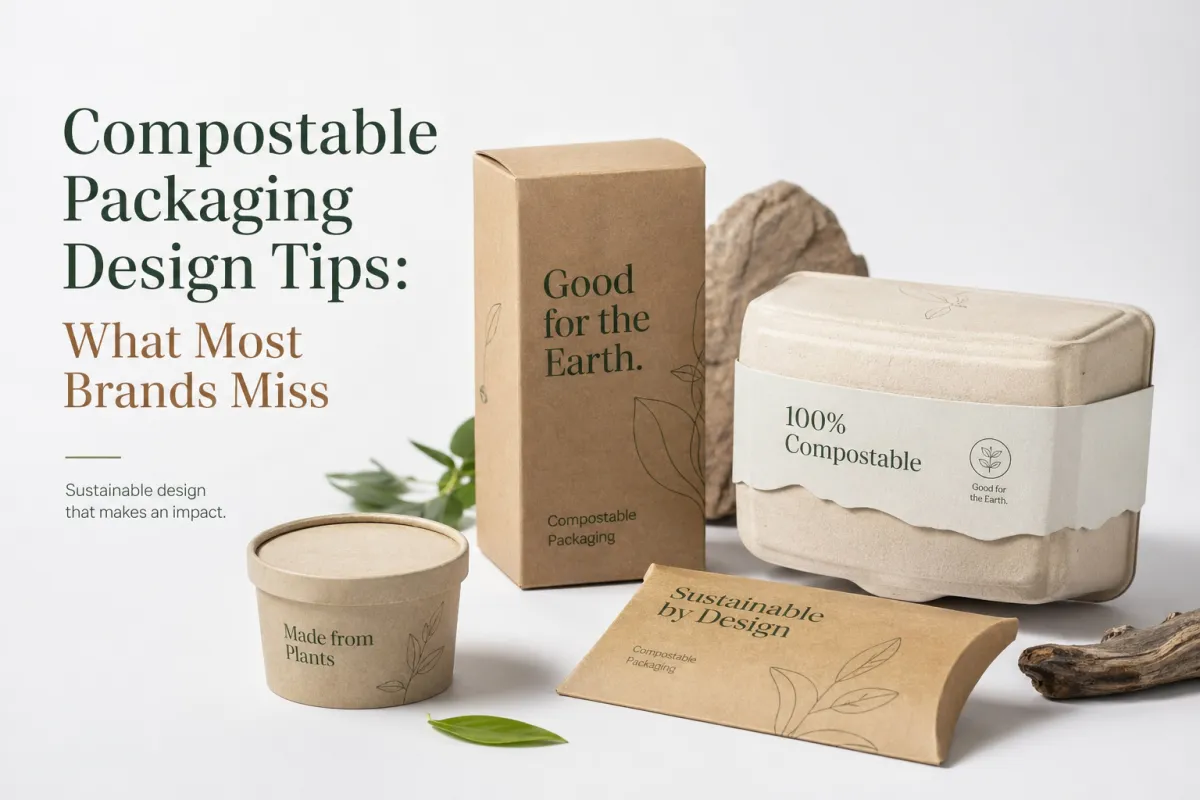
A compostable package can still be a bad package. That is the part many teams miss. If the seal gives way, the pouch tears in transit, or the lid warps before the product reaches the buyer, the claim does not repair the damage. The pack still becomes waste. The most useful compostable packaging design tips always start with performance, because performance is the thing customers notice first.
Confusion around terminology causes a second layer of trouble. “Compostable,” “biodegradable,” “recyclable,” and “plant-based” do not mean the same thing, even though marketing language often blurs them together. Compostable material is designed to break down under defined conditions into carbon dioxide, water, biomass, and inorganic components without leaving harmful residue behind. Recyclable material belongs in a recovery stream. Plant-based only tells you where the feedstock came from. A sugarcane fiber tray and a compostable pouch are not interchangeable just because both came from plants. The chemistry decides the outcome, not the color palette.
Design choices shape the final claim more than most people expect. Shape changes stress points in transit. Seal width changes leak resistance. Ink coverage affects both print cost and, in some cases, compost compatibility. Coatings and windows can turn an apparently compliant structure into a non-compliant one if one component falls outside the claim. Strong compostable packaging design tips look at the whole stack, not just the base substrate on the quote sheet.
Picture a coffee pouch with a matte finish, a clear window, a heavy zipper, deep black print, and enough barrier to hold aroma for months. Each request sounds reasonable on its own. Put them together in a compostable structure and the tradeoffs multiply fast. The mockup looks premium. The production sample often feels compromised. That gap is where a lot of compostable projects break down, especially when design teams have never stood next to a packing line and watched how a seal behaves after a warm run through production.
Compostable packaging is not a style choice. It is a material system, a performance target, and a compliance file rolled into one printed shell.
For packaging buyer conversations, I like to reduce the decision to four questions: what product is inside, how long it must stay stable, where it will be used, and where the customer is expected to dispose of it. If the disposal answer is vague, the claim is vague too. That is not cynicism. It is packaging discipline. Practical compostable packaging design tips make the disposal path part of the brief instead of an afterthought taped on at the end.
Shelf reality matters just as much. Retail packaging has to sell quickly. If the pack looks thin, curls at the edges, or carries print that makes the brand feel cheap, the compostable claim will not rescue conversion. Package branding and branded packaging meet the technical side here. A compostable pack still needs strong typography, a clear visual hierarchy, and a shape that reads well from a few feet away. Good compostable packaging design tips do not excuse weak design. They force sharper choices.
A decent benchmark is simple: build for 24 to 48 hours of retail handling, 5 to 10 touchpoints in the customer journey, and a realistic shipping trip before worrying about poetic copy. That kind of thinking keeps product packaging honest. Anything less, and the compostable claim starts behaving like a liability instead of an asset.
How Do Compostable Packaging Design Tips Work in Practice?
Composting is biology with rules attached. Heat, moisture, oxygen, microbes, and time all have to line up for a compostable package to break down properly. Industrial composting runs hotter and more controlled than home composting, which is why a material can pass an industrial standard and still sit stubbornly intact in a backyard bin. That gap is not a technical footnote. It changes the package selection entirely.
Industry references often point to ASTM D6400 for plastics and ASTM D6868 for paper or other substrates with compostable plastic coatings, plus certification marks such as BPI, TÜV Austria OK compost INDUSTRIAL, or OK compost HOME, depending on the market. The details matter because a sample that looks identical on a shelf may behave very differently once you add a print layer, a closure, or a barrier coating. The EPA offers a useful overview of composting basics at the EPA composting guidance page, and the Sustainable Packaging Coalition at packaging.org is a useful reference for how the industry talks about material claims.
Real packaging is a stack of decisions. The base substrate matters, but so do adhesives, inks, laminations, windows, closures, labels, and sometimes a liner. One non-compostable zipper can undo the entire claim. A paper pouch with a barrier layer that never breaks down as intended may look responsible and still fail the standard. That is the difference between practical compostable packaging design tips and decorative green language.
Industrial and home composting are separate targets. Home-compostable materials have to break down in lower, less controlled conditions, which usually narrows material choices and stretches the timeline. Industrial compostable packaging can use a broader range of structures, but only if the customer actually has access to an industrial facility. A technically valid claim can still be functionally useless if the disposal stream is unavailable. That awkward split sits at the center of a lot of eco packaging.
Here is the decision path I use:
- If the product is dry and low-fat, begin with a simple paper-based or fiber-based structure.
- If the product is moist, oily, or oxygen-sensitive, define the minimum barrier before discussing graphics.
- If shelf life matters, test the full structure, not only the substrate.
- If the pack needs a window, zipper, or label, confirm each component fits the composting claim.
That sequence sounds plain, which is kind of the point. The fastest way to wreck a compostable project is to build around appearance first and function second. Better compostable packaging design tips push the team to ask whether the barrier is truly needed, whether the closure can be simplified, and whether the shape can reduce material use without creating damage.
Take a takeout container. If it has to hold hot food, resist grease for 20 to 30 minutes, and avoid warping in delivery, the structure has to be chosen for that abuse. Swapping plastic for fiber and calling it done is how teams end up with soggy lids and disappointed customers. The coating has to be compostable, the seal has to hold, and the print has to survive steam and handling. Compostable packaging design quickly becomes packaging engineering with branding attached.
Testing is the point where theory either survives or falls apart. A sample that looks crisp on a desk can fail as soon as real product, condensation, and compression enter the picture. Anyone talking about compostable packaging design tips without mentioning fill-product testing is selling the easy part and skipping the part that costs money.
Compostable Packaging Design Tips for Cost, Pricing, and Tradeoffs
Cost is where many compostable projects get complicated fast. Compostable materials usually cost more than standard plastics, and the gap widens on small runs. Specialty films, certified inks, compostable adhesives, and lower-volume production all push the number upward. If someone says the premium is “tiny” without asking about order quantity or print coverage, that estimate deserves a second look.
For many projects, compostable packaging can run roughly 15% to 60% higher than a conventional structure, depending on format and volume. Add complex graphics, windows, metallic effects, or custom closures and the range can stretch further. The exact number depends on the format, but the pattern stays the same: simpler structures cost less, and custom printed boxes with extra features get expensive quickly. Solid compostable packaging design tips should show where the money goes and where the design can be trimmed.
Hidden costs matter too. Certifications, supplier declarations, migration testing, shelf-life validation, and compliance reviews all add time and money. So does fixing a design after the first prototype misses the mark. For a branded packaging refresh, the cost of getting the claim wrong can be far higher than the premium for better materials. That is not drama. It is arithmetic.
Here is a useful way to compare common options:
| Option | Typical unit cost range | Strengths | Tradeoffs |
|---|---|---|---|
| Simple kraft paper pouch | $0.18-$0.32 at 5,000 units | Clean look, lower print cost, easier structure | Limited barrier, may need lining or coating |
| Compostable film pouch with zipper | $0.28-$0.55 at 5,000 units | Better moisture protection, strong retail presence | Higher material cost, harder component matching |
| Molded fiber tray | $0.22-$0.48 at 5,000 units | Good for food service, strong sustainability story | May need coating or lid to control grease and steam |
| Paperboard box with compostable liner | $0.35-$0.75 at 5,000 units | Strong shelf appeal, flexible branding space | More components, more testing, more ways to miss the mark |
That table is not a quote. It is a reality check. Some brands get the best result from a simple compostable pouch because it balances price and performance. Others need a stronger barrier structure because spoilage, returns, or complaints would cost more than the upgrade. That is how compostable packaging design tips should be used: not to chase the cheapest unit price, but to protect the economics of the product.
Volume changes the game. Small runs pay more for setup, sourcing, and production inefficiency. Larger runs soften some of that pain, but they do not erase it. A 2,000-piece run and a 20,000-piece run live in different cost worlds. Buyers comparing product packaging options should ask for price bands at multiple quantities, not a single hero number that looks tidy in an email.
Finishing choices create tradeoffs too. Matte effects, soft-touch coatings, metallic print simulation, and clear windows all add complexity. Those features may elevate retail packaging, but they also create compostability problems or force a redesign. If package branding is being built around a compostable structure, the team has to decide whether the visual upgrade is worth the added material burden. Sometimes it is. Sometimes it is just vanity with better lighting.
One practical rule keeps procurement honest: compare cost against damage rate, complaint rate, and shelf conversion, not just unit price. A package that saves two cents but raises leakage or returns is not cheaper. It is more expensive with prettier graphics. That is one of the most useful compostable packaging design tips for sourcing teams because it pushes the conversation out of the spreadsheet and into business impact. If you need a place to start spec comparisons, Custom Packaging Products is the right internal starting point before you commit to a structure.
Step-by-Step Compostable Packaging Design Tips Process and Timeline
The cleanest way to handle a compostable project is to treat it like a technical launch, not a graphic refresh. Start with a brief that defines the product, fill weight, shelf-life target, disposal expectation, and budget range. If those details are fuzzy, the design will drift. Good compostable packaging design tips depend on a precise brief because compostable materials leave less room for casual improvisation.
A realistic process usually looks like this:
- Define product requirements and disposal target.
- Shortlist 2 to 3 material structures.
- Review size, seal, barrier, and closure options.
- Prepare artwork with the print method in mind.
- Produce a prototype and inspect fit, fill, and sealing.
- Run performance tests with real product.
- Confirm claims, documentation, and production readiness.
Timelines vary, but simple projects often move in a few weeks once the structure is known and the artwork is ready. More custom compostable packaging takes longer, especially if new tooling, barrier validation, or supplier documentation is involved. A practical planning range is often 2 to 4 weeks for early sampling, then another 1 to 3 weeks for revisions and approval if the first sample is close. If a structural redesign is needed, the calendar stretches. The material does not care about your launch date.
Delays tend to cluster in the same places. First, the barrier does not perform as expected. Second, the seal area fails under heat or compression. Third, the artwork assumes a finish that the compostable structure cannot support. Fourth, compliance questions slow the project because nobody checked the claim language early enough. Good compostable packaging design tips build in checkpoints before those problems get expensive.
Here is the approval checklist I would not skip:
- Compostability claim backed by supplier documentation and, where applicable, certification.
- Seal performance tested with actual fill product and normal handling.
- Shelf-life validation for moisture, aroma, grease, or oxygen sensitivity.
- Drop and compression performance, especially if the pack ships in master cartons.
- Artwork review for print limits, instruction clarity, and end-of-life messaging.
Speed comes from discipline, not optimism. Lock the size early. Remove unnecessary features. Keep the first version simple enough to test quickly. If the brand wants the package to be compostable, premium, shelf-ready, and ultra-low-cost on the first try, the project is already in trouble. The smarter path is to build a minimum viable structure that protects the product, then refine the visuals after the technical basics are proven. That is one of those compostable packaging design tips people skip because it sounds plain. Plain is cheaper than a recall.
Use the timeline to align the whole team as well. Brand, operations, sourcing, and sales need the same spec sheet. A one-page document listing material, size, target barrier, print method, claim language, and testing criteria prevents a lot of avoidable confusion. Packaging projects usually fail in the space between departments, not just on the factory floor.
Common Mistakes in Compostable Packaging Design Tips
The most common mistake is forcing non-compostable extras into a compostable structure. Standard pressure-sensitive labels, mixed-metal inks, plastic laminates, and non-compostable zippers are the usual suspects. One bad component can ruin the whole system. That is why compostable packaging design tips always include a component-by-component review instead of a vague “eco-friendly” stamp.
Vague language creates the next layer of trouble. “Earth-friendly,” “eco-safe,” and “green” are not technical claims. They are marketing fog. If the package is industrially compostable, say that. If it is home compostable, say that only when the evidence supports it. If it is simply made from renewable feedstock, say that instead. Clear claims protect the brand and help customers trust the packaging. Vague claims are how complaints turn into legal emails.
Overdesign is just as risky. Teams like matte coatings, metallic accents, windows, custom closures, and layered graphics because the mockup looks premium. Then the production sample comes back looking like a compromise because the compostable structure had limits from the start. Strong package branding can work with compostable materials, but the design has to accept fewer finishing options. Smart compostable packaging design tips do not promise miracles. They build a good-looking pack inside the material rules.
Product mismatch is another familiar failure. A dry snack does not need the same barrier as roasted coffee. A greasy takeout item behaves differently from tea. A supplement pouch needs different protection than a bakery bag. If the product inside is not matched to the structure, the package will fail even when the composting claim is technically valid. In product packaging, the contents drive the structure. That should be obvious, yet it is still where many projects slip.
Access to composting infrastructure causes a final problem. A package may comply with an industrial composting standard and still be awkward for a customer who has no local access to an industrial composting facility. That does not make the claim false. It makes the user experience messy. Practical compostable packaging design tips should include disposal instructions, a realistic note on pack, and a sober look at whether the audience can actually use the end-of-life pathway.
Testing also gets underestimated. Empty samples reveal almost nothing about grease resistance, condensation behavior, seal durability, or print abrasion. Real tests should use real product, filled packs, and normal handling. Distribution-style testing is useful even when the package is not a shipping box. If the pack fails in transit, the compostability argument loses its meaning because the contents are already damaged.
If the package cannot protect the product, the sustainability claim does not rescue it. Customers buy the product, not the brochure.
That is why the best compostable packaging design tips sound almost unglamorous. Simplify the structure. Validate the claim. Test with the real product. Not sexy. Very effective. And far less expensive than discovering the problem after a full production run of custom printed boxes that should have been simpler from the start.
Expert Compostable Packaging Design Tips for Better Results
Design for the product first. Sustainability comes after the structure can actually do its job. That order saves money and keeps the packaging honest. If the pack is for a dry snack, a simpler paper-based design may work well. If it is for something greasy or aromatic, the barrier needs to be deliberate. The best compostable packaging design tips start with function because function is what keeps the product marketable.
Simplify the graphics where possible. Fewer layers, fewer special effects, and fewer incompatible finishes usually make the package easier to produce and more reliable to compost. That does not mean boring. It means clearer visual hierarchy. Strong typography, clean icon placement, and disciplined color use often outperform a crowded design with too many finishes. A clean retail packaging layout can look premium without becoming wasteful.
Test with filled product, not empty shells. That sounds obvious until you see how many teams skip it. Food weight changes seal stress. Oils change migration risk. Condensation changes print adhesion. Even a small change in fill volume can affect the top seal. The package should be evaluated under real use conditions, not just held in someone’s hand during a sales review. That is where many compostable packaging design tips prove their value: they insist on real-world testing.
Ask suppliers for documentation, not only claims. You want the certification or compliance trail, barrier evidence, and failure cases if they have them. If a supplier can only talk about green positioning and cannot explain what happens when the material meets grease, moisture, or long shelf storage, keep looking. FSC-certified paper, compostability references, and test data tell you more than a polished pitch. Package sourcing is a paperwork sport whether anyone likes that or not.
Use the pack itself to reduce confusion at disposal. Clear copy helps. So does a simple instruction panel with higher contrast and larger type than the rest of the legal copy. If the package is intended for industrial composting, say so plainly. If a customer needs to remove a label or closure before disposal, explain that in direct language. Effective compostable packaging design tips often include better end-of-life messaging than most brands expect, because a correct claim that nobody understands is not very useful.
There are also a few practical design moves that make the project easier to manage:
- Use one primary material wherever possible instead of mixing formats.
- Keep copy blocks short and direct so the label area stays readable.
- Choose high-contrast printing for composting instructions and handling notes.
- Plan for scuffing by avoiding fragile visual effects near folds and seals.
- Build the SKU around the simplest size that still protects the fill weight.
These are not flashy tricks. They are the kind of compostable packaging design tips that help a project survive procurement, prepress, and production without turning into a mess. And that matters more than another round of “can we make it pop?” because a package that prints cleanly, ships cleanly, and disposes correctly is already doing the hard part.
One more thing deserves attention: do not let the sustainability story outrun the product story. If the package looks impressive but the food stales, the seal leaks, or the box crushes, the brand loses trust. Product packaging has to earn its keep. The compostable claim should support the brand, not carry it like some overworked intern with a color-coded spreadsheet.
Next Steps: Put Compostable Packaging Design Tips Into Action
Start with an audit of the current pack. List the product’s actual needs: moisture, grease, oxygen, aroma, light, shipping stress, shelf life, and disposal target. Then write down what cannot change. That one exercise usually exposes half the hidden assumptions in a redesign. The smartest compostable packaging design tips begin with a spec sheet, not a mood board.
Next, request 2 to 3 material options from your supplier or designer. Compare them side by side on cost, lead time, print quality, barrier performance, and claim compatibility. Ask for the simplest version first. If the plain structure works, great. If it does not, complexity can be added with intent instead of panic. That is a better way to buy custom packaging products than guessing and hoping the sample looks convincing.
Before full production, run the obvious tests: seal strength, print durability, drop resistance, shelf-life behavior, and actual fill performance. Then confirm the compostability claim with documentation that matches the structure, not just the raw substrate. If the brand story says compostable, the packaging has to support that promise without caveats buried in a footnote. That is where compostable packaging design tips prove their worth.
A one-page packaging spec sheet is worth the time. Include dimensions, material stack, print method, closure type, claim language, test results, and approval sign-off. It keeps the brand, designer, and supplier from talking past each other. Packaging projects are usually delayed by confusion, not by one giant technical failure. A clear spec removes a lot of that friction.
Finally, keep the end goal realistic. Compostable packaging is useful when it is designed well, produced cleanly, and paired with an honest disposal path. It is not a magic sticker. It is a design choice with tradeoffs. The brands that understand that get better results, fewer complaints, and a package that feels intentional instead of performative. The practical takeaway is simple: choose the simplest structure that protects the product, verify every component in the claim, and test the full pack with real product before launch. That is how compostable packaging design tips turn into packaging That Actually Works.
What are the most important compostable packaging design tips for beginners?
Start with the product’s protection needs, then choose the simplest compostable structure that can meet them. Avoid extra layers, mixed materials, and fancy finishes until you know they will not break performance or pricing. The best compostable packaging design tips for beginners are usually the least glamorous ones.
How do compostable packaging design tips differ from recyclable packaging advice?
Compostable packaging has to break down under the right conditions, while recyclable packaging has to fit an existing recycling stream. That means adhesives, inks, coatings, and closures are judged differently, and the design rules are not interchangeable. Good compostable packaging design tips focus on end-of-life breakdown; recyclable advice focuses on sorting and recovery.
How much more does compostable packaging usually cost?
It often costs more than standard plastic because of specialty materials, certifications, and lower-volume production runs. The real gap depends on print complexity, order size, and whether the package needs barriers, windows, or custom closures. In practice, the premium can be modest on simple structures and much higher on custom builds, so the numbers need to be quoted case by case.
How long does the compostable packaging design process usually take?
Simple projects can move in a few weeks, but custom compostable structures often take longer because sourcing and testing are slower. Prototype review, compliance checks, and barrier testing are usually the biggest timeline drivers. If the first sample fails, add time. That is just how production works, no matter how optimistic the launch calendar looks.
What should I test before launching compostable packaging?
Test seal strength, drop resistance, shelf life, print durability, and real-product performance, not just empty samples. Also verify the compostability claim with supplier documentation so the design matches the marketing. Those checks make the difference between a package that sounds good and a package that actually survives the market.