Buyer Fit Snapshot
| Best fit | compare biodegradable film vs molded pulp for packaging buyers comparing material specs, print proof, MOQ, unit cost, freight, and repeat-order risk where brand print, material, artwork control, and repeat-order consistency matter. |
|---|---|
| Quote inputs | Share finished size, material target, print colors, finish, packing count, annual reorder estimate, and delivery region. |
| Proofing check | Approve dieline scale, logo placement, barcode or warning zones, color tolerance, and any recyclable or compostable wording before bulk production. |
| Main risk | Vague material claims, crowded artwork, or missing packing details can create delays even when the unit price looks attractive. |
Fast answer: Compare Biodegradable Film vs Molded Pulp: Film, Closure, Print, and Fulfillment should be specified like a repeatable production item. The safest quote includes material, print method, finish, artwork proof, carton packing, and reorder notes in one written spec.
What to confirm before approving the packaging proof
Check the product dimensions against the actual filled item, not only the sales mockup. Ask for tolerance on folds, seals, hang holes, label areas, and retail display edges. If the package carries a logo, QR code, warning copy, or legal claim, reserve that space before decorative graphics fill the panel.
How to compare quotes without losing quality
Compare board or film grade, print process, finish, sampling route, tooling charges, carton quantity, and freight assumptions side by side. A lower quote is only useful if the supplier can repeat the same color, closure quality, and packing count on the next order.
To compare biodegradable film vs Molded Pulp, start with the failure mode that would hurt most. A moisture-sensitive snack kit needs a clear retail sleeve, but it also has to survive a 36-inch drop, warehouse stacking, and a delivery lane that treats corners like a personal enemy. In that kind of job, the answer is rarely philosophical. It is usually practical. Biodegradable film tends to win on visibility, moisture control, and lightweight presentation. Molded pulp tends to win on cushioning, structure, and the sturdy feel buyers notice the second they lift the carton.
I am looking at this from a packaging buyer's seat, not a theory-first angle. I have sat through enough sample reviews to know the pattern: the material that looks tidy in a meeting can fall apart once it hits the pack line or the truck. If you compare biodegradable film vs molded pulp without checking tears, punctures, condensation, compression, and shelf appeal together, the result can look good on a spec sheet and fail in the real lane. That gap is expensive. Cheap materials turn costly fast once damage, rework, or a late launch start eating the budget. The same is true for compostable packaging claims that sound nice and do very little in the warehouse.
The basic decision is simple. The tradeoffs are not. Moisture, dust, and visibility loss push the conversation toward film. Crush, movement, and product scuffing push it toward pulp. Everything that follows is about those tradeoffs in the real world, not in a tidy presentation deck. If you care about a moisture barrier, protective inserts, and total landed cost, compare biodegradable film vs molded pulp with those three things in mind first.
Which Is Better? Compare Biodegradable Film vs Molded Pulp
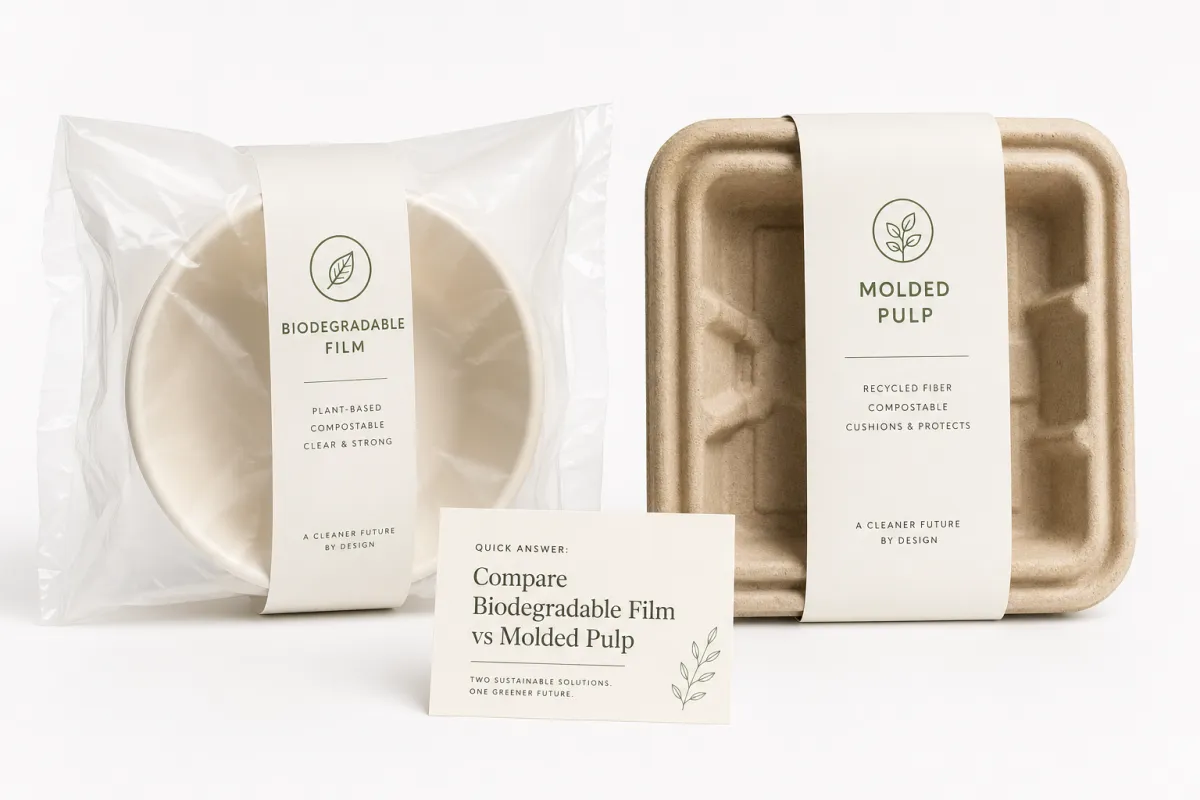
compare biodegradable film vs molded pulp usually comes down to the failure mode that would hurt the most. A clear film sleeve protects against dust and moisture while keeping the product visible. A molded pulp insert absorbs impact, keeps the item from shifting, and makes the package feel more intentional in hand. If the pack has to look premium on a shelf, biodegradable film often gets the first look. If it has to survive a rough distribution lane, molded pulp usually earns the stronger vote.
Buyers make this harder than it needs to be by asking which material is "better" in general. Better for what? A personal care refill pouch inside a display carton has different needs from a ceramic accessory boxed for ecommerce. compare biodegradable film vs molded pulp makes more sense when the question is framed around risk: tears, punctures, condensation, compression, or shelf appeal. Name the risk and the choice gets clearer.
The short answer is straightforward: biodegradable film usually wins on visibility, lightweight presentation, and moisture control. molded pulp usually wins on cushioning, structure, and a more protective feel. That sounds obvious, yet teams still pick a material because it fits a sustainability brief before checking whether it fits the packing line, the transit lane, and the approval schedule.
So no, this is not a theory exercise. compare biodegradable film vs molded pulp deserves a buyer's review that covers cost, process, printability, and the ugly parts nobody likes to mention. That is what separates a package that survives sampling from one that survives production, shipping, and the complaints afterward.
Top Options Compared: Compare Biodegradable Film vs Molded Pulp
compare biodegradable film vs molded pulp is easiest to judge side by side. The table below is not a lab report, but it reflects how these materials usually behave in production: film is thinner, clearer, and more presentation-friendly; pulp is thicker, more structural, and more forgiving when the carton gets knocked around. I like tables for this sort of thing because they cut through the sales language in about two seconds flat.
| Criteria | Biodegradable Film | Molded Pulp |
|---|---|---|
| Moisture resistance | Generally stronger; useful for wraps, sleeves, and sealed bags | Weaker unless coated or stored in dry conditions |
| Cushioning and impact protection | Limited; can protect surface finish, not heavy impact | Strong; good for inserts, trays, and product immobilization |
| Transparency | High; product remains visible | Opaque; product is hidden |
| Branding surface | Good for print, labels, and window-style presentation | Better for embossing, ink, or minimal graphics |
| Compostability claims | Depends on resin blend and certification | Depends on fiber source, coatings, and local disposal rules |
| Line compatibility | Often easier if existing sealing or wrapping equipment is in place | Requires fit testing and sometimes new tooling |
| Storage footprint | Compact rolls or flat stock | Bulkier stacks; more warehouse volume per unit |
Here is the skimmer verdict: compare biodegradable film vs molded pulp for presentation and speed, and film usually looks stronger; compare them for protection and handling, and pulp usually wins. The operational trap is easy to miss. A material can look better on a sustainability sheet and still create more damage, more waste, or slower packing in the warehouse. That kind of mismatch is how a "better" package becomes a headache nobody budgeted for.
Best-fit use cases are not hard to spot if the product is treated honestly. Biodegradable film works for sleeves, wraps, bags, and display-forward packaging where product visibility matters. Molded pulp works for inserts, trays, shippers, and protective nests where structure matters more than a clear view.
"A package is not finished when it looks good on a table. It is finished when the product arrives intact after a bad truck ride, a rushed packout, and a humid storeroom."
The quick verdict is simple: compare biodegradable film vs molded pulp by asking what you are trying to prevent. Film is the cleaner choice when moisture and presentation dominate. Pulp is the safer choice when compression and movement dominate. If you can only test one thing first, test the failure mode that would cost you the most returns.
Detailed Reviews: Biodegradable Film in Real Packaging Tests
compare biodegradable film vs molded pulp becomes a lot more interesting once the film meets real handling conditions. The best biodegradable film formats are the ones that behave predictably on existing equipment: sleeves that hold a print panel flat, wraps that do not wrinkle badly, and bags that seal without constant operator correction. When the format is simple, the material almost disappears. That is the point.
Barrier performance is the first place film earns its keep. For moisture-sensitive goods, a good biodegradable film can slow humidity transfer enough to keep labels, coatings, powders, or light snacks from looking tired before they reach the customer. Not every film behaves the same way. Resin blend, thickness, seal design, and storage conditions all matter. A 30-50 micron film can be perfectly serviceable for some wraps, while another blend at the same gauge may seal poorly or tear too easily at the corners. I have seen that happen with two suppliers using basically the same spec sheet. The difference showed up the second the test line got warm.
Printability is another real advantage. compare biodegradable film vs molded pulp on branding, and film usually wins because it gives you a clean, flat surface for labels, overprints, or high-contrast graphics. That matters for retail packaging, where the first impression is visual and buyers often judge a product in under three seconds. If the brand needs clarity, gloss, or a crisp window effect, film can look more premium than many teams expect.
The weak points are not subtle. Puncture sensitivity is real. If the product has sharp edges or the packer over-tensions the wrap, a biodegradable film can split faster than a buyer wants to admit. Heat-seal tuning also causes headaches. Too low, and the seal creeps open. Too high, and the film distorts, shrinks, or melts unevenly. In a production run, that can mean more rejects than the team budgeted for.
Compostability claims need a careful eye. compare biodegradable film vs molded pulp here, and film usually attracts stronger marketing language, but the label only matters if the resin blend and certification match the disposal route. ASTM D6400 and EN 13432 are the names buyers hear most often, but a compostable certificate is not the same thing as local composting access. If the facility will not accept the package, the claim loses practical value fast. That is not cynicism. That is just how waste systems work.
For a practical buyer, biodegradable film feels premium when it is thin, quiet, and clean in the hand. It starts to feel like a compromise when the job needs protection that the film cannot deliver on its own. That is the moment to compare biodegradable film vs molded pulp as a system decision, not a material preference. Sometimes the right answer is film for presentation and pulp for protection, paired together instead of treated as rivals.
One more issue matters a lot: line speed. A film format that runs at 35-60 packs per minute with only small adjustments can save more labor than a marginally cheaper material. That is where the comparison gets uncomfortable. compare biodegradable film vs molded pulp is not just about material cost; it is about whether the package slows down the people who have to make it every day. Add in seal consistency, operator training, and moisture barrier performance, and the real winner shows up quickly.
Detailed Reviews: Molded Pulp in Real Packaging Tests
compare biodegradable film vs molded pulp from a protection standpoint, and molded pulp usually feels more convincing within seconds. The material has mass. It has depth. It gives the product a nest instead of a wrap, which is why it shows up in electronics inserts, takeaway trays, cosmetic shippers, and any box where movement is the enemy. Buyers trust it because it looks like it belongs in a shipper, not just inside one.
Cushioning is the main benefit. A well-designed pulp insert can spread impact across a wider area, reducing point loads on corners, lenses, lids, or printed surfaces. In practice, that matters on drop tests and vibration runs. If you are validating against ISTA methods, especially for ecommerce or parcel shipping, molded pulp often restrains product better than a film-only setup. The ISTA test framework is worth a look if you want to validate more than a visual sample.
Stackability is another strength. compare biodegradable film vs molded pulp on warehouse handling, and pulp wins because it stays in shape. Trays nest well, inserts do not slide around easily, and the package feels more stable during packout. That reduces movement, which in turn reduces scuffing and rattling. For fragile items, that quiet confidence is worth real money.
Molded pulp is not magic. Bulkier storage is a genuine drawback. A film roll takes up a fraction of the floor space that a molded pulp stack does, and that matters if warehouse rent is expensive or the line runs multiple SKUs from a small footprint. Tooling is another hurdle. Even a basic cavity design may need several rounds of sampling before the fit is right, and a bad fit can turn a protective insert into decorative filler.
Moisture sensitivity also deserves respect. compare biodegradable film vs molded pulp in humid climates, and pulp often needs a more careful plan. Some grades absorb moisture and soften, especially if they sit for long periods in high humidity. That does not make them weak across the board, but it does mean buyers should test the package in the conditions it will actually face, not just in a dry sample room. A pulp tray that looks perfect on the bench can get a little mushy in a hot loading dock. That is the sort of detail nobody wants to discover late.
The best molded pulp jobs feel reassuring in hand. The item sits where it should, the insert does not collapse, and the consumer does not have to dig for the product. The worst jobs feel bulky and overbuilt, especially when the product is small and lightweight. At that point, compare biodegradable film vs molded pulp again and ask whether the added structure is solving a real problem or just signaling sustainability. Sometimes the answer is awkward, but it saves money.
There is also a sourcing angle. Fiber source matters, and buyers should ask whether the pulp uses recycled fiber, bagasse, bamboo, or a virgin mix. If you want to connect the material story to responsible sourcing, the FSC framework helps when paper-based inputs are part of the conversation. It will not answer every question, but it does keep the sustainability story honest. And honestly, that is rare enough to be useful.
Price Comparison: What Biodegradable Film vs Molded Pulp Costs
compare biodegradable film vs molded pulp and the price gap is not always the one people assume. Film often looks cheaper because the raw material can be low-cost, especially for simple sleeves or wraps. Molded pulp often looks more expensive because tooling, drying, and cavity development create upfront costs. Once damage rate, warehouse space, and brand impact enter the picture, the answer changes quickly. Funny how that works.
For simple biodegradable film jobs, a rough working range might land around $0.04-$0.12 per unit at moderate volume for straightforward wraps or sleeves, with printed or higher-barrier formats moving into the $0.10-$0.28 range depending on size and coverage. Molded Pulp Inserts often start higher, sometimes around $0.18-$0.45 per unit at smaller runs, with tooling potentially adding $1,500-$8,000 or more depending on cavity count, trim complexity, and whether the insert needs custom fit testing. Those are not universal prices, but they are realistic enough to help a buyer frame the conversation.
Raw material is only part of the story. compare biodegradable film vs molded pulp on converting costs, and film usually benefits from existing sealing or wrapping lines. If the line already exists, the conversion cost stays lower. Molded pulp, on the other hand, often needs cavity development, trim setup, and more sample rounds before production approval. That setup can be worth it, but it needs to be accounted for early.
Hidden costs matter more than most procurement sheets admit. If the film tears and creates rework, labor climbs. If the pulp takes more warehouse room, freight and storage climb. If the package has to be replaced after transit damage, the "cheaper" option stops being cheaper. compare biodegradable film vs molded pulp on total landed cost, and the winner often depends on whether the package is protecting a $2 item or a $200 item. That is the real split, not the invoice total.
There is also the cost of claims. Sustainability language has to be supported, especially if the package is sold as compostable, recyclable, or responsibly sourced. If the marketing team wants stronger claims, the testing and documentation overhead can add to the project budget. With film, certification questions can get complicated fast. With pulp, fiber origin, coatings, and end-of-life language need the same level of scrutiny.
In practice, I would never judge compare biodegradable film vs molded pulp on unit price alone. That number can mislead by an order of magnitude if damage rates or packing speed are ignored. A packaging line that saves six seconds per unit can beat a cheaper material very quickly, and a more protective insert can pay for itself the first time it prevents a batch of returns.
Warehouse footprint is an underpriced variable too. Film stores compactly. Pulp stacks take volume. If your facility charges by pallet position or your contract packer bills storage separately, the "cheap" choice can become expensive over a quarter. That is why compare biodegradable film vs molded pulp should always be read as a system cost question, not a material line item.
Process and Timeline: From Sample to Production
compare biodegradable film vs molded pulp also means comparing how each project moves from concept to production. Film is usually faster when the format is simple and the tooling already exists. Molded pulp usually takes longer upfront because the cavity shape, drying behavior, and fit tolerances need more care. Buyers who miss that difference often build launch plans that are too optimistic by several weeks.
The film development path is usually straightforward: brief, material selection, print proof, seal test, and production approval. If the design is a sleeve, bag, or wrap with standard dimensions, turnaround can be relatively quick. In many cases, a simple biodegradable film project can move from proof approval to production in 10-15 business days, assuming the art is ready and the supplier has stock. That timeline can stretch if the film needs special barrier properties or a custom print setup.
Molded pulp is more involved. A cavity shape has to be designed around the product, not just around the carton. Then samples need to be checked for fit, crush, and ease of packout. Drying and finish can change the final dimensions slightly, which is why one prototype rarely solves everything. In many projects, compare biodegradable film vs molded pulp, and pulp takes 3-6 weeks or longer from concept to production-ready approval, especially if revisions are needed.
Bottlenecks show up in the same places over and over. Print approvals can hold up film. Seal validation can expose weak points in the film structure. For pulp, cavity revisions and humidity behavior can drag the schedule out. If the package has to be validated against transit standards, testing can become the longest phase, not manufacturing. The hard truth is that compare biodegradable film vs molded pulp often reveals process risk before material risk. That is useful, even if it is annoying.
Testing should be practical, not ceremonial. Run a drop test. Run a compression test. Condition samples in humidity if the product will travel through damp lanes or sit in warm storage. If possible, test the pack on the actual line with the actual operators. They will find problems that a CAD screen cannot show. That one hour of hands-on testing can save a week of rework later. I have seen a carton go from "approved" to "absolutely not" in under ten minutes once the packers got hold of it.
There is a planning lesson here. compare biodegradable film vs molded pulp is not just a sustainability decision; it is a scheduling decision. Film can be faster to launch, especially when the pack is light and presentation-led. Pulp can be safer for fragile goods, but it rewards early planning. If the launch date is fixed, the wrong material choice can become a timeline problem long before it becomes a packaging problem.
My rule of thumb is simple: if the product needs a quick seasonal rollout, start by testing the film path first. If the product is fragile enough that one damaged shipment hurts the brand, start by testing the pulp path first. That ordering saves time because it focuses the development work where the risk is highest.
How to Choose: Compare Biodegradable Film vs Molded Pulp
compare biodegradable film vs molded pulp with a decision framework, not a preference. Start with the product type. Start with the shipping distance. Start with the shelf environment. A small, moisture-sensitive item with strong visual branding usually points toward film. A brittle or irregular product that needs restraint usually points toward pulp. That simple split solves more packaging debates than most teams want to admit.
If display is the priority, choose biodegradable film first. It is the better fit for clear sleeves, lightweight wraps, and products that need the consumer to see color, texture, or form before purchase. If protection is the priority, choose molded pulp first. It is the better fit for inserts, trays, and shipping components that need to stop movement and absorb impact.
For many buyers, compare biodegradable film vs molded pulp really means comparing two different kinds of confidence. Film gives confidence in presentation and moisture control. Pulp gives confidence in structure and transit performance. Both can be sustainable in different ways, but neither should be selected because the sustainability story sounds nice in a meeting.
Here is the practical checklist I would use before placing an order:
- Request physical samples, not just renders.
- Run a drop test with filled packaging.
- Check condensation or humidity exposure if the product is sensitive.
- Confirm MOQ, tooling fees, and lead times in writing.
- Verify compostability or fiber-source claims before approving artwork.
One more point matters for commercial buyers: total cost of failure. If the product is low value and the customer can tolerate minor cosmetic issues, biodegradable film can be the practical choice. If the product is high value or fragile, molded pulp is usually the safer spend. compare biodegradable film vs molded pulp becomes far less abstract once you ask how much one damaged shipment would cost in refunds, replacements, and lost trust.
My honest recommendation is simple. Use biodegradable film when you need clarity, light weight, and decent moisture defense. Use molded pulp when you need cushioning, structure, and a more substantial protective feel. compare biodegradable film vs molded pulp is not a contest with one permanent winner; it is a fit test for your product, your line, and your distribution lane.
If you are still undecided, run both versions on real samples. Then compare biodegradable film vs molded pulp under the conditions that matter: transit, storage, packout speed, and customer-facing presentation. The better package is the one that survives those four checks without creating a new problem elsewhere. That is the part people skip, and it is usually where the budget gets burned.
FAQ
Which is better for food packaging: biodegradable film or molded pulp?
For food packaging, compare biodegradable film vs molded pulp based on what the pack needs to do. Use biodegradable film when you need moisture protection, visibility, or a wrapper around the product. Use molded pulp when the package needs trays, inserts, or crush protection during transport. Check food-contact and certification language first, because that matters more than the marketing term on the front panel.
Is biodegradable film or molded pulp cheaper for custom packaging?
Biodegradable film is often cheaper at scale for simple formats, especially when the converting line already exists. Molded pulp can cost more upfront because tooling and drying add setup expense. Still, compare biodegradable film vs molded pulp by looking beyond the invoice. Damage rate, freight, rework, and warehouse space can change the real winner fast.
Which performs better in shipping: biodegradable film or molded pulp?
Molded pulp usually performs better when the main risk is crush, impact, or product movement. Biodegradable film performs better when the main risk is moisture, dust, or visibility loss. In long-distance shipping, compare biodegradable film vs molded pulp with the lane in mind: pulp often wins for primary protection, while film is stronger for secondary wraps or display layers.
How long does production take for biodegradable film vs molded pulp?
Biodegradable film can move faster if the format is simple and the seal structure is already proven. Molded pulp usually takes longer because the tooling, cavity shape, and drying behavior need more setup. In both cases, compare biodegradable film vs molded pulp by asking where the delay is likely to happen: artwork approval, sample revisions, or actual production.
Are biodegradable film and molded pulp actually compostable?
Not all products marketed as compostable will break down the same way, so certification matters. Local composting access and facility rules can matter more than the label on the package. Mixed-material designs can also reduce compostability even if one component is certified. If you compare biodegradable film vs molded pulp on end-of-life claims, verify the exact resin, fiber source, and certification before you approve the spec.
For buyers making a real sourcing decision, compare biodegradable film vs molded pulp with the same discipline you would use for any other packaging change: sample it, test it, measure damage, and validate the claim language. If the product needs clarity and moisture defense, film is the cleaner path. If the product needs restraint and impact protection, pulp is the better bet. That is the difference between a package that sounds sustainable and a package that actually holds up in the field.