Buyer Fit Snapshot
| Best fit | Compare Biodegradable Ink Labels vs Soy projects where brand print, material claims, artwork control, MOQ, and repeat-order consistency need to be specified before quoting. |
|---|---|
| Quote inputs | Share finished size, material target, print colors, finish, packing count, annual reorder estimate, ship-to region, and any compliance wording. |
| Proofing check | Approve dieline scale, logo placement, barcode or warning zones, color tolerance, closure strength, and carton packing before bulk production. |
| Main risk | Vague material claims, crowded artwork, missing packing details, or unclear freight terms can make a low unit price expensive after revisions. |
Fast answer: Compare Biodegradable Ink Labels vs Soy: Print Tolerance, Proofing, and Reorder Cost should be specified like a repeatable production item. The safest quote records material, print method, finish, artwork proof, packing count, and reorder notes in one written spec.
Production checks before approval
Compare the actual filled-product size with the drawing, then confirm tolerance on folds, seals, hang holes, label areas, and retail display edges. Reserve space for logos, QR codes, warning copy, and material claims before decorative graphics fill the panel.
Quote comparison points
Review material grade, print process, finish, sampling route, tooling charges, carton quantity, and freight assumptions side by side. A quote is only useful when the supplier can repeat the same color, closure quality, and packing count on the next order.
Compare biodegradable ink labels vs soy: Which One Actually holds up? The honest answer depends on the whole label, not just the ink sitting on top of it. I have seen Labels That Looked perfect on the proof sheet, then curled after a cold shipment, scuffed on a carton line, or lost legibility before the product even made it to retail. A label only earns its keep if it survives the warehouse, the shelf, and the handoff to the customer.
I compare biodegradable ink labels vs soy by looking at the full construction, because the facestock, adhesive, coating, curing method, and disposal path usually decide the result long before the ink chemistry gets any credit. The press run matters, sure, but it is only one part of the system. If the substrate and adhesive are mismatched, the rest is just decoration.
From a packaging buyer's point of view, the real test is survival. Will the label hold through condensation on a chilled bottle? Does it scuff in transit? Does the type stay clean after retail handling? Does the end-of-life claim still make sense once the package enters recycling, composting, or landfill? Those are the questions that matter when you compare biodegradable ink labels vs soy in the market, not in a presentation deck.
My short answer is plain. Soy ink usually wins on familiarity, pressroom comfort, and predictable commercial output. Biodegradable ink labels only win when the entire build is designed to biodegrade together, with matching substrate and adhesive, and even then the claim needs proof. That may sound less glamorous than the brochure version, but packaging usually rewards what works.
Compare biodegradable ink labels vs soy: the real-world answer
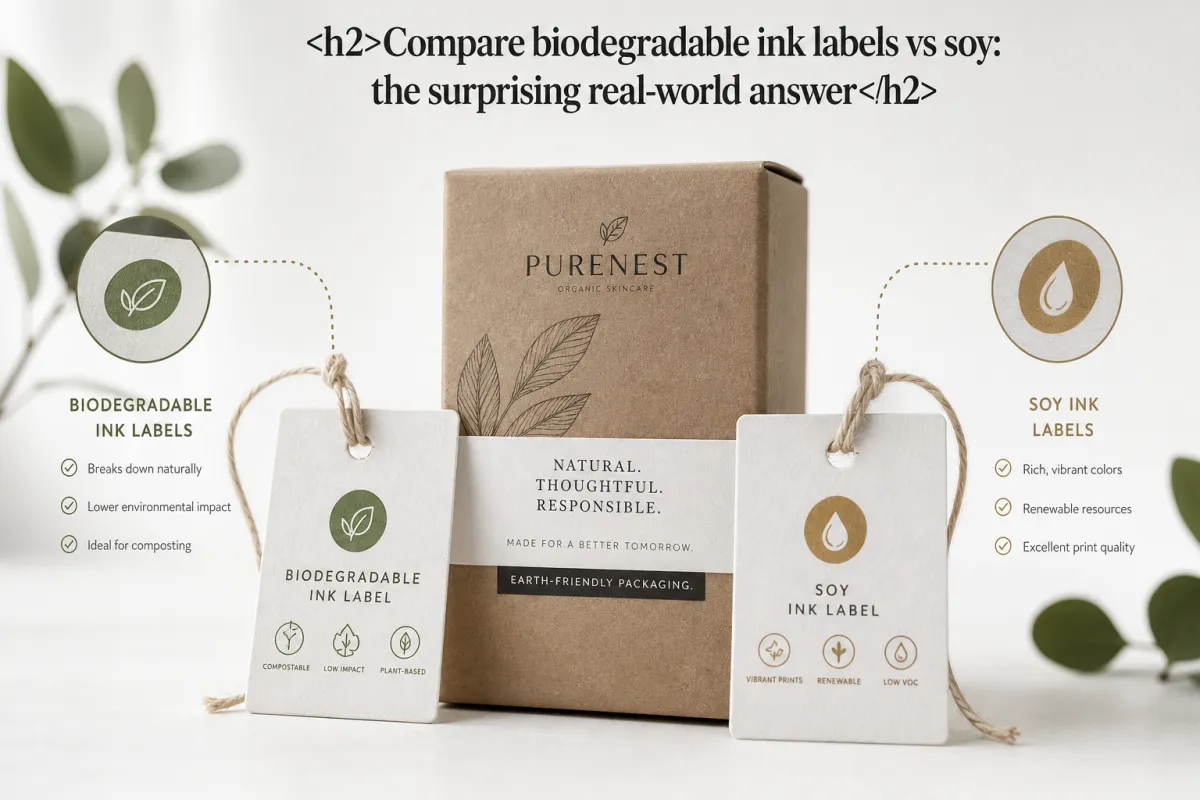
The biggest mistake buyers make is judging sustainability by ink chemistry alone. When you compare biodegradable ink labels vs soy, the ink is only one layer in a much larger system. A compostable-sounding ink on a paper stock with a stubborn adhesive is not a compostable label. It is a standard label with a friendlier marketing line.
Real packaging behaves differently from the sample table. A label can outlast the box, fail before the product reaches the shelf, or look fine in a dry sample and fall apart after two days in cold storage. That is especially true in chilled supply chains, beverage multipacks, bath and body cartons, and any pack that sees humidity or abrasion. Compare biodegradable ink labels vs soy with that in mind and the conversation gets more honest very quickly.
The buyer's test is straightforward: does the label survive shipping, storage, condensation, rub, and retail handling without creating a problem? If the answer is no, sustainability comes second. That is why the smartest packaging teams treat compare biodegradable ink labels vs soy as a specification decision, not a philosophy debate. The pressroom is gonna tell you fast where the weak points are.
"The label is rarely the greenest part of the pack on paper. The weak point is usually the adhesive or the coating, and that is what buyers forget first."
There is also a commercial reality hiding in the background. The more ambitious the environmental claim, the more carefully the entire label stack needs to be checked. Soy ink is often easier because commercial printers know it well, stock choices are familiar, and press behavior is predictable. Biodegradable ink labels can be attractive, but only if the substrate, adhesive, and any protective coating are aligned. If they are not, the claim collapses under normal use. Buyers usually discover that after the sample stage, when they compare biodegradable ink labels vs soy against live shipments rather than mockups.
For brands that want a steady first step, a standard paper label printed with soy-based ink may be the safer commercial move. For brands building a verified composting story, biodegradable ink labels deserve a careful review, but only with documentation in hand. If you need a broader starting point for the packaging system, the Custom Labels & Tags page is a practical place to review stock, finish, and adhesive options before narrowing down the print method.
If your end-of-life message depends on recycling or responsible fiber sourcing, the details matter there too. The EPA's recycling guidance is a useful reference for what actually enters existing recovery streams, while FSC certification helps clarify whether the paper component carries a recognized forestry standard: EPA recycling guidance and FSC certification standards.
Top options compared: compare biodegradable ink labels vs soy
When teams compare biodegradable ink labels vs soy, I usually see three real-world builds rather than two neat categories. First: soy-based ink on standard paper stock. Second: biodegradable ink labels on compostable or bio-based stock. Third: a hybrid setup that tries to balance shelf appeal, supply availability, and a softer sustainability claim. Each one solves a different problem, and each one comes with its own set of tradeoffs.
Soy-based labels on paper stock are the broad commercial default. They print well, run through many standard production workflows, and usually make sourcing simpler. For a lot of brands, that matters more than chasing the most ambitious end-of-life story. Biodegradable ink labels on compostable stock are more specific. They make sense when the brand story is tightly linked to compostability and the supplier can prove the whole build. Hybrids sit in the middle. They help teams move in a better direction without jumping straight into a fragile material stack.
If I were setting up a buyer scorecard, I would compare biodegradable ink labels vs soy using five criteria:
- Print quality - color density, line sharpness, and registration stability.
- Moisture resistance - especially for chilled, refrigerated, or bathroom products.
- Certification readiness - whether claims can be supported by documents and standards.
- Supply availability - stock access, repeatability, and backup sourcing.
- Adhesive compatibility - whether the label stays put on glass, carton, PET, or flexible pack film.
The tradeoff that matters most is simple: the more ambitious the sustainability claim, the more you have to scrutinize the substrate and adhesive. A soy-based label printed on a recyclable paper facestock may be easier to place into existing workflows than a "biodegradable" build that depends on specialty materials. That is why compare biodegradable ink labels vs soy is never just about the ink. It is really about whether the whole label can behave consistently from press to pallet.
Vendor familiarity matters too. Many print shops know soy ink behavior well because it fits standard commercial output. Biodegradable ink labels can require tighter control on drying, coating choice, and proof approval. That does not make them inferior. It simply means the production team has less room for guesswork. Smaller orders usually leave more room to adjust; larger orders reduce that margin fast.
For a quick reference, use this comparison table before you decide whether to compare biodegradable ink labels vs soy as a sustainability play or as a production decision.
| Option | Typical build | Best for | Watch-outs | Typical unit range |
|---|---|---|---|---|
| Soy ink on paper stock | Paper facestock, standard adhesive, common finish | Retail labels, cartons, broad commercial use | Not automatically compostable; finish and glue still matter | $0.08-$0.22 at moderate volume |
| Biodegradable ink labels on compostable stock | Compostable or bio-based facestock, specialty adhesive | Compostable packaging programs, sustainability-led brands | Needs proof across the full stack; may need more testing | $0.14-$0.35 at moderate volume |
| Hybrid label build | Mixed sustainability features with standard print methods | Transition projects and lower-risk launches | Message can be harder to explain clearly to buyers | $0.10-$0.28 at moderate volume |
One practical note: those unit ranges move with print coverage, roll size, die complexity, and whether the label needs a specialty topcoat. A small MOQ can make any option look expensive because setup costs get spread over fewer pieces. When you compare biodegradable ink labels vs soy, the apparent "green premium" often reflects production complexity more than the ink formula itself.
Detailed reviews: compare biodegradable ink labels vs soy on performance
Color and finish are the first places buyers notice differences. Soy ink often delivers familiar pressroom results: solid fills, readable small type, and consistent brand colors when the supplier already has the setup dialed in. When you compare biodegradable ink labels vs soy on visual output alone, soy usually feels safer because most printers are already used to it. Biodegradable inks can still look excellent, but they may demand more careful process control to keep edge sharpness and density where you want them.
That matters if your packaging uses fine typography, tight logos, or rich black backgrounds. A label for a premium candle or a boutique beverage does not leave much room for muddy edges. Even a one-point shift in registration can make the whole run feel less polished. Compare biodegradable ink labels vs soy on mockups and you may not spot the difference. Compare them after a week in distribution and the story can change.
Durability is where the test gets real. I would always ask for abrasion, condensation, and adhesion checks on the exact stock you plan to use. If the label will sit on a chilled bottle, expose it to moisture in a bathroom, or rub against adjacent cartons, the proof has to reflect that. A label that survives a dry tabletop test can still fail after 24 to 72 hours of refrigeration. That happens often enough that it should be expected, not treated as a surprise.
For that reason, compare biodegradable ink labels vs soy on at least three stress points:
- Rub resistance - does the print smear when handled repeatedly?
- Moisture exposure - does the label blister, curl, or stain?
- Edge lift - do the corners stay down after storage or temperature change?
Adhesion deserves its own paragraph because it is usually the hidden failure point. On glass jars, a label can peel if the adhesive is too aggressive for a textured coating. On cartons, it may hold perfectly until humidity softens the facestock. On flexible packaging, the label might stay attached but wrinkle during handling. When you compare biodegradable ink labels vs soy, the ink choice may have only a small effect on those issues. The adhesive and substrate combination usually decides whether the label behaves like a packaging component or a loose sticker.
Sustainability claims are where honesty matters most. Soy ink is often easier to explain because it is familiar and generally less disruptive to existing print workflows. Soy ink alone does not make a label recyclable or compostable. Biodegradable ink labels can support a stronger disposal story, but only if the full system is designed for it and the supplier can prove it. Compostability claims should be checked against recognized standards such as ASTM D6400, ASTM D6868, or EN 13432, depending on the market. Without that proof, the claim is marketing, not evidence.
This is where many packaging teams get misled. They compare biodegradable ink labels vs soy as if the ink choice will make the package "green." It will not. The facestock, adhesive, coating, and disposal stream matter more. A label that performs beautifully but ends up in the wrong recovery stream is not a sustainability win. A label with an elegant claim that peels, smears, or confuses customers is not a branding win either.
My verdict style view is straightforward. If your brand needs a dependable commercial label with predictable press behavior, soy ink is usually the easier path. If your packaging is part of a verified compostable system, biodegradable ink labels can be worth the extra scrutiny. That is the point where compare biodegradable ink labels vs soy stops being a theory exercise and becomes a supply chain decision.
Compare biodegradable ink labels vs soy: cost, pricing, MOQ, and quote
Price is where the conversation gets practical. When teams compare biodegradable ink labels vs soy, the sticker price can look deceptively close at first glance. Then the quote gets broken into line items and the differences appear: specialty substrate, adhesive upgrade, extra proofing, certification review, color matching, and sometimes slower production scheduling.
For soy-based labels on standard paper stock, the economics are usually simpler. Suppliers already know the workflow, the setup is familiar, and the waste rate tends to be lower. Biodegradable ink labels can carry a premium because the label construction may need compostable or bio-based materials, more careful handling, and additional documentation. That does not mean they are overpriced. It means the material stack is more selective.
Low MOQ can distort the picture. A run of 500 or 1,000 labels may not show the true cost difference because setup fees dominate the total. At 5,000 pieces, the per-unit spread starts to look more realistic. In many commercial quotes, soy-based labels might land around $0.08-$0.22 per unit depending on size and coverage, while biodegradable ink labels on specialty stock may sit closer to $0.14-$0.35 per unit. Those are working ranges, not promises. Print coverage, die complexity, and finish can move either number quickly.
Here is the part buyers often miss: a cheaper label can become more expensive once waste, reruns, or shipping damage enter the picture. If a compostable label fails after delivery and you need a second print run, the "low-cost" option no longer looks low-cost. Compare biodegradable ink labels vs soy with total cost of ownership in mind, not just the quote on day one. That is the difference between a tidy spreadsheet and an order that actually lands well.
Quote structure also varies by supplier. Some bundle proofing, testing, and basic certification checks. Others itemize everything. A buyer who sees a low base price may still end up paying extra for plate changes, color correction, or special storage requirements. That is not a red flag by itself. It is a sign to read the quote line by line and ask what is included.
For commercial buyers, this is the simplest decision rule I use: if the label is a standard marketing asset and the sustainability story is secondary, soy ink often gives better value. If the label itself is part of the sustainability claim, biodegradable ink labels may justify the premium only when the supplier can back up the full construction. A label quote without testing, certification, or material disclosure is only half a quote.
One more cost note: repeatability matters. If your brand needs a new order every few months, supplier stability becomes more valuable than a one-time savings. A label that can be re-ordered with fewer surprises may save more over the year than a cheaper first run. That is true whether you compare biodegradable ink labels vs soy for a beverage launch, a subscription box, or a seasonal promotion.
Process and timeline: compare biodegradable ink labels vs soy lead times
Lead time is another place where the comparison becomes concrete. The production path usually starts with artwork approval, then material sourcing, proofing, print setup, drying or curing, slitting, packing, and shipment. Compare biodegradable ink labels vs soy across that chain and you will usually find that soy-based work moves through standard commercial workflows more easily.
That speed advantage is not automatic. If the soy-based label uses a custom finish, an unusual adhesive, or a color-critical brand palette, the timeline can stretch just like any other custom order. Still, suppliers are more likely to have soy-compatible materials on hand, which reduces sourcing friction. Biodegradable ink labels can add time because the supplier may need specialty stock, extra documentation, or more sample rounds before sign-off.
A realistic planning window for many label projects is 7-12 business days after proof approval for a standard soy-based run, and 10-18 business days for a more specialized biodegradable build. That is not a rule. It depends on order size, backlog, and freight. Even so, those ranges are useful when you compare biodegradable ink labels vs soy and need to tell operations what to expect.
There are five timing checkpoints I recommend for almost every label order:
- Sample request - ask early so the material can be tested against the package.
- First proof - confirm color, layout, and finish before production.
- Revision cycle - allow time for changes, especially if claims need legal review.
- Production slot - check whether the supplier has the exact stock and adhesive in house.
- Freight buffer - leave room for transit delays or a reprint if something fails.
The hidden scheduling variable most buyers miss is backlog on the exact stock or adhesive. A shop can promise a fast turnaround and still stall for three days because the specialty facestock is on allocation. That is why compare biodegradable ink labels vs soy as a sourcing question, not just a print question. The substrate schedule often matters more than the ink family.
Testing should happen in parallel with scheduling, not after it. If the product is refrigerated, condenses, or travels through humid environments, ask for samples on the exact substrate and run a quick proof test. A twenty-four hour hold in the fridge can tell you more than a glossy mockup ever will. If the label passes that, you still need rub testing and adhesion checks. If it fails, you saved yourself a lot of freight and frustration.
The fastest labels are the ones that do not need rescue. A supplier that can explain curing, drying, and material compatibility in plain terms is usually worth more than a slightly lower quote. When you compare biodegradable ink labels vs soy, a timeline that leaves room for actual testing is often the safer commercial choice.
How to choose between biodegradable ink labels vs soy
Start with the disposal path. That sounds simple, but it is where many projects go off course. If the package is meant for recycling, composting, landfill, or mixed waste, the label has to fit that reality. Compare biodegradable ink labels vs soy only after you know where the package actually ends up. A compostable claim on a label does not help if the package enters a recycling stream that cannot accept it.
Next, look at the product conditions. Cold-chain products behave differently from dry shelf goods. Moisture-heavy environments are different from premium cosmetic cartons. Short-run promotions are different from stable, repeat-ordered SKUs. The right answer changes with each one. Compare biodegradable ink labels vs soy using the package's worst-case condition, not its ideal condition.
Here is a practical decision matrix I use:
- Cold-chain, chilled beverage, or condensation-heavy use - favor the label system with the strongest moisture resistance, even if that means soy ink on a proven stock.
- Compostable packaging program with documentation - biodegradable ink labels deserve a detailed review, especially with written proof for the full construction.
- Premium shelf product - compare print fidelity, finish, and edge quality first, then sustainability claims.
- Fast-turn promotion or pilot launch - soy-based labels usually reduce sourcing risk and simplify reorders.
- Subscription or repeat replenishment - prioritize repeatability and low defect risk over a claim that is hard to maintain.
Soy is usually the safer commercial choice because it is broadly compatible, easy to source, and less likely to trigger surprise workflow issues. That does not make it the most advanced sustainability option. It makes it dependable. For many brands, dependable is exactly what they need. Compare biodegradable ink labels vs soy through that lens and the preference often becomes clearer.
Biodegradable ink labels deserve a closer look when the brand has a verified compostable packaging system, a clear disposal narrative, and a supplier who can prove the full stack. That means documents, not just adjectives. It also means asking what happens to the adhesive residue, the coating, and the facestock after disposal. If the supplier cannot answer that cleanly, the label is not ready.
There is also a communications angle. A buyer can choose a technically correct label and still confuse customers if the message is too vague. "Biodegradable" is not a magic word. Some customers read it as a disposal instruction. Others treat it as a promise the label cannot keep. Compare biodegradable ink labels vs soy with the customer-facing claim in mind, because the wrong wording can create more support emails than sales lift.
If you want a broader packaging refresh, the Custom Labels & Tags page is a useful way to narrow down facestock, adhesive, and finish choices before you settle on the print chemistry. That is often where the best decision gets made: not in the ink conversation, but in the label construction conversation.
Our recommendation and next steps
If I had to reduce the whole decision to one rule, it would be this: choose the substrate first, the adhesive second, and the ink third. That order matters because the package's real-world behavior depends on the whole stack. Compare biodegradable ink labels vs soy only after you know what the label has to survive and where it is supposed to go after use.
My recommendation hierarchy is straightforward. For most standard commercial labels, soy ink on a proven stock is the safer choice. For packages that belong in a verified compostable system, biodegradable ink labels can be the right answer, but only if the facestock, adhesive, and coating are equally compostable and the supplier can document it. For everything in between, a hybrid build is often the most honest middle path.
Before placing a full order, ask for three tests on the exact build:
- Moisture exposure - short fridge hold, condensation, or damp handling.
- Rub resistance - repeated handling, carton contact, or transit abrasion.
- Peel strength after storage - especially on glass, PET, or coated carton.
Then ask for the documents that back up the sustainability story. Technical data sheets are good. Certification letters are better. A written explanation of end-of-life claims is best. If a supplier is serious, they should be able to explain whether the label is recyclable, compostable, or simply printed with a lower-impact ink set. That level of clarity makes compare biodegradable ink labels vs soy much easier to defend internally.
My honest view is that brands sometimes chase the label claim before they solve the packaging problem. That is backward. A label that survives shipping and still tells the right story is worth more than a cleaner-sounding ink formula that cannot hold up under pressure. Compare biodegradable ink labels vs soy by testing the full label build, then order the option that survives your actual shipping and shelf conditions.
The clearest takeaway: if the package needs dependable performance first, soy ink on a proven label construction is usually the better fit; if the package is part of a documented compostable system, biodegradable ink labels can be worth the extra scrutiny, but only after you verify the full stack and test it under real conditions.
Are biodegradable ink labels better than soy labels for compostable packaging?
Only if the facestock, adhesive, and any coatings are also compatible with composting. Soy ink is often easier to source and print, but it does not automatically make the label compostable. Ask for proof of the entire label system, not just the ink.
Do soy-based labels recycle better than biodegradable ink labels?
Recyclability usually depends more on the paper or film stock and the adhesive than on the ink alone. A soy-printed label on a recyclable substrate may be easier to accept in existing recycling streams. If the label uses heavy coatings or aggressive glue, the recycling benefit can disappear.
Which option has the lower unit cost at small MOQ?
Soy-based labels are often cheaper at low MOQ because they fit standard production workflows. Biodegradable ink labels can cost more if they need specialty stock, certification, or extra proofing. Always compare quote totals, not just ink price, because waste and reprints can change the real unit cost.
How long do biodegradable ink labels take to produce compared with soy?
Soy labels usually move faster when the supplier already has the stock and setup in place. Biodegradable ink labels can add time if the supplier needs to source specialty materials or verify claims. A safe planning window is to request samples early and keep a buffer for revisions and freight.
What tests should I ask for before ordering biodegradable ink labels vs soy?
Request rub, moisture, and adhesion testing on the exact substrate you plan to use. Ask for performance after refrigeration or condensation if your product is cold-chain or beverage-related. If sustainability claims matter, ask for documentation that covers the full label construction.


