Buyer Fit Snapshot
| Best fit | Poly Mailers vs Kraft Mailers projects where brand print, material claims, artwork control, MOQ, and repeat-order consistency need to be specified before quoting. |
|---|---|
| Quote inputs | Share finished size, material target, print colors, finish, packing count, annual reorder estimate, ship-to region, and any compliance wording. |
| Proofing check | Approve dieline scale, logo placement, barcode or warning zones, color tolerance, closure strength, and carton packing before bulk production. |
| Main risk | Vague material claims, crowded artwork, missing packing details, or unclear freight terms can make a low unit price expensive after revisions. |
Fast answer: Poly Mailers vs Kraft Mailers: Spec Review should be specified like a repeatable production item. The safest quote records material, print method, finish, artwork proof, packing count, and reorder notes in one written spec.
Production checks before approval
Compare the actual filled-product size with the drawing, then confirm tolerance on folds, seals, hang holes, label areas, and retail display edges. Reserve space for logos, QR codes, warning copy, and material claims before decorative graphics fill the panel.
Quote comparison points
Review material grade, print process, finish, sampling route, tooling charges, carton quantity, and freight assumptions side by side. A quote is only useful when the supplier can repeat the same color, closure quality, and packing count on the next order.
Poly Mailers vs Kraft Mailers: Which One Actually Wins? The honest answer depends on what you are shipping, how far it has to travel, and what sort of first impression you want the package to make. For lightweight apparel and soft goods, poly mailers vs kraft mailers usually tilts toward poly because the bags are lighter, less expensive, and far better at shrugging off damp porches, wet sorting areas, and the kind of rough handling that happens when a parcel moves through a busy carrier network. Kraft mailers can feel more refined in the hand, and that matters for some products, but a prettier package is not always the smarter buy. Packaging has a funny way of revealing wishful thinking. The bag either holds up or it does not.
I have seen plenty of businesses lose money in packaging because they start with the look and work backward from there. Poly Mailers vs kraft mailers is really a discussion about protection, postage, labor, and the way a customer feels the moment the parcel lands on the table. A package that arrives clean but flimsy can still drag down the brand. A package that looks elegant but tears in transit is worse, because it teaches the customer to expect disappointment. The economics are pretty straightforward once you look at the full shipping path instead of just the mood board.
Quick Answer: Poly Mailers vs Kraft Mailers
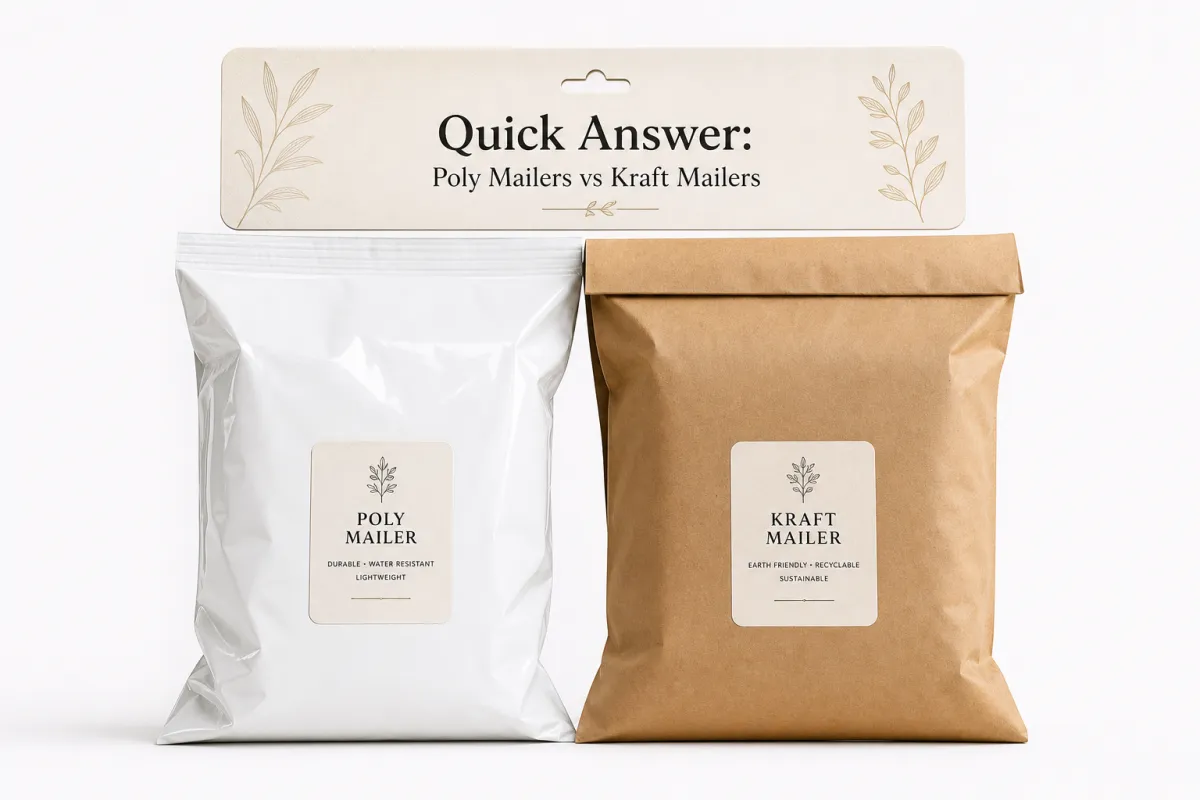
Poly mailers are usually the better choice for clothing, accessories, and other soft products that do not need hard crush protection. They weigh less, cost less, and handle moisture far better than paper-based options. In Poly Mailers vs kraft mailers, that water resistance matters more than a lot of teams want to admit. A kraft mailer can look handsome on a packing table, then come back wrinkled and tired after a rainy delivery route or a wet warehouse floor.
Kraft mailers usually win on presentation. They feel stiffer, photograph well, and carry a more tactile, handmade character that many customers read as thoughtful or premium. That hand-feel is not imaginary. People notice it the first second they pick up the parcel, even if they do not explain it in technical terms. The catch is simple: presentation has to earn its keep. If the mailer adds postage, slows packing, or increases claims, the premium stops being premium and starts becoming overhead. That is a tough pill to swallow, but it is the real math.
A clean way to think about poly mailers vs kraft mailers before buying anything:
- Protection: Poly handles moisture and tearing better; kraft feels stiffer but is less forgiving in wet transit.
- Branding: Poly supports bright print and a retail-ready look; kraft supports a softer, natural presentation.
- Postage: Poly usually keeps weight down, which can help avoid higher shipping tiers.
- Disposal: Kraft is easier for many customers to understand, while poly may need film-recycling programs or store drop-off.
- Use case: Apparel, socks, and flat soft goods often suit poly; stationery and giftable flat items often suit kraft.
If the package can get wet, get crushed, or spend time on a conveyor belt that does not care about your branding, poly mailers vs kraft mailers becomes a durability question first and a design question second.
Start with the product itself if you need a fast answer. Flat, light, flexible items usually push poly mailers vs kraft mailers toward poly. Flat items with more presentation value can justify kraft. Anything brittle, heavy, or oddly shaped may need a box instead. Packaging should fit the job, not the other way around.
Top Options Compared: Poly Mailers vs Kraft Mailers
This choice has more than two lanes, and that is where a lot of teams get sloppy. Poly mailers vs kraft mailers is not just plastic versus paper. The real options usually include standard poly mailers, padded poly mailers, uncoated kraft mailers, and reinforced kraft mailers. Each one behaves differently in transit, which matters because a T-shirt, a candle sample, and a flat book do not face the same shipping stress.
Standard poly mailers are the leanest option. They are thin, flexible, and efficient in volume. Padded poly mailers add a little cushion for items that need scratch protection without a full corrugated box. Uncoated kraft mailers have that clean paper feel and take stamps or handwriting well. Reinforced kraft mailers are sturdier, though they still do not become moisture-proof just because the paper is thicker. That is the trap in poly mailers vs kraft mailers. Better construction helps. Hope does not.
| Mailer Type | Typical Best Use | Strengths | Tradeoffs | Typical Unit Range |
|---|---|---|---|---|
| Standard poly mailer | Apparel, socks, flat soft goods | Lowest weight, moisture resistance, low cost | Less premium feel, less rigid presentation | $0.12-$0.28 at 5,000 units |
| Padded poly mailer | Small accessories, cosmetics, low-fragility items | Light cushioning, still relatively light | More expensive than plain poly, still not rigid | $0.22-$0.55 at 5,000 units |
| Uncoated kraft mailer | Boutique apparel, stationery, handmade goods | Tactile feel, easy handwriting, natural look | Weaker in wet transit, less tear resistance | $0.18-$0.38 at 5,000 units |
| Reinforced kraft mailer | Books, kits, higher-touch e-commerce orders | Stiffer panel feel, better presentation | Heavier, pricier, still moisture-sensitive | $0.28-$0.60 at 5,000 units |
A practical recommendation matrix looks like this: subscription apparel and promo goods usually move poly mailers vs kraft mailers toward poly; artisan goods and giftable flat items often favor kraft; sample kits can work either way depending on how much crush protection they need; small books or stationery sets may justify reinforced kraft if the customer experience matters. Once the item rattles, bends, or stains, neither format may be enough and a box starts making more sense.
Labor matters too. A packing line that uses labels, stamps, or handwritten notes can find kraft easier to work with because the surface accepts marks cleanly. High-volume operations often prefer poly because it opens quickly, seals cleanly, and creates less friction at the station. Over a month, that adds up to real time saved rather than tiny pennies shaved off a unit cost. Poly mailers vs kraft mailers has a way of showing up in payroll, not just procurement.
Detailed Reviews: Where Each Mailer Actually Wins
Poly mailers are the safer bet in wet, dirty, or rough shipping conditions. A decent film mailer resists splashes, sheds light rain, and survives stacking without getting limp or soggy. In poly mailers vs kraft mailers, that advantage shows up in the ordinary parts of transit, not the dramatic ones. Real shipping damage usually comes from friction, compression, and a little moisture working together over time. Poly handles that kind of abuse well.
Print flexibility is another reason buyers favor poly. Bold graphics, repeated patterns, high-contrast logos, matte finishes, gloss finishes, and custom colors all tend to look sharp on film. The surface can cover more of the package without making it feel awkward or overbuilt. Uniformity matters too. If every parcel needs to look the same, poly mailers vs kraft mailers often lands on poly because the printed finish stays consistent across large runs.
Kraft mailers win on feel and first impression. They feel firmer in the hand, look tactile, and often photograph beautifully in a controlled product shot. That matters for brands that want the outer package to feel deliberate before the buyer ever sees the product. Still, poly mailers vs kraft mailers is not a styling contest alone. Kraft can crease, scuff, and show water damage faster than most people expect. A package that looked charming on day one can look tired after a messy route.
The hard truth is that scuffs on kraft can read as character for a minute and then just look worn. Seal strength matters on both materials, but kraft is less forgiving if a fold is off or the adhesive strip is weak. Poly mailers usually hide small handling mistakes better. Kraft can absolutely do the job, though the margin for error is narrower. Poly mailers vs kraft mailers becomes a process question as much as a material question once you move into production.
Judge the bag like a transit material, not a branded sleeve. A good supplier should be ready to talk about seal strength, film thickness, and compression behavior. For film-based packaging, ask about thickness in mils and whether the material aligns with common test references such as ASTM D882 for tensile properties. For transit stress, ask whether the mailer has been evaluated against procedures that mirror rough handling in distribution; the International Safe Transit Association offers useful guidance at ISTA. That may sound technical because it is technical. Packaging failures usually hide in the small details people skip over.
My rule stays simple: if a mailer cannot survive one wet sidewalk, one conveyor belt, and one sloppy warehouse stack, it is not ready for serious e-commerce use.
Sustainability deserves the same level of honesty. Kraft mailers are not automatically better for the environment just because they are paper. Coatings, recycled content, fiber sourcing, and local recovery options all shape the real story. If that part of your brand matters, check certified fiber sources through FSC and do not treat a brown surface as proof of anything. Poly mailers vs kraft mailers is not a moral contest. It is a materials choice with disposal consequences.
Plainly put, poly mailers usually win when the main job is to protect a soft product at low cost. Kraft mailers usually win when the main job is to present a flat product in a more thoughtful way. Neither one is magic. Both fail if the gauge is wrong, the size is wrong, or the adhesive is weak. That is how a brand ends up paying for the same mistake twice.
Price Comparison: Poly Mailers vs Kraft Mailers Costs
Pricing is where poly mailers vs kraft mailers stops being abstract and starts living in a spreadsheet. Basic poly mailers are usually the cheapest option, especially at higher volumes. In common wholesale runs, plain stock poly may land around $0.12-$0.20 per unit, while custom-printed versions often move closer to $0.18-$0.28 depending on size, color count, and print coverage. Add padding and the price climbs. That is expected.
Kraft mailers usually start higher because the substrate is thicker, the structure is more labor-intensive, and the paper base is less forgiving during production. A simple Custom Kraft Mailer may sit around $0.18-$0.38, while reinforced formats or more complex print work can move toward $0.40-$0.60. In poly mailers vs kraft mailers, the difference can look modest on a quote sheet and become obvious once you multiply it across 10,000 units. Packaging math has a habit of turning small gaps into budget issues.
The hidden costs matter just as much as the unit price. Poly mailers often weigh less, so lighter orders can stay under postage thresholds more easily. Kraft mailers may push parcels into a higher mailing band if the rest of the shipment is already near a cutoff. Damage replacement changes the equation again. If one format cuts returns or claims even a little, that savings can outweigh a higher unit price. Poly mailers vs kraft mailers is not about the cheapest bag. It is about the cheapest delivered order.
Labor also shifts the cost picture. Poly mailers tend to open, fill, seal, and stack with very little friction. Kraft mailers can be just as workable if the dimensions and fold pattern are right, but a poor fit slows the pack line. That delay shows up every day. Ten extra seconds per parcel is a real payroll expense in a busy warehouse, even if the bag itself looked like the less expensive option.
- Lower-cost path: poly mailers for soft goods, especially where the product is already light and non-fragile.
- Premium-path cost: kraft mailers if presentation helps conversion or reduces customer complaints.
- Volume effect: at 1,000 units the gap feels small, while at 10,000 units it becomes a negotiation and freight issue.
- Design effect: heavy print coverage raises cost on both materials, though kraft often feels the increase faster.
If you are reading quote sheets, include freight, tooling, proofing, and spoilage. A low unit cost with poor yield is not a bargain. For many brands, poly mailers vs kraft mailers comes down to where the money moves after the bag is printed. Poly can save on postage. Kraft can support perceived value. The wrong choice is the one that quietly makes you spend twice to fix a problem that was obvious before production started.
Production Process & Timeline: What to Expect
Most packaging delays start with file prep, not the factory floor. Clean artwork moves quickly. Sloppy artwork creates revision rounds, and suddenly poly mailers vs kraft mailers is no longer the issue. The real issue is a low-resolution logo uploaded at the last minute and sent for proof as if print quality were optional. A proper order usually begins with dieline confirmation, artwork placement, and a color target before sampling.
Stock poly mailers can move fast because there is no custom print step and the material is already in inventory. Custom Printed Poly Mailers take longer, though they still tend to move faster than many packaging formats because the base film is predictable. Kraft mailers also move on a normal schedule, while special coatings, reinforced panels, and custom finishes can add time. For standard custom work, 12-15 business days after proof approval is a practical planning range, with extra time needed for complexity or freight. Planning beats hoping every single time.
Build in time for the parts nobody loves talking about: proof corrections, color matching, test samples, and transit from the factory to your warehouse. Poly mailers vs kraft mailers both need that discipline. A fixed launch date means you order earlier than feels comfortable. Wait too long and packaging becomes the bottleneck, which is a lovely way to discover how panic sounds in a shared workspace.
A simple launch sequence helps:
- Confirm dimensions against the product's flat size plus closure allowance.
- Ask for a sample or virtual proof before production starts.
- Check print placement, barcode zones, and seal direction.
- Allow extra time if you need custom colors or recycled content claims.
- Reserve a buffer for freight delays and receiving.
If you are building a larger packaging program, compare the mailer with the rest of your box and insert strategy. The outer mailer should support the shipment, not fight it. You can browse more Custom Packaging Products if you are building a full kit, or review Custom Poly Mailers if you already know the leaner route fits your operation. Poly mailers vs kraft mailers becomes easier once the full order flow is in front of you.
The biggest timeline mistake is treating mailers like commodity items and expecting custom results anyway. Even a straightforward order needs correct sizing, decent artwork, and clear approval. Kraft work deserves extra time if you are after a polished paper finish. Poly deserves the same care if you want a specific print effect or tighter color match. Physics does not care that the approval meeting ran long.
How to Choose Between Poly Mailers and Kraft Mailers
Start with the product, not the trend. Poly mailers vs kraft mailers should be decided by weight, moisture risk, handling, and customer expectation. Soft, flat, non-fragile goods usually point toward poly. Flat products that benefit from a more tactile presentation may justify kraft. Anything that needs hard crush protection or suspension should move beyond both and into a box. That is not being picky. That is avoiding avoidable damage.
A quick decision checklist works well in practice:
- Choose poly if you want low shipping weight, strong moisture resistance, and efficient packing.
- Choose kraft if you want a more premium feel, easier handwriting, and a natural-looking presentation.
- Avoid both if the item needs rigid crush protection, suspension, or heavier cushioning.
- Check disposal if your customers care about recycling and you need the end-of-life story to be easy to understand.
- Match size carefully because oversized mailers look sloppy and can raise freight cost.
Sustainability claims deserve a sober look. Poly mailers vs kraft mailers is not a clean win for either side on green optics. Kraft can use recycled fiber and FSC-certified material, yet coatings, mixes, and local recycling rules still matter. Poly can include recycled content too, and some film mailers can enter plastic film recovery streams, though curbside acceptance varies widely. If disposal messaging matters to your brand, be specific. Vague claims usually annoy buyers who already know the difference.
Customer expectations matter more than most teams admit. If your buyers want a boutique unboxing, kraft may support that feeling even if it costs a little more. If your buyers want speed, function, and weather resistance, poly is usually the better signal. Poly mailers vs kraft mailers often breaks cleanly along brand position: value-driven apparel, promo items, and replenishment orders lean poly; giftable, seasonal, or handmade goods lean kraft. Mixed catalogs need sharper judgment because one format rarely fits every SKU.
The cheapest choice is not always the cheapest outcome. A brand can save a little on paper mailers and then pay for returns because the route was damp or the outer pack looked tired on arrival. The same brand can overspend on premium paper packaging for a product that never needed it. Poly mailers vs kraft mailers should be treated as a margin decision, not a mood-board decision.
Our Recommendation: What We Would Buy First
If I were placing the first order for a budget apparel brand, I would buy poly. No drama. Poly mailers vs kraft mailers for tees, leggings, socks, and other light soft goods usually ends with poly because the shipping math is better and the package behaves better in transit. For a premium giftable brand, I would test kraft first, especially if the parcel is flat and the opening moment matters. For mixed catalogs, I would not force one format onto every SKU. That is how teams end up with packaging that is technically acceptable and operationally awkward.
The practical move is to run a side-by-side test before committing. Order both styles, send a batch through actual orders, and compare damage, postage, packing time, and customer feedback. Keep the test honest. Use the same product, the same packer, the same carrier, and the same routes if you can. Poly mailers vs kraft mailers should be judged by outcomes, not by whichever sample looked better on a table. Track returns for a few weeks, not just unboxing reactions on the first day.
A simple buying sequence keeps the process grounded:
- Order one sample of each mailer style in the correct size.
- Pack the same product and weigh both versions.
- Ship test orders to a few real addresses in different weather conditions.
- Compare customer photos, return rates, and packaging complaints.
- Pick the version that protects margin and product presentation, not the one that merely looks nicer in a catalog.
That is the real answer to poly mailers vs kraft mailers. The better mailer is the one that protects the product, supports the brand, and does not quietly inflate the shipping bill. For most shops, poly gets the first look and kraft gets a serious test if presentation matters. Some brands will find kraft worth the extra cost because the customer experience earns it back. Decide with numbers, not packaging folklore.
Are poly mailers or kraft mailers cheaper for small businesses?
Poly mailers are usually cheaper per unit and lighter to ship, which makes them the safer budget choice for apparel and other low-breakage items. In poly mailers vs kraft mailers, kraft often costs more up front, though it can still make sense if the premium look improves conversion or reduces complaints enough to justify the spend.
Which is better for shipping clothes: poly mailers or kraft mailers?
Poly mailers are usually the better everyday choice for clothing because they are lightweight, flexible, and resistant to moisture. Kraft mailers can work if the brand wants a sturdier, more giftable presentation and the garments are not being shipped in wet conditions. For most clothing brands, poly mailers vs kraft mailers is not much of a contest.
Do kraft mailers tear easier than poly mailers?
Yes, plain kraft mailers can be more vulnerable to ripping, especially at seams or when they get damp. Reinforced kraft options hold up better, but poly still tends to win on tear resistance and rough-handling performance. If the route is rough, poly mailers vs kraft mailers usually favors poly for durability alone.
Are poly mailers recyclable or eco-friendly?
Some poly mailers can be recycled through plastic film programs, but they are not always accepted in curbside recycling. Eco-friendliness depends on material mix, recycled content, and how customers can actually dispose of them. Kraft may look cleaner on the surface, yet poly mailers vs kraft mailers is more about the full material story than the color of the outer layer.
How do I decide between poly mailers vs kraft mailers for branded packaging?
Choose poly if you want lower cost, stronger weather resistance, and more room for bold custom printing. Choose kraft if you want a tactile, premium, handwritten look and the product does not need heavy moisture protection. For branded shipping, poly mailers vs kraft mailers should be chosen around the customer journey, not just the logo.
Poly mailers vs kraft mailers is a practical decision, not a moral one. Pick the format that fits your product weight, shipping conditions, margin target, and brand feel. If you want the honest default, poly wins more often than people say out loud. If you want the stronger presentation for flat, giftable items, kraft can earn its place. Either way, test both once, measure damage and postage, and stop guessing.


