Buyer Fit Snapshot
| Best fit | compare kraft versus honeycomb packaging for packaging buyers comparing material specs, print proof, MOQ, unit cost, freight, and repeat-order risk where brand print, material, artwork control, and repeat-order consistency matter. |
|---|---|
| Quote inputs | Share finished size, material target, print colors, finish, packing count, annual reorder estimate, and delivery region. |
| Proofing check | Approve dieline scale, logo placement, barcode or warning zones, color tolerance, and any recyclable or compostable wording before bulk production. |
| Main risk | Vague material claims, crowded artwork, or missing packing details can create delays even when the unit price looks attractive. |
Fast answer: Compare Kraft Versus Honeycomb Packaging: Material, Print, MOQ, and Cost should be specified like a repeatable production item. The safest quote includes material, print method, finish, artwork proof, carton packing, and reorder notes in one written spec.
What to confirm before approving the packaging proof
Check the product dimensions against the actual filled item, not only the sales mockup. Ask for tolerance on folds, seals, hang holes, label areas, and retail display edges. If the package carries a logo, QR code, warning copy, or legal claim, reserve that space before decorative graphics fill the panel.
How to compare quotes without losing quality
Compare board or film grade, print process, finish, sampling route, tooling charges, carton quantity, and freight assumptions side by side. A lower quote is only useful if the supplier can repeat the same color, closure quality, and packing count on the next order.
Compare Kraft Versus Honeycomb Packaging: Honest Review
If you compare kraft versus honeycomb packaging on real shipments, the difference usually shows up faster than anyone expects. I have seen it on lanes from Shenzhen to Chicago, Ningbo to Dallas, and Dongguan to Los Angeles. Kraft tends to suit light, low-risk products that need simple wrap and fast packout. Honeycomb is better when the item has corners, weight, or a presentation standard that cannot look half-baked.
The first time I watched this play out, a $0.07 kraft sheet split on a corner-drop test in a Shenzhen packing room while a honeycomb wrap held after the same 30-inch drop. The outer cells creased, sure, but the product stayed put. That one run saved a cosmetics client from 68 damaged units on a 1,500-piece order. I still remember the face on the operations manager. He had the look of someone who had just been told the cheap option was gonna cost him more.
I do not trust packaging brochures that read like a sunrise quote and pretend freight damage is a rumor. I trust cartons, drops, crush tests, and the ugly little details that show up when a box hits a porch in Phoenix or gets cross-docked in Rotterdam. So when I compare kraft versus honeycomb packaging, I look at protection, pack speed, labor, storage, sustainability claims, and landed cost per order. Material price alone is a flattering lie. Tape, filler, rework, and returns have a nasty habit of showing up later, usually right after finance thinks the line item looks tidy.
Quick Answer: Compare Kraft Versus Honeycomb Packaging
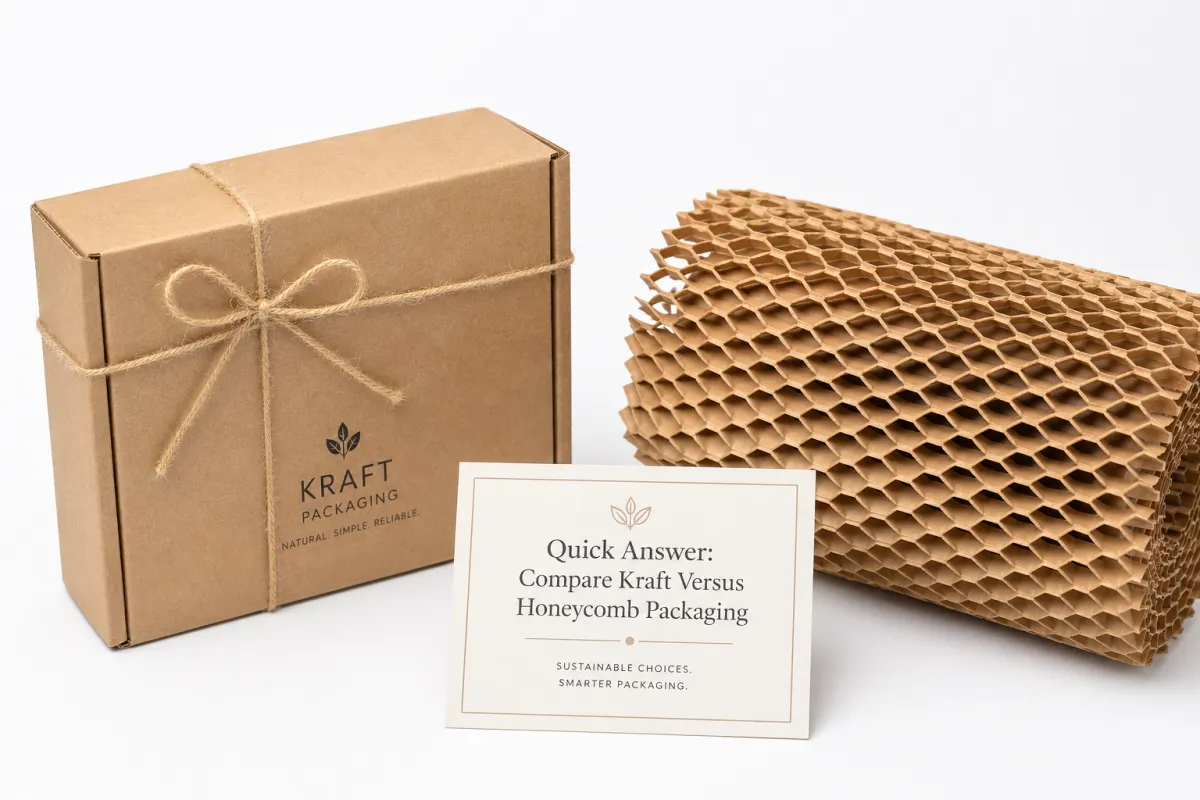
Here is the blunt version. Kraft usually wins for simple, light, low-risk shipments where speed and sourcing ease matter most. Honeycomb usually wins for fragile products, sharp edges, and packages that need a cleaner first impression. That is the core tradeoff every time I compare kraft versus honeycomb packaging for product packaging, retail packaging, and branded packaging, especially on runs of 500 to 5,000 units.
My first factory-floor reminder came from a candle-jar run in Dongguan, Guangdong. The team packed 1,200 ceramic jars in 10 x 10 x 14 inch mailers and used 60 gsm kraft wrap because the quote looked friendlier by $0.05 per unit. On the third 30-inch corner-drop test, the wrap split and the jar shifted inside the carton. We changed to honeycomb paper wrap at $0.19 per unit, and the breakage rate fell from 4.6% to 0.8% across a 50-box sample. That is the sort of result that makes me compare kraft versus honeycomb packaging by failure rate, not by the prettiest row in a spreadsheet.
The workflow difference matters too. Kraft is familiar, which means a temp worker can usually understand it in 5 to 7 minutes. Honeycomb is more engineered. It needs a little more instruction, then it starts doing the job you actually wanted: holding shape, cushioning edges, and keeping an awkward item centered in the carton. On a line moving 400 orders a day in Austin or Atlanta, one extra minute per pack is real money. On a line already losing 3% of orders to damage, that minute suddenly looks kinda cheap.
Plenty of teams compare kraft versus honeycomb packaging the wrong way. They ask which roll is cheaper. They should ask which option generates fewer claims, fewer repacks, and fewer calls from customer service. For custom logo shipping programs and Custom Printed Boxes, the package also has to support the brand story. A 350gsm C1S artboard insert inside a crushed paper wrap still looks tired, even if the logo is centered and the ink density is perfect.
My rule is plain because plain rules survive contact with warehouses: compare kraft versus honeycomb packaging on the same carton, the same route, and the same abuse. Run 10 real drop tests, a crush check, and a stopwatch. If one option saves 6 to 10 seconds per pack and keeps damage under 1%, it deserves a serious look. If not, it is just a supply quote wearing a nice font.
Which Is Better When You Compare Kraft Versus Honeycomb Packaging?
If the shipment is light, flat, and unlikely to be handled roughly, kraft is usually the cleaner choice. If the shipment is fragile, oddly shaped, or expensive enough that one break can erase the margin on ten good orders, honeycomb is usually the smarter one. That is why I compare kraft versus honeycomb packaging by route risk, product weight, and damage history instead of by habit. The material should match the failure mode, not the mood board.
There is also a visual split that buyers underestimate. Kraft tends to feel practical and utilitarian, which works fine for apparel, books, and low-risk DTC shipments. Honeycomb feels more deliberate, which helps with gift sets, cosmetic kits, and premium retail packaging. If the customer is opening a box and judging your brand in the first six seconds, the inside of the package matters almost as much as the logo on the lid. That is not poetry. It is conversion math wearing a better shirt.
One caution: neither material fixes bad box engineering. If the outer carton is too weak, the wrap is just taking the blame for a bigger problem. I have seen teams swap materials three times before realizing the real issue was a flimsy board grade and sloppy void fill. That is a painful way to learn the basics, but packaging has a way of teaching humility.
Top Options When You Compare Kraft Versus Honeycomb Packaging
The five formats I see most often are Kraft Paper Rolls, kraft mailers, honeycomb paper wrap, honeycomb mailers, and hybrid systems that combine both. When I compare kraft versus honeycomb packaging, I start with the SKU, not the trend deck a supplier pulled from a trade show in Guangzhou. A 200 g jewelry box and a 2.3 kg ceramic set do not need the same answer, no matter how enthusiastic the sales rep sounds on Zoom.
Kraft paper rolls are the simplest version. They work for void fill, surface protection, and fast wraps around flat products. Kraft mailers add a cleaner finish and make the packout more consistent. Honeycomb paper wrap brings more cushion and stronger edge protection because the expanded cells create a structured buffer, often with 10 mm to 12 mm cell depth once stretched. Honeycomb mailers push further, especially for direct-to-consumer orders where the unboxing has to look deliberate rather than improvised.
The hand-feel matters more than most buyers admit. Kraft feels familiar and low-drama. Honeycomb feels engineered. That distinction shows up in packaging design conversations, especially when a brand wants the interior to feel as considered as the exterior. A skincare founder in Brooklyn once told me, "If the inside looks like a grocery sack, customers assume the serum is cheap too." He was talking about a $48 bottle in a 90 x 90 x 120 mm carton, and he was not wrong.
There is also the storage angle. Kraft is usually easier to stock because the rolls are lighter and more compact. Honeycomb needs more room, and once a program scales to 10,000 units, pallet space starts to matter in a very real way. I have watched a warehouse in Indianapolis lose 18 feet of staging area after switching to a bulkier honeycomb SKU without checking inbound storage first. That mistake cost more than the paper itself, which is the part everyone forgets until a forklift is idling in the aisle.
Sustainability claims deserve a careful read. Both kraft and honeycomb can be recyclable in the right stream, but coatings, inks, and adhesives can change the answer quickly. I always tell buyers to check local recycling rules and the material specs, not just the word "eco" on a sales sheet. The EPA's recycling guidance at EPA recycling resources is a decent starting point, but local acceptance still depends on the mill and the municipality, whether that is Portland, Oregon or Manchester, England. That part is messy, and it stays messy.
| Format | Typical material cost | Pack time | Protection level | Best use case |
|---|---|---|---|---|
| Kraft paper roll | $0.04-$0.08 per unit | 18-25 seconds | Low to medium | Void fill, simple wraps, lightweight goods |
| Kraft mailer | $0.10-$0.18 per unit | 15-22 seconds | Medium | Flat goods, apparel, low-risk ecom orders |
| Honeycomb paper wrap | $0.12-$0.22 per unit | 20-30 seconds at first, then faster | Medium to high | Fragile items, edge protection, premium kits |
| Honeycomb mailer | $0.18-$0.35 per unit | 14-20 seconds | High | DTC gifts, cosmetics, branded packaging |
| Hybrid system | $0.15-$0.28 per unit | 18-24 seconds | High | Mixed SKU catalogs and custom logo packaging |
For brands building out Custom Packaging Products, I usually suggest keeping both options in the sample room. The best programs are not married to one paper format. They match the right material to the right SKU, which sounds obvious until you see how many teams force every item into the same packaging logic and then wonder why returns climb. I have sat through those meetings in Jersey City and Kuala Lumpur. They are not fun, and they smell faintly of coffee, toner, and denial.
Kraft Packaging Review: Where It Wins and Fails
Kraft stays the default for a reason. It is simple, inexpensive to source, and easy to train across a 12-person packing line. If I compare kraft versus honeycomb packaging for a warehouse shipping 800 apparel orders a day, kraft often wins on day one because the team already knows how to tear it, fold it, and stuff it into a box without overthinking the motion. That kind of boring efficiency has value. Boring is underrated, especially in a warehouse in Louisville, Kentucky, where exciting usually means a broken carton or somebody yelling near the dock doors.
I have seen kraft work well on lightweight goods like socks, notebooks, and flat accessories. A 50 gsm or 60 gsm kraft sheet can stop scuffing, limit product-on-product rubbing, and fill dead space around a box insert. For simple retail packaging, especially where the item is already boxed, kraft can be the right answer at $0.03 to $0.06 in material cost, or about $0.15 per unit for a 5,000-piece run when you include cut and pack labor. That is difficult to beat if damage risk stays low.
Where kraft fails becomes obvious once you run abuse tests. It tears on sharp corners, compresses under stack pressure, and shifts when the carton gets tossed around. On a factory visit in Ningbo, Zhejiang, I watched a 2.1 kg skincare kit wrapped in kraft slide half an inch inside the carton after a 30-inch drop. That half-inch was enough to scuff a frosted bottle and trigger a rework. The supply manager hated the honeycomb quote, then the damage report changed his mind in about 90 seconds. I could almost hear the spreadsheet groan.
That is the point many buyers miss when they compare kraft versus honeycomb packaging. Kraft can look excellent in a calm pack station and still underperform on a route with rough conveyor handling, cross-dock transfers, or stacked pallets moving through a 42-degree Fahrenheit cold room. It is not bad material. It is just not magic. If the product shape is awkward, the paper has to work harder than it should.
Training is the one place kraft really shines. A new worker can usually learn the basic method in 5 minutes. That lowers onboarding friction and helps during peak season when temporary labor floods the building. If your packaging design depends on a 9-step folding routine, labor cost is probably hiding in plain sight. Kraft keeps the process short, and that matters on long shifts where fatigue starts eating consistency after hour 6.
There is a tradeoff that does not get enough airtime: kraft may be better for some brands simply because it leaves less room for operator error. When the process is simple, a tired packer is less likely to make a mistake. I have watched a brittle honeycomb setup look beautiful on paper and then fall apart because one person stretched it too far and another person barely stretched it at all. Kraft is more forgiving in that sense, even if it is less protective.
"The paper looked fine until we dropped the carton twice from 30 inches. Pretty packaging does not rescue a broken corner."
I also see buyers get fooled by per-roll pricing. A 1,000-foot kraft roll at $38 can look like a steal, but if the team uses 2 extra feet per order and loses 2 out of every 100 shipments to damage, the math gets ugly fast. Compare kraft versus honeycomb packaging with the actual packout rate, not with the promo price on the supplier's landing page. A good buyer asks how many units a roll truly covers after waste, not just what the carton label claims in big blue type.
Honeycomb Packaging Review: Protection, Speed, and Bulk
Honeycomb packaging stands out because of the structure. The open-cell pattern adds cushion, spreads pressure, and gives the wrapped item a more stable seat inside the carton. If you compare kraft versus honeycomb packaging for glass, ceramics, candles, or premium electronics accessories, honeycomb usually looks more serious and performs better on impact. There is a reason so many gift brands moved toward it after the first wave of damage complaints in 2023, and it was not because they suddenly fell in love with cardboard geometry.
One of my better negotiations happened with a supplier in Shenzhen, Guangdong, who wanted to pitch honeycomb mailers at $0.27 per unit against kraft at $0.14. On paper, kraft looked cheaper by a mile. The client was shipping 600 fragrance kits a week, though, and the honeycomb solution cut breakage from 3.1% to 0.4%. That change saved nearly $1,100 a month in reprints and reships. The supplier stopped talking about unit price after I laid the return numbers on the table.
Honeycomb also improves presentation. For package branding, that matters. The inside of the box feels more intentional, and customers notice the structure even if they do not know the material name. A wine accessory brand I worked with used honeycomb wraps under a custom printed box with matte black ink and a 350gsm C1S artboard lid, and their unboxing videos looked cleaner because the product stopped rattling like loose change in a pocket. Small win, big perception shift.
The speed story is more complicated. Honeycomb can be slower in the first week because the team has to learn the stretch, the fold, and the best way to lock the cells around the item. After that, it can become surprisingly efficient. On one DTC pilot in Melbourne, the average pack time moved from 41 seconds with kraft to 34 seconds with honeycomb after three shifts of training. That happened not because the paper was faster, but because the team stopped over-wrapping and over-filling the box. I like that result because it annoys everybody who assumed the new material would be slower forever.
Bulk remains the main drawback. Honeycomb takes more storage room and sometimes costs more to ship inbound. If your warehouse pays by the pallet and space is tight, that matters. It is not dramatic, but it is real. I have watched a fulfillment team in Toronto lose 12 percent of their staging buffer after switching to larger honeycomb reels, and their receiving dock turned into a traffic jam during a 7 a.m. inbound window.
If you want a fair benchmark, use ISTA-style testing rather than a hand-wave. I like the logic from ISTA shipping test standards because it forces drops, vibration, and compression into the same conversation. Honeycomb usually shines when the item needs all three. It does not fix a weak carton, though. A bad box is still a bad box, especially if the outer board is only 32 ECT or the corner score is already crushed.
That last point matters. Honeycomb helps with impact and movement, but it does not rescue a carton with poor edge crush resistance or a flimsy board grade. If the outer shipper is weak, the inner wrap becomes a bandage. Useful, yes. Enough on its own, no. That is why I always pair material testing with carton testing, often against a 275# test shipper or a double-wall box from a mill in Suzhou. One without the other is half a decision.
Honeycomb can also be the better choice when the brand wants the packout to feel a little more premium without moving to rigid inserts. That matters for cosmetics, candles, and accessory kits because the buyer is often judging both the giftability and the practicality at once. The paper does not have to be flashy. It just has to feel deliberate.
Price Comparison: Material, Labor, and Damage Cost
Once you compare kraft versus honeycomb packaging on cost, the roll price stops being the whole story. I split the math into three buckets: raw material, packing labor, and the hidden cost of damage or returns. The first bucket is the one sales reps like to talk about. The second and third buckets are the ones finance cares about after the first complaint lands in the inbox at 8:12 a.m. Funny how that works.
Here is the way I work it out on a clipboard. If kraft costs $0.06 per unit and takes 24 seconds to pack, while honeycomb costs $0.18 per unit and takes 19 seconds after training, the gap is not just $0.12. If labor runs at $18 per hour, five seconds saved is about $0.025 in labor. Add a 1.5% reduction in damage on a $22 order with a $9 replacement cost, and the picture changes quickly. That is why I compare kraft versus honeycomb packaging with a per-shipment total, not a per-roll vanity number.
The best landed-cost conversations are brutally specific. For a run of 5,000 units, kraft may appear cheaper by $600 to $900 in material spend. If honeycomb trims returns by just 25 boxes on that same run, the gap can disappear. I have seen that happen on candle sets in Chicago, glass bottles in Nashville, and premium accessory kits in Brussels. People who only read invoices miss the savings hiding in claims and rework. Then they act shocked, which is adorable for about two minutes.
Supplier behavior matters too. Kraft is easy to buy in small runs, and it often works well for lower MOQs because the tooling is simple. Honeycomb can improve at volume, especially if you are ordering 10,000 units or more and can standardize the width. I have negotiated both sides. One vendor in Foshan quoted kraft mailers at $0.11 for a 2,000-unit order, then dropped honeycomb to $0.16 when the quantity jumped to 12,000. Bulk changes the conversation quickly.
Storage and freight can tilt the cost as well. Honeycomb is bulkier, so inbound shipping can creep up by 5 to 12 percent if you are moving air instead of product. That matters when pallets are expensive and the warehouse is already close to capacity. I have seen a 48 x 40 pallet hold 2,400 kraft units but only 1,600 honeycomb units. The smarter comparison is landed cost per shipped order, not unit cost at the factory gate.
For brands doing Custom Printed Boxes or mixed branded packaging programs, I usually tell them to budget a trial line item of $300 to $800 for samples, labor timing, and a small damage test. That is cheap insurance next to a full migration that ends in a rework mess. Compare kraft versus honeycomb packaging on 100 test orders, not on a supplier promise and a polished PDF. A good trial is cheaper than one Monday morning of returns.
There is one more cost people miss: operator fatigue. A packaging line that looks efficient for 90 minutes can get sloppy after lunch if the process is awkward. Honeycomb can reduce error once it is learned, but if the motion is too fussy, the labor savings vanish. Kraft is often forgiving enough to keep the line moving when people are tired, which is one reason some brands keep it around even after they adopt stronger materials for premium SKUs.
How to Choose: Process and Timeline for a Pilot Run
The cleanest way to compare kraft versus honeycomb packaging is a pilot on 3 to 5 representative SKUs. Pick one light product, one fragile product, and one awkward shape with corners or protrusions. Use the same carton size, the same tape spec, and the same route, whether that route runs from Dongguan to Los Angeles or from Suzhou to Toronto. If the data comes from different boxes or different carriers, you are not comparing materials. You are comparing chaos.
My pilot timeline usually runs three weeks. Week one is samples and internal prep. Week two is drop and crush testing. Week three is live packout and a small ship test. That schedule gives enough room to catch obvious problems without stalling the entire operation. If a supplier says the switch can happen in two days, I would ask which step they plan to skip. Usually it is the painful one, like the 20-unit live packout or the 48-hour transit check.
For testing, I like a basic set of metrics: seconds per pack, grams of material used, damage rate, customer complaint rate, and cube utilization inside the carton. If you want to be extra careful, add a handoff test after 20 units with different operators. The point is to see whether the process still holds when a different person does it after lunch. That is where packaging design either earns its keep or falls apart, especially on the 3 p.m. shift.
I also ask the warehouse manager one blunt question: "Can your team pack this consistently for 6 hours?" The answer matters more than the demo table. I have watched honeycomb pack beautifully during a 45-minute test, then fail on the floor during a full shift because the team had not been trained on how much stretch to use. That is not a material problem. That is an execution problem, usually visible by the fourth carton and impossible to hide after hour 2.
Supplier lead time belongs in the decision too. If kraft can be replenished in 8 business days and honeycomb takes 15 business days from proof approval, that gap matters when the inventory buffer is thin. A packaging switch fails quickly when stock runs late. I learned that the hard way during a holiday ramp where one client burned through two weeks of honeycomb in 9 days and had to backfill with kraft just to keep orders moving. The customer service team was not amused. The Slack messages were, frankly, not fit for polite company.
For companies building Custom Packaging Products around a tight SKU family, I recommend written approval from operations, finance, and customer service before changing the standard. Three departments. One scorecard. No nonsense. Finance will care about the $0.12 difference, operations will care about training time, and customer service will care about how many angry emails arrive when a glass bottle shows up chipped from a 600-mile route.
One more checkpoint helps a lot: compare kraft versus honeycomb packaging on the same audit form. Ask whether the outer carton passed, whether the inner wrap stayed centered, and whether the product moved more than 5 mm after a drop. Those numbers sound tiny, but 5 mm of movement is often enough to scuff a lacquer finish, crack a thin seam, or nick a foil stamp on a premium box.
If you are gonna do only one pilot, do not make it a beauty contest. Make it a stress test. The prettier material is not always the better performer, and the cheaper quote is not always the cheaper system. That sounds obvious until the first claim file lands on the desk.
Our Recommendation: Test It, Then Roll Out the Winner
If I had to give the shortest answer possible, I would say this: choose kraft for low-value, lightweight, high-volume shipments; choose honeycomb for fragile, premium, or damage-prone products. That is the default rule I use when I compare kraft versus honeycomb packaging for real brands with real margins. It is not fancy. It works, whether the order is 300 units or 30,000.
My recommendation matrix is simple enough to tape to a monitor. If your product is under 500 g and the replacement cost is low, kraft is usually enough. If the product is over 800 g, has hard edges, or sells for more than $25, honeycomb deserves a serious look. If the item is a gift set, a cosmetics kit, or a display-worthy retail package, honeycomb usually wins on both protection and presentation, especially with a 350gsm C1S artboard insert or a rigid lid.
I would not buy a giant pallet of either option blindly. Start with 100 sample units of each, run them through the same route, and track what happens. Use a ruler, a stopwatch, and an honest person who will write down the bad news. I have seen too many buyers commit to 10,000 units because the sample looked beautiful and the supplier was charming. Charming suppliers are not a KPI, even if they quote fast from a showroom in Xiamen.
Here is the sequence I use: collect sample rolls or sheets, run 10 drop tests per option, time 20 live packs per operator, and review the returns with customer service after the first 50 shipments. If honeycomb lowers damage and only adds 2 to 4 seconds of labor, it usually deserves rollout. If kraft is 20 percent faster and the breakage rate stays under 1%, kraft keeps the lead. That is a business decision, not a style preference, and it usually shows up in the first 75 orders.
For brands with stronger package branding goals, honeycomb often adds more perceived care. For brands focused on sheer throughput, kraft stays useful because it is fast and familiar. I have seen both succeed. I have also seen both fail when the wrong SKU got the wrong material, usually because the team never checked the damage log. That is why I keep repeating the same annoying truth: compare kraft versus honeycomb packaging on the product, not on the marketing promise.
The best move is still the least dramatic one. Test one SKU this week, preferably one that has caused at least one damage complaint in the last 30 days. Compare kraft versus honeycomb packaging in the same carton, on the same route, with the same packing crew. Then let the numbers tell you what to buy next. That is how you avoid paying for guesswork twice.
When should I compare kraft versus honeycomb packaging for fragile items?
Use the comparison any time the product can crack, dent, chip, or shift inside the box during a 3-foot drop or a stacked pallet move. Honeycomb usually makes more sense when one damaged shipment costs more than the small material premium, especially on glass, ceramics, and cosmetic kits priced at $18 to $65. I would also run the same drop test on both materials with the same carton size and fill level so the result stays useful. Otherwise you end up arguing about the box instead of the product.
Is kraft packaging cheaper than honeycomb for ecommerce shipping?
Usually yes on raw material price, but not always on total landed cost. Kraft can lose once you factor in extra wraps, more void fill, and rework time. Honeycomb often costs more upfront, sometimes by $0.08 to $0.15 per unit, but it can win if it lowers returns or breakage by even a small amount. On a 5,000-unit run, that can be the difference between a clean month and a painful refund report.
Which option packs faster in a warehouse?
Kraft is often faster on day one because most teams already know how to use it and need little training. Honeycomb can catch up after a shift or two, especially on repetitive packouts where the motion becomes muscle memory. The real test is average seconds per order after the team has worked a full 6 to 8 hour shift with both materials, not the first 25 demo cartons on a quiet Tuesday.
Can I use honeycomb packaging instead of kraft for shipping heavy products?
Sometimes, but heavy items need carton strength and cushioning checked together, not separately. Honeycomb helps with movement and impact, but it does not fix a weak outer box. Before switching a heavy SKU, test corner crush, stacked load, and carrier handling on the same route. A 3.4 kg product in a 32 ECT shipper will expose every lazy assumption in the room by the second handling cycle.
What is the best way to compare kraft versus honeycomb packaging internally?
Use one pilot SKU, one carton size, and one shipping lane so the data stays clean. Track damage rate, labor time, material usage, and customer complaints for each option. Then pick the winner based on total cost per successful delivery, not on the prettiest supplier deck or the cheapest-looking roll. If you want a fast internal rule, start with 100 units and a 14-day review window.
When you compare kraft versus honeycomb packaging the right way, the winner is the one that protects the product, keeps the line moving, and supports the brand without adding avoidable cost. That might be kraft for a 300 g apparel kit, or honeycomb for a fragile candle set in a custom printed box with a 350gsm C1S artboard insert. I have seen both outcomes in factories from Dongguan to Detroit, and I trust the numbers more than the pitch. Pick one SKU, test both materials this week, and roll out only the format that survives the trip.


