Buyer Fit Snapshot
| Best fit | Compare Paper vs Plastic Packaging projects where brand print, material claims, artwork control, MOQ, and repeat-order consistency need to be specified before quoting. |
|---|---|
| Quote inputs | Share finished size, material target, print colors, finish, packing count, annual reorder estimate, ship-to region, and any compliance wording. |
| Proofing check | Approve dieline scale, logo placement, barcode or warning zones, color tolerance, closure strength, and carton packing before bulk production. |
| Main risk | Vague material claims, crowded artwork, missing packing details, or unclear freight terms can make a low unit price expensive after revisions. |
Fast answer: Compare Paper vs Plastic Packaging: Material, Print, Proofing, and Reorder Risk should be specified like a repeatable production item. The safest quote records material, print method, finish, artwork proof, packing count, and reorder notes in one written spec.
Production checks before approval
Compare the actual filled-product size with the drawing, then confirm tolerance on folds, seals, hang holes, label areas, and retail display edges. Reserve space for logos, QR codes, warning copy, and material claims before decorative graphics fill the panel.
Quote comparison points
Review material grade, print process, finish, sampling route, tooling charges, carton quantity, and freight assumptions side by side. A quote is only useful when the supplier can repeat the same color, closure quality, and packing count on the next order.
Compare Paper vs Plastic Packaging: Which Wins for Brands? I still picture a humid Tuesday afternoon on a production floor in Shenzhen, where a stack of 350gsm C1S artboard cartons looked immaculate under 6,500K warehouse lights and then started losing their crisp edges after one full day beside an open dock door. The corners had already begun to fatigue by the time the pallets reached the staging lane, and the matte aqueous coating was showing a faint ripple where condensation had settled on the outer wrap. That was the day I stopped treating compare paper vs plastic packaging like a style debate and started treating it like a decision about product survival, freight damage, and margin on a 5,000-piece run. Honestly, that shift saved me from a few expensive mistakes, plus at least two awkward client calls I was very happy to avoid.
If you sell cosmetics, apparel, snacks, supplements, or gifts, compare paper vs plastic packaging against the conditions your product actually faces: compression in transit, moisture on a delivery route, grease from hands, vibration in mixed freight, and those first few seconds when a customer opens the box and decides whether the brand feels careful or careless. Paper can elevate packaging with texture, print depth, and a sense of intention, especially on a 4-color folding carton with foil or embossing. Plastic can keep a product clean, dry, and intact without asking the logistics team to apologize later, which matters when a 10,000-unit fulfillment run moves through Atlanta, Miami, and Dallas in the same week. I have watched buyers save seven cents a unit on paper, then lose nearly five dollars an order when the seam split or the box crushed. That is not savings. That is an expensive sentence dressed up as procurement, and I say that with the full weight of a thousand quote sheets on my desk.
Quick Answer: Compare Paper vs Plastic Packaging
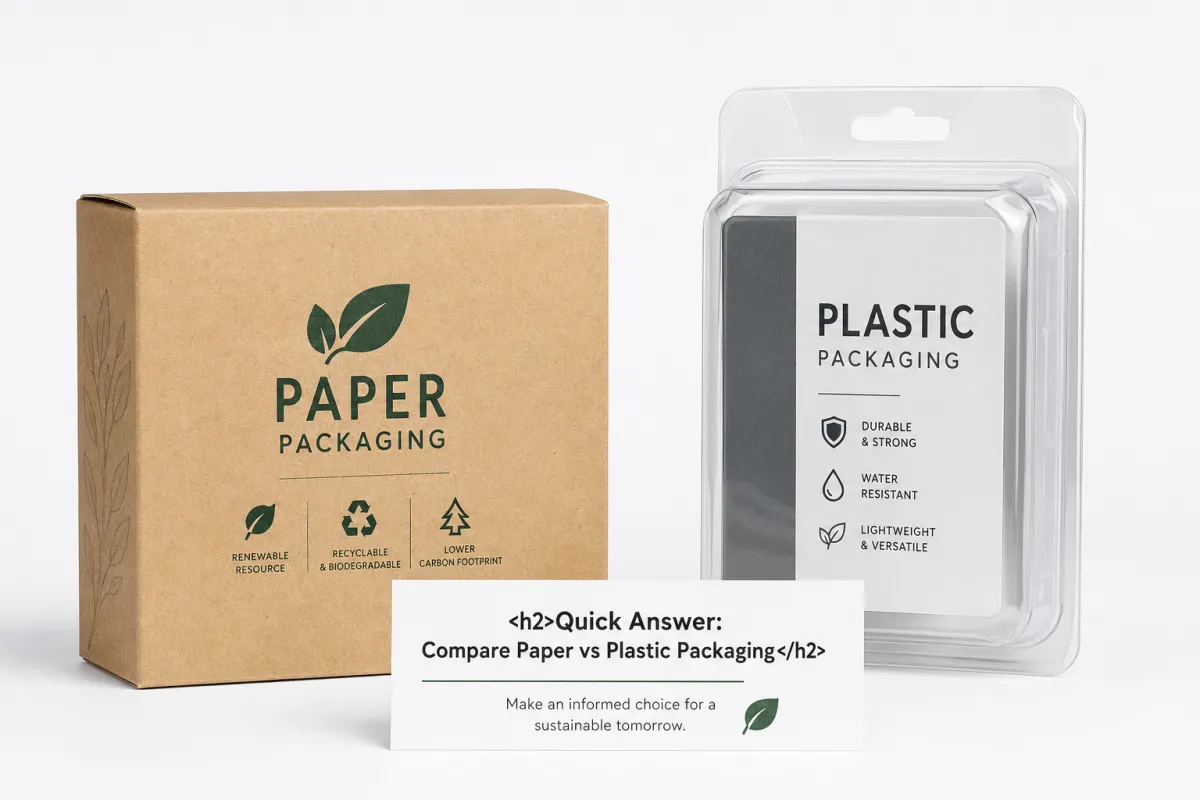
The short version is plain: compare paper vs plastic packaging by asking whether presentation or protection matters more for this SKU. Paper usually wins for shelf storytelling, premium branding, folding cartons, embossing, foil, and the kind of retail package that invites a customer to slow down and look twice, especially when the outer spec is 350gsm to 400gsm board with soft-touch lamination. Plastic usually wins for barrier protection, puncture resistance, visibility, lower freight weight, and high-volume programs where every gram and every cent show up on the P&L, like 20,000-unit e-commerce launches moving out of Ningbo or Dongguan.
On a fragrance project for a Los Angeles brand, I watched a team defend a paper-first concept because the sample looked elegant under soft studio lighting in a Culver City photo studio. The actual shipping plan told a different story: 600 units moving through mixed freight, three warehouse touches, and a final delivery route that included dusty backrooms and boutique stock rooms with almost no climate control. We changed the system to a paper outer carton with a thin PET barrier sleeve inside, and the damage rate fell from 6.2% to just under 1% across the next two shipments. That is the kind of result compare paper vs plastic packaging brings into focus fast. It is also the kind of result that makes everyone nod in the meeting room like they already knew it, which they absolutely did not.
"Pretty packaging that fails in transit is expensive art." A retailer in Chicago said that after we replaced a warped 300gsm paper sleeve with a tighter 80-micron plastic inner pouch and cut complaints by half on a 4,800-unit reorder.
My practical verdict is simple. Compare paper vs plastic packaging through four filters: product sensitivity, shelf life, unboxing goals, and the kind of abuse the package will take in the real world. Dry, light, presentation-led products usually fit paper better, especially if the item weighs under 250 grams and ships in a rigid or folding carton. Heavy, greasy, moist, fragile, or seal-dependent products usually belong in plastic, whether that means a 60-micron LDPE mailer or a 100-micron PET/PE pouch. The answer is rarely ideological. It is usually mechanical, and the market tends to reward the material that survives the route from factory floor to customer doorstep.
- Paper wins for premium presentation, stronger retail branding, and custom printed boxes that carry foil, texture, or soft-touch lamination on 350gsm to 400gsm board.
- Plastic wins for moisture resistance, stretch, sealing, and shipping performance when the carton is not the main part of the brand story, especially on 60- to 100-micron films.
- Hybrid wins when a brand needs both a strong visual face and a functional barrier, especially for tea, refills, and multi-component kits packed in Shenzhen or Dongguan.
If you compare paper vs plastic packaging only through the lens of the sales deck, you will miss the hard parts: scuffing on a conveyor, humidity in a Miami warehouse, and the way a courier tosses a parcel into a van at 7:40 a.m. I have seen all three in the same week, and the package that looked smartest in sampling was often the one that failed once reality got involved. That is the part people forget, usually right after they fall in love with a render from a studio mockup or a CAD file that has never touched a forklift.
Top Options Compared: Compare Paper vs Plastic Packaging Types
To compare paper vs plastic packaging properly, you have to look at the format, not just the raw material. A folding carton solves a different problem from a poly mailer. A rigid box, a pouch, a sleeve, and a clamshell each serve a different job, and the wrong format can make the package feel overbuilt or underpowered even if the substrate itself is fine. I have seen teams Choose the Right material and still get the wrong result because the structure was fighting the product from day one, especially on jobs where the dieline changed three times between proof and production.
- Folding cartons: Paper usually wins here for cosmetics, candles, supplements, and small retail packaging because a 350gsm C1S carton prints cleanly, stacks well, and keeps shelf presentation controlled.
- Rigid boxes: Paper-based rigid setups deliver strong luxury cues for gifts and high-margin branded packaging, though a 2mm board setup costs more and occupies more freight space per 1,000 units.
- Mailers: Paper mailers work well for apparel and lightweight accessories; plastic poly mailers win when a 60-micron film and lower freight cost matter more than a paper-first look.
- Pouches and bags: Plastic usually dominates for resealability, barrier performance, and low-cost volume, especially in food and supplements packed in 100-micron PET/PE laminate.
- Clamshells and blisters: Plastic still leads for display, visibility, and tamper cues, even as pressure around recycling claims keeps rising in California, Ontario, and the UK.
- Sleeves and wraps: Paper sleeves add a visible brand face. Plastic shrink wraps add containment and protection, which is why both keep showing up in custom packaging products across Shenzhen and Guangzhou.
Print behavior matters more than many buyers expect. Paper handles offset-style color, embossing, debossing, foil stamping, spot UV, and soft-touch lamination with less friction than plastic, especially on coated artboard from a plant in Dongguan or Foshan. Plastic can print beautifully too, though it often needs direct print setup, labels, or a secondary sleeve to look premium, and that extra step can add three to five business days to the schedule. That is one reason compare paper vs plastic packaging often lands in paper’s favor for luxury cosmetics and in plastic’s favor for functional shipping formats. The machine operators usually have opinions about this too, and they are rarely shy about sharing them between press checks and lunch breaks.
Visibility creates another divide. Plastic lets the product show through, which helps when the item itself sells the story: a snack bar with a textured finish, a hardware part with a precise shape, or a refill pouch with a color-coded formula. Paper hides the product, which can feel more deliberate and gift-like. I have heard buyers describe paper as more responsible and more expensive, while plastic sounds practical, sealed, and straightforward. Both reactions are genuine, and neither one is a universal rule, especially when a 12-gram sachet pack has to live beside a 500-gram retail unit.
For brands building Custom Printed Boxes, compare paper vs plastic packaging by tracing the customer’s first touch. A fold-over carton for a serum is not the same conversation as a gusseted plastic pouch for protein powder. The carton gives room for storytelling, regulatory copy, and brand marks. The pouch gives stronger protection, lower freight weight, and a cleaner path to shelf life in rougher distribution conditions. If the package needs to survive a warehouse that feels like a sauna by noon, I know which one I trust first, especially on summer shipments leaving Houston or Guangzhou in July.
When a Canadian apparel client asked me to compare paper vs plastic packaging for a 40,000-piece e-commerce launch, the deciding factor had nothing to do with appearance. It was rain in Vancouver and Toronto. Their parcels sat on porches for 30 to 90 minutes in wet weather, and the paper mailer prototype picked up edge swell after two simulated wet-handling cycles in a Mississauga test room. We moved to a coextruded poly mailer and added a 250gsm paper insert card for branding. The customer-facing feel stayed on brand, and the return rate stayed out of the warehouse, which is frankly where it belongs.
If you want a broader view of packaging structure and terminology, the Sustainable Packaging Coalition at packaging.org has useful references that help buyers talk to suppliers without guessing the names of the parts. That matters more than it seems. Half the bad quotes I see begin with vague specs, not bad materials, and a supplier in Zhejiang cannot decode "make it nicer but not too expensive" into a 5,000-piece quote with any precision. A clear spec sheet saves everyone a week and at least one defensive email.
Detailed Reviews: Paper vs Plastic Packaging in Real Use
Paper packaging
Paper packaging is easier to brand, easier to texture, and usually easier to explain to a retail buyer who wants a story they can place on a shelf talker. I like paper for folding cartons, paper mailers, sleeves, and rigid boxes because it gives you room to build a visual language with 4-color printing, foil, and tactile finishes. A 350gsm C1S artboard carton with aqueous coating can look far more expensive than it is if the layout stays disciplined, the barcode sits in the right panel, and the window area is controlled to under 20% of the front face. Done well, it has a quiet confidence that shoppers can feel before they can explain it.
The catch arrives quickly: paper is vulnerable. It crushes. It scuffs. It absorbs moisture. It can warp in humid rooms, especially during long pallet runs that sit in a Guangzhou dock for six to eight hours before loading. On one visit to a converter in Dongguan, I watched a stack of matte-laminated cartons pick up corner memory after sitting beside a loading bay for a single afternoon. The material was fine. The warehouse was not. That is the part buyers miss when they compare paper vs plastic packaging from a sample kit on a clean desk. Samples behave nicely. Trucks do not.
Paper also has a grease problem. For bakery items, snack products, and anything handled with oily fingers, bare paper can stain quickly unless you add a barrier coating or an inner liner. That brings cost and process complexity. If the package has to survive a ten-day shipping window to Phoenix, Orlando, or Calgary, paper needs honest protection. Otherwise, the box becomes part of the problem instead of part of the solution. I have had more than one client discover this after the first batch of complaints, which is a very expensive way to learn about oil migration on a 2,000-unit pilot run.
There is also a paper issue that does not get enough airtime: fiber quality changes the whole job. A crisp SBS board from a good mill behaves differently from a recycled board with shorter fibers and a looser caliper. The recycled stock may be the better environmental choice for some programs, but if the product is a heavy serum bottle or a premium candle, you may need to bump the board weight, change the locking tab geometry, or add a molded insert. That is not a moral failing. It is just packaging engineering, and the box is gonna tell you the truth whether you want it to or not.
Plastic packaging
Plastic packaging is lighter, tougher, and usually better at doing the unglamorous work that keeps a product safe. A 60-micron LDPE poly mailer can take abrasion that would shred a thin paper mailer. A 100-micron PET/PE pouch can hold powder or refills with better sealing performance than most paper structures can manage without help. When brands compare paper vs plastic packaging for shipping performance, plastic often wins by a clean margin, especially once parcels move through a 12-stop courier route or a regional distribution center in Reno or Memphis.
Plastic is not automatically cheap-looking. That assumption is lazy. A matte black pouch with a resealable zipper, careful typography, and tight trim can look excellent, especially when the zipper spec is a 7mm profile and the print registration stays within 0.5 mm. The problem is discipline. Plastic asks for more control to feel premium, and a bad label on plastic looks cheap faster than a bad print on paper. I have seen that play out in client meetings more than once: the paper mockup forgave the rough edges, while the plastic version exposed every alignment mistake under a bright light in a Hong Kong showroom.
Plastic also gives you better product visibility and often stronger protection for supplements, industrial parts, consumables, and e-commerce items that get handled roughly. The tradeoff is perception. Some customers read plastic as less responsible, even when the actual material choice lowers waste through lighter weight and fewer damaged shipments. That is why compare paper vs plastic packaging needs brand context, not just a slogan about recycling. The carbon math, the logistics math, and the perception math are not always on the same page, especially when a 30,000-unit reorder is already booked on the calendar.
One more practical point: not all plastic behaves the same. LDPE, PET, PP, and coextruded films each bring different sealing windows, clarity, stiffness, and puncture resistance. A buyer who says "plastic" in a sourcing call is only halfway to a useful spec. If you need a heat seal that holds through summer freight, or a zipper that opens and closes cleanly after a dozen uses, the resin choice matters. A lot. That is the kind of detail a factory in Dongguan will happily engineer for you, but only if you ask the right question the first time.
What the testing showed
Testing changes opinions faster than brand meetings ever do. I like to use drop tests, compression checks, and transit simulations to compare paper vs plastic packaging instead of arguing over mood boards. For practical shipment testing, ISTA testing standards are a useful reference point, especially when you want to model drops, vibration, and handling sequences rather than hoping the parcel stays intact by luck. A single ISTA 3A-style sequence can reveal more than three rounds of conference-room feedback.
On one supplement project, we ran an ISTA 3A-style drop sequence at 1.2 meters after the buyer insisted on a premium paper outer box. The paper box looked better on the shelf, no question. Once the glass bottle was inside, the fill shifted enough to bruise the corners after the third drop and crack the corner crush score beyond acceptable limits. The plastic blister option passed the same handling with far less drama. The result was not glamorous. It was useful. And useful packaging usually pays its way on a 5,000-piece run. I will take boring success over pretty failure every single time.
Paper can still hold up better than people expect if the structure is right. A 400gsm SBS carton with clean internal locking tabs and a proper insert can survive more abuse than a weak plastic sleeve with sloppy heat seals, especially if the insert keeps the product centered within 2 to 3 mm. The issue is not the label on the material. The issue is the structure, the closure, and whether the design was built for the real route instead of a fantasy route with dry air, kind couriers, and no warehouse stacking over four high.
My honest view after years of packaging reviews is this: compare paper vs plastic packaging with a failure mindset. Ask what breaks first. A clean paper carton may win in a boutique on Melrose Avenue. A sealed plastic pouch may win in a warehouse in Kansas City. A rigid paper box may survive gifting better than a clear plastic clamshell. Material choice starts to matter only after the use case is clearly defined, the SKU weight is known, and the shipping lane is mapped. Before that, the conversation is just aesthetic weather.
Price Comparison: Compare Paper vs Plastic Packaging Costs
Cost is where buyers often get sloppy. They compare a sample carton against a sample pouch and call it a decision. That is not a cost comparison. That is a mood board with an invoice attached. To compare paper vs plastic packaging honestly, you need material thickness, print coverage, finish, tooling, minimum order quantity, and freight weight, not just the unit price on a quotation from a supplier in Shenzhen, Xiamen, or Wenzhou.
I have seen a buyer reject a paper carton at $0.18 per unit because a plastic pouch came in at $0.11, then spend $1,200 more on inserts and repacking labor because the pouch had no structure. I have also watched a premium beauty brand pay $0.42 for a rigid paper box and sell through the line faster because the unboxing matched the shelf price. Cheap is not cheap if it causes returns, damage, or dead stock. I know that sounds obvious, but somehow it still needs saying in every other sourcing meeting, usually right after the buyer asks whether the quote includes lamination.
| Format | Material | Typical Unit Cost at 5,000 | Typical Unit Cost at 20,000 | Sample / Prototype Cost | Lead Time | Best Use Case |
|---|---|---|---|---|---|---|
| Folding carton | 350gsm C1S artboard, aqueous coating | $0.15 per unit for 5,000 pieces | $0.10 per unit for 20,000 pieces | $120 | 12-15 business days from proof approval | Cosmetics, gifts, light retail packaging |
| Rigid box | 2mm board with printed wrap | $1.28 per unit for 5,000 pieces | $0.88 per unit for 20,000 pieces | $180 | 15-22 business days from proof approval | Premium branded packaging, VIP kits |
| Paper mailer | 450gsm kraft board, water-based print | $0.19 per unit for 5,000 pieces | $0.13 per unit for 20,000 pieces | $95 | 10-14 business days from proof approval | Apparel, accessories, subscription kits |
| Poly mailer | 60-micron LDPE with 1-color print | $0.08 per unit for 5,000 pieces | $0.05 per unit for 20,000 pieces | $80 | 7-10 business days from proof approval | High-volume e-commerce, light shipping |
| Resealable pouch | 100-micron PET/PE laminate | $0.12 per unit for 5,000 pieces | $0.07 per unit for 20,000 pieces | $110 | 10-13 business days from proof approval | Supplements, snacks, refills |
| Clear clamshell | PET thermoform | $0.21 per unit for 5,000 pieces | $0.15 per unit for 20,000 pieces | $150 | 14-18 business days from proof approval | Visibility, retail display, tamper cues |
These numbers are working figures, not fairy tales. Freight can move them. So can coating choices, zipper specs, window patches, and whether the design needs a custom insert. A $0.12 pouch can become a $0.17 pouch the moment you specify a better zipper and a matte finish, and a $0.15 carton can become $0.23 once foil stamping, soft-touch lamination, and a complex tuck structure enter the conversation. Buyers who compare paper vs plastic packaging only on headline cost tend to be surprised by the extras, usually right after they approve artwork and realize the quote was only the beginning.
Prototype cost matters too. Sample cost is not production cost, and production cost is not landed cost. Landed cost includes freight, duties, palletization, damage risk, and the cost of carrying inventory. If a paper pack is 18 grams heavier per unit and you ship 20,000 units by air from Hong Kong to Chicago, that difference can erase the savings from the quote sheet. On one import order, a client saved six cents per unit on material and paid nine cents more per unit in air freight. The math was not subtle. It was rude, really, and the finance team had the spreadsheet open by 8:15 a.m.
Hidden expenses deserve blunt language. Weak barrier protection can create spoilage. Fragile corners can create returns. A package that looks premium but breaks in transit can force reprinting, repacking, and a second round of labor. That is why compare paper vs plastic packaging through total job cost, not the fantasy of the unit price alone. A $0.18 carton with a 2% damage rate can end up more expensive than a $0.09 pouch with a 0.4% damage rate.
If your buying team wants a framework, use four buckets: prototype, sample, production, and landed delivery. Add a fifth bucket called failure cost. It sounds harsh because it is. A low-cost package that damages product is not low-cost. It is a discount on the wrong line item, especially when the replacement shipment has to move by air from Shenzhen to Los Angeles in three days.
Process and Timeline: From Quote to Delivery
The process to compare paper vs plastic packaging usually follows the same skeleton, but the pain points change. You begin with a quote, then a dieline or structure check, then artwork setup, then samples, then revision rounds, then production, then packing, then shipping. If any one of those steps stays vague, the schedule slips by three to seven business days before anyone notices the delay has started. Somehow, that is always discovered on a Friday afternoon, usually when someone is already packing for a 4:00 p.m. flight.
- Quoting: You confirm size, material, print coverage, finish, and MOQ. One missing spec can swing pricing by 20%, especially on 5,000-piece paper runs.
- Dieline or structure check: Paper formats need structural validation; plastic formats need sealing, gusset, or tooling checks, often with a 1- to 2-day engineering review.
- Artwork setup: The printer wants vector files, Pantone references, and bleed. A bad file can cost a day, and a missing dieline callout can cost two.
- Sampling: You review color, fit, and closure. Good suppliers usually ship simple samples in 3-5 business days from their Shenzhen or Dongguan shop floor.
- Revision rounds: One round is normal. Three rounds usually means the brief changed halfway through, and now everyone is pretending that was the plan.
- Production and packing: Simple repeat runs can take 7-12 business days. Custom structures with foil or magnet closures take longer.
- Freight and delivery: Ocean, air, and domestic trucking each add a different delay window, from 2 days by air to 25-35 days by ocean.
Speed is not distributed evenly. A simple poly mailer with one-color print can move quickly, sometimes in 7-10 business days after proof approval. A custom paper rigid box with a magnetic closure, foil, and soft-touch lamination can take 18-25 business days because each finish adds setup, drying, and inspection time. That is not a flaw. It is physics meeting labor. Paper has more stages. Plastic has more tooling nuance. Neither one cares about your launch date, which is tragic but extremely consistent.
At a supplier meeting in Dongguan, a packaging manager told me the fastest jobs were the ones with the least ego. He was right. The simplest packaging design tends to ship first because it has fewer chance points: fewer coatings, fewer components, fewer approvals, fewer opportunities for someone in marketing to say, "Can we try one more version?" That one more version usually costs 48 hours and a pile of emails. I have watched entire schedules evaporate over a slightly different shade of white, usually between 2:00 p.m. and 4:00 p.m. on a Thursday.
Sample approval is one of the biggest timeline risks. A buyer who waits four days to approve a proof can push the whole schedule, especially if the supplier is waiting to release plates or tooling. Freight is another risk. Air freight can save a launch date, yet it can also erase the savings you thought you had after you compare paper vs plastic packaging on paper. Tight launch window? Choose the format with the fewest custom steps and the least rework risk, because a 72-hour rush fee can swallow a month of careful savings.
One small operational habit helps a lot: write down the approval owner before samples go out. I learned that after a round of paper cartons sat untouched because design thought ops would sign off, ops thought marketing wanted the final say, and marketing was on a plane to New York. That little omission cost four days and a lot of muttered phone calls. Nobody wants to be the person explaining why a container missed its booking because the wrong inbox stayed quiet.
How to Choose the Right Packaging for Your Product
To compare paper vs plastic packaging well, start with the product itself. Weight matters. Moisture matters. Shelf life matters. Shipping distance matters. Tamper evidence matters. A dry 120-gram accessory can fit nicely in paper. A 500-gram refill pouch carrying powder that clumps in humidity usually belongs in plastic. That is not me being dramatic; that is me trying to keep your customer from opening a damaged parcel and making the same face I make when a pallet label goes missing at 6:30 a.m. in a crowded warehouse.
Sustainability claims need discipline. Recycled content is not the same thing as recyclability. Recyclability is not the same thing as compostability. A package can use FSC-certified fiber and still be a poor choice if it gets ruined before the customer opens it. I have watched brands put a green badge on a weak package, then spend more money replacing damaged product than they saved on the material. That is not sustainability. That is self-congratulation with freight attached, and it gets expensive fast on a 10,000-unit order.
If your team is talking about FSC chain-of-custody or local recycling claims, ask for documentation instead of slogans. The FSC site helps with fiber sourcing language, and EPA recycling resources can help you check how claims line up with real collection systems. A package that looks eco-friendly on a presentation slide can fail the moment a customer tries to dispose of it in a city that does not accept that format. Real life has a terrible habit of refusing clean narratives, especially across Seattle, Toronto, and London where collection rules can differ by district.
Brand positioning changes the answer as well. Luxury brands often tolerate higher paper costs because the unboxing and shelf presence support the price point. Value brands usually want lower-cost plastic structures that ship safely and do not generate damage tickets. Neither choice is wrong. The mistake is buying a premium look with a budget structure or buying a budget look and expecting a luxury result. A $0.22 paper carton can support a $48 serum; a $0.06 poly mailer rarely should.
When I visited a contract packer in Shenzhen, the buyer laid three options on the table for a serum launch: a paper carton at $0.21, a plastic blister at $0.16, and a hybrid at $0.24. The hybrid won because the product needed a rigid face for retail display and a protective inner layer for warehouse handling. That is a classic compare paper vs plastic packaging decision. Not paper versus plastic in theory, but paper versus plastic under actual operating conditions, with forklifts, humidity, and human impatience all participating.
Here are the supplier questions I ask before signing off on an order:
- What is the MOQ at 1,000, 5,000, and 20,000 units?
- What is the unit price with and without foil, lamination, or zipper upgrades?
- What sample lead time should I expect, and what does the sample cost cover?
- What testing has been done for crush, moisture, seal strength, or transit damage?
- What happens if the first proof misses color or fit?
- How is freight quoted, and does the price include carton packing or palletization?
If you are still choosing between options, a small sample run is usually the fastest way forward. Our Custom Packaging Products page is a good place to narrow the structure first, then compare paper vs plastic packaging after the dimensions, finish, and shipping constraints are clear. I would rather see a buyer spend $140 on samples than $14,000 on the wrong first run, especially when the sample order ships from a factory in Foshan or Ningbo within 4 business days.
Practical rule: if the package has to impress from a distance and survive a gentle shelf life, paper usually leads. If it has to seal, flex, resist moisture, or travel through rough logistics, plastic usually leads. That single sentence has saved people a lot of time and a few very expensive mistakes, including one 8,000-piece reprint that nobody wanted to discuss twice.
Our Recommendation: What We Would Order and Why
If I had to compare paper vs plastic packaging for most brands without overthinking it, I would choose paper for premium presentation, gifting, and retail storytelling. I would choose plastic for protection, moisture resistance, and budget-sensitive volume. That is the honest answer, and it changes as soon as the product changes. A paper carton can feel elegant and absolutely worth $0.18 per unit. A plastic pouch can protect a refill product and cost $0.08. Both can be the right business decision, and both can still make a procurement manager stare at the spreadsheet like it insulted them personally.
For beauty, apparel, candles, and giftable retail packaging, I usually start with paper because it carries package branding with more warmth. Texture, foil, embossing, and soft-touch finishes do a great deal of work without making the structure feel crowded, especially on 350gsm to 400gsm board sourced from Guangdong or Zhejiang. For food, supplements, industrial parts, and e-commerce items that get tossed around in transit, plastic usually earns its keep because barrier performance and puncture resistance lower the chance of a damaged shipment. That difference shows up fast when a 3,000-unit order hits the warehouse floor.
My favorite answer is often a hybrid. A paper outer shell with a plastic liner, pouch, or barrier sleeve gives you the brand surface and the functional protection. I have used that setup for tea, bath salts, refill sachets, and direct-to-consumer kits where the outer box had to feel premium while the inside still needed to handle humidity and rough handling. It is rarely the cheapest route. It is often the smartest one, which is a nice change for once, especially when the order has to clear customs in Los Angeles before a Friday launch.
The best move is to request samples, compare landed cost, and test the package in the roughest reasonable condition you can create. Put it in a warm room. Drop it from 1.0 meters. Shake it for 30 seconds. Leave it in a van if the schedule allows. If the package survives that, compare paper vs plastic packaging again with fewer assumptions and better data. You will make a better call, and you will probably avoid a return rate that makes the finance team go quiet by Monday morning.
My final take stays simple. Compare paper vs plastic packaging with your product in hand, not your ego in charge. If you want premium feel and stronger shelf presence, paper usually wins. If you want sealing, durability, and lower-cost protection at scale, plastic usually wins. Pick the material that survives your actual route, not the one that sounds nicest in a brand meeting in New York, Chicago, or London.
How do I compare paper vs plastic packaging for food products?
Check grease resistance, moisture barrier, seal strength, and shelf-life needs before you compare paper vs plastic Packaging for Food. Paper works better for dry items with short exposure, like tea sachets or bakery wraps in a 300gsm sleeve, while plastic usually performs better for freshness, leak control, and longer distribution windows of 7 to 21 days.
Is paper or plastic packaging cheaper for small custom runs?
Paper is often cheaper for simple cartons or mailers with basic printing, especially when the structure is straightforward and the finish is minimal. Plastic can beat paper on unit price at scale, but tooling, sealing, and barrier specs can push the number up quickly, so compare paper vs plastic packaging by sample, production, and freight cost together, not just by a 5,000-piece quote.
Which looks more premium, paper or plastic packaging?
Paper usually reads as more premium because it handles texture, embossing, foil, and soft-touch finishes better than most plastic formats, especially on 350gsm to 400gsm board. Plastic can still look sharp if the shape is clean and the graphics are disciplined, but it takes more control to make the result feel high-end.
How long does it take to produce custom paper or plastic packaging?
Simple repeat jobs can move quickly, but custom artwork, samples, and approvals add time to both materials. Paper packaging often needs more structural setup, while plastic packaging often depends more on tooling, sealing specs, and print method, so lead time usually lands somewhere between 7 and 25 business days depending on complexity and proof approval timing.
What should I ask a supplier before I compare paper vs plastic packaging orders?
Ask for MOQ, unit pricing at multiple quantities, sample lead time, production lead time, and freight assumptions. Also ask what testing was done for crush, moisture, and transit damage so you are not buying a pretty mistake with a nice quote attached, especially if the supplier is quoting from Shenzhen, Dongguan, or Ningbo.

