Buyer Fit Snapshot
| Best fit | compare satin finish poly mailers pricing for packaging buyers comparing material specs, print proof, MOQ, unit cost, freight, and repeat-order risk where brand print, material, artwork control, and repeat-order consistency matter. |
|---|---|
| Quote inputs | Share finished size, material target, print colors, finish, packing count, annual reorder estimate, and delivery region. |
| Proofing check | Approve dieline scale, logo placement, barcode or warning zones, color tolerance, and any recyclable or compostable wording before bulk production. |
| Main risk | Vague material claims, crowded artwork, or missing packing details can create delays even when the unit price looks attractive. |
Fast answer: Compare Satin Finish Poly Mailers Pricing: Cost, MOQ, Proof, and Reorder Checks should be specified like a repeatable production item. The safest quote includes material, print method, finish, artwork proof, carton packing, and reorder notes in one written spec.
What to confirm before approving the packaging proof
Check the product dimensions against the actual filled item, not only the sales mockup. Ask for tolerance on folds, seals, hang holes, label areas, and retail display edges. If the package carries a logo, QR code, warning copy, or legal claim, reserve that space before decorative graphics fill the panel.
How to compare quotes without losing quality
Compare board or film grade, print process, finish, sampling route, tooling charges, carton quantity, and freight assumptions side by side. A lower quote is only useful if the supplier can repeat the same color, closure quality, and packing count on the next order.
If you compare satin finish poly mailers against glossy or plain matte mailers, the difference shows up almost immediately in hand. Satin has enough sheen to feel deliberate, yet it avoids the harsh reflection that makes every scuff, crease, and fingerprint stand out under warehouse lighting. For apparel, accessories, and gift-ready goods, that first impression can raise perceived brand value before the customer even sees the product itself.
The right choice is rarely the thickest sheet or the prettiest color chip. It is the mailer that balances print quality, seal strength, shipping cost, and the way the finish supports the brand story without adding waste or friction. Brands that compare satin finish poly mailers too late often discover that the closure feels weak, the size creates extra void space, or the surface prints less cleanly than promised.
Many buyers still compare satin finish poly mailers by appearance alone and miss the operational details that matter most. A better path is to compare satin finish poly mailers by thickness, adhesive reliability, scratch resistance, color consistency, and whether the supplier will send samples before bulk production. That is where the real value sits, and that is where the bad surprises usually hide.
Compare Satin Finish Poly Mailers: Quick Answer
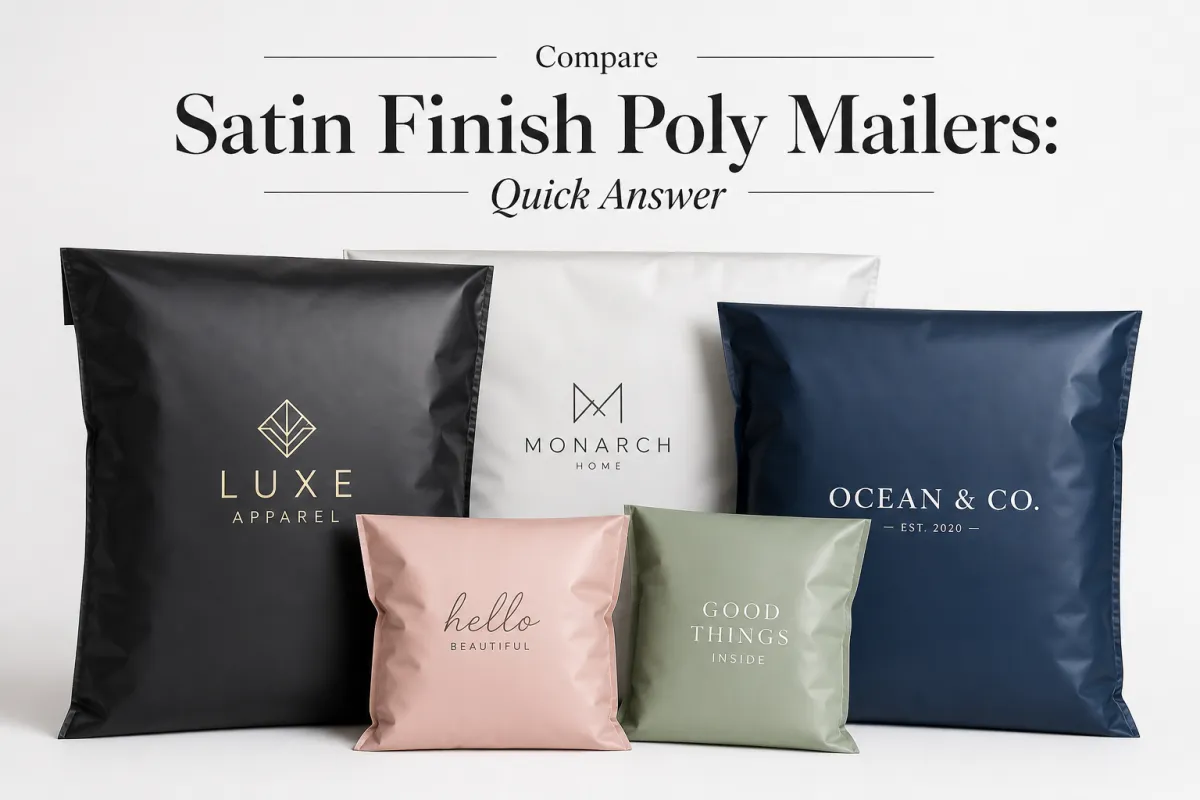
To compare satin finish poly mailers properly, start with the material, not the artwork. A satin outer finish usually gives you a softer visual effect than a high-gloss film, so the package looks more polished on camera and less worn after normal fulfillment handling. That matters because a mailer is often the first physical touchpoint a customer has with a brand.
Side by side with glossy options, satin usually wins on scuff hiding and photo appearance. Glossy mailers can look brighter, but they also tend to show scratches, label rub, and fingerprints faster. Satin is the more forgiving surface, especially for stores shipping folded apparel, scarves, small accessories, or boxed gift items.
The real decision is not "premium" versus "budget." It is whether the mailer protects the product, supports the brand, and ships at a cost that still makes sense after freight and printing. A 2.5 to 3 mil build may be enough for light garments, while heavier bundles or sharper contents often belong in a 4 mil or reinforced structure. If you compare satin finish poly mailers without checking thickness and seam quality, you are only looking at half the picture.
A satin surface earns its keep when the package arrives with a few carrier marks and still looks intentional, not tired.
My quick verdict framework is simple. If you compare satin finish poly mailers, check five things first: material thickness, adhesive seal reliability, scratch resistance, color consistency, and whether samples are available before the full order. Those five items tell you more about the real buying experience than a sales sheet ever will.
- Best first impression: custom printed satin mailers with clean spot colors and moderate sheen.
- Best daily shipping value: stock satin mailers with a dependable peel-and-seal strip.
- Best for photography: neutral satin tones that reduce glare on camera.
- Best for durability: thicker film with strong side seams and tear resistance.
In practice, compare satin finish poly mailers by how they behave in hand, in transit, and on screen. That is where the honest difference shows up.
Compare Satin Finish Poly Mailers: Top Options
When buyers compare satin finish poly mailers, the market usually breaks into four practical categories. Each one serves a different type of brand, and the right pick depends on whether the package is meant to save money, build a luxury feel, or carry a strong visual identity through social content and unboxing videos.
Premium satin mailers are the safest choice for brands that care about presentation. They often use a smoother outer film, tighter color control, and a cleaner peel strip. On the shelf, they read as polished without looking loud. If you compare satin finish Poly Mailers for Boutique apparel, premium beauty accessories, or subscription gifts, this is usually where the brand experience starts to feel complete.
Recycled-content satin mailers sit in a different lane. They are aimed at brands that want to talk about material reduction, recycled content, or lower-impact packaging choices. The honest trade-off is that the surface can feel slightly less silky, and print consistency can vary more from run to run. Still, if you compare satin finish poly mailers for sustainability messaging, these are worth a serious look as long as you verify the actual recycled-content documentation, not just a marketing claim.
Budget satin mailers are the volume play. They make sense for merchants shipping a lot of low-risk apparel or lightweight accessories and trying to keep packaging spend under control. The downside is predictable: thinner film, more variation in sheen, and a greater chance that the seal or outer finish feels less refined. Compare satin finish poly mailers in this tier carefully, because a low per-unit price can disappear fast if returns, rework, or brand perception become issues.
Custom-printed satin mailers are the marketing-heavy option. They are the best fit for stores that use packaging as a brand billboard and want the logo, pattern, or tagline to show clearly in customer photos. If you compare satin finish poly mailers for social sharing, this category often outperforms plain stock mailers because the satin surface keeps the graphics from looking overly shiny or washed out.
Here is the practical lens I use: compare satin finish poly mailers by the job they have to do. If the mailer needs to look expensive, choose the option with the best print clarity and surface consistency. If it needs to survive daily picking and packing, choose the one with the most dependable seam and adhesive. If it needs to tell a sustainability story, verify the source claims before you approve a quote.
Most brands do best with a middle-ground build. Not the cheapest. Not the fanciest. Just the one that carries the product, prints cleanly, and still looks good after a carrier sort center has done its work.
Detailed Reviews of Satin Finish Poly Mailer Builds
When you compare satin finish poly mailers at the build level, the details separate a good supplier from a forgettable one. Seam strength matters. Opacity matters. Puncture resistance matters. A mailer can look elegant and still fail if the side seal splits under pressure or if a label rubs the surface badly enough to make the package look used before it leaves the building.
The outer finish itself deserves close attention. A true satin surface should diffuse light just enough to reduce glare, but not so much that the package looks chalky or dull. If you compare satin finish poly mailers with a sample in your hand, rub the surface lightly, fold it, and check how the film recovers. Some finishes keep their look after handling; others show burnish marks almost immediately. That small difference becomes very noticeable in busy fulfillment environments.
Size is another place where buyers overpay. Oversized mailers waste material, increase shipping volume, and create a sloppy presentation. Tight-fit mailers can stretch seams and make insertion painful for staff. For lightweight tees, 9 x 12 or 10 x 13 often works well. For sweatshirts, bundled apparel, or thicker accessory sets, 12 x 15.5 or 14.5 x 19 is usually more realistic. When you compare satin finish poly mailers, match the inner usable space to the product, not just the outer catalog label.
Print performance on satin is often better than people expect, but it is not magic. Spot colors usually stay crisp, dark inks look controlled, and metallic accents can appear more refined than they do on high-gloss film. Full-coverage artwork can also look more expensive because the finish softens reflection. Still, compare satin finish poly mailers using a printed proof under normal lighting, not only under studio lights. A proof that looks rich in a photo may look muddy in a packing station.
Usability details matter just as much as visual ones. Tear strips, for example, are valuable for apparel brands because they reduce frustration at opening and help the customer feel that the package was designed with care. Tamper evidence also matters; if the adhesive strip is weak, resealing becomes too easy. If you compare satin finish poly mailers with an eye toward operations, also check how they stack, whether they slide smoothly through packing stations, and whether the cartons hold the mailers flat without curling.
If you're gonna test one thing first, make it the seal. A package can survive a lot, but a weak closure will make every other decision feel a little suspect.
Build checklist: compare satin finish poly mailers against these five points Before You Order.
- Seam strength: ask how the side and bottom seals are formed and whether the film is tested under load.
- Adhesive strip: check peel consistency, seal width, and how the adhesive behaves in warm or humid rooms.
- Opacity: verify that contents do not show through in bright light.
- Surface durability: look for scuff resistance, label rub performance, and crease recovery.
- Print clarity: review edge sharpness, color consistency, and registration on the satin surface.
If a vendor can reference film tensile or impact tests such as ASTM D882 or ASTM D1709, that usually signals a more disciplined production setup than vague claims about being "strong." For transit expectations, ask whether the packaging was evaluated against relevant ISTA procedures; the framework at ISTA is a useful place to start if you want to compare satin finish poly mailers in a way that reflects real shipping conditions.
Compare Satin Finish Poly Mailers: Price Comparison
Price is where many buyers compare satin finish poly mailers badly. They look at unit cost and stop there. That is not enough. Real landed cost includes the mailer, printing, freight, minimum order quantity, packaging cartons, and the hidden cost of buying the wrong size. A quote that looks cheap on paper can turn expensive once you factor in waste, reorders, or poor customer perception.
For practical buying, I usually break the market into four price tiers. Stock unprinted mailers are the cheapest and are often suitable for fast-moving apparel stores. Lightly customized mailers add a logo or a simple one-color print and usually improve presentation without pushing the budget too far. Fully printed branded mailers cost more but deliver the strongest marketing value. Premium specialty builds, including higher recycled-content structures or advanced print coverage, sit at the top end. If you compare satin finish poly mailers across those tiers, the differences are easier to understand than one long quote sheet.
| Option | Typical Use | Typical MOQ | Estimated Unit Price | What to Watch |
|---|---|---|---|---|
| Stock satin mailers | Fast restocks, low-risk apparel | 500 to 1,000 | $0.11 to $0.19 | Check film thickness and seal strength |
| Recycled-content satin mailers | Sustainability messaging | 1,000 to 3,000 | $0.15 to $0.27 | Verify actual recycled-content documentation |
| Lightly customized satin mailers | Small logo or one-color brand mark | 3,000 to 5,000 | $0.18 to $0.30 | Ask for proof color and adhesive testing |
| Fully printed satin mailers | Brand-led unboxing and social content | 5,000+ | $0.24 to $0.48 | Confirm artwork setup, plate charges, and freight |
Those numbers are not fixed. Size, ink coverage, film thickness, and shipping distance can move them fast. A 10 x 13 mailer with light print might land near the low end, while a larger 14.5 x 19 mailer with full exterior coverage can push well above the middle of the range. If you compare satin finish poly mailers from multiple suppliers, ask each one to quote the same dimensions, thickness, and print coverage, or the numbers will not mean much.
The cheapest quote is often the least honest one. Thin material can raise damage risk. Weak adhesive can create repackaging costs. A slightly more expensive mailer that seals reliably and arrives looking intact can save money in support tickets and replacements. I would rather see a brand spend a few cents more per unit than buy a bargain mailer that makes the package feel inconsistent.
Volume changes the math too. Higher quantities usually reduce unit cost, but only if the brand can store inventory and use it before style changes or seasonal shifts make the design stale. If you compare satin finish poly mailers for a launch campaign, it may be smarter to order a smaller pilot run first, even if the unit price is a bit higher. That extra caution can save a lot of headache later, and honestly, a lot of boxes too.
For brands that want a broader packaging mix, it can help to review Custom Packaging Products alongside packaging-specific mailer options. And if your store already knows it needs a mailer format, start with Custom Poly Mailers so you can compare satin finish poly mailers against the exact build you plan to buy.
How to Choose Satin Finish Poly Mailers
To compare satin finish poly mailers intelligently, start with the product you ship most often. Lightweight tees do not need the same structure as boxed cosmetics or bundled accessories. A thin, elegant mailer can be perfect for one category and completely wrong for another. The product weight, shape, and edge profile should drive the material choice, not the other way around.
Shipping conditions matter more than many teams admit. If packages move through rough carrier networks, the best-looking finish may not be the safest choice. In that case, seam strength, puncture resistance, and adhesive performance should outrank cosmetic details. Compare satin finish poly mailers with an eye toward the worst handling scenario, not the best one. A package that survives a smooth local route may fail when it hits a longer regional chain.
Brand story also has to fit the finish. Minimalist brands often do better with satin neutrals, muted grays, or soft blacks because the package reads as calm and controlled. Bold direct-to-consumer brands may want a high-contrast print or a saturated color block because the packaging is part of the marketing. If you compare satin finish poly mailers for a fashion, beauty, or lifestyle label, the finish should echo the tone of the product, not fight it.
Here is the buyer checklist I would actually use. Compare satin finish poly mailers by size, thickness, closure type, print method, and recycled-content priorities. Then look at the evidence: sample feel, proof accuracy, and how the package behaves after a few folds and a few minutes of handling. That is more valuable than a polished presentation deck.
- Size: allow enough room for the product, but avoid excessive empty space.
- Thickness: choose a film that matches the weight and shape of the contents.
- Closure: confirm the peel strip seals cleanly and stays closed.
- Print method: verify spot colors, coverage, and registration quality.
- Material claims: ask for documentation if recycled content or sourcing claims matter.
For sustainability questions, ask for chain-of-custody or recycled-content proof where it applies. If your packaging program includes paper inserts, belly bands, or paper-based labels, the FSC framework is a useful reference; the broader sourcing conversation should be documented rather than assumed. A helpful external reference is the FSC site, especially if your team compares satin finish poly mailers alongside other packaging formats and needs a clear paper-based sourcing framework.
The safest choice is usually the one that feels slightly conservative. Compare satin finish poly mailers with sample packs in your actual products, under your actual lighting, and with your actual packing team. That test catches more problems than a spec sheet ever will.
Process and Timeline: Sampling to Production
If you compare satin finish poly mailers before ordering, the sampling stage is where you save the most money. Request samples, pack them with real products, and inspect the seal, the print, and the surface after handling. A sample that looks fine on a desk may behave very differently once it is filled, folded, and stacked in a shipping area.
The process should move in a clean sequence. First, confirm size and thickness. Second, review print proof quality and color expectations. Third, test the adhesive strip and verify that the seal stays closed after a short dwell time. Fourth, check whether the supplier has respected the final dimensions and any special requirements such as tear strips or recycled-content documentation. When brands compare satin finish poly mailers in a rush, they often skip one of those steps and pay for it later.
Customization extends the timeline. Stock mailers can move quickly because there is no artwork setup, no plate work, and fewer proof corrections. Custom-printed satin finish poly mailers usually need design approval, color matching, production scheduling, and freight booking. A realistic production window is often 12 to 15 business days after proof approval for straightforward runs, and longer if the artwork is complex or the order is large. Compare satin finish poly mailers with that lead time in mind, especially if the order supports a seasonal launch.
Delays usually come from the same few places. Artwork changes late in the process. Size changes after sample approval. Underestimated quantity. Adjustments to thickness or finish after the quote is already locked. The smoother orders are usually the ones where the brand has already decided what matters most before requesting the first sample.
One more practical point: build time for freight and receiving into the schedule. A lot of packaging deadlines are lost not in production, but in transit and dock processing. If you compare satin finish poly mailers for a holiday or campaign launch, back up from the in-stock date, not the ship date. That small difference matters.
For teams that want to keep the entire packaging line moving, it helps to align the mailer order with the rest of the packaging purchase plan. That way, if a supplier is already quoting cartons, labels, or tissue, you can compare satin finish poly mailers against adjacent packaging decisions and spot inconsistencies before they turn into receiving headaches.
My simple rule: sample early, lock the spec early, and approve the proof only after someone has tested the package with real goods. That is how you compare satin finish poly mailers without turning the order into guesswork.
Our Recommendation and Next Steps
My recommendation is straightforward. If your brand needs the strongest presentation, choose a custom-printed satin mailer with dependable seam strength and clear color control. If your priority is value, choose a stock satin build with solid adhesive and the right size. If you need the best balance, compare satin finish poly mailers in the middle tier: enough print quality to look branded, enough thickness to survive daily shipping, and enough consistency to avoid embarrassment in customer photos.
For apparel and light accessories, that middle tier is often the sweet spot. It gives you enough visual polish to support unboxing content without pushing the budget into luxury territory. For heavier bundles or more fragile kits, I would move up in thickness before I would add more decorative print. Compare satin finish Poly Mailers on protection first, branding second, and the whole decision becomes easier.
Next steps should be practical. Shortlist two or three options, order samples, test them with actual products, and compare how they look in hand and on camera. Then confirm the final size, thickness, closure type, and print method before you place a pilot order. If the supplier is reliable, the first run should teach you enough to scale confidently. If it is not, you will know before inventory is tied up.
That is the real advantage of taking time to compare satin finish poly mailers properly. You are not just choosing a bag. You are choosing how the customer experiences the package, how your team handles fulfillment, and how much friction you create after the order has shipped.
If you want to move forward now, start with a sample request, review the specs carefully, and compare satin finish poly mailers against the actual products you ship most often. Then place a small pilot order, measure the results, and scale only after the finish, seal, and print all hold up in real use.
How do I compare satin finish poly mailers with glossy mailers?
Compare texture, glare, and how easily scuffs show up during handling and shipping. Satin usually reads more premium on camera and in unboxing photos, while glossy can look brighter but shows fingerprints and scratches more easily. If you compare satin finish poly mailers directly against glossy samples, the satin option often looks calmer and more forgiving.
Are satin finish poly mailers strong enough for apparel shipments?
Yes, if you Choose the Right thickness and seam quality for the product weight. Lightweight apparel often ships well in standard satin mailers, but heavier bundles or sharp-edged items may need a thicker build or an inner protective layer. Compare satin finish poly mailers by film gauge and seal strength, not just by surface appearance.
What should I check before ordering custom satin finish poly mailers?
Confirm size, thickness, adhesive strength, print method, and whether the supplier offers samples or proofs. Ask for a real product test so you can verify color accuracy, surface feel, and seal performance before bulk production. That is the most reliable way to compare satin finish poly mailers without guessing.
Do satin finish poly mailers take longer to produce than stock mailers?
Usually yes, because custom artwork, proofing, and production scheduling add time. Stock options can ship faster, while custom orders need enough lead time for approvals, printing, and freight. If you compare satin finish poly mailers for a launch, leave room for sample review and transit time.
Which satin finish poly mailers are the cheapest in real-world use?
The lowest unit price is not always the cheapest after freight, damage risk, and reorders are included. The best value is usually the mailer that fits the product properly, prints cleanly, and seals reliably without wasting material. To compare satin finish poly mailers fairly, look at landed cost and avoid pricing decisions based on the quote alone.