Buyer Fit Snapshot
| Best fit | Compare shipping insurance packaging requirements in practice projects where brand print, material claims, artwork control, MOQ, and repeat-order consistency need to be specified before quoting. |
|---|---|
| Quote inputs | Share finished size, material target, print colors, finish, packing count, annual reorder estimate, ship-to region, and any compliance wording. |
| Proofing check | Approve dieline scale, logo placement, barcode or warning zones, color tolerance, closure strength, and carton packing before bulk production. |
| Main risk | Vague material claims, crowded artwork, missing packing details, or unclear freight terms can make a low unit price expensive after revisions. |
Fast answer: Compare shipping insurance packaging requirements in practice should be specified like a repeatable production item. The safest quote records material, print method, finish, artwork proof, packing count, and reorder notes in one written spec.
Production checks before approval
Compare the actual filled-product size with the drawing, then confirm tolerance on folds, seals, hang holes, label areas, and retail display edges. Reserve space for logos, QR codes, warning copy, and material claims before decorative graphics fill the panel.
Quote comparison points
Review material grade, print process, finish, sampling route, tooling charges, carton quantity, and freight assumptions side by side. A quote is only useful when the supplier can repeat the same color, closure quality, and packing count on the next order.
A shipment can look perfect on the dock and still lose its insurance claim. I have seen cartons with clean corners, tidy labels, and careful pallet wrap end up rejected because the packout did not match the policy language. That gap is exactly why you need to compare shipping insurance packaging requirements before the first seal is pulled. Carrier acceptance and claim acceptance are not the same test. They do not fail on the same detail, and they rarely fail politely.
There is a practical way to think about it. A 120 kg optic assembly with glass lenses can roll through the shipping network without drama and still fall apart as a claim if the box lacked corner reinforcement or the inner pack moved during transit. The label can be correct. The pallet can be clean. None of that matters if the insurer decides the packaging was too weak for the risk. That pattern shows up in ecommerce shipping, industrial spares, and high-value product packaging far more often than most buyers expect. Compare shipping insurance packaging requirements lane by lane and the hidden gaps become obvious.
The test I use is blunt: does the packaging stop damage, can it defend a claim, and does it keep fulfillment efficient? That sequence matters because the cheapest premium is not the whole cost. I am not offering legal advice, and I am not pretending one SKU tells the story for a whole portfolio. A warehouse manager, a quality lead, and a finance director should all be able to use the same comparison without arguing over vague wording. That is the point of compare shipping insurance packaging requirements in a real operations setting.
How do you compare shipping insurance packaging requirements before you ship?
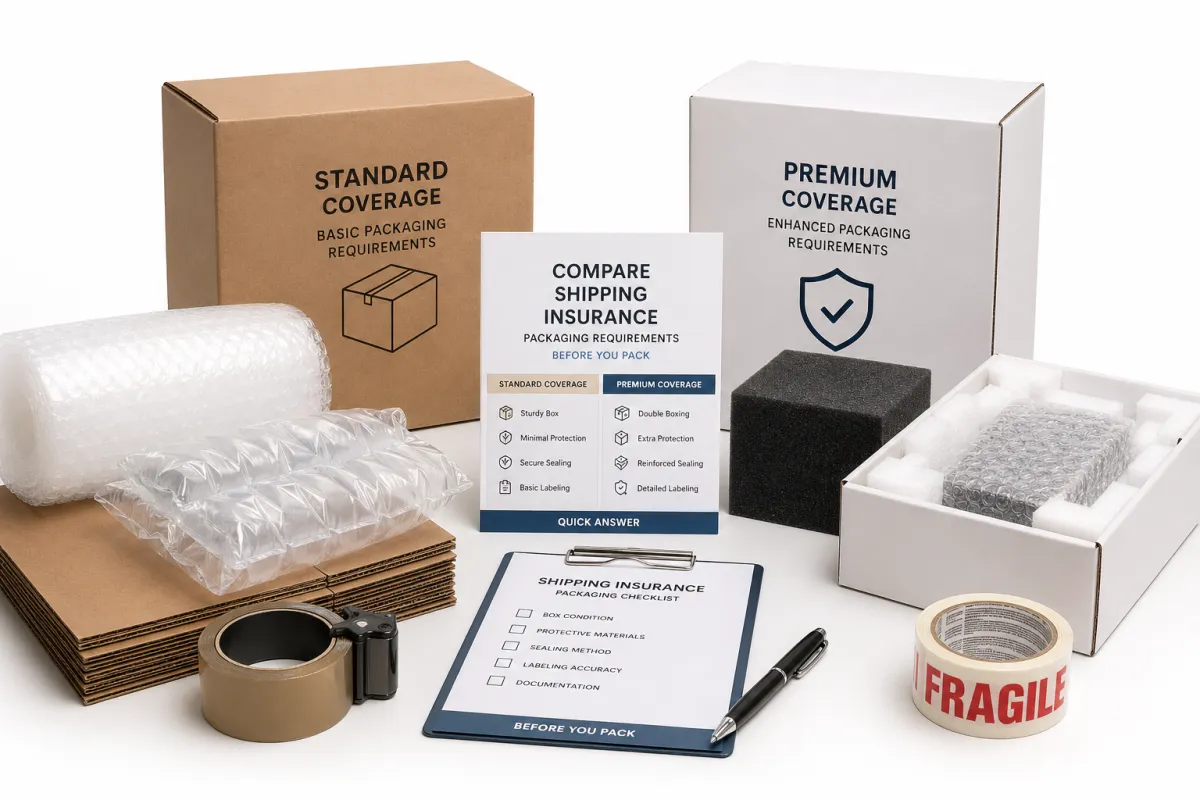
Most teams start by asking the wrong question. They ask, "Which quote is cheapest?" and stop there. The better question is, "Will the package pass both the movement test and the claim test?" compare shipping insurance packaging requirements by that logic, and you expose a second tier of rules that most pricing pages hide. It is less about bargain shopping and more about deciding what evidence, materials, and process discipline each lane can truly support.
A useful frame is a packaging compliance matrix built around three buckets: physical protection, review defensibility, and operational practicality. Physical protection tells you what carton, foam, void fill, or palletization standard is expected. Review defensibility tells you what the insurer will accept as proof after a loss event. Operational practicality tells you whether the team can do it every day, not just on a pilot pallet. If one bucket is thin, the policy may work on paper but fail in the real facility rhythm.
That means compare shipping insurance packaging requirements against your carrier acceptance criteria, not just the premium table. If a package can clear the pickup scan yet cannot satisfy the insurer's claim defense documentation standard, then the workflow is quietly set up for rework and dispute. In that sense, the phrase is blunt and practical: good packaging is a quality-control system, not a decorative final step.
Quick Answer: Compare shipping insurance packaging requirements Before You Pack
Start with the split that actually matters. The carrier decides whether the shipment can move. The insurer decides whether the shipment can be paid on if something breaks. If you compare shipping insurance packaging requirements only through the lens of premium cost, you miss the part that drives claim denials. A carton can be carrier-ready and still fail insurer scrutiny if the cushioning, carton strength, or pallet build does not match the policy standard.
A simple comparison framework usually gets the clearest answer:
- Damage prevention: Does the carton, insert, tote, or crate protect the product under vibration, drop, compression, and humidity changes?
- Claim defensibility: Can you prove the build steps, materials, and photo evidence if the shipment is challenged later?
- Cost efficiency: Do the packaging materials, labor, surcharge, and possible rework still make sense beside the claim risk?
That is why compare shipping insurance packaging requirements by risk class, not by brand name or portal convenience. A 1 kg cosmetics set, a 15 kg medical device, and a 140 kg machined component do not belong on the same rule set. The first may travel safely in a mailer with rigid inserts. The second may need double-wall corrugated, foam corner blocks, and a photo record. The third may need a crate, steel banding, and pallet deck protection. Compare shipping insurance packaging requirements against the stress points that actually exist, not the sales language.
Branded packaging creates another trap. Companies often invest in polished retail packaging and assume it is enough for freight insurance. It often is not. Retail packaging can look premium and still fail edge crush or top-load tests. If the shipment will travel through mixed handling, compare shipping insurance packaging requirements against actual test data, not the print finish on the box. A visual identity does not replace structure.
A few references help anchor the comparison. Parcel testing often lines up with ISTA testing standards, and paper sourcing can benefit from FSC guidance when sustainability claims matter. Neither one makes the claim for you, yet both give the program a firmer base than a vague “packed properly” statement.
If your team is sourcing the outer pack, pair the comparison with Custom Shipping Boxes for stronger outer protection, Custom Poly Mailers for lighter low-risk SKUs, and Custom Packaging Products for inserts, tape, labels, and void fill. Packaging design and insurance alignment should move together instead of living in separate spreadsheets.
Practical verdict: compare shipping insurance packaging requirements by route, weight, fragility, temperature swing, and claim evidence needs. That version protects margin.
If the carton cannot prove its own protection, the claim often turns into an argument about packaging instead of damage.
Top Options Compared Across Carriers, E-commerce Platforms, and Freight Insurers
To compare shipping insurance packaging requirements properly, it helps to break the market into five practical buckets: major parcel carriers, pallet freight providers, freight forwarders with bundled insurance, standalone cargo insurers, and digital broker platforms. They do not judge packaging in the same way. That difference matters more than most buyers realize.
Parcel carriers are usually the simplest to set up, especially for ecommerce shipping and mixed retail packaging programs. Speed is their strength. Their weakness is that acceptance rules can be looser than claim rules. A package may be accepted at the dock, then scrutinized later for weak carton construction, crushed corners, or poor cushioning. Compare shipping insurance packaging requirements against the claim language, not only the shipping label rules.
Pallet freight providers are more forgiving on weight and dimensions, yet they expect tighter pallet discipline: flush stacking, no overhang, stable stretch wrap, corner protection where needed, and readable labels on two sides. Standalone cargo insurers often ask for more proof, but they also tend to be clearer about what qualified packaging looks like. Digital broker platforms sit in the middle. Their quotes may feel simple, and then the packaging rules tighten once the declared value moves up.
| Option | Typical Packaging Standard | Documentation Burden | Best Fit | Common Cost Notes |
|---|---|---|---|---|
| Major parcel carriers | Double-wall cartons for fragile goods, internal cushioning, intact seals, clear labels | Low to medium | Consumer goods, accessories, light custom printed boxes | Often a base included limit, then added value charges above that limit |
| Pallet freight providers | Stable pallet build, edge protection, wrap retention, no protruding items | Medium | Heavy parts, mixed-SKU freight, industrial order fulfillment | May add accessorials if rework is needed at dock |
| Freight forwarders with bundled insurance | Mode-specific packaging proof, export-safe carton or crate standards | Medium to high | Cross-border lanes, consolidated freight, international handoffs | Insurance convenience can hide admin and processing fees |
| Standalone cargo insurers | Clear test data, palletization records, photos, declared-value support | High | High-value fragile shipments, repeat lanes, controlled packaging programs | Lower headline rates can still require stronger packaging investment |
| Digital insurer brokers | Rule sets vary by lane, commodity, and value band | Low to medium | SMB exporters, ecommerce shippers, multi-carrier users | Easy quoting can hide minimum premiums or endorsement charges |
The larger point hides in the transport mode. Compare shipping insurance packaging requirements against the move chain itself, not only the provider. Air freight, LTL, FTL, parcel, and maritime handoffs expose different stress patterns. A carton that survives parcel drops may still fail pallet compression. A crate that survives truck vibration may still pick up condensation at an airport transfer. Good packaging programs compare shipping insurance packaging requirements with route reality, including dwell times and temperature changes.
Use familiar shipping patterns to pressure-test the comparison. Fragile replacement parts usually need repeatable inner protection and photo evidence. Medical devices call for clean, traceable packout steps and often do better with controlled packaging materials. Heavy industrial components usually need pallet or crate structures that spread load correctly, especially when the center of gravity is dense or uneven. These are not edge cases. They are the standard failure points that show whether a policy is practical or just tidy on paper.
Speed can be deceptive. Automated rating engines can issue a quote in seconds, and that still does not mean the shipment is truly approved. Manual underwriting may take longer, yet it often catches the packaging detail that later protects the claim. During peak season, compare shipping insurance packaging requirements with extra care. A policy that worked last month can become stricter when loss ratios move or volume spikes.
One unexpected lesson came from a team shipping climate-control components. Their parcel carrier accepted a new foam design that reduced cube. Their insurer then asked for stronger load-securing evidence after two denied claims on the same SKU. Same shipment, same route, different standards. Comparing shipping insurance packaging requirements taught them something uncomfortable: speed was masking an evidence gap. That is how operations usually discover true underwriting risk.
Detailed Reviews: What Tested Packaging Programs Actually Require
From a packaging buyer’s point of view, the real test is not whether a program sounds flexible. The real test is whether it still approves the shipment after a hard claim review. To compare shipping insurance packaging requirements in a useful way, I look at what a tested packaging program asks for during recurring claims, not just what it says in the quote flow.
Parcel programs usually fail or pass on the same few points. A fragile SKU in a single-wall carton may survive if the item is light and centered, but heavier products or rougher routes push the risk up fast. Double-wall corrugated is often the safer baseline. A carton with a documented edge crush rating around 44 ECT or a tested equivalent, plus molded pulp, foam, or paper-based blocking that prevents movement, gives the claim file a better chance. Branded packaging or premium print should never weaken the protection spec. Product packaging still has to defend the product.
Freight claims shift the focus from carton strength to load stability. Compare shipping insurance packaging requirements here by asking whether the stack holds under compression, whether the wrap stays tight under vibration, and whether the load resists puncture from nearby freight. Mixed-SKU pallets are the hardest to protect. One pallet may carry dense accessories, loose manuals, and a few fragile components. A strong outer carton does not save a loose inner build. The insurer reads that as poor load control, and the denial risk rises.
Evidence carries more weight than most teams expect. Photos before sealing, serial or batch labels, tamper indication, and pallet wrap coverage all strengthen the claim file. If those steps are not documented, the comparison weakens before the shipment leaves the dock. Compare shipping insurance packaging requirements by asking which steps are auditable. A rule that cannot be documented on the warehouse floor usually becomes a claim dispute later.
Parcel and ecommerce programs
Parcel programs are easier to standardize for ecommerce shipping, yet they still punish loose void fill, weak corner performance, and oversized Product Packaging That leaves too much empty space. If the box rattles when shaken, the insurer is already looking for a denial angle. Better results usually come from right-sized Custom Printed Boxes, inner suspension where needed, and clear photos that show the condition before seal-up.
Within parcel lanes, compare shipping insurance packaging requirements not only by box grade but by claim outcome data. The same carton class can look good on one route and weak on another because handling profiles differ. For teams that dispatch multiple couriers, this variation is why policy language gets messy unless there is a central packaging matrix with current revisions.
Freight and cargo programs
Freight and cargo programs tend to ask whether the pack matches the declared value and route risk. Compare shipping insurance packaging requirements here by asking whether the carton or crate can survive forklift touch points, stacking, and humidity. A wooden crate with poor fastening can still lose a claim if the internal blocking failed. A foam insert that works inside a carton may need a different spec if the same SKU ships in a cold, damp container line.
Weak spots often hide in plain sight. Some policies describe packaging through examples instead of thresholds, which leaves too much room for interpretation after a loss. Other programs change the rules during the year without a clear notice trail, so the warehouse follows last quarter’s standard and gets blamed later. If you compare shipping insurance packaging requirements across multiple providers, those vague changes are usually where the real risk hides.
Green flags: written ECT or burst specs, item-level photos, clear packing sequence, and a claim response SLA. Red flags: “adequate packaging” with no definition, no reference photos, no moisture or compression guidance, and no written endorsement process for declared value. If a provider cannot explain the packaging rule to the floor team in one minute, the program is not ready for a serious claims process.
The best programs tend to be plainspoken. They do not try to impress anyone with a glossy quote page. They give measurable thresholds, test expectations, and a claim trail that a warehouse can actually keep. That is the kind of program that helps compare shipping insurance packaging requirements without forcing the whole team to think like lawyers.
Price Comparison: Compare shipping insurance packaging requirements Without Missing Hidden Costs
The cheapest quote on paper is not always the cheapest shipment in the real world. To compare shipping insurance packaging requirements honestly, break the cost into pieces: premium, booking fee, admin fee, underwriting surcharge, re-packaging labor, and the delay cost of a failed pre-shipment inspection. A low premium can still become expensive if the packaging has to be rebuilt in a rush.
Parcel coverage often looks inexpensive until the declared value rises. A small add-on can seem harmless, then fragile or high-value shipments force stronger cartons, better inserts, or extra photos just to stay compliant. Freight policies can look cheaper per dollar insured, yet they may bring minimum premiums or endorsement fees that matter once volume rises. That is where compare shipping insurance packaging requirements becomes a total-cost exercise instead of a rate-shopping exercise.
| Cost Element | Parcel Carrier Coverage | Freight Forwarder / Bundled | Standalone Cargo Insurance |
|---|---|---|---|
| Premium range | Often a small added fee or per-$100 value charge | Commonly moderate, with admin built in | Frequently the lowest percentage rate on stable lanes |
| Booking / endorsement fees | Usually low, but can rise with value bands | Medium and sometimes hidden in the portal | May apply for special commodities or route changes |
| Packaging compliance cost | Double-wall cartons, inserts, label discipline | Pallet wraps, braces, and export-safe build steps | Testing reports, photo logs, and stronger pack specs |
| Failure cost | Claim delay, repack, re-label, or denial | Dock rework, missed departure, possible storage fees | More up-front diligence, but stronger claim position |
Typical market ranges vary a lot, though a few patterns repeat often enough to plan around. Parcel add-on coverage may feel small at low values, then climb quickly once declared value gets serious. Freight cargo insurance often sits in a narrower percentage band for low-hazard goods, yet fragile or high-theft lanes can jump materially. A precondition fee, a declared-value endorsement, or a packaging-compliance review can also appear as a separate line. Those are the charges that quietly change the economics when you compare shipping insurance packaging requirements across routes.
The packaging line itself matters too. Stronger cartons, anti-static bagging, shock maps, molded pulp, humidity barriers, tamper evidence, and third-party test reports all cost money. Sometimes that spend pays for itself because it prevents larger losses. Sometimes it does not. A buyer should compare shipping insurance packaging requirements with repack labor and likely claim savings, then decide whether the stronger spec belongs on every SKU or only the fragile set.
Here is a simple example. A 40-unit pallet of dense hardware has a declared value of $18,000. A low-premium policy may look attractive, yet if the insurer wants a new crate spec, added corner posts, and a documented photo trail, the pack-out labor can erase the headline savings. A slightly more expensive policy with clearer standards may reduce dispatch friction and keep the warehouse moving. That is why compare shipping insurance packaging requirements by route and risk class, not by price alone.
Custom packaging can pay back, but not always. Stronger Custom Shipping Boxes can reduce damage claims and make the insurer more comfortable, which often delivers a quick return. If the box is oversized, overprinted, and heavy without improving protection, the extra cost is only decoration. Good packaging design should protect product packaging first and brand presentation second.
To sharpen a cost comparison, add a category for packaging audit readiness. If one insurer demands photos from three angles plus stretch-wrap timestamps, that overhead is real even if the premium is attractive. Another may require less documentation but a harder physical threshold. Neither is always superior. A higher fee can still be cheaper in execution if it prevents repeated disputes.
Process and Timeline: From quote to approved shipment under shipping insurance packaging requirements
A clean claim starts before booking. To compare shipping insurance packaging requirements in a way that helps operations, map the timeline from data collection to final handoff. A realistic sequence usually goes like this: gather SKU dimensions and weight, match coverage to route and declared value, self-audit the packaging, confirm carrier acceptance, secure insurer endorsement if needed, then dispatch with photo evidence and scan handoff records. If something goes wrong later, that trail is what keeps the claim defensible.
For planning, actual timing ranges are more useful than vague promises. Quote comparison often takes 5-10 business days if the lanes are simple and the data is clean. Packaging sign-off can take 3-7 business days if the team already has carton specs, photos, and test data. Final dispatch integration may take 1-3 business days once the SOP is approved and the warehouse knows which labels, inserts, and seals to use. If materials need to be custom built, add time for print approval and supplier lead time. That is one more reason to compare shipping insurance packaging requirements before the shipping window tightens.
Most delays come from avoidable gaps. Missing material specs are common. So are unclear bridge weights, unstable declared-value proof, and photos that are too dark or too low in resolution to support the claim file. A simple rule helps: each pack file should include the SKU code, packaging material spec, weight, dimensions, and at least two clear photos before sealing. That small discipline saves a surprising amount of back-and-forth.
For recurring shippers, a short timeline checklist works well:
- Freeze the policy or endorsement cutoff date so the warehouse knows when changes stop.
- Set rerouting windows for freight that may miss a carrier handoff.
- Request advance claim review for sensitive batches, especially fragile or high-value units.
- Confirm whether the packing line is using the current carton revision, not last month’s revision.
- Keep camera evidence templates in the dispatch area so photos follow one standard.
That checklist matters because busy order fulfillment teams default to what is close at hand. If the old box spec is still on the rack, people will use it. If the photo template is buried in a shared folder, someone will skip it. Compare shipping insurance packaging requirements with the warehouse’s actual behavior, not the ideal process map on the wall.
Seasonal peaks and port or airport congestion make the process more fragile. A temporary carrier rule change can invalidate a previously approved pack if nobody updates version control. That problem shows up often in ecommerce shipping programs where volume rises quickly. International shipments add another layer because customs inspection tolerance, moisture exposure, and transfer handling can change the packaging expectation midstream. Compare shipping insurance packaging requirements on domestic lanes and export lanes separately, even if the SKU is identical.
One reliable operational habit is to treat the packaging standard like a controlled document. Revision number, issue date, and approved lane should all be visible. That sounds tedious, and it is. But tedious is what keeps a claim from turning into a debate. In practice, compare shipping insurance packaging requirements with the same discipline you would use for any quality-controlled spec.
If you are running two shifts, compare shipping insurance packaging requirements against your underwriting requirements review cycle, not only against carrier cut-off times. The team that updates pack instructions at shift change with one email chain and one signature has fewer surprises at morning reconciliation than the team that relies on spoken reminders.
How to Choose Shipping Insurance Packaging Requirements for Your SKU Portfolio
If you manage more than a few SKUs, the smartest move is to score them by risk instead of treating each one as a special case. A simple model works well: assign a weight class, a fragility score, a route complexity score, and a replacement-value score. Then compare shipping insurance packaging requirements against that score and place each SKU into a packaging tier. The whole program becomes easier to read.
The logic is straightforward. A low-value, low-fragility accessory may fit in a mailer or light carton, especially if the outer pack is stable and the route is short. A mid-value retail unit may need a stronger custom printed box, cushioning, and photo proof. A high-value or fragile item may need a crate or heavily reinforced carton, plus a tighter evidence workflow. That is the point of compare shipping insurance packaging requirements: it tells you where to spend money and where to hold back.
For teams with a decent packaging operation, a 30-day pilot is usually enough to expose weak spots. Test 8-12 SKUs per lane, track claim outcomes, packaging prep time, and invoice variance, then compare shipping insurance packaging requirements against the results. If compliance steps slow dispatch too much, the policy may be too strict for that lane. If the claims get cleaner and the extra labor stays modest, the stronger standard is probably worth keeping.
Capability matters more than many teams admit. A crew with a strong QA discipline, a good camera evidence workflow, and a warehouse system that can flag carton revision numbers will defend claims better than a larger crew with loose habits. If your company is still early on that curve, start with a small group of SKUs and build from there. The right packaging design for a complex policy is the one your team can actually execute every day.
Branded packaging deserves a hard look too. A premium appearance can help retail packaging and product presentation, yet it should not introduce fragility. Heavy print coverage, specialty coatings, and decorative structures can raise cost without improving protection. Compare shipping insurance packaging requirements with the actual material stack, not the mockup. A box that is only pretty will not help the claim.
For mixed fulfillment models, split the portfolio into clear lanes:
- Parcel lane: Small, durable, repeat-order items with predictable pack behavior.
- Freight lane: Dense, heavier items that need pallet stability and stronger evidence.
- Export lane: Items exposed to longer transit, humidity, or inspection handling.
- Special handling lane: Fragile, high-value, or temperature-sensitive SKUs.
That split keeps compare shipping insurance packaging requirements from turning into an endless internal debate. It also makes it easier to choose between policy upgrades, repacking changes, or a different provider entirely. If claim defensibility is weak but product value is high, a specialist rider or a stronger cargo policy may be the better move. If the packaging itself is weak across the board, fix the pack first. No insurance product can fully rescue a bad build.
One more detail matters more than it looks: compare shipping insurance packaging requirements against the people doing the packing, not just the product. If the standard requires precise foam placement and the shift has high turnover or limited training, the risk rises quickly. In those cases, simpler packaging often wins because it reduces human error. Good order fulfillment is not only speed. It is repeatable execution under pressure.
Our Recommendation: Practical 10-Step Action Plan to Start Comparing Right Now
If I had to reduce the decision to one line, it would be this: compare shipping insurance packaging requirements by lane, then choose the simplest program that still gives you a defendable claim file. For high-volume commodity goods, a standard carrier or parcel-linked setup may be enough if the cartons are right-sized and the evidence is disciplined. For fragile custom manufacturing parts, a freight cargo policy or specialist insurer is usually safer because the claim rules are clearer and the packaging expectations are more direct. For mixed portfolios, a hybrid setup usually makes the most sense.
Here is the 10-step sequence I recommend:
- Build a master matrix of SKUs, lanes, value bands, and pack types.
- Freeze your current-state packaging spec so you have a true baseline.
- Compare shipping insurance packaging requirements across at least three providers.
- Run a 30-day trial on 8-12 representative SKUs.
- Track claim-denial reasons, not just the premium total.
- Update carton, insert, and pallet SOPs based on the trial.
- Train pack-out operators with photos and one-page build sheets.
- Align declared values in ERP, sales, and dispatch tools.
- Add a packaging compliance gate before the shipment is released.
- Review the policy and packaging standard every quarter.
The value of that sequence is its practicality. It does not assume every SKU needs custom engineering. It does not assume the cheapest premium is the safest choice. It does not assume a glossy portal understands branded packaging, fragile inserts, or ecommerce shipping volume. It forces compare shipping insurance packaging requirements to answer the same question each time: can the shipment survive the move, and can the claim survive the review?
If the team still has to decide what to change first, start with the outer pack. Better Custom Shipping Boxes and purpose-fit inserts usually deliver the fastest return because they reduce both damage and claim friction. For lighter products, Custom Poly Mailers can work well, but only if the item inside is suited to mailer handling. For fillers, tape, labels, and wrap, Custom Packaging Products let you tighten the system without rewriting the whole fulfillment flow.
One final perspective: compare shipping insurance packaging requirements with the same seriousness as your defect rate and on-time KPI. It is not a side project; it is an operating standard that sits between warehouse behavior and financial outcome. It sounds less glamorous than campaign copy, yet it is often the hidden winner on gross margin.
The final takeaway is plain. Comparing shipping insurance packaging requirements is not a paperwork exercise, and it is not a rate-shopping exercise alone. It is a claims-safety investment that protects margin, protects customer trust, and protects the people on the floor who have to pack the same SKU again tomorrow. If you compare shipping insurance packaging requirements with that level of discipline, the policy, the carton, and the claim file begin working together instead of fighting each other.
FAQ
When I compare shipping insurance packaging requirements, what minimum tests should be done for high-value fragile parts?
Use a minimum test pack that includes edge impact, vibration, and top-load compression for each pallet height, then compare shipping insurance packaging requirements by both carrier and insurer acceptance. Visual box strength is not enough, because a carton that looks sturdy can still fail once the internal load shifts or the outer corners take a hit. Keep the same SKU-specific test sample across every provider so the comparison stays fair and repeatable.
How do I spot conflicts when comparing shipping insurance packaging requirements with carrier rules?
Build a two-column checklist: one side for the carrier’s acceptance criteria, one side for the insurer’s claim-defense criteria, and mark each clause as required, recommended, or optional. If either side says a rule is required, treat it as a hard standard in your warehouse SOP. That simple discipline makes compare shipping insurance packaging requirements far easier to manage because it turns hidden conflicts into visible action items.
Which pricing line items are easiest to miss in a shipping insurance packaging requirements comparison?
Precondition fees, endorsement fees for declared value, and packaging-compliance reviews are often low in the quote and high in the monthly total once volume builds. Check whether repeat inspections, reweighing, and relabeling are included or billed separately, because those charges grow quickly in mixed-SKU order fulfillment. Include packaging labor adjustments too, especially for foam inserts, double-wall cartons, and controlled-humidity materials.
What timeline should I budget for a policy-compliant packaging change during a comparison project?
A practical baseline is 5-10 business days for full quote comparison, 3-7 business days for documented packaging sign-off, and 1-3 business days for final dispatch integration once standards are approved. Add extra time if materials are custom-built because carton conversion, supplier lead time, and label production can push urgent orders past dispatch windows. If shipments are urgent, stage the change lane by lane and run parallel approvals so critical customers are not delayed.
Can I use one comparison framework for both domestic and international shipments without extra effort?
Use the same scoring model, but add an international layer for dangerous-goods classing, customs documentation, moisture exposure, and destination inspection tolerance. Compare shipping insurance packaging requirements for domestic and cross-border lanes in the same spreadsheet so your team can see where a compliant domestic pack still fails international claim tests. In most programs, the safest answer is a dual profile: one baseline for domestic freight and one audited add-on for export handling risk.